







You have felt the tap water taste different in late summer — that faint mineral edge, the slight murkiness that was not there five years ago. You have seen the reservoirs drop and the headlines cycle past, each one a little more urgent than the last. You have watched your utility bill climb and assumed it was inflation, or politics, or bad luck. It is none of those things alone. It is the invisible cost of a machine that never sleeps, never thirsts — and yet drinks more water than your entire neighborhood. The artificial intelligence revolution is here, and its thirst is not a footnote. It is a crisis that corporations are only beginning to admit and communities are already living through [1].
In 2025, Amazon disclosed that its global data centres consumed 2.5 billion gallons of water — a figure that would irrigate tens of thousands of acres of farmland or supply drinking water to hundreds of thousands of families for a full year [1]. The company reported a water-usage effectiveness of approximately 0.03 gallons per kilowatt-hour of IT load, a metric it framed as industry-leading. But framing is not the same as fact, and 2.5 billion gallons is not an abstraction. It is 2.5 billion gallons extracted from aquifers, rivers, and municipal supplies — in communities where the same water sustains agriculture, health, and life [5]. The International Energy Agency projects that global data centre electricity demand could more than double by 2026, driven almost entirely by the computational intensity of generative AI workloads [2]. Where electricity surges, water follows. Every megawatt of cooling demand is a gallon drawn from somewhere someone else needs it.
What Is Actually Happening
The official narrative from cloud hyperscalers is one of relentless sustainability progress — net-zero pledges, renewable energy procurement, efficiency dashboards. The reality is considerably less elegant. Amazon Web Services, Microsoft Azure, and Google Cloud are in a sprint to build AI infrastructure at a pace that has no historical precedent in the technology sector [6]. Every new generation of large language model requires exponentially more compute. Every training run for a frontier model consumes the energy equivalent of a small city and the water equivalent of a small lake. The Ecoticias investigation into Amazon’s water disclosures revealed that its AI workloads consume more water than those of its direct rivals — while the company simultaneously markets itself as an efficiency leader [1]. The gap between the press release and the pipe is widening.
In China, the contradiction is even starker. Beijing has positioned green power procurement for AI data centres as a national priority, embedding it within broader renewable energy targets. But Reuters reporting and expert analysis now confirm what grid engineers have warned privately for years: the pace of data centre construction is outrunning the pace of renewable generation capacity by a significant and growing margin [4]. The consequence is straightforward — AI data centres built on the promise of clean power are, in practice, drawing from grids still substantially fed by coal. The green label is applied. The emissions continue. The water used in cooling those coal-powered backup systems is not even counted in most corporate disclosures [4][8].
The communiqué promises clean AI. The coal plant hums behind the curtain.
The Case For Liquid Cooling
The strongest case for a different approach comes from an unlikely source: Nvidia. Its Rubin-generation reference design represents the most aggressive attempt yet to decouple AI infrastructure growth from water consumption. The principle is direct — run servers at higher operating temperatures and replace evaporative cooling towers with closed-loop liquid cooling systems that recirculate coolant rather than consuming water [1]. In theory, this eliminates the most water-intensive stage of data centre operation. The engineering is proven. The economics are increasingly competitive.
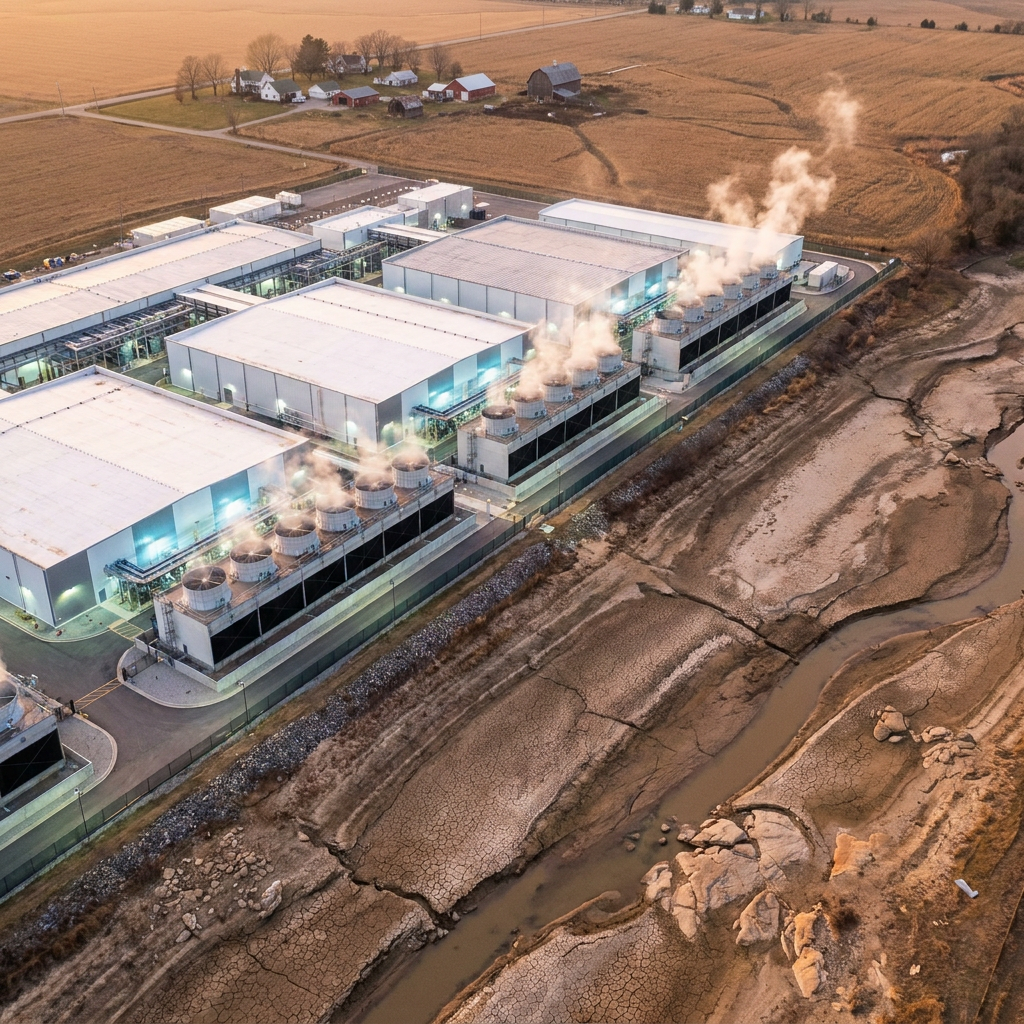
But here is what that elegant engineering cannot explain: why, if the technology exists, the majority of the world’s largest data centre operators have not adopted it at scale [6]. The answer is not technical. It is financial and structural. Retrofitting existing facilities is expensive. Liquid cooling requires different server architectures, different facility layouts, and different supply chains. The hyperscalers have billions of dollars of sunk infrastructure designed around air-cooled and evaporative models. Switching means admitting that the existing estate — the one sold to regulators and investors as state-of-the-art — was built on a resource assumption that is no longer tenable [7]. The technology is ready. The willingness to eat the cost of transition is not.The engineering points forward. The balance sheet looks backward.
The Power Struggle Beneath
Follow the water, and you will find the same power dynamics that have defined energy politics for a century. The cloud hyperscalers — Amazon, Microsoft, Google, and in Asia, Alibaba and Tencent — are not merely technology companies. They are energy and water infrastructure operators of a scale that rivals nation-states [6]. Their procurement decisions shape electricity markets. Their data centre siting choices determine which communities bear the resource burden of the AI economy. And their lobbying determines how — and whether — regulators even measure that burden.
In China, the AI infrastructure buildout has become inseparable from the broader geopolitical competition for clean energy dominance. Beijing controls the global supply chain for solar panels, lithium-ion batteries, and rare earth minerals with a precision that Europe and the United States are still struggling to counter [4]. When Chinese data centres fail to meet green power targets because the grid cannot keep pace, it is not merely a domestic energy planning failure — it is a signal that the world’s most aggressive clean energy deployer is hitting the same ceiling that confronts everyone: infrastructure takes time, and AI does not wait [4][8].
Meanwhile, in Europe, the regulatory apparatus designed to manage this — the EU Green Deal, the Energy Efficiency Directive, the Corporate Sustainability Reporting Directive — is technically sound and bureaucratically paralysed. The vision is correct. The machinery implementing it moves at a fraction of the speed at which new data centre applications are approved [9]. The result is a continent that sets the standards and then watches others build the infrastructure while it processes the paperwork.
The green economy is arriving. The question is whether it will be built on real efficiency or on accounting tricks and water drawn from someone else’s well.
Real People, Real Consequences
You do not need to understand water-usage effectiveness ratios to feel what 2.5 billion gallons means. In communities adjacent to hyperscale data centres in the American West, residents have reported declining well levels, altered municipal water pressure, and agricultural irrigation restrictions that coincide directly with data centre expansion [7]. In parts of India and Southeast Asia, where cloud providers are rapidly expanding capacity, the competition between data centre cooling demand and agricultural water needs is not a theoretical risk — it is a present tension, measured in crop yields and household access [5].
The water footprint of AI is not distributed equally. It is concentrated in the places where water is already scarce and where communities have the least political leverage to demand transparency from the corporations consuming it. A single large language model training run can require the evaporation of hundreds of thousands of gallons of cooling water — water that, once evaporated, does not return to the local watershed [5][7]. It is gone. And the communities downstream are left to absorb the deficit.
This is not a future scenario. This is your present. The question is not whether AI will consume enormous quantities of water and energy. It already does. The question is whether we — citizens, regulators, investors — will demand that the companies profiting from this consumption pay the full environmental cost, or whether we will allow them to externalise it onto the communities least equipped to bear it [3][7].
The agreement is signed in a boardroom in Seattle. The well runs dry in a village in Rajasthan. The connection is not metaphorical. It is hydraulic.
What follows?
There is a narrow and honest path through this. It requires three things, and none of them are optional if we are serious about an AI future that does not accelerate the very climate destabilisation it is supposedly being built to solve.
First, mandatory and auditable water and energy disclosure for every data center above a defined capacity threshold. Not voluntary reporting. Not sustainability theatre. Actual, verified, site-level accounting of water withdrawal, water consumption, energy source mix, and thermal discharge [8]. The IEA and the European Environment Agency have both called for this. The technology to measure it exists. The political will to mandate it does not — and that is a choice, not a limitation [2][9].
Second, investment in cooling infrastructure that eliminates evaporative water use at the hardware level. Nvidia’s liquid cooling reference design is a starting point, not an endpoint. Closed-loop systems, immersion cooling, and waste-heat recovery should be not optional innovations but baseline requirements for any new facility seeking regulatory approval [1][6]. The engineering case is settled. The policy case must follow.
Third — and this is where the geopolitical dimension becomes unavoidable — we must stop pretending that renewable energy procurement alone solves the AI resource problem. It does not. Intermittent renewables, excellent as they are, cannot provide the baseload power that always-on AI workloads demand without massive storage or firm clean generation [4]. This is precisely where advanced nuclear — including small modular reactors — becomes not a nice-to-have but a structural necessity for any credible decarbonisation of the digital economy [10]. Anyone who tells you we can power infinite AI growth on solar panels and good intentions alone is not being serious about the physics, the timeline, or the water [3].
The cloud will keep drinking. The question is whether we will let it drink until the rivers run dry, or whether we will build systems — technical, regulatory, and political — that make the cost visible, the accountability real, and the infrastructure sustainable. We are not running out of water. We are running out of the excuse that the problem is too complex to address.
Will you wait until your tap runs dry before you demand transparency from the company whose servers never sleep? Who is deciding the pace of this transition — you, your government, or the corporation that owns the infrastructure? And when the bill arrives in full — in depleted aquifers, in failed harvests, in communities without clean water — will we say we did not see it coming, or will we admit that we chose not to look?
— REFERENCES —
[1] Ecoticias. (2026). “Amazon’s sparkling cloud hides a dirty secret: its AI gulps more water than rivals and still calls itself ‘efficient’.” Ecoticias. Retrieved from https://www.ecoticias.com/en/amazons-sparkling-cloud-hides-a-dirty-secret-its-ai-gulps-more-water-than-rivals-and-still-calls-itself-efficient/33612
[2] International Energy Agency. (2024). Electricity 2024: Analysis and forecast to 2026. IEA. Retrieved from https://iea.blob.core.windows.net/assets/6b2fd954-2017-408e-bf08-952fdd62118a/Electricity2024-Analysisandforecastto2026.pdf
[3] IPCC. (2023). Climate Change 2023: Synthesis Report. Contribution of Working Groups I, II and III to the Sixth Assessment Report of the Intergovernmental Panel on Climate Change. IPCC. Retrieved from https://www.ipcc.ch/report/ar6/syr/
[4] Reuters. (2026, June 22). “China’s push for green power use in AI projects faces hurdles, experts say.” Reuters. Retrieved from https://www.reuters.com/business/energy/chinas-push-green-power-use-ai-projects-faces-hurdles-experts-say-2026-06-22
[5] Li, P., Yang, J., Islam, M. A., & Ren, S. (2024). “Making AI Less ‘Thirsty’: Uncovering and Addressing the Hidden Water Footprint of AI Models.” Nature Water. Preprint available at arXiv:2304.03271. Retrieved from https://arxiv.org/abs/2304.03271
[6] Bloomberg Green. (2025). “AI Is Draining Water From Areas That Need It Most.” Bloomberg.com. Retrieved from https://www.bloomberg.com/graphics/2025-ai-impacts-data-centers-water-data
[7] Chatham House. (2025). “AI water usage requires governments to rethink their approach to water.” Chatham House. Retrieved from https://www.chathamhouse.org/2026/06/ai-water-usage-requires-governments-rethink-their-approach-water
[8] International Energy Agency. (2025). “Understanding the energy-AI nexus.” In Energy and AI. IEA. Retrieved from https://www.iea.org/reports/energy-and-ai/understanding-the-energy-ai-nexus
[9] European Environment Agency. (2024). Europe’s state of water 2024: the need for improved water resilience. EEA. Retrieved from https://www.eea.europa.eu/en/analysis/publications/europes-state-of-water-2024
[10] IRENA. (2024). World Energy Transitions Outlook 2024: 1.5°C Pathway. International Renewable Energy Agency. Retrieved from https://www.irena.org/-/media/Files/IRENA/Agency/Publication/2024/Nov/IRENA_World_energy_transitions_outlook_2024_Summary.pdf
——————
AI Disclosure: This post was created with the assistance of artificial intelligence. The ideas, analysis, and opinions expressed are my own — AI was used to help compose, structure, and refine my personal notes and thoughts into the final written content. Images, videos and music featured in this post were also generated using AI tools, based on my own creative prompts and direction.
