






Have you ever wondered what happens when the tools you build to punish a regime end up strengthening it instead?
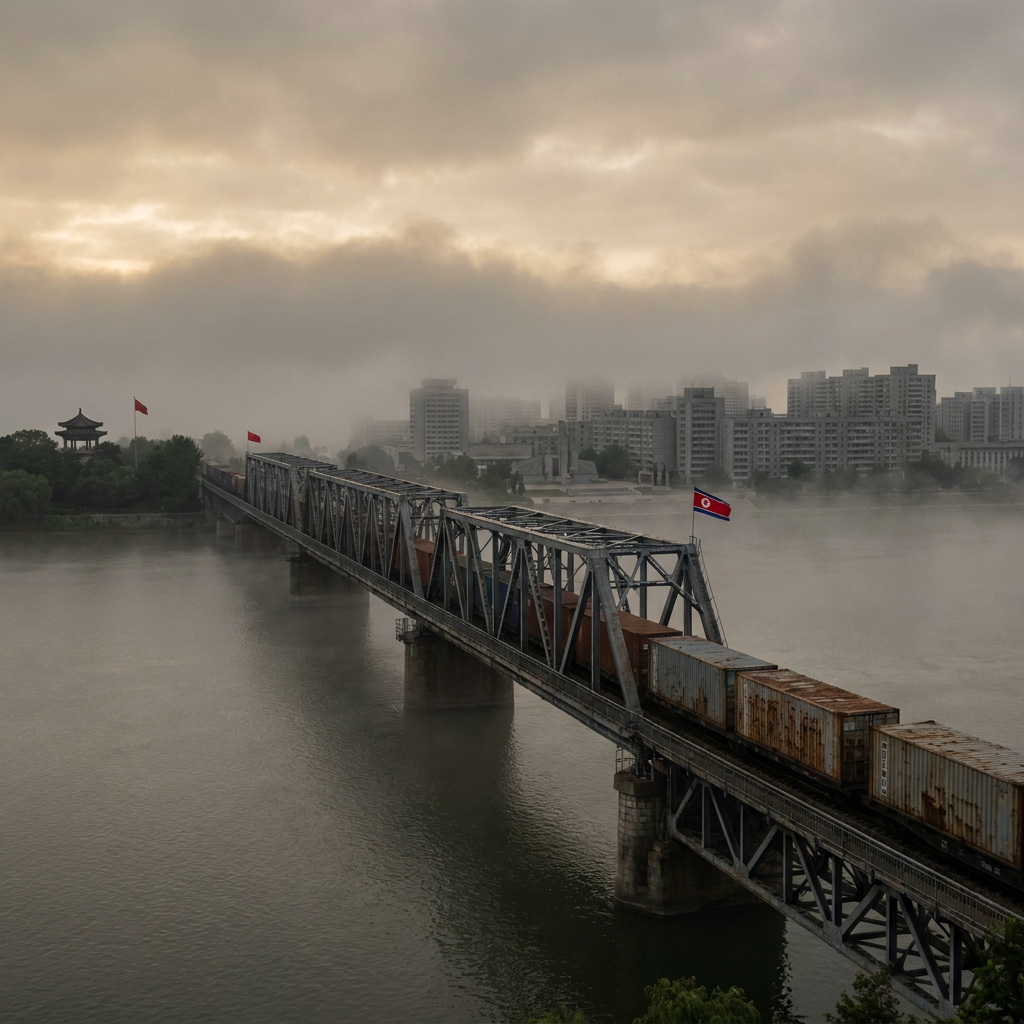
South Korea’s own unification ministry now confirms what many analysts have whispered for years: North Korea’s economy is recovering, driven precisely by the two powers most capable of shielding Pyongyang from the consequences you and your governments demanded [1]. Air China resumed direct flights to Pyongyang in March after a six-year suspension. Daily passenger rail between Beijing and the North Korean capital is running again. China’s foreign minister visited Pyongyang last week to “promote practical cooperation” [1]. We designed sanctions to isolate. Instead, we built a corridor.
The Architecture We Dismantled Ourselves
The architecture of North Korean isolation was never simple. Since Pyongyang’s first nuclear test in 2006, the United Nations Security Council has layered sanctions designed to choke revenue streams funding weapons development [2]. China, accounting for over 90 percent of North Korea’s external trade, was the essential chokepoint — and Beijing largely cooperated, at least on paper [3]. Russia, until 2022, played a secondary role. Then came Moscow’s full-scale invasion of Ukraine, and with it, a strategic calculus that made Pyongyang not merely tolerable but useful [4]. North Korean munitions began flowing to Russian forces. In return, economic and military technology assistance flowed back [1]. We assumed the sanctions regime would hold because we assumed its guarantors would remain aligned. That assumption is now in ruins.
The Strongest Case for the Other Side
The strongest case for sanctions still working is this: North Korea’s nominal GDP remains roughly $30 billion — a fraction of South Korea’s economy and barely a rounding error in global terms [1]. The regime still cannot feed its own people reliably. A famine in the mid-1990s killed hundreds of thousands, and the COVID-19 pandemic pushed many North Koreans back into extreme hunger [1]. As the Council on Foreign Relations has documented, sanctions have meaningfully constrained Pyongyang’s access to advanced dual-use technologies and hard currency [5]. You could argue the recovery is marginal, fragile, and entirely dependent on two patrons who themselves face economic headwinds. The sanctions, this argument goes, haven’t failed — they’ve merely shifted the cost of maintaining North Korea from the international community onto Beijing and Moscow’s balance sheets [5]. That’s a burden, not a victory for Kim Jong-un.
And yet — does burden-sharing between two nuclear-armed powers with a shared interest in defying Washington sound like a containment strategy to you?
Recovery Is Not an Accident
Here is what Seoul’s own analysts now admit: the North has “moved beyond a period of contraction” and “entered a phase of gradual recovery” [1]. Chatham House has argued that the China-Russia-DPRK triangle represents not an anomaly but a structural feature of the emerging multipolar order — one the Western sanctions architecture was never designed to confront [6].
Kim Jong-un himself declared at a landmark congress that North Korea had overcome its “worst difficulties” and was entering a stage of “optimism and confidence in the future” [1].
This is not the language of a sanctioned pariah on the ropes. This is the language of a regime that has found its footing — and it found that footing because we forced it into the arms of the only two countries willing to catch it [7].
You must ask yourself: when the sanctions regime’s enforcement depends on China and Russia’s cooperation, and China and Russia are the very powers enabling the target’s survival, what exactly are we enforcing?
Real People Pay the Real Price
Geopolitics is not abstract when you live next door to it. Twenty-five million North Koreans have endured decades of food insecurity, forced labour, and information blackout — and the economic “recovery” flowing from Beijing and Moscow is not trickling down to them [8]. South Koreans, meanwhile, live under the shadow of an expanding nuclear programme that Seoul’s own ministry acknowledges Pyongyang has no intention of abandoning [1]. In the broader region, Japanese citizens face missile overflights that have become grimly routine [8]. And you, sitting in Brussels or Berlin or London, should understand that every dollar of sanctioned North Korean revenue that bypasses the regime funds capabilities that destabilise the security architecture you depend on. The UN Security Council, which passed those sanctions, cannot enforce them — it hasn’t passed a new North Korea resolution since 2017, vetoed into paralysis by Russia and China [9].
We built a firewall and handed the keys to the people on the other side.
Future Implications.
So where does this leave us? The International Institute for Strategic Studies has warned that the deepening Russia-DPRK military partnership could accelerate Pyongyang’s missile and submarine programmes beyond what sanctions alone were ever designed to prevent [10]. Carnegie analysts argue that without a fundamental rethink — including secondary sanctions enforcement that the West has historically been unwilling to pursue against China — the current regime is effectively dead on arrival [9]. You are living through the managed chaos I keep describing: a sanctions architecture that serves as political theatre while the real economy of North Korea pivots east, where the rules are different and the enforcement is selective. Kim Jong-un has solved his isolation problem. The question is whether we have solved ours.
Why are we still pretending sanctions work? Who benefits from the fiction? And what will it take before you demand a strategy that actually matches the world we live in?
— REFERENCES —
[1] Euronews. (2026, April 17). “China and Russia ties driving North Korean economic recovery, Seoul ministry says.” Retrieved from https://www.euronews.com/2026/04/17/china-and-russia-ties-driving-north-korean-economic-recovery-seoul-ministry-says
[4] AP News. (2026, March 30). “China resumes direct flights to North Korea after 6 years.” Retrieved from https://apnews.com/article/air-china-flight-north-korea-tourism-83457241c49f3db4047f973d3f11396f
[7] Reuters. (2026, March 12). “First train to Pyongyang in six years leaves Beijing as neighbours revive link.” Retrieved from https://www.reuters.com/world/asia-pacific/chinas-first-north-korea-bound-train-six-years-set-depart-beijing-2026-03-12/
[8] Wall Street Journal. (2026). “The 24-Hour Train Between Beijing and Pyongyang Is Back on Track.” Retrieved from https://www.wsj.com/world/asia/the-24-hour-train-between-beijing-and-pyongyang-is-back-on-track-bdefa01c
[9] Daily NK. (2026). “Report: China accounts for more than 90% of North Korea’s total trade.” Retrieved from https://www.dailynk.com/english/report-china-accounts-for-more-tha/
[10] Politifact. (2017, May 1). “Does China account for 90% of North Korean trade, as Rex Tillerson said?” Retrieved from https://www.politifact.com/factchecks/2017/may/01/rex-tillerson/does-china-account-90-north-korean-trade-rex-tille/
[11] Hankyoreh. (2019, December 2). “N. Korea’s trade dependence on China has increased to 90% over last 3 years.” Retrieved from https://english.hani.co.kr/arti/english_edition/e_northkorea/919283.html
[12] AP News. (2026). “US says North Korea delivered 1,000 containers of equipment and munitions to Russia for Ukraine war.” Retrieved from https://apnews.com/article/north-korea-russia-us-munitions-ukraine-war-7091eaba254b680888a9b1ec8a68135f
[13] Kyiv Independent. (2026, February 12). “Nearly 11,000 North Korean troops stationed in Russia’s Kursk Oblast at start of 2026, media reports.” Retrieved from https://kyivindependent.com/nearly-11-000-north-korean-troops-stationed-in-russias-kursk-oblast-at-start-of-2026-media-reports/
[14] CNN. (2025, May 30). “14,000 troops, 100 ballistic missiles and millions of munitions: What North Korea has sent to Russia, report finds.” Retrieved from https://www.cnn.com/2025/05/30/asia/north-korea-russia-ukraine-weapons-report-intl-hnk
[15] AP News. (2022, May 26). “China and Russia veto new UN sanctions on North Korea.” Retrieved from https://apnews.com/article/politics-asia-united-states-north-korea-8f0e8d644856425b35d4e6072c363db7
[16] PBS. (2024, March 28). “Russian veto effectively ends the UN panel that monitors North Korea nuclear sanctions.” Retrieved from https://www.pbs.org/newshour/politics/russian-veto-effectively-ends-the-un-panel-that-monitors-north-korea-nuclear-sanctions
[17] Council on Foreign Relations. (2026). “What to Know About Sanctions on North Korea.” Retrieved from https://www.cfr.org/backgrounders/north-korea-sanctions-un-nuclear-weapons
[18] Arms Control Association. (2026). “UN Security Council Resolutions on North Korea.” Retrieved from https://www.armscontrol.org/factsheets/un-security-council-resolutions-north-korea
——————
AI Disclosure: This post was created with the assistance of artificial intelligence. The ideas, analysis, and opinions expressed are my own — AI was used to help compose, structure, and refine my personal notes and thoughts into the final written content. Images, videos and music featured in this post were also generated using AI tools, based on my own creative prompts and direction.
