






Have you noticed that the most consequential trade corridors of the next decade are being built without a single European or American signature at the table?
Kazakhstan and Türkiye just set a $15 billion bilateral trade target — up from a record $10 billion — and they did it over a single commission meeting in Astana, not through Brussels, not through Washington, and certainly not through any institution you were taught to trust [1]. Turkish Vice President Cevdet Yılmaz called the Middle Corridor a “mandatory choice” for Eurasian supply chains, not an alternative — a distinction you should sit with for a moment, because if the corridor is mandatory, then everything built around the old routes is becoming optional [1]. They signed a joint action plan. They outlined an agricultural plant in Astana, a logistics hub in Aktobe, pharmaceutical expansion in Almaty, and an aluminium facility in Shymkent [1].
Meanwhile, you are still being told that Western-led trade architecture is the only architecture that matters. Are you paying attention yet?
The Turkic Pivot You Weren’t Supposed to Notice
The institutional DNA of this relationship runs deeper than a single commission meeting. The Organisation of Turkic States — formerly the Cooperation Council of Turkic-Speaking States — has been quietly building an alternative framework for Eurasian integration since 2009, and its 2021 transformation into a full political bloc was not a cosmetic rebrand [2]. Kazakhstan sits at the geographic centre of this bloc, holding the majority of Central Asia’s GDP and serving as the linchpin for any viable east-west corridor that bypasses both Russian and Iranian territory [3]. Türkiye, meanwhile, has been methodically expanding its footprint: over 5,000 Turkish-capital companies now operate in Kazakhstan, with a joint project portfolio exceeding €8 billion across more than 170 initiatives [1]. Erdoğan’s scheduled state visit on 14 May — including a High-Level Strategic Cooperation Council session and an informal summit in Turkistan — is not a ceremonial gesture; it is a ratification of a geopolitical realignment that has been accelerating since Russia’s 2022 invasion of Ukraine scrambled every corridor assumption you took for granted [4]. The two countries are not discovering each other. They are formalising what circumstance already forced into existence.
The Strongest Case for the $15 Billion Dream
The strongest case for this partnership is brutally simple: Kazakhstan needs to escape its raw materials trap, and Türkiye needs a continental corridor it controls [5]. Prime Minister Olzhas Bektenov said explicitly that Kazakhstan is shifting exports away from raw materials towards higher value-added goods in partnership with Turkish businesses, with President Tokayev ordering a “new investment cycle” focused on quality over volume [1]. For Astana, this is existential — commodity dependence left Kazakhstan exposed to the same boom-bust cycles that have cursed every petrostate since the 1970s [6]. For Ankara, the Middle Corridor offers something NATO never could: a continental logistics role that makes Turkey indispensable to Eurasian commerce regardless of its Western alliance fatigue [5]. The European Bank for Reconstruction and Development has flagged Central Asia’s transit potential as a generational infrastructure opportunity, and both Astana and Ankara are racing to fill it before China’s Belt and Road Initiative absorbs the bandwidth [7]. And yet — can you build a $15 billion trade relationship on customs pledges and industrial memoranda when neither country has resolved its own structural bottlenecks? Kazakhstan’s non-commodity export base remains thin, and Türkiye’s inflation crisis has not exactly made Turkish capital abundant [8]. Ambition is not the same as capacity. You should know the difference by now.
What the West Refuses to Say Out Loud
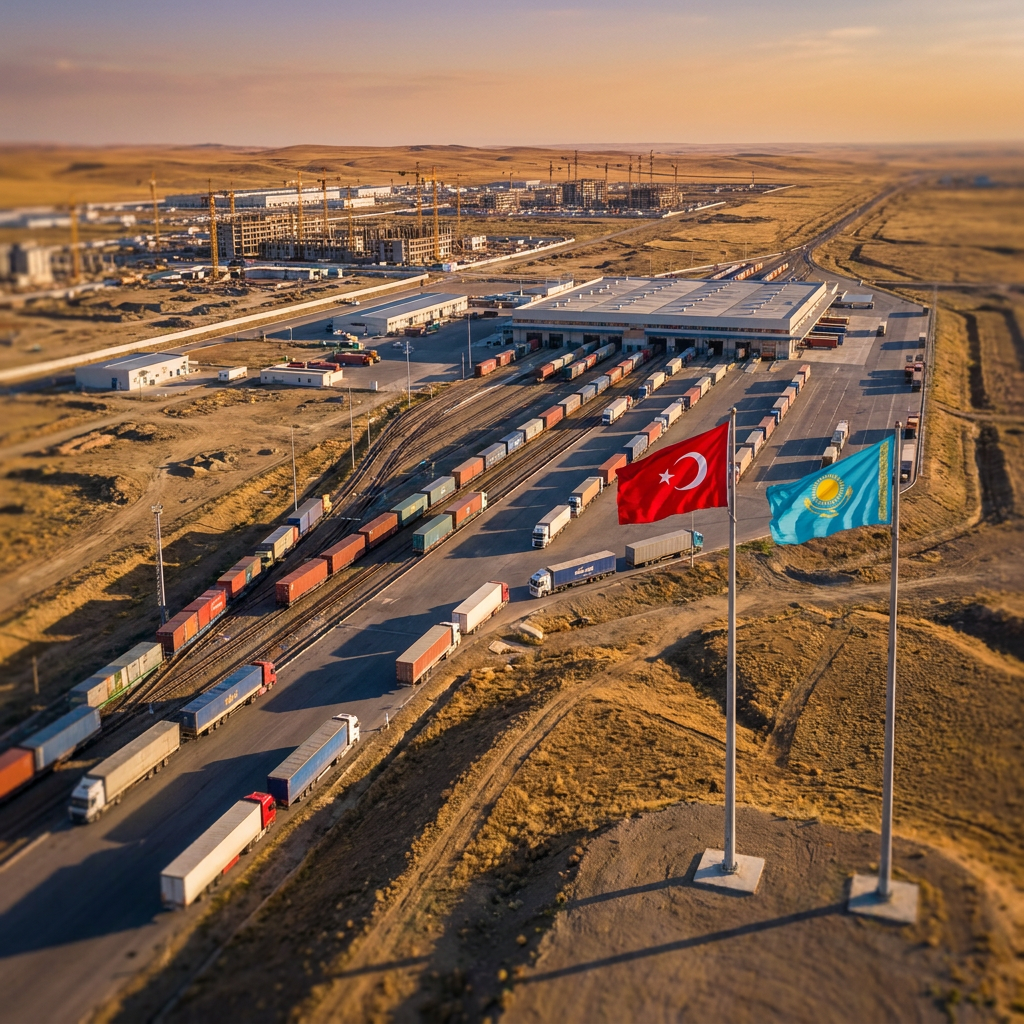
Now consider what this looks like from the other side of the Bosphorus — or rather, from the other side of the Atlantic. Western analysts have been warning for years that Turkey’s drift from NATO orthodoxy is a problem, but they refuse to articulate what that problem actually is [9]. The problem is not that Erdoğan is unreliable. The problem is that Erdoğan is building a parallel economic architecture that does not require Western permission, and Central Asian states — Kazakhstan included — are choosing to participate because the Western model offered them lectures instead of logistics [10]. The Northern Corridor through Russia is now paralysed by geopolitical tension and sanctions regimes that make every shipper nervous. The southern route through Iran is at capacity and politically radioactive [1]. Yılmaz said the quiet part aloud: the Middle Corridor is not an option — it is a necessity. And if you are a European policymaker still pretending that EU trade agreements with Kazakhstan substitute for the continental infrastructure being built right now by Ankara and Astana, you are not managing decline. You are accelerating it. The EU is a declining geopolitical player precisely because it treats every non-Western partnership as a sideshow rather than a structural shift [9]. This is not a sideshow. This is the show.
The Real Cost of Watching From the Sidelines
What does this mean for you — not the diplomat, not the analyst, but the person paying €2.04+ per litre for diesel in Berlin or watching grain prices swing because a Kazakh wheat shipment got rerouted [11]? It means the infrastructure decisions being made in Astana and Aktobe right now will determine who controls the cost of everything you import from east of the Caspian within five years. Kazakhstan’s exports to Türkiye surged 17% in 2025 alone, reaching €3.3 billion, while trade overall grew 9% to €4.6 billion [1]. Those are not abstract numbers. That is aluminium reaching European factories through Turkish ports. That is pharmaceutical precursors being manufactured in Almaty instead of being sourced from Chinese suppliers you cannot audit. When 5,000 Turkish companies operate on Kazakh soil, they employ Kazakh workers, pay Kazakh taxes, and redirect Kazakh output toward Turkish — and by extension Turkic — supply chains [1]. If you are European, ask yourself: where are you in this equation? If you are American, ask yourself the same thing. The answer should make you uncomfortable.
What Next?
We are watching two mid-tier powers build continental infrastructure that neither Washington nor Brussels can easily disrupt, because neither of them is asking permission [5]. Kazakhstan’s GDP growth remains above 4%, buoyed by oil but now deliberately diversifying into manufacturing, agriculture, and pharmaceuticals through precisely these Turkish partnerships [6]. Türkiye, for all its inflation headaches, remains NATO’s second-largest army and the only Alliance member that can credibly operate across both European and Central Asian markets simultaneously [9]. The Middle Corridor will not replace the Suez Canal or the Trans-Siberian Railway next year. But the action plan signed in Astana is not a press release — it is a roadmap, and roadmaps have a way of becoming roads [1]. The real question is not whether Astana and Ankara can hit $15 billion. The real question is: when they do, will you have noticed, or will you still be debating sanctions frameworks in rooms nobody outside Western capitals cares about? Why is Eurasian integration happening without us? Who benefits when we pretend it is not happening? And what will it take before we admit that the future of trade is being negotiated in languages we chose not to learn?
— REFERENCES —
[1] Khassenkhanova, G. (2026, April 17). Ankara pushes deeper economic ties with Astana ahead of Erdoğan visit. Euronews. Retrieved from https://www.euronews.com/2026/04/17/ankara-pushes-deeper-economic-ties-with-astana-ahead-of-erdogan-visit
[2] Organization of Turkic States. (2021). Historical Background. Retrieved from https://turkicstates.org/en
[3] World Bank. (2026). Central Asia Overview. Retrieved from https://www.worldbank.org/en/country/centralasia/overview
[4] Daily Sabah. (2026). Middle Corridor lauded as alternative to routes affected by conflicts. Retrieved from https://www.dailysabah.com/business/transportation/middle-corridor-lauded-as-alternative-to-routes-affected-by-conflicts
[5] Foreign Policy Research Institute. (2023). The Middle Corridor through Central Asia: Trade and Influence Ambitions. Retrieved from https://www.fpri.org/article/2023/02/the-middle-corridor-through-central-asia-trade-and-influence-ambitions
[6] UNCTAD. (2021). Escaping from the Commodity Dependence Trap through Technology and Innovation. Retrieved from https://unctad.org/system/files/official-document/ditccom2021d1_en.pdf
[7] Euronews. (2026, March 25). EBRD spearheads €5.9bn investment programme in emerging Central Asian markets. Retrieved from https://www.euronews.com/business/2026/03/25/ebrd-spearheads-59bn-investment-programme-in-emerging-central-asian-markets
[8] Trading Economics. (2026). Turkey Inflation Rate. Retrieved from https://tradingeconomics.com/turkey/inflation-cpi
[9] CSIS. (2024). Strategic Ambiguity: Erdoğan’s Turkey in a Multipolar World. Retrieved from https://www.csis.org/analysis/strategic-ambiguity-erdogans-turkey-multipolar-world
[10] Reuters. (2026). Kazakhstan-Turkey trade relations. Retrieved from https://www.reuters.com/world/asia-pacific/kazakhstan-turkey-trade-relations
[11] Eurostat. (2026, April 21). Significant increase in fuel prices in March 2026. Retrieved from https://ec.europa.eu/eurostat/web/products-eurostat-news/w/ddn-20260421-1
AI Disclosure: This post was created with the assistance of artificial intelligence. The ideas, analysis, and opinions expressed are my own — AI was used to help compose, structure, and refine my personal notes and thoughts into the final written content. Images, videos and music featured in this post were also generated using AI tools, based on my own creative prompts and direction.
