





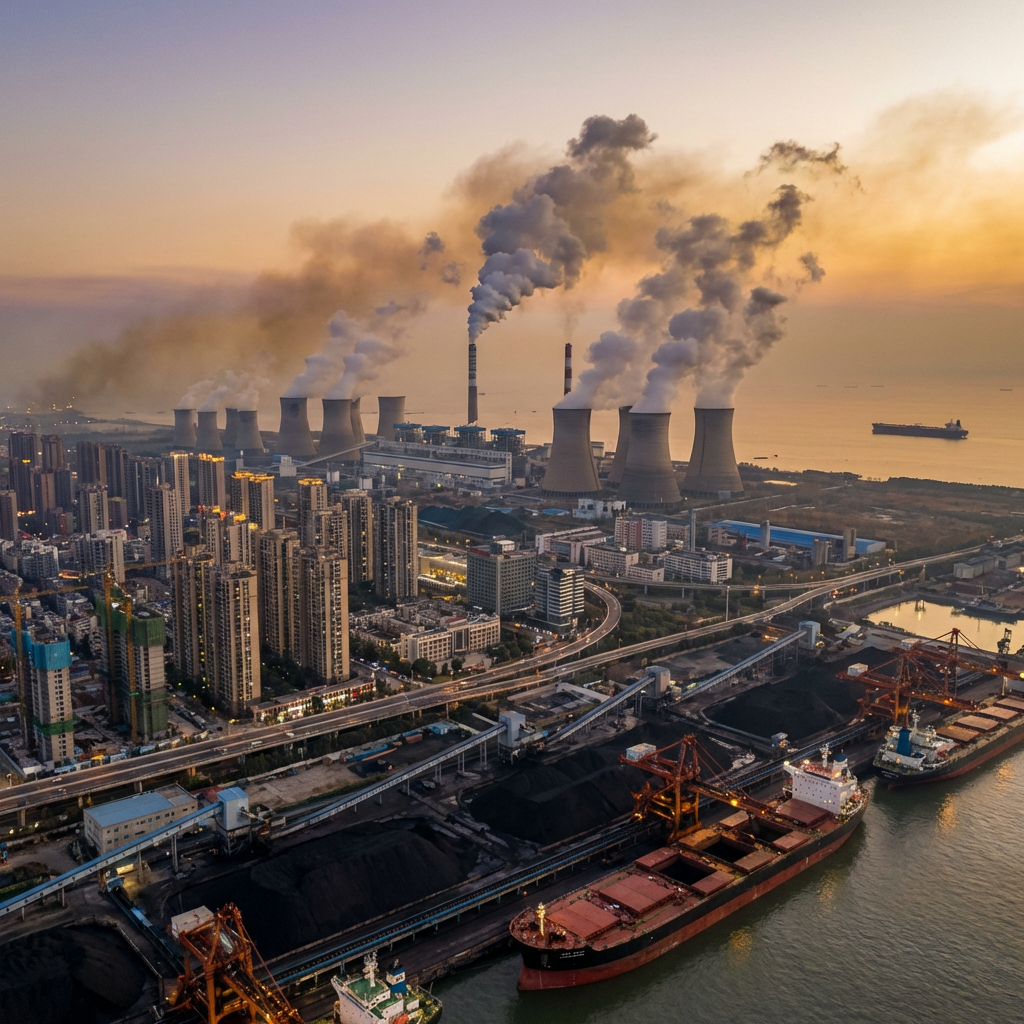
As energy disruptions ripple outward from the Strait of Hormuz, where Iran has effectively imposed a de facto toll gate on maritime traffic, Asian nations are scrambling to keep the lights on — and increasingly turning to coal to do it. The shift threatens to unwind years of hard-won progress on decarbonisation across the world’s most populous continent.
The strategic pivot back to coal underscores a painful reality confronting policymakers from Tokyo to Jakarta: when energy security collides with climate ambition, security wins. As shipping insurers hike premiums and LNG tanker traffic slows to a crawl, the coal plants that governments once pledged to retire are roaring back to life.
Background Context
The Strait of Hormuz handles roughly 20% of global oil transit and a significant share of LNG shipments, making it the single most critical chokepoint in the world’s energy supply chain. Iran’s escalating posture — including the seizure of commercial vessels, demands for inspection fees, and veiled threats to restrict passage during heightened geopolitical tensions — has injected acute uncertainty into an already fragile market.
Asia’s dependence on Middle Eastern energy is staggering. Japan imports approximately 90% of its energy needs, South Korea relies on imports for over 93% of its primary energy, and India sources roughly 85% of its crude oil from abroad, with the Persian Gulf accounting for the lion’s share. China, the world’s largest energy consumer, imported a record 11.3 million barrels per day of crude in 2024, according to the National Bureau of Statistics.
For years, these nations have pursued ambitious renewable energy targets. China installed more solar capacity in 2024 than the entire world did in 2023. India pledged to reach 500 GW of non-fossil fuel capacity by 2030. Japan and South Korea both committed to net-zero by 2050. But those long-term plans offer little comfort when gas-fired power plants face fuel shortages this quarter.
Detailed Coverage
The coal resurgence is already visible in the data. China’s coal-fired power generation rose 5.4% year-on-year in Q1 2025, according to the China Electricity Council, even as total electricity demand grew at a slower 3.8% pace — meaning coal is gaining share, not merely meeting incremental demand. Provincial governments have quietly extended the operating permits of plants that were scheduled for decommissioning.
India’s Central Electricity Authority reported that coal-based generation hit a record 1,198 billion kilowatt-hours in the fiscal year ending March 2025, up 8.2% from the prior year. Coal India Limited, the state-owned mining giant, increased production to 780 million tonnes — also a record — and the government has fast-tracked approvals for new mine expansions in Jharkhand and Odisha.
Japan, which had been gradually reducing coal’s share of its electricity mix, reversed course in the first quarter. The Ministry of Economy, Trade and Industry confirmed that coal accounted for 32% of electricity generation in March 2026, up from 28% a year earlier, as LNG spot prices surged past $18 per million British thermal units — nearly double the five-year average.
South Korea’s Korea Electric Power Corporation (KEPCO) restarted two coal units at the Yeongheung power complex that had been placed on seasonal standby, citing “energy supply reliability concerns.” Vietnam, Bangladesh, and Pakistan have all accelerated coal import contracts as LNG deliveries face indefinite delays.
- China: Coal-fired generation up 5.4% YoY in Q1 2026 (China Electricity Council)
- India: Coal power output hit record 1,198 BkWh in FY2025-26 (Central Electricity Authority)
- Japan: Coal share of electricity rose to 32% in March 2026, from 28% a year earlier (METI)
- South Korea: Two coal units restarted at Yeongheung complex (KEPCO)
- LNG spot prices: Surpassed $18/MMBtu, nearly double the five-year average
- Strait of Hormuz: Handles ~20% of global oil transit daily
Expert Perspectives & Data
“What we’re seeing is a textbook case of energy trilemma in action,” said Dr. Fatih Birol, Executive Director of the International Energy Agency, speaking at a briefing in Paris in April 2025. “When affordability and security are under acute stress, the environment pays the price. The question is whether this is a temporary adjustment or the start of a structural reversal.”
The IEA’s latest World Energy Outlook interim update, published in March 2026, warned that global coal demand could rise by 120–180 million tonnes above baseline projections if Hormuz-related disruptions persist through the end of the year. That would push total global coal consumption to approximately 8.7 billion tonnes — a new all-time high.
Lauri Myllyvirta, Lead Analyst at the Centre for Research on Energy and Clean Air (CREA), noted that the emissions implications are severe. “Every percentage point increase in Asia’s coal generation mix translates to roughly 150–200 million additional tonnes of CO₂ annually,” he said. “We are potentially looking at the equivalent of adding the entire annual emissions of a country like Spain on top of existing trajectories.”
Energy consultancy Wood Mackenzie estimates that Asian LNG demand could fall by 12–15 million tonnes in 2026 if the Hormuz situation is not resolved by mid-year, with coal and fuel oil filling the gap. “This is not a story about one country’s policy choices,” said Valery Chow, Head of Asia Pacific Gas & LNG Research at Wood Mackenzie. “It’s about the structural vulnerability of an entire continent that built its energy transition on the assumption of cheap, reliable gas.”
Implications
For the global energy market, the coal resurgence sends a stark signal: the transition away from fossil fuels remains hostage to geopolitical risk. Investors who poured capital into LNG infrastructure expecting steady Asian demand growth now face the prospect of stranded assets, while coal miners who were supposed to be sunset industries enjoy an unexpected windfall. Carbon credit markets have already reacted — EU ETS allowances rose 11% in April 2026, partly driven by expectations of higher Asian emissions.
For ordinary people across Asia, the implications cut both ways. On one hand, coal’s return helps stabilise electricity supply and keeps tariffs from spiralling — a critical concern for households already squeezed by rising food and transport costs. On the other hand, coal combustion worsens air quality in cities that already rank among the world’s most polluted. The World Health Organisation estimates that outdoor air pollution contributes to over 2 million premature deaths annually in South and East Asia alone. More coal means more particulate matter, more respiratory illness, and more pressure on already strained public health systems.
Small business owners in energy-intensive sectors — manufacturing, textiles, food processing — face a double bind. Higher LNG and oil prices inflate their operating costs, while governments prioritise residential and critical infrastructure supply. Rolling blackouts, already a reality in parts of Pakistan and Bangladesh, could spread if the disruption deepens through the summer cooling season.
The bottom line is simple: when the Strait of Hormuz sneezes, Asia’s energy markets catch a cold — and right now, the prescription is coal. Whether this is a temporary fever or a chronic condition depends entirely on how quickly geopolitical tensions ease and whether governments invest aggressively in energy storage, grid interconnection, and diversified supply chains. For now, the climate clock is ticking louder than ever.
AI Disclosure: This post was created with the assistance of artificial intelligence. The ideas, analysis, and opinions expressed are my own — AI was used to help compose, structure, and refine my personal notes and thoughts into the final written content. Images, videos and music featured in this post were also generated using AI tools, based on my own creative prompts and direction.
References:
- U.S. Energy Information Administration (EIA) / Statista — “A Quarter of Maritime Oil Trade Flows Through the Strait of Hormuz”, March 2026. Available at: https://www.statista.com/chart/35914/destination-maritime-crude-oil-strait-of-hormuz/
- Visual Capitalist / EIA — “Charted: Oil Trade Through the Strait of Hormuz by Country”, Energy Now, March 2026. Available at: https://energynow.com/2026/03/charted-oil-trade-through-the-strait-of-hormuz-by-country-visual-capitalist/
- ZeroCarbon Analytics — “Asian Countries Most at Risk from Oil and Gas Supply Disruptions in the Strait of Hormuz”, February 2026. Available at: https://zerocarbon-analytics.org/insights/briefings/asian-countries-most-at-risk-from-oil-and-gas-supply-disruptions-in-strait-of-hormuz/
- Lloyd’s List — “Tehran’s Toll Booth System Is Now Controlling Hormuz Traffic”, March 2026. Available at: https://www.lloydslist.com/LL1156720/Tehrans-toll-booth-system-is-now-controlling-Hormuz-traffic
- Wood Mackenzie — “Strait of Hormuz Closure Threatens South Asia LNG Supply”, March 2026. Available at: https://www.woodmac.com/press-releases/strait-of-hormuz-closure-threatens-south-asia-lng-supply/
- Wood Mackenzie — “The Strait of Hormuz Closure Pressures LNG Spot Prices, Threatens Northeast Asia Gas Market”, March 2026. Available at: https://www.woodmac.com/press-releases/me-conflicts-impact-on-nea-gas-market/
- Reuters — “India Will Use More Coal Over the Next 25 Years, Report Says”, February 2026. Available at: https://www.reuters.com/business/energy/india-will-use-more-coal-over-next-25-years-report-says-2026-02-10/
- Carbon Brief / Centre for Research on Energy and Clean Air (CREA), Lauri Myllyvirta — “Analysis: Coal Power Drops in China and India for First Time in 52 Years After Clean Energy Records”, January 2026. Available at: https://www.carbonbrief.org/analysis-coal-power-drops-in-china-and-india-for-first-time-in-52-years-after-clean-energy-records/
- International Energy Agency (IEA) / LNG Industry — “IEA: Coming Surge in LNG Production Set to Reshape Global Gas Markets”, October 2025. Available at: https://www.lngindustry.com/special-reports/28102025/iea-coming-surge-in-lng-production-set-to-reshape-global-gas-markets/
- University of Illinois, FarmDoc Daily — “The Strait of Hormuz: Why Global Trade Dependency Turns a Localized Conflict into a Global Crisis”, March 2026. Available at: https://farmdocdaily.illinois.edu/2026/03/the-strait-of-hormuz-why-global-trade-dependency-turns-a-localized-conflict-into-a-global-crisis/
