




The escalating confrontation between the United States and Iran is not merely a regional crisis; it is a strategic accelerant for China’s global ambitions. As Washington’s attention, diplomatic capital, and military assets are drawn into a volatile standoff with Tehran, Beijing is capitalizing on the distraction to consolidate its position, secure economic interests, and advance its narrative as a stable alternative to a conflict-prone West. This dynamic represents a classic geopolitical diversion, weakening America’s capacity to focus on its stated priority: strategic competition in the Indo-Pacific.
Strategic Background
The US-Iran relationship has been defined by enmity since the 1979 Islamic Revolution, a rivalry institutionalized through decades of sanctions, proxy conflicts, and nuclear brinkmanship. The 2015 Joint Comprehensive Plan of Action (JCPOA) offered a temporary détente, but the US withdrawal in 2018 under President Trump reignited a “maximum pressure” campaign, pushing Iran’s nuclear program to advanced levels and deepening regional instability. This long-standing conflict exists within a broader Middle Eastern power struggle involving Israel, Saudi Arabia, and various non-state actors, a theater where the US has maintained a dominant, if increasingly contested, military and diplomatic presence.
Concurrently, China has methodically expanded its footprint in the region through the Belt and Road Initiative (BRI), becoming the primary trading partner for Iran and a major investor in Gulf Arab states. Beijing’s 2023-brokered rapprochement between Iran and Saudi Arabia demonstrated its growing diplomatic clout, positioning itself as a pragmatic mediator free from the ideological baggage of Washington. This dual strategy—deep economic integration paired with diplomatic engagement—has allowed China to build influence without directly challenging US military primacy, instead waiting for moments of American strategic overextension.
What This Move Signals
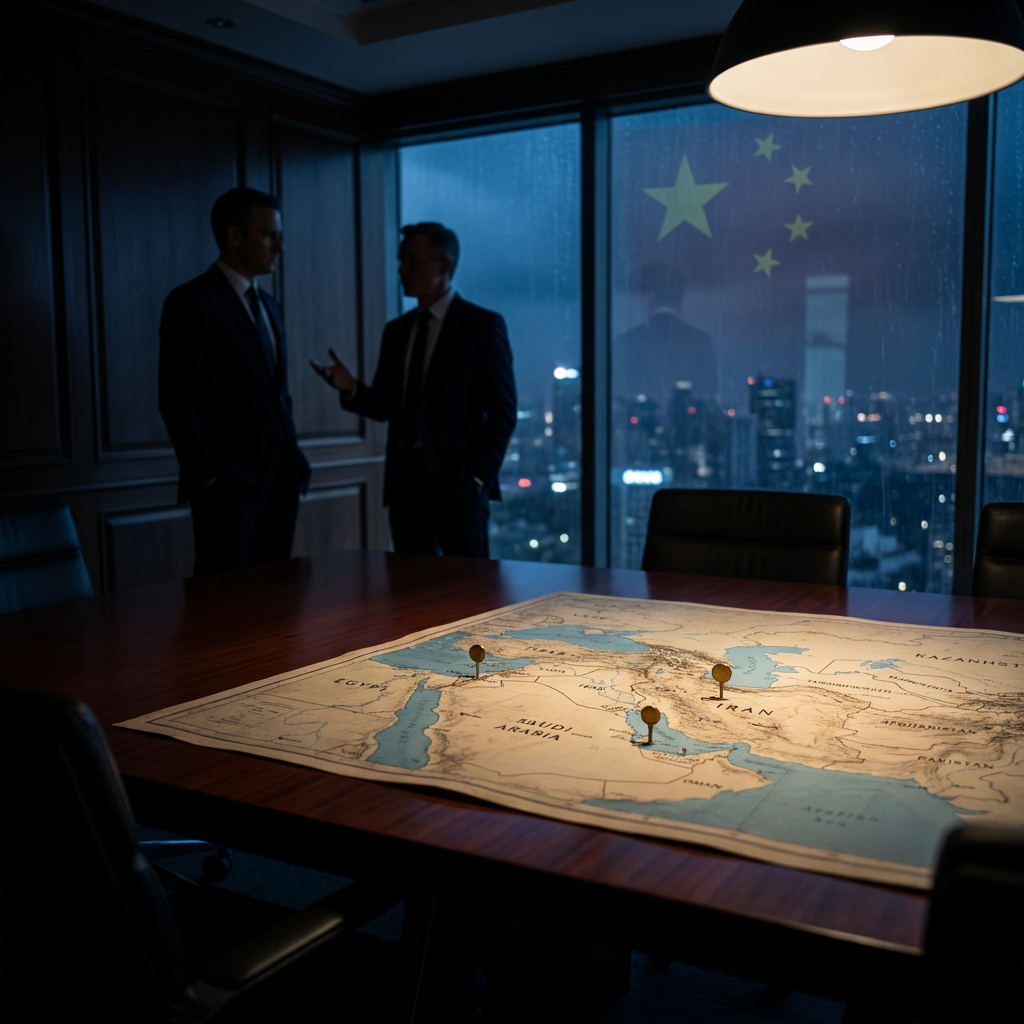
The current surge in US-Iran tensions signals a critical failure in containment strategy and exposes a fundamental vulnerability in Washington’s global posture: the inability to manage multiple crises simultaneously. Each carrier strike group deployed to the Persian Gulf, each tranche of sanctions issued, and each diplomatic hour spent on de-escalation with Tehran is a resource not allocated to the Indo-Pacific. This is not lost on Beijing. China’s leadership interprets this as confirmation that US power, while immense, is finite and can be strategically drained through peripheral conflicts.
For China, this scenario offers a dual advantage. First, it provides a shield for its actions in the Taiwan Strait and the South China Sea, reducing the likelihood of robust US intervention during a period of Middle Eastern volatility. Second, it reinforces China’s value proposition to the Global Middle East and the broader Global South: that partnership with Beijing offers economic benefits without the geopolitical risk and moralizing entanglements of an alliance with Washington. The message is clear: the US brings instability; China brings infrastructure and predictable commerce.
Implications for European Security and Interests
The impact on the European Union is severe and multifaceted. Militarily, a full-scale US-Iran conflict would trigger a refugee crisis on Europe’s southern flank, threaten freedom of navigation in the Red Sea and Strait of Hormuz, and potentially draw NATO members into a theater far from the alliance’s core focus on its eastern border. Economically, energy markets would face catastrophic disruption, spiking oil and gas prices and exacerbating Europe’s energy insecurity, while key trade routes through the Suez Canal could be paralyzed.
Politically, this crisis exposes and deepens divisions within the EU. Member states hold divergent views on Iran, from those prioritizing non-proliferation and regime engagement to those aligning fully with Washington’s hardline stance. This fragmentation weakens Europe’s collective voice and renders a common strategic response nearly impossible. Normatively, the EU’s role as a champion of the JCPOA and diplomatic solutions is undermined by its powerlessness to prevent escalation, damaging its credibility as a geopolitical actor.
Overall, this development is unequivocally negative for the EU. It directly threatens European energy security, territorial stability, and political cohesion, while indirectly empowering a systemic rival (China) by distracting the EU’s primary security guarantor (the US).
Trans-Atlantic and Allied Dimensions
For the United States, the Iran crisis represents a strategic trap of its own making. It validates the concerns of those who argue Washington’s Middle East commitments are a costly diversion from great power competition. The Biden administration’s focus on assembling a coalition to counter Houthi attacks in the Red Sea, while necessary, consumes naval resources and diplomatic bandwidth. This creates a palpable tension within the US strategic establishment between addressing immediate threats and maintaining long-term focus on China.
Alignment between the EU and US is fragile. While both oppose Iran’s nuclear ambitions and regional destabilization, Europe is more vulnerable to the economic and migratory fallout of a conflict and has traditionally favored engagement over coercion.
The risk of alliance fracture lies not in a direct break, but in a gradual erosion of trust as European powers perceive US actions as dragging them into a conflict contrary to their core interests, while simultaneously failing to address their primary security concern: Russia.
The Other Side of the Board
China is the primary beneficiary. The distraction allows Beijing to advance its interests with reduced resistance, from finalizing energy deals with Iran under US sanctions to strengthening diplomatic and commercial ties across the Gulf. Russia also gains, as any spike in global energy prices boosts its war economy and any US resource drain diminishes support for Ukraine. For Iran, the calculus is risky but clear: heightened tensions consolidate domestic political control, justify nuclear brinkmanship as a deterrent, and strengthen its hand by showcasing the costs of US pressure.
Regional actors like the UAE and Saudi Arabia are recalibrating. While relying on US security guarantees, they are simultaneously deepening economic and technological partnerships with China, hedging their bets in a multipolar region. This event accelerates that hedging, pushing Middle Eastern powers to diversify their security and economic portfolios away from exclusive reliance on Washington.
Brussels on the Chessboard
The EU’s response has been a mixture of diplomatic statements calling for restraint, activation of crisis management mechanisms, and continued rhetorical support for a revived nuclear deal. The European External Action Service has urged de-escalation, and key member states like France and Germany have engaged in shuttle diplomacy. However, these actions are fundamentally reactive and lack strategic weight.
The Strategic Verdict
This is a critical failure. The EU’s response is that of a concerned bystander, not a strategic power. While possessing significant economic leverage through its market size and role as a major Iranian trading partner, Brussels has failed to deploy it decisively to shape outcomes. A strategically assertive EU would have, months ago, tabled a concrete, independent diplomatic initiative—beyond merely supporting the stalled JCPOA process—that offered Iran a viable economic pathway in exchange for verifiable nuclear and regional concessions, while simultaneously presenting a unified security plan to Gulf partners. Instead, it has defaulted to a supporting role behind a distracted Washington, ceding the diplomatic field to China and exposing European interests to grave risk. In geopolitics, this passivity is not neutrality; it is a choice that weakens Europe.
Forward Outlook: Three Signals to Watch
The trajectory of this crisis will be determined by three key indicators. First, watch the International Atomic Energy Agency’s (IAEA) quarterly reports on Iran’s enriched uranium stockpiles; a breakout capability would trigger a severe US-Israeli response. Second, monitor China’s oil imports from Iran; a significant increase would signal Beijing’s confidence in circumventing US sanctions and its commitment to anchoring Tehran economically. Third, observe EU internal debates at the next Foreign Affairs Council; any move beyond statements toward a concrete, independent European diplomatic initiative would be a revolutionary shift.
The ultimate strategic lesson is clear: while the US and Iran duel in the desert, the most consequential geopolitical prize—global strategic primacy—is being quietly contested in boardrooms from Beijing to Brussels, and Europe is currently not in the game.
