






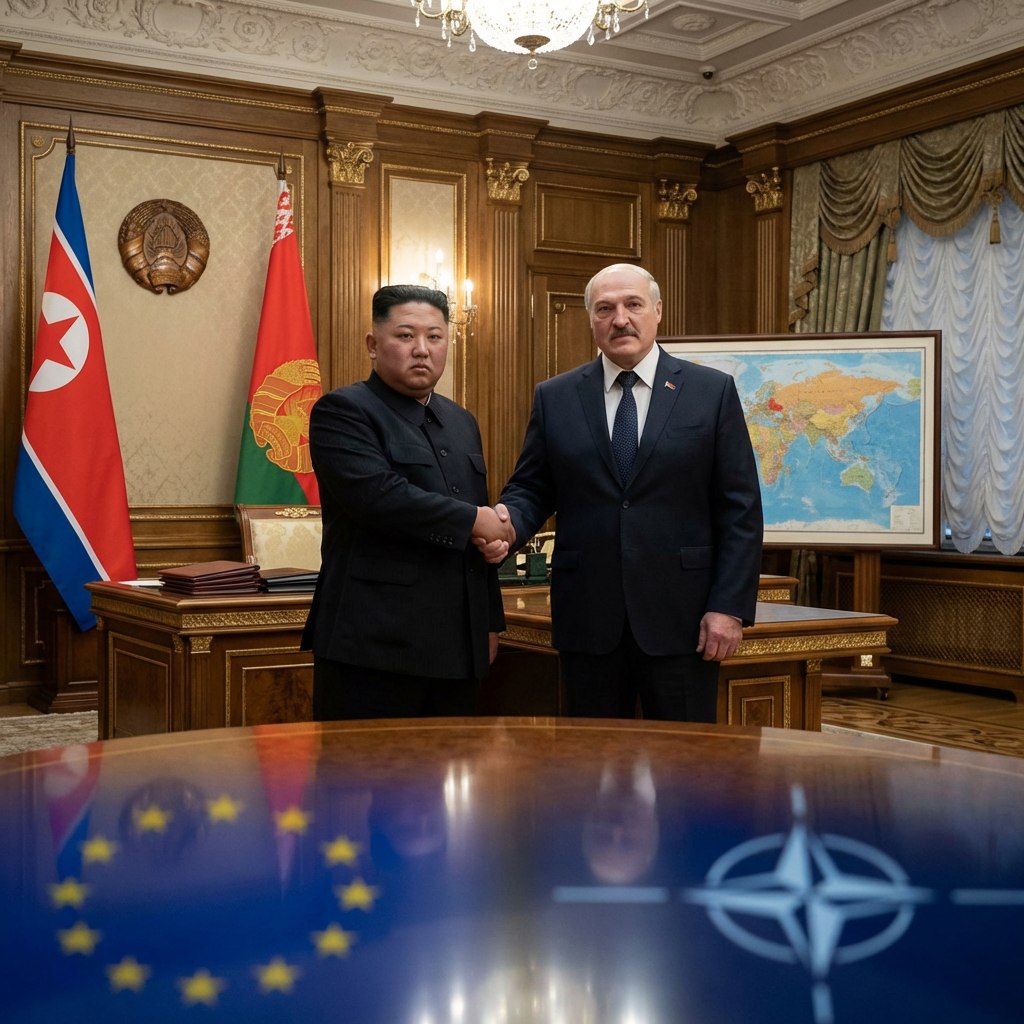
On March 26, 2026, North Korean leader Kim Jong-un met Belarusian President Alexander Lukashenko in Minsk, delivering a joint condemnation of Western sanctions and political pressure against Belarus. This summit is not a mere diplomatic formality; it represents a deliberate consolidation of a revisionist partnership that directly challenges the European Union’s security architecture and the trans-Atlantic alliance’s eastern deterrence posture. The event signals a tangible expansion of the anti-hegemonic bloc, leveraging Belarus as a strategic conduit between Pyongyang and Moscow, with immediate implications for European stability.
Strategic Background
Belarus has been under escalating EU and US sanctions since the disputed 2020 election and its subsequent role as a staging ground for Russia’s 2022 invasion of Ukraine. North Korea, enduring decades of isolation, has deepened its military and economic ties with Moscow, particularly since 2022, providing ammunition and receiving technological inputs in return. Lukashenko’s regime has increasingly relied on Russian political and economic support to withstand Western pressure, creating a natural alignment with other sanctioned states.
The meeting follows a pattern of intensified diplomatic outreach between Pyongyang and Minsk, including reports of arms shipments and technical exchanges via Russian logistics networks. Historically, Belarus and North Korea maintained limited ties during the Soviet era, but the current dynamic is driven by shared adversarial postures toward the West and mutual dependence on Russian patronage. This summit formalizes a linkage that had previously operated in the shadows of the Russia-Ukraine conflict.
What This Move Signals
The primary strategic intent is to demonstrate the resilience and growing coordination of states opposed to the US-led international order. By hosting Kim, Lukashenko signals that Belarus has alternative patrons beyond Moscow, enhancing its bargaining power and reducing the perceived cost of Western isolation. For North Korea, the engagement provides a European foothold, complicating sanctions enforcement and offering new channels for procurement and revenue generation.
This alignment sends a clear message to Brussels and Washington: pressure campaigns are forging counter-coalitions rather than inducing capitulation. It represents a form of hybrid warfare, where diplomatic recognition and economic ties are weaponized to erode the cohesion of Western sanctions regimes. The move also grants Russia strategic depth, using Belarus as a buffer and now a bridge to connect its Asian and European partners, thereby projecting influence across two continents.
The power balance shifts as this partnership potentially facilitates technology transfer, from North Korean artillery systems to Belarusian dual-use capabilities, threatening NATO’s eastern flank. It creates a proxy relationship where Belarus serves as a logistical and diplomatic hub for Pyongyang’s engagement in Europe, amplifying the deterrent threat against Poland and the Baltic states.
Implications for European Security and Interests
Militarily, this development negatively impacts European security by potentially enhancing Belarus’s defense-industrial capacity with North Korean inputs, increasing the hybrid threat on the EU’s border. It could lead to more sophisticated provocations, such as migrant crises or cyber-attacks, backed by a broader coalition of hostile actors.
Economically, the partnership may facilitate sanctions evasion, undermining the EU’s coercive tools and creating loopholes for critical technology flows to sanctioned entities. Energy security is indirectly affected as Belarus remains a key transit route for Russian gas; enhanced ties with North Korea could lead to more assertive leverage over European energy dependencies.
Politically, the summit exposes divisions within the EU, with member states like Hungary potentially viewing engagement with Belarus as less confrontational, while frontline states demand a harder line. This tests the bloc’s cohesion and its ability to maintain a unified sanctions policy.
Normatively, the EU’s standing as a promoter of human rights and international law is challenged, as the Kim-Lukashenko partnership flaunts its disregard for these principles with impunity. The severity of the negative impact is high, as it consolidates an adversarial axis on Europe’s doorstep, requiring a strategic reassessment of deterrence and containment policies.
Trans-Atlantic and Allied Dimensions
The event directly affects the United States by complicating its non-proliferation goals and sanctions enforcement, as North Korea gains a new avenue for circumventing restrictions. NATO’s eastern deterrence is weakened if Belarus becomes a conduit for advanced weaponry, potentially triggering alliance debates on force posture and readiness.
There is alignment between EU and US interests in opposing this partnership, but divergence may emerge in response strategies; Washington might prioritize unilateral sanctions or military signaling, while Brussels could face pressure for diplomatic engagement with Minsk to peel it away from Pyongyang. This risks alliance fracture if responses are not coordinated, particularly if some EU members advocate for dialogue over coercion.
The broader Western alliance architecture is strained, as the partnership exemplifies how sanctions can drive targeted states into tighter coalitions, necessitating a review of coercive diplomacy’s effectiveness. Opportunities for coordinated response include joint sanctions designations and intelligence sharing on evasion networks.
The Other Side of the Board
For Russia, this development strengthens its hand by solidifying a loyal ally in Belarus and extending its network of revisionist partners. It creates vulnerabilities, however, if over-reliance on North Korean munitions exposes quality issues or if Western retaliation escalates economic pressure on Moscow.
China gains indirectly, as a more fragmented Western focus on Eastern Europe could reduce pressure on Beijing in the Indo-Pacific. Yet, it may also complicate China’s balancing act, as overt support for North Korea’s European ventures could trigger secondary sanctions. Regional powers like Poland and Lithuania face heightened security threats, prompting potential calls for increased NATO deployments.
The partnership opens strategic options for Russia to project power through proxies, but it also closes diplomatic avenues for de-escalation with the West, hardening geopolitical blocs. For North Korea, the gain is a European platform, but it risks further isolation if the EU responds with enhanced maritime interdiction and financial tracking.
Brussels on the Chessboard
As of the summit, the EU has issued statements condemning the meeting and reaffirming sanctions on Belarus, with the European Council calling for vigilance against sanctions circumvention. Diplomatic channels have been activated to discuss potential new designations targeting entities facilitating North Korea-Belarus trade.
The Strategic Verdict
The EU’s response, while consistent with its normative stance, is critically inadequate for the strategic challenge posed. Issuing condemnations without immediate, tangible measures—such as accelerated sanctions packages or enhanced military support to eastern member states—signals indecision. In geopolitics, this passivity is a choice that emboldens adversaries; the EU must act as a strategic power, not a committee. Decisive action would have included pre-emptive sanctions on Belarusian defense sectors and a coordinated diplomatic push to isolate the partnership at the UN. The cost of inaction is a strengthened anti-Western axis that erodes European security incrementally.
Forward Outlook
Watch for three specific signals: first, the outcome of the upcoming NATO foreign ministers’ meeting in April 2026, where eastern flank security will be debated; second, any new EU sanctions designations targeting North Korean-Belarusian trade networks in the next quarter; and third, Russian military exercises in Belarus scheduled for summer 2026, which may showcase integrated capabilities. The Kim-Lukashenko summit is a crystallizing moment for a multipolar coercion strategy, forcing Europe to choose between reactive diplomacy and proactive deterrence.
