


The missiles are still flying, but the myth of invincibility has already landed — shattered, irretrievably, on the floor of a global order that can no longer sustain the weight of American pretension.
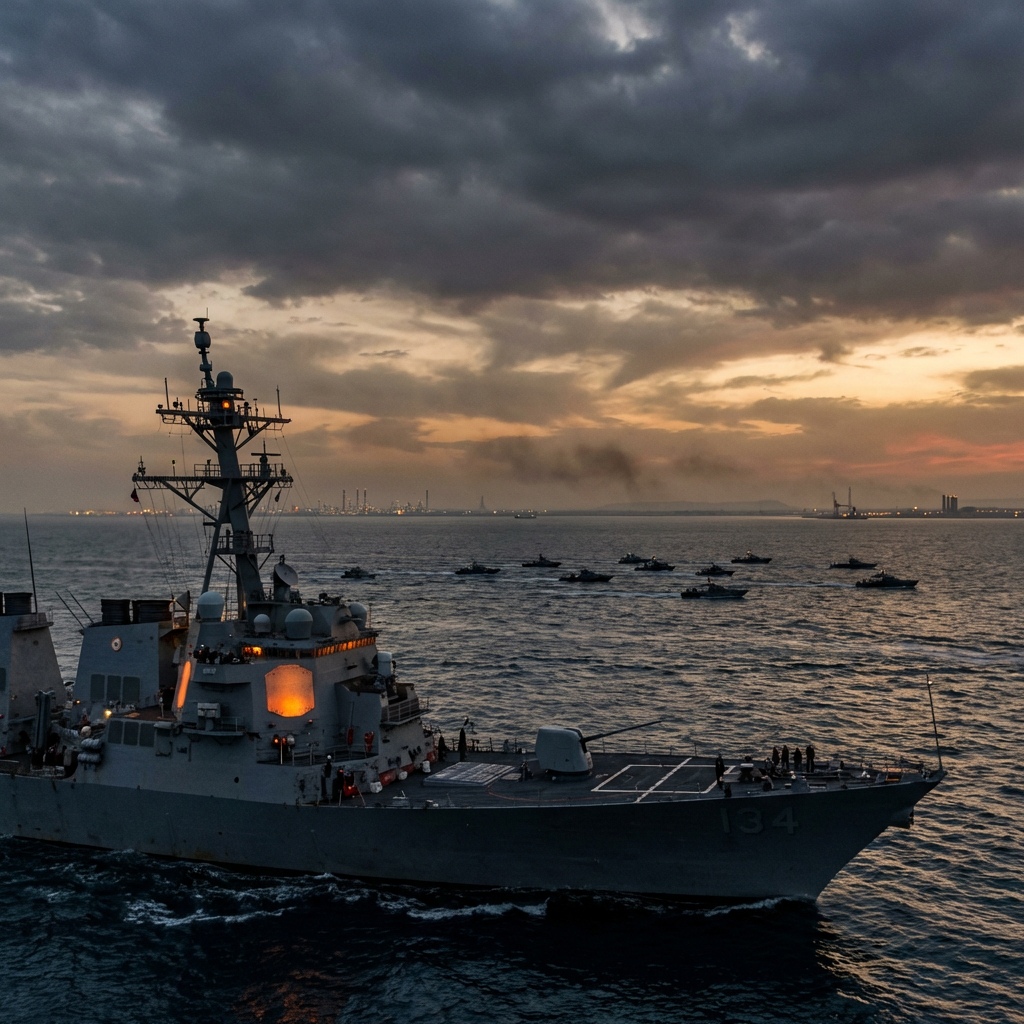
The United States has launched direct military operations against Iran, striking nuclear enrichment facilities, Revolutionary Guard command nodes, and critical energy infrastructure across the country. The campaign, which began in late March 2026, represents the most significant direct US military engagement in the Middle East since the 2003 Iraq invasion — and arguably the most consequential test of American power projection since the end of the Cold War. Tehran has retaliated with ballistic missile strikes on US bases in the Gulf, proxy activations across Iraq, Syria, Lebanon, and Yemen, and a credible threat to close the Strait of Hormuz. What was sold as a decisive strike against a weakened adversary is rapidly becoming a grinding, multi-front confrontation that reveals more about American vulnerability than American strength.
Strategic Background
The path to direct US-Iran military confrontation has been building for over two decades. The 2015 Joint Comprehensive Plan of Action (JCPOA) temporarily constrained Iran’s nuclear program, but the Trump administration’s unilateral withdrawal in 2018 shattered the diplomatic framework and unleashed a cascade of escalation. Iran accelerated uranium enrichment to 60% purity — weapons-grade threshold — while the International Atomic Energy Agency lost meaningful access to key facilities. By 2024, Iran’s breakout time to produce fissile material for a nuclear weapon had shrunk to approximately one week, according to IAEA assessments.
The regional architecture shifted simultaneously. The Abraham Accords realigned Gulf states toward Israel, but they did not neutralize Iran’s network of proxy forces — Hezbollah, the Houthis, Iraqi Shia militias, and Palestinian Islamic Jihad — which Tehran had spent decades cultivating as asymmetric deterrents. The October 7, 2023 Hamas attack on Israel and the subsequent Gaza war activated this network in ways that exposed the limits of US-backed Israeli military dominance. Houthi attacks on Red Sea shipping disrupted global trade flows for months. Hezbollah’s standoff with Israel created a permanent northern threat. Each escalation drew the United States deeper into a regional quagmire it could neither control nor exit.
Iran’s conventional military has been degraded by years of sanctions, but its strategic depth — geographic, demographic, and ideological — remains formidable. The country spans 1.6 million square kilometers of mountainous terrain, possesses the world’s fourth-largest oil reserves, and commands loyalty across a Shia crescent stretching from Tehran to Beirut. This is not Iraq in 2003. This is a civilizational state with four thousand years of continuous governance experience and a population of 88 million that has endured forty-five years of sanctions without regime collapse.
What This Move Signals
The US military campaign against Iran signals a fundamental strategic miscalculation rooted in a dying paradigm. Washington has applied the logic of unipolar coercion — overwhelming force, rapid regime capitulation, swift political resolution — to an adversary that does not operate within that framework. Iran’s response has been neither capitulation nor collapse. It has been calibrated escalation: enough retaliation to inflict real costs, enough restraint to avoid triggering a nuclear response, enough ambiguity to keep the escalation ladder uncertain.
The message being sent is not the one Washington intended. The strikes were supposed to demonstrate that the United States can still impose its will on any actor, anywhere, at any time. Instead, they demonstrate that American power projection now comes with a price tag the domestic political system may not sustain. Oil prices have surged past $130 per barrel. US military casualties are mounting. The carrier strike groups deployed to the Gulf are drawing resources from the Indo-Pacific theater — the one theater where US strategic competition with China demands undivided attention.
Tehran is playing a longer game. Every day the conflict continues without decisive US victory erodes the credibility of American deterrence globally. The counterargument is that overwhelming US air superiority will eventually degrade Iran’s military capacity to the point of forced compliance. It fails because Iran’s strategic calculus was never built on winning a conventional war — it was built on making the cost of victory prohibitively high for the victor, a doctrine Hezbollah perfected in 2006 and Iran has now scaled to the state level.
The strategic intent behind Iran’s retaliatory posture is transparent: force the United States into a conflict of attrition that bleeds American credibility, fractures domestic consensus, and accelerates the global perception that the hegemon can no longer enforce its will. Deterrence that requires constant kinetic proof is no longer deterrence — it is a performance for audiences that have already stopped believing.
Implications for European Security and Interests
Europe is not a spectator in this conflict. It is a hostage. The Strait of Hormuz handles approximately 20% of global oil transit. The Bab el-Mandeb, already disrupted by Houthi operations, controls access to the Suez Canal — the artery of European-Asian trade. A sustained closure of either chokepoint would trigger an energy crisis across the continent that would make the 2022 gas shock look like a market correction.
The military implications are equally severe. NATO’s southern flank — Turkey, Greece, Italy, Spain — faces direct exposure to escalation spillover. Refugee flows from a destabilized Iran would dwarf the 2015 Syrian crisis. Iran’s population is four times larger than Syria’s, and the geographic pathways into Europe are shorter and more numerous. The EU’s already strained migration management framework would face existential pressure.
Politically, the conflict exposes the EU’s most dangerous dependency: its inability to act independently of Washington in a crisis that directly threatens European security. No European power was meaningfully consulted before the strikes. No EU institution was briefed on escalation thresholds. Europe’s security architecture remains structurally subordinate to American decision-making — and American decision-making is currently driven by domestic electoral calculations and a president who views alliances as billing arrangements.
The normative cost is equally steep. European credibility as a champion of international law — already damaged by inconsistent responses to Gaza — suffers further when the EU fails to condemn or even clearly articulate a position on a military campaign launched without UN authorization, without NATO consultation, and without any identifiable legal framework under international humanitarian law. Europe’s soft power is being hollowed out by its own silence.
Trans-Atlantic and Allied Dimensions
The US-Iran war has not strengthened the trans-Atlantic alliance. It has weaponized it. Trump’s approach to European engagement on this crisis follows the same extortion logic applied to NATO burden-sharing, trade negotiations, and every other bilateral issue: comply with American demands or face economic punishment. European nations have been presented with a binary choice — support the campaign unconditionally or face secondary sanctions, trade penalties, and public humiliation via social media diplomacy.
NATO’s collective defense guarantee — already structurally weakened by Trump’s transactional posture — faces its most serious credibility test since the alliance’s founding. Article 5 was designed for territorial defense against a Soviet invasion. It was never designed to compel European participation in an offensive military campaign against a Middle Eastern state that poses no direct territorial threat to any NATO member. The legal and political fiction that this operation falls within NATO’s mandate is wearing thin.
The divergence between US and European interests is now structural, not episodic. Washington’s strategic priority is maintaining primacy in the Middle East to protect Israel, contain Iran, and preserve petrodollar dominance. Europe’s strategic priority is energy security, migration management, and maintaining the multilateral institutional order that protects smaller states from great power coercion. These objectives overlap only accidentally. The alliance is functioning on inertia, not shared purpose.
The counterargument is that European security ultimately depends on American military power, and that breaking with Washington during an active conflict would be suicidal. It fails because dependency maintained through coercion is not an alliance — it is a protection racket. Europe must eventually choose between the comfort of subordination and the risk of strategic autonomy. The Iran war is making that choice unavoidable.
The Other Side of the Board
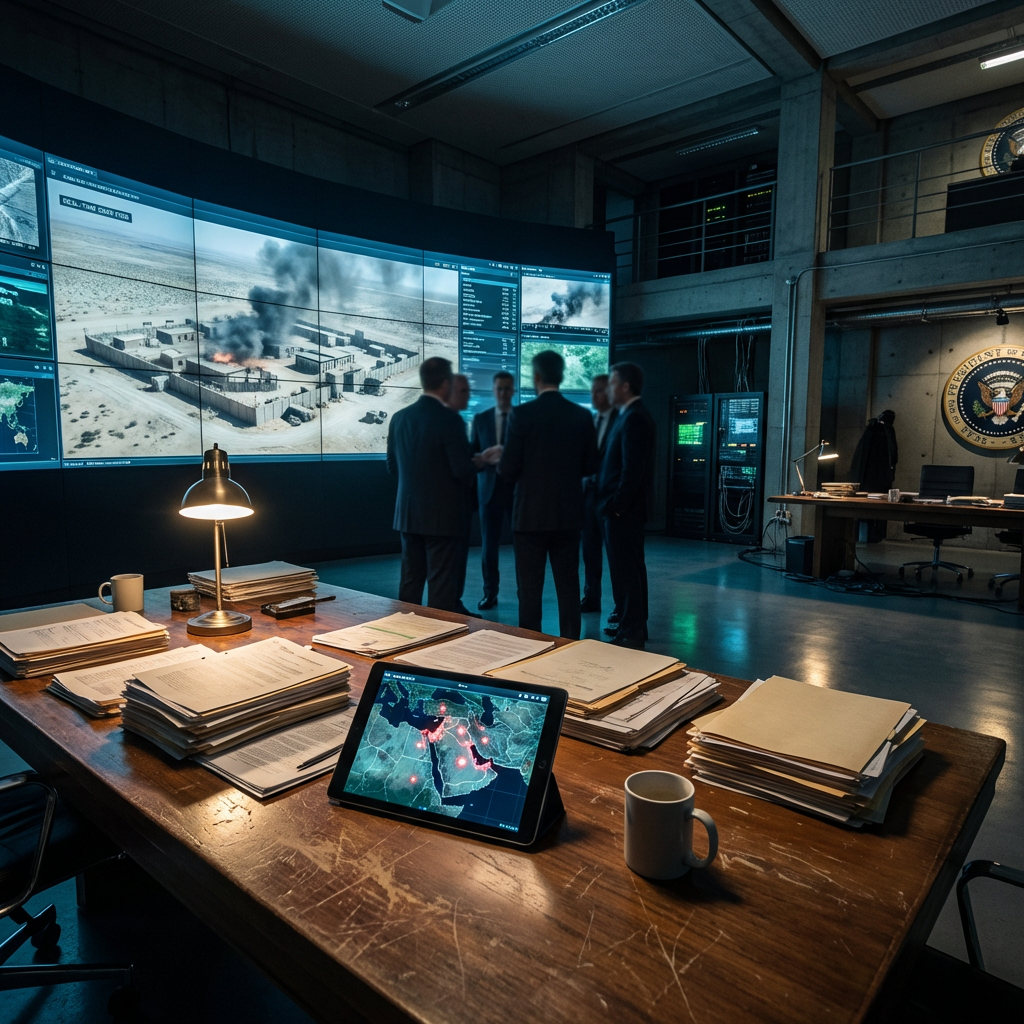
Russia is the primary beneficiary of America’s Middle Eastern entanglement. Every US military asset deployed to the Gulf is a military asset not deployed to Eastern Europe. Moscow’s attrition campaign in Ukraine — deliberate, patient, grinding — continues without meaningful escalation of Western support. The Kremlin has no interest in a quick resolution to the Iran conflict. A prolonged American quagmire in the Middle East is the single most favorable strategic development for Russian interests in Europe since the 2003 Iraq invasion distracted Washington from Putin’s consolidation of power.
China’s calculus is equally clear. Beijing has positioned itself as a mediator — brokering the Saudi-Iran rapprochement in 2023, offering diplomatic frameworks at the UN — while quietly accelerating its military modernization and economic decoupling preparation. The US-Iran war validates China’s core strategic thesis: American power is overstretched, its alliances are transactional, and its domestic political system cannot sustain prolonged military engagement. Every month of Middle Eastern conflict is a month of reduced American capacity to contest the Indo-Pacific.
Turkey under Erdoğan is positioning for maximum leverage. Ankara has refused to support the US campaign, maintained diplomatic channels with Tehran, and signaled willingness to mediate — all while deepening its defense industry independence and expanding its influence across Africa and Central Asia. Erdoğan understands that this conflict creates space for regional powers to operate outside the Western institutional framework. Turkey is not hedging. It is executing a deliberate strategy of strategic autonomy that European analysts continue to underestimate at their peril.
The Gulf states face an uncomfortable reckoning. Saudi Arabia and the UAE built their security architectures on American guarantees. Those guarantees now look conditional, expensive, and potentially unreliable.
Riyadh’s accelerated engagement with Beijing, its BRICS membership aspirations, and its refusal to increase oil production at Washington’s request all signal a hedging strategy that would have been unthinkable a decade ago. The petrodollar system — the financial foundation of American global power — is being quietly renegotiated.
Brussels on the Chessboard
The European Union has issued statements calling for de-escalation, restraint, and adherence to international law. The European Council held an emergency session. The High Representative for Foreign Affairs expressed concern. None of this constitutes a strategic response.
The Strategic Verdict
Europe’s response to the US-Iran war is not a policy — it is a press release. The EU has failed to articulate an independent position, failed to propose a diplomatic framework, failed to prepare contingency plans for energy disruption, and failed to address the migration surge that is already beginning. The institutions in Brussels are performing the rituals of multilateral governance while the geopolitical ground shifts beneath them. Decisive action would have looked like this: an immediate European energy security emergency protocol, a unified diplomatic initiative independent of Washington, and a clear public statement establishing European red lines on escalation. None of these happened. Europe is not watching a crisis unfold — it is watching its own strategic obituary being written in real time.
Forward Outlook: Three Signals That Will Define the Next 90 Days
The trajectory of this conflict will be determined by three critical variables. First, watch the Strait of Hormuz. Any sustained disruption to oil transit through the strait will trigger an immediate European energy crisis and force EU governments into emergency decisions they are entirely unprepared for. Second, watch the US domestic political landscape. Congressional authorization debates, casualty figures, and polling data on the war will determine whether Washington escalates or seeks an exit — and Europe must be prepared for either outcome. Third, watch the Russia-Ukraine front. Moscow will use every day of American distraction to consolidate territorial gains and degrade Ukrainian defensive capacity. If Europe cannot sustain independent support for Ukraine while the US is engaged in Iran, the entire Eastern European security architecture collapses.
The age of American-led crisis management is over. What replaces it depends entirely on whether Europe finds the political courage to act as a strategic power — or continues to wait for permission from a hegemon that can no longer afford to grant it.
