




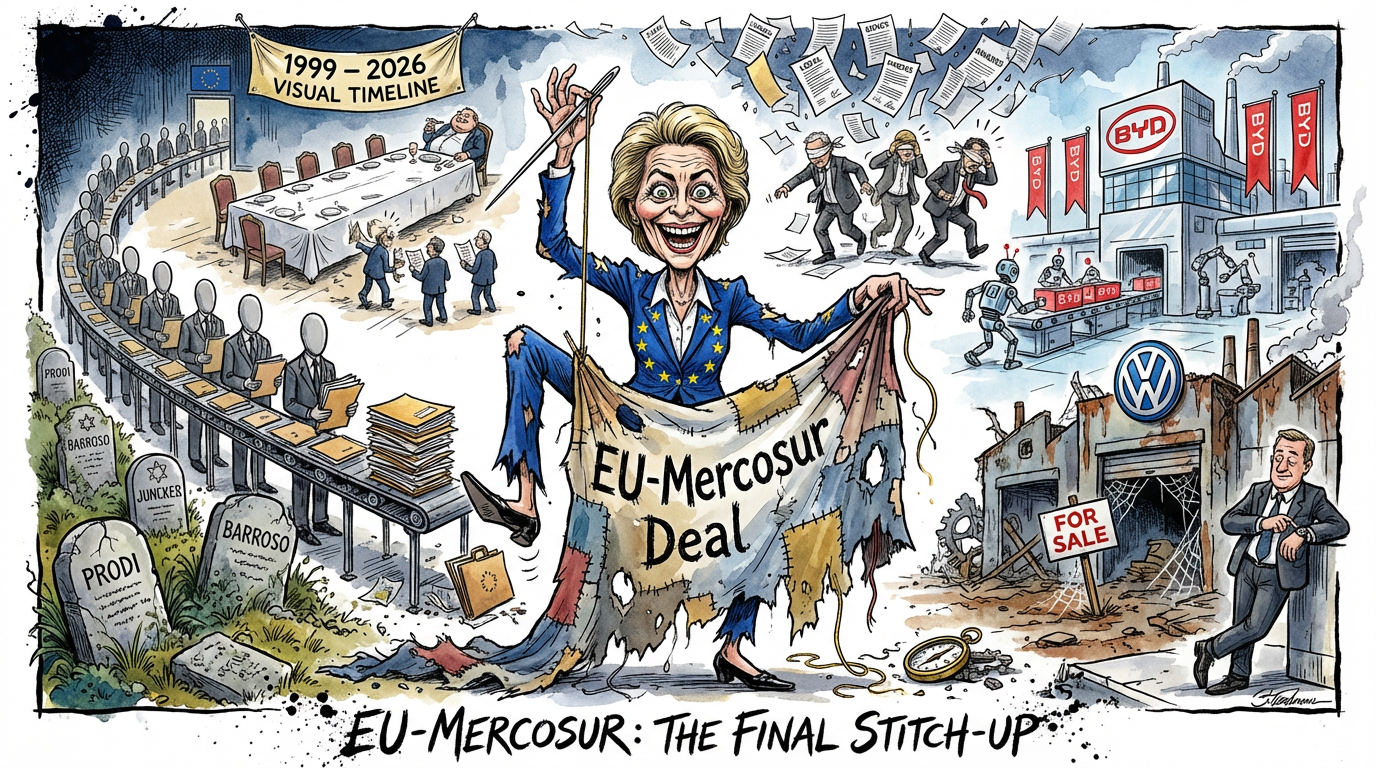

How the EU–Mercosur Deal Became Europe’s Most Expensive Diplomatic Irrelevance.
After 25 years of negotiations, the EU–Mercosur trade agreement was signed in Asunción in January 2026, linking over 720 million people across Europe and South America. Brazil’s Senate unanimously ratified the deal on 4 March 2026, following earlier approvals from Argentina and Uruguay. On paper, it is Europe’s most ambitious free trade agreement ever concluded.
In practice, it is already in crisis. On 21 January 2026, the European Parliament voted by just 334 to 324 to refer the deal to the Court of Justice of the EU, challenging whether the Commission illegally split the agreement into two texts to bypass the requirement for ratification by all 27 national parliaments. The CJEU opinion could take up to two years. Despite this, the Commission announced provisional application of the trade provisions anyway — implementing a legally contested deal while its legality is being decided.
Strategically, the deal is already fighting a losing battle. China has been Brazil’s top trading partner since 2009, now absorbing around 30% of Brazilian exports, while Europe’s share collapsed from 28% to 16% since 2000. In January 2026, China overtook Argentina to become Brazil’s top vehicle exporter, with BYD investing over $1 billion to manufacture EVs inside the country.
The industries lobbying hardest for the deal — European automakers and chemicals giants — are precisely the ones least equipped to compete in a market China already dominates with next-generation products. Meanwhile, the deal’s agricultural concessions directly contradict the EU’s own 2026 food sovereignty goals, fuelling the farmer protests that have blocked roads across France and Ireland.
The essay’s conclusion is stark: the EU built a meticulous diplomatic ark, but China already rode the flood. Europe spent 25 years negotiating access to a market it no longer leads.

The EU-Mercosur deal matters. It matters for European workers, for businesses, for strategic positioning in a world where China moves fast and Europe moves in committees. I have no argument with the goal.
What I reject — completely — is the process. Twenty-five years. Five Commission Presidents. Dozens of Trade Commissioners. A final text kept secret from the very parliaments that are supposed to represent the people it affects. Environmental clauses written after the decision was already made. Provisional application triggered while the Court of Justice hasn’t even ruled on whether the deal is legal.
This was not diplomacy. This was a rotating cast of political actors — each one treating this deal as a career milestone rather than a mission to complete. When they left, the bureaucrats filled the vacuum. And bureaucrats do what they do best: they produce paper. More clauses. More annexes. More process. The deal became the process, and the process became the deal.
Meanwhile, China didn’t negotiate. China invested. China built factories. China financed buyers directly. China took the market — not with a 2,000-page treaty — but with a $1 billion factory on the site of a Ford plant that Europe abandoned.
The goal was right. The people entrusted with it were not equal to it. And the citizens of Europe — and of Mercosur — deserved better than 25 years of institutional theater dressed up as historic achievement.”
Twenty-five years. A quarter of a century of summits, negotiating rounds, political crises, agricultural riots, and constitutional wrangling — and what does the European Union have to show for it? A trade deal with South America that, before a single tariff has been cut, is already drowning in legal challenge, political opposition, and strategic obsolescence. Welcome to the EU–Mercosur agreement: the most ambitious free trade deal Europe has ever built, and quite possibly the most pointless.
Let us be fair, briefly. The agreement signed in Asunción in January 2026 is not nothing. It represents a genuine commercial bridge between the EU and four South American economies — Brazil, Argentina, Uruguay, and Paraguay — combining over 720 million people and a GDP approaching $22 trillion. Mercosur commits to eliminating tariffs on 91% of EU goods over fifteen years; the EU reciprocates on 95% of Mercosur exports within twelve. Brazil’s Congress ratified enthusiastically, with the lower house approving in February and the Senate voting unanimously on 4 March 2026. Argentina and Uruguay ratified weeks earlier. The political momentum was real.[1][2][3][4][5]
And then Europe did what Europe does best. It ate itself.

The Legal Grenade
On 21 January 2026, the European Parliament — by 334 votes to 324, a margin thin enough to slice prosciutto with — voted to refer the entire deal to the Court of Justice of the EU. The charge: that the Commission illegally split the agreement into two separate texts to lower the approval threshold, bypassing the requirement for all 27 national parliaments to ratify. France, Austria, Hungary, Ireland, and Poland voted against the deal at Council level. Left-wing MEPs called the Commission’s push for provisional application “a democracy bypass of historic proportions”. The CJEU opinion will take up to two years. In the meantime, Brussels plans to provisionally apply the trade provisions from May 2026, effectively saying: we will implement a legally contested deal while the court decides whether the deal is legal. That is not confidence. That is brinkmanship dressed as governance.[6][7][8][9][10][11][12][13]
If the Court rules against the agreement’s legal structure — which legal scholars note is not impossible, given the Parliament’s challenge rests on legitimate treaty interpretation questions — the entire instrument would need to be redesigned. Every Mercosur country that has already ratified would face a new deal requiring fresh parliamentary approval. Brazil’s Senate would be ratifying a document that no longer exists. After 25 years. Again. The German automotive industry’s own lobby, the VDA, has warned that this scenario could cause South American countries to lose patience with Europe entirely and walk away from the table. They would not be wrong.[14][15][16]
China Did Not Wait
While Europe negotiated and litigated, China did something radical: it showed up. Not with white papers and sustainability annexes, but with ports, factories, and capital. Since 2009, China has been Brazil’s single largest trading partner. By 2024, China was absorbing roughly 30% of all Brazilian exports, while the EU’s share had collapsed from 28% in 2000 to just 16%. That is not a trend. That is a structural replacement happening in slow motion.[17]
In January 2026, China overtook Argentina to become Brazil’s top vehicle exporter, shipping 16,800 cars worth $375 million in a single month — largely electric vehicles. BYD is investing over $1 billion to manufacture inside Brazil using a former Ford plant in Bahia. Chinese EV imports to Brazil grew tenfold in the first half of 2025 alone. The European Parliament’s own research service published a briefing in February 2025 acknowledging that China “is on track to overtake the United States as Latin America’s leading trade partner by 2035” and that its Belt and Road investments — including the $1.9 billion Chancay megaport in Peru — are reshaping the entire region’s logistical architecture. The EU arrived, in the words of one European analyst, “too late and poorly”.[18][19][20][21][22][23]
Lobbied by Dinosaurs
The industries driving EU enthusiasm for this deal are precisely the ones least positioned to exploit it. Germany’s automotive sector pushed hardest, yet faces a Brazilian market already pivoting toward Chinese EVs it cannot competitively match. European chemicals giants like BASF have been quietly relocating production capacity to China, not South America, under the weight of post-2022 energy costs and regulatory overload at home. The Mercosur deal is being championed by industries fighting managed decline, using diplomatic capital to pry open markets that competitors have already occupied with next-generation products. Europe is negotiating hard for the right to sell horses into a market that already drives cars.[16][24][18]
A Self-Defeating Architecture
The deal is, structurally, Noah’s Ark — loaded with every conceivable political priority. Environmental clauses. Human rights frameworks. Labor standards. Sustainable development commitments. Each addition made it more politically defensible in Brussels and more diplomatically fragile elsewhere. Sciences Po’s analysis of the Mercosur integration process identified exactly this: a “deficit of political commitment” and “blurred priorities” that handed a consequential strategic instrument to bureaucrats whose instinct is to build processes, not power. The Commission even kept the final updated text from member-state governments during the December 2024 push to conclude negotiations — a manoeuvre that the EU Ombudsman has since scrutinised for transparency failures. The sustainability impact assessment was published after the deal was concluded. The blueprint came after the building.[25][26][27]
What Europe Should Actually Be Doing
Here is the uncomfortable truth no Commissioner will say plainly: Europe does not need Mercosur’s agricultural imports. The EU is already broadly food self-sufficient in caloric terms. Its own 2025 Vision for Agriculture and Food identifies internal resilience and food sovereignty as core strategic priorities in an unstable world. Importing cheaper beef and soy from Argentina to undercut French and Irish farmers — while simultaneously imposing the Green Deal’s environmental standards on those same farmers — is not a coherent trade strategy. It is a contradiction that explains precisely why tractors are blocking roads across Europe and why France voted no.[28][29]
What Europe should be exporting to the world is not combustion engines and bulk chemicals. It is sovereign AI infrastructure, programmable money, autonomous mobility, aerospace capacity, and precision manufacturing. The EuroHPC network and InvestAI fund are targeting €20 billion into European AI compute to reduce dependency on American and Chinese platforms. Horizon Europe’s 2026–2027 programmes are funding autonomous systems, digital sovereignty and advanced robotics. Just last week, twelve major European banks — including BNP Paribas, ING, and UniCredit — launched Qivalis, a euro-backed stablecoin designed explicitly to end European reliance on dollar-denominated digital payment infrastructure. The ECB itself has warned that payment networks “can be weaponised” and that European monetary sovereignty depends on keeping settlements within European jurisdiction.[30][31][32][33][34][35][36]
These are the industries — AI, fintech, robotics, space, clean mobility — where European regulation is not a burden but the world’s highest barrier to entry. A product built to EU standards, settled in digital euros, running on European AI infrastructure, is a product no rival can easily replicate or undercut.
The EU–Mercosur deal is not worthless. As a diplomatic signal that Europe wants a structured relationship with South America, it has value. As a critical minerals framework for the green transition, it has theoretical merit. But as a live, investable, legally stable trade instrument in 2026? It is murky water — provisionally applied, constitutionally contested, championed by declining industries, and pointed at a market China has already transformed from the inside out.[22][37][38][39]
Twenty-five years of negotiations produced an ark. The flood already came, and Beijing rode it. Europe is still checking the manifest.
References:
Reuters, “Brazil Congress approves EU-Mercosur deal,” 4 March 2026.[5]
Agência Brasil, “Brazil’s Senate approves Mercosur–EU trade agreement,” 4 March 2026.[2]
CityNews Halifax, “Brazil’s Congress ratifies EU-Mercosur trade deal,” 4 March 2026.[3]
Wikipedia, “EU–Mercosur Partnership Agreement,” ongoing entry.[10]
Real Instituto Elcano, “The European Parliament halts the EU–MERCOSUR agreement in court,” 25 January 2026.[14]
Euronews, “Von der Leyen to implement Mercosur deal despite MEPs’ legal challenge,” 26 February 2026.[11]
Reuters, “EU lawmakers deal blow to Mercosur trade deal by referring it to top court,” 21 January 2026.[12]
EU Perspectives, “The EU–Mercosur deal explained: Courts, farmers, and political fallout,” 25 January 2026.[8]
Euronews, “European Parliament freezes Mercosur deal, referring it to EU Court of Justice,” 20 January 2026.[7]
Verfassungsblog, “Has the European Parliament Shot Itself in the Foot?,” 17 February 2026.[15]
VDA, “Statement regarding Mercosur Resolution,” 20 January 2026.[16]
European Parliament Research Service (EPRS), “China’s increasing presence in Latin America: Implications for the EU,” Briefing, February 2025.[22]
MEXC/SCMP, “China surpasses Argentina to become Brazil’s top car exporter,” 9 February 2026.[18]
Foreign Policy, “The EU-Mercosur Deal Is a Hedge Against the Donroe Doctrine,” 14 January 2026.[17]
South China Morning Post, “China becomes Brazil’s biggest vehicle exporter in January,” 9 February 2026.[19]
BNamericas, “Agreement with the EU could increase investments in Mercosur,” 11 January 2026.[39]
Americas Market Intelligence, “China Quietly Expands Trade Power in Latin America,” July 2025.[20]
Eunews, “The EU arrived too late and poorly in Latin America,” 26 March 2025.[23]
Veblen Institute, “Key Insights into the Final EU–Mercosur Agreement,” 11 December 2024.[26]
Sciences Po OPALC, “In-depth analysis of Mercosur integration,” 2022.[25]
DIHK, “Relieving companies of EU bureaucracy and strengthening European competitiveness,” 2025.[24]
European Commission, “Horizon Europe Work Programme 2026–2027: Digital, Industry and Space,” December 2025.[32]
European Relations, “AI for Strategic Autonomy: Europe’s Bid for AI Independence,” 9 February 2026.[30]
European Commission, “A new roadmap for agriculture and food in Europe until 2040,” 18 February 2025.[28]
Forbes, “European Banks Launch Euro-Backed Stablecoin To End Reliance on America,” 9 March 2026.[34]
EFFRA, “Made in Europe Calls 2026/2027,” 2025.[33]
Digital Euro Association, “The Role of Stablecoins in Financial Sovereignty,” June 2025.[35]
Steinbeis Europe, “Achieving Open Strategic Autonomy in Digital and Emerging Technologies,” December 2025.[31]
European Commission, “Vision for Agriculture and Food 2025–2040,” 2025.[29]
ECB, “Europe and Monetary Sovereignty,” speech by ECB Executive Board member, 11 February 2026.[36]
Altios, “EU–Mercosur Isn’t Frozen: The Trade Deal Can Start in 2026,” 5 March 2026.[13]
DGAP, “A Last Chance at an EU-Mercosur Agreement,” February 2023.[38]
Al Jazeera, “EU parliament refers Mercosur free trade deal to bloc’s top court,” 21 January 2026.[6]
European Parliament Think Tank, “China’s increasing presence in Latin America,” 24 February 2025.[21]
PowerShift, “EU trade agreement with Latin America under scrutiny,” 1 March 2026.[27]
Reuters, “Brazil lower house approves EU-Mercosur free trade deal,” 25 February 2026.[4]
Business & Human Rights Resource Centre, “European Parliament votes to refer EU-Mercosur to EU Court of Justice,” 3 March 2026.[40]
Policy Center for the New South, “EU–Mercosur agreement: The deal neither side knew it would desperately need,” 25 January 2026.[37]
Reuters, “EU and Mercosur sign trade deal after 25 years of negotiations,” 17 January 2026.[1]
FoodNavigator, “Parliament refers EU-Mercosur to Court of Justice,” 20 January 2026.[9]
⁂
- https://www.reuters.com/world/americas/eu-mercosur-sign-trade-deal-after-25-years-negotiations-2026-01-17/
- https://agenciabrasil.ebc.com.br/en/economia/noticia/2026-03/brazils-senate-approves-mercosur-eu-trade-agreement
- https://halifax.citynews.ca/2026/03/04/brazils-congress-ratifies-eu-mercosur-trade-deal/
- https://www.reuters.com/business/brazil-lower-house-approves-eu-mercosur-free-trade-deal-2026-02-25/
- https://www.reuters.com/world/americas/brazil-congress-approves-eu-mercosur-deal-2026-03-04/
- https://www.aljazeera.com/news/2026/1/21/eu-parliament-refers-mercosur-free-trade-deal-to-blocs-top-court
- https://www.euronews.com/my-europe/2026/01/21/european-parliament-freezes-mercosur-deal-referring-it-to-eu-court-of-justice
- https://euperspectives.eu/2026/01/the-eu-mercosur-deal-explained-courts-farmers-and-political-fallout/
- https://www.foodnavigator.com/Article/2026/01/21/eu-mercosur-referred-to-court-of-justice/
- https://en.wikipedia.org/wiki/EU–Mercosur_Partnership_Agreement
- https://www.euronews.com/my-europe/2026/02/27/commission-to-implement-contentious-mercosur-trade-deal-despite-eu-parliament-opposition
- https://www.reuters.com/world/eu-lawmakers-vote-whether-launch-legal-challenge-mercosur-trade-deal-2026-01-21/
- https://altios.com/publication/eu-mercosur-isnt-frozen-the-trade-deal-can-start-in-2026/
- https://www.realinstitutoelcano.org/en/commentaries/the-european-parliament-halts-the-eu-mercosur-agreement-in-court-what-is-at-stake/
- https://verfassungsblog.de/shot-itself-in-the-foot/
- https://www.vda.de/en/press/press-releases/2026/260121_VDA-Statement_Mercosur_Resolution
- https://foreignpolicy.com/2026/01/14/eu-mercosur-trade-deal-trump-donroe-doctrine/
- https://www.mexc.com/news/675141
- https://www.scmp.com/news/china/article/3342980/china-becomes-brazils-biggest-vehicle-exporter-january-surpassing-argentina
- https://americasmi.com/insights/2025-china-latin-america-trade-expansion/
- https://www.europarl.europa.eu/thinktank/en/document/EPRS_BRI(2025)769504
- https://www.europarl.europa.eu/RegData/etudes/BRIE/2025/769504/EPRS_BRI(2025)769504_EN.pdf
- https://www.eunews.it/en/2025/03/27/the-eu-arrived-too-late-and-poorly-in-latin-america-now-pays-the-price-of-chinas-strong-presence/
- https://www.dihk.de/resource/blob/124524/bc2f622a15170bbff008d192961f44d4/dihk-proposals-for-reduction-of-eu-regulatory-burden-data.pdf
- https://www.sciencespo.fr/opalc/sites/sciencespo.fr.opalc/files/in-depth analysis of mercosur integration.pdf
- https://www.veblen-institute.org/Key-Insights-into-the-Final-EU-Mercosur-Agreement.html
- https://power-shift.de/en/pressemitteilung/eu-handelsabkommen-unter-der-lupe/
- https://ireland.representation.ec.europa.eu/news-and-events/news/commission-presents-roadmap-thriving-eu-farming-and-agri-food-sector-2025-02-19_en
- https://agriculture.ec.europa.eu/overview-vision-agriculture-food/vision-agriculture-and-food_en
- https://europeanrelations.com/ai-for-strategic-autonomy-europes-bid-for-ai-independence/
- https://www.steinbeis-europa.de/de/foerderungen/achieving-open-strategic-autonomy-in-digital-and-emerging-enabling-technologies-horizon-europe
- https://ec.europa.eu/info/funding-tenders/opportunities/docs/2021-2027/horizon/wp-call/2026-2027/wp-7-digital-industry-and-space_horizon-2026-2027_en.pdf
- https://www.effra.eu/wp-content/uploads/2025/10/MiE-Calls-20262027.pdf
- https://www.forbes.com/sites/christerholloman/2026/03/09/european-banks-launch-their-own-stablecoin-as-hedge-against-america/
- https://digital-euro-association.de/blog/the-role-of-stablecoins-in-financial-sovereignty
- https://www.ecb.europa.eu/press/key/date/2026/html/ecb.sp260212~9fabe9baaa.en.html
- https://www.policycenter.ma/publications/eu-mercosur-agreement-deal-neither-side-knew-it-would-desperately-need
- https://dgap.org/en/research/publications/last-chance-at-eu-mercosur-agreement
- https://www.bnamericas.com/en/interviews/agreement-with-the-european-union-could-increase-investments-in-mercosur
- https://www.business-humanrights.org/en/latest-news/european-parliament-votes-to-refer-eu-mercosur-trade-agreement-to-eu-court-of-justice/
