





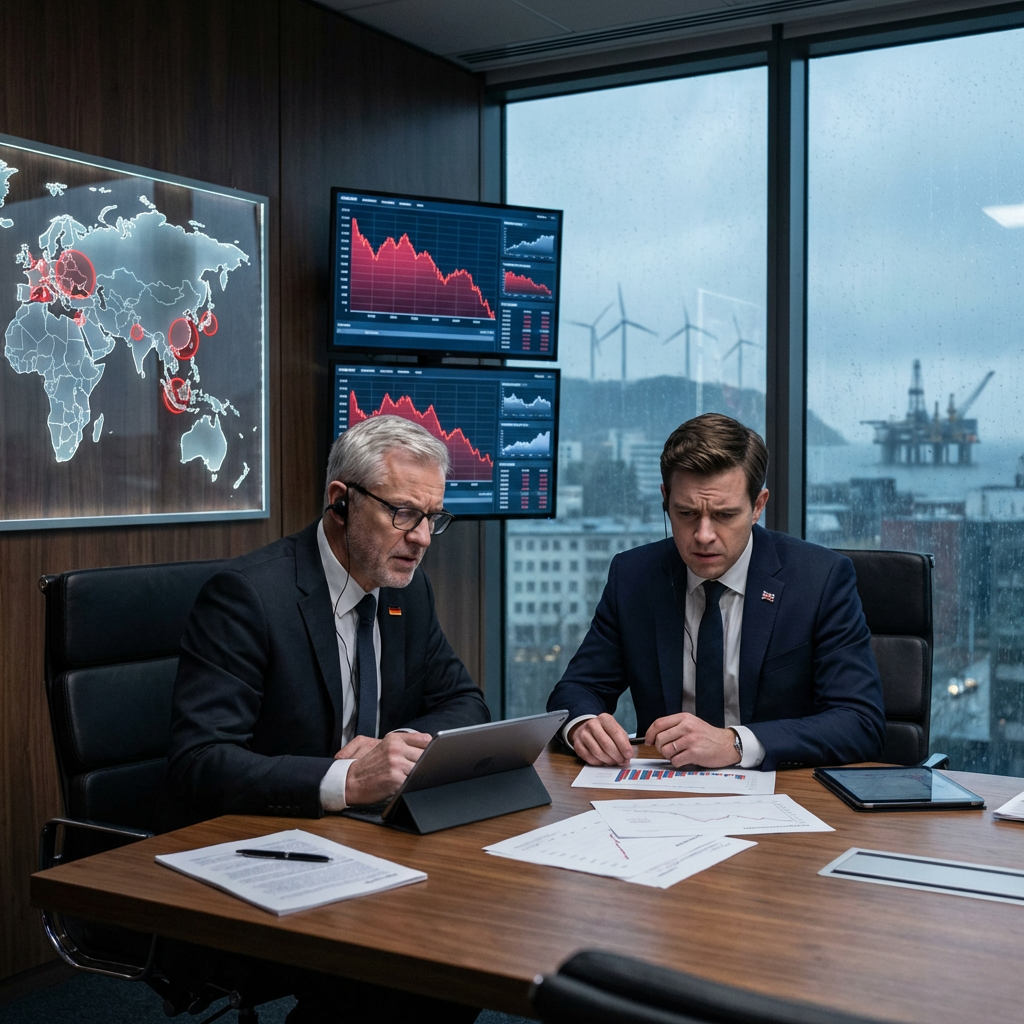
Germany’s finance minister issued a stark warning on March 26, 2026, declaring that the world economy faces a “catastrophe” as the Organisation for Economic Co-operation and Development slashed the United Kingdom’s growth forecast, citing escalating geopolitical tensions and persistent energy market disruptions. This dual alarm from Europe’s largest economy and a leading international institution underscores the fragility of global recovery efforts.
Background
The global economy has been navigating a minefield of challenges since the early 2020s. The COVID-19 pandemic exposed supply chain vulnerabilities, while the Russia-Ukraine war, which began in 2022, triggered an energy crisis that sent prices soaring and inflation to multi-decade highs.
Central banks, including the European Central Bank and the Bank of England, responded with aggressive interest rate hikes to tame inflation, but these measures have dampened consumer spending and business investment. According to the World Bank, global growth slowed to 2.1% in 2025, well below pre-pandemic averages.
Recent months have seen additional pressures: trade tensions between the US and China have resurfaced, and climate-related events, such as droughts in Europe and floods in Asia, have disrupted agricultural output and industrial production.
Economic Fallout and Policy Divergence
The OECD’s latest economic outlook, released on March 26, 2026, cut the UK’s growth forecast for the year to 0.5%, a sharp revision from the 1.2% projected in November 2025. The report cited weak domestic demand, declining business confidence, and the lingering effects of Brexit on trade and investment.
In Germany, the government has maintained a cautiously optimistic stance, with growth projected at 1.0% for 2026, but officials warn that external risks could tip the economy into recession. Data from the Federal Statistical Office shows that industrial production fell by 0.8% in February 2026, reflecting softer global demand.
This divergence highlights contrasting policy approaches: Germany has prioritized fiscal discipline and export-led growth, while the UK grapples with post-Brexit regulatory uncertainty and a housing market slowdown. Eurostat figures indicate that inflation in the eurozone stands at 4.2% as of March 2026, compared to 3.8% in the UK, complicating monetary policy coordination.
Geopolitical Undercurrents and Energy Markets – Oil Price Shock
Energy markets remain a critical flashpoint. Natural gas prices in Europe have risen by 20% since January 2026 due to supply disruptions from Russia and increased competition for liquefied natural gas shipments. The International Energy Agency reports that oil prices are hovering around $90 per barrel, driven by OPEC+ production cuts and geopolitical risks in the Middle East.
The transition to renewable energy is accelerating, with Germany investing over €100 billion in green technologies as part of its Energiewende policy. However, short-term dependencies on fossil fuels leave economies exposed. In the UK, delays in nuclear power projects and offshore wind farms have heightened energy security concerns.
Geopolitically, tensions in Eastern Europe and the South China Sea threaten to disrupt trade routes and supply chains. A recent report by the Council on Foreign Relations notes that economic sanctions and counter-sanctions are becoming more frequent, fragmenting global markets and increasing costs for businesses and consumers.
What Analysts Are Saying -OECD Economic Outlook
Economists at the International Monetary Fund argue that coordinated fiscal stimulus is necessary to avert a deeper downturn. “Without synchronized action, we risk a prolonged stagnation that could undo decades of poverty reduction,” said one senior IMF official in a recent briefing.
Conversely, analysts from the Peterson Institute for International Economics caution against excessive government spending. “While support is needed, unchecked deficits could reignite inflation and debt crises, particularly in emerging markets,” they wrote in a policy brief published in March 2026.
Geopolitical strategists emphasize the risk of decoupling. “The world is splitting into competing blocs, with technology and trade barriers rising,” noted a director at the Brookings Institution. “This not only hampers growth but also increases the likelihood of conflicts that could have catastrophic economic consequences.”
The Real-World Impact – Iran War Impact
For ordinary people, these economic headwinds translate into tangible hardships. In the UK, household energy bills have increased by 15% year-on-year, with the average annual cost now exceeding £2,500. Food prices are up 8%, driven by higher transport and import costs.
Job security is eroding: unemployment in the UK rose to 4.5% in February 2026, from 4.0% a year earlier, with significant losses in retail and manufacturing. In Germany, while unemployment remains low at 3.2%, wage growth has stalled, failing to keep pace with inflation.
Transportation costs are soaring, with petrol prices in both countries above €2 per liter. Public services are under strain; in the UK, the National Health Service reports longer waiting times due to budget constraints, while in Germany, education funding cuts have sparked protests.
Personal freedoms may be compromised if economic stress leads to social unrest. Historical patterns show that during downturns, governments sometimes enact restrictive measures, such as limiting protests or expanding surveillance, which could undermine civil liberties.
Political Accountability
Governments have taken varied actions. Germany announced a €50 billion support package in February 2026, focusing on energy subsidies for low-income households and incentives for industrial innovation. The UK government, meanwhile, has introduced tax breaks for small businesses but postponed planned increases in social welfare payments.
At the European level, the ECB has raised interest rates to 4.5% to curb inflation, but this has increased borrowing costs for mortgages and loans, squeezing household budgets. Critics argue that a more balanced approach, combining monetary tightening with targeted fiscal support, is needed.
The Standard They Should Be Held To – Global Recession
Economic growth must be nurtured through competitive markets and innovation, but not at the expense of workers’ welfare. Governments should ensure that business-friendly policies are coupled with strong labor protections and fair wages.
Social investment in healthcare, education, housing, and social security is a non-negotiable duty of any elected administration. These are not partisan issues but foundational to a functioning society, and neglecting them erodes public trust and long-term stability.
Civil liberties—including freedom of speech, press, assembly, and privacy—must be upheld even in times of crisis. Any policy that curtails these rights, whether under the guise of security or economic necessity, must be challenged to preserve democratic integrity.
Navigating the Economic Storm Ahead – Energy Crisis
Key upcoming events include the G20 summit in July 2026, where leaders will debate global economic governance, and the OECD’s next forecast revision in September, which could further adjust growth projections based on mid-year data.
Indicators to watch include energy price trends, particularly natural gas and oil, inflation reports from the US, EU, and China, and political stability in regions like Eastern Europe and the Middle East. Additionally, corporate earnings in the second quarter will signal business health.
As nations confront these intertwined challenges, the choice between isolation and cooperation will shape whether the global economy steers clear of catastrophe or plunges into deeper turmoil.
