




The Two Faces of Europe: Antifascist by Day, Lackey by Night .
The article critiques Europe’s contradictory stance in global geopolitics, highlighting its performative antifascist posture toward Russia’s aggression in Ukraine while simultaneously submitting to authoritarian pressures from its Western ally, the United States. Europe has vocally condemned Putin’s invasion and supported international law through sanctions and aid, yet it remains dependent on the U.S. politically and economically, often conceding to American demands despite harmful consequences for European interests. This dependency, likened to a “psychologically abusive relationship,” reveals Europe’s diminished capacity for independent strategic action. The piece draws parallels between Trump’s illiberal Atlanticism and Putin’s Eurasian authoritarianism, noting both leaders’ ethno-nationalist, imperialistic approaches that undermine the EU’s foundational liberal values. It underscores that while Europe condemns Russia and China for violating international law, it grants tacit approval to the U.S., effectively endorsing a selective, double-standard application of global rules that erodes the credibility of the “rules-based international order.” Europe’s hypocrisy is starkly exposed in its reaction to the International Criminal Court’s investigations: it supports ICC actions against Putin but backs away when the court pursues accountability in the Middle East, signaling moral inconsistency and fueling authoritarian propaganda. This selective enforcement weakens the international system and empowers illiberal powers. Despite possessing significant economic leverage, including Russian frozen assets and the world’s largest single market, Europe lacks the political will to exercise real independence from U.S. influence. The article warns that Europe’s failure to uphold consistent principles and act decisively risks repeating the appeasement and moral failures of 1938, undermining both its credibility and the liberal international order it professes to defend.
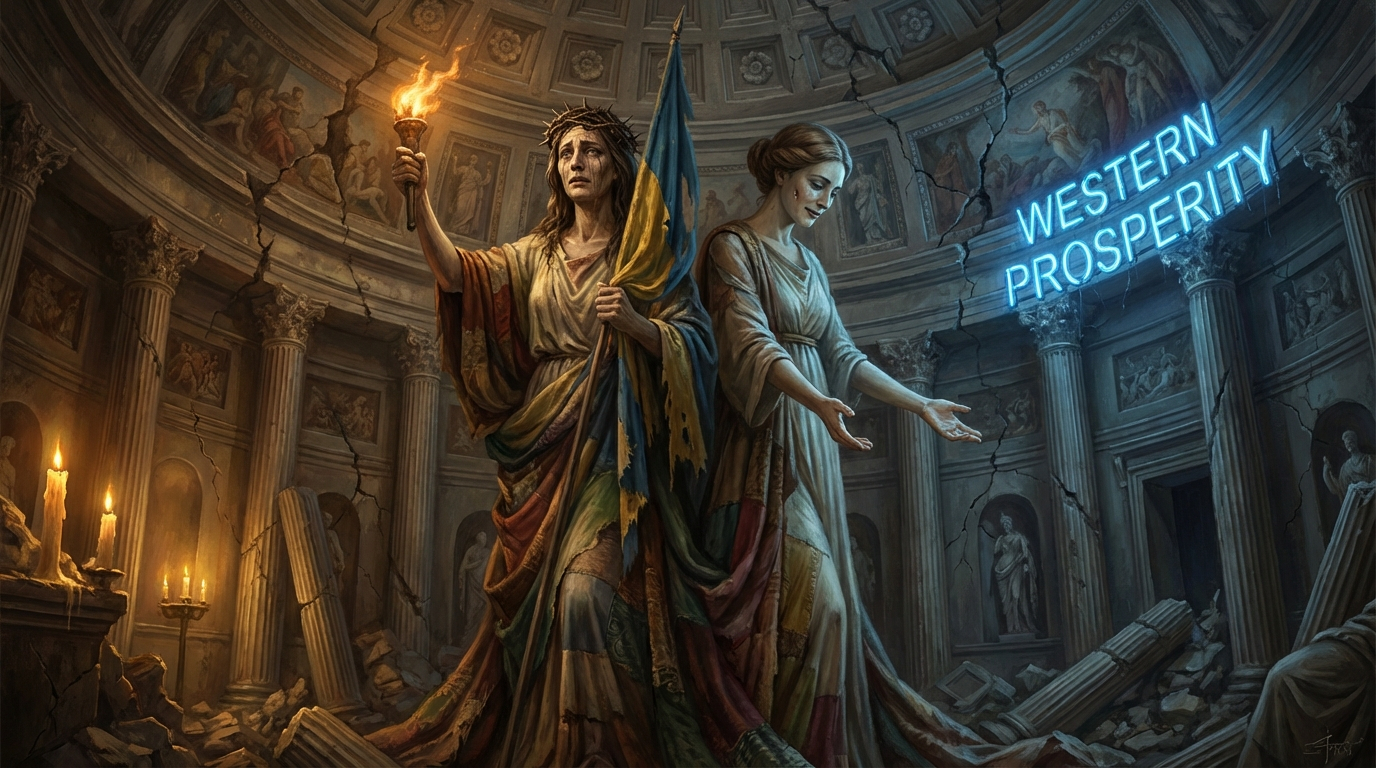
Europe has spent three years wrapping itself in the Ukrainian flag. It has sanctioned oligarchs, funded artillery shells, cheered ICC arrest warrants, and lectured the Global South on the sacred inviolability of international law. European leaders have stood at podiums from Brussels to Kyiv invoking the ghosts of 1938, warning gravely that appeasement is how democracies die. It is a powerful performance. The problem is that it is, increasingly, exactly that — a performance, staged for a domestic audience, dissolving the moment the script demands real courage.
Because while Europe was performing its antifascist awakening against one authoritarian bully on its eastern border, it was quietly genuflecting to another one pressing in from the west. And the moral contortions required to maintain both positions simultaneously have finally become too grotesque to ignore.
A Psychologically Abusive Relationship
At the Munich Security Conference in February 2026, a European diplomat offered an analogy that was more revealing than intended.
The continent’s relationship with the Trump administration, they said, was “a bit like a psychologically abusive partner” — one who reminds you constantly of how good things once were, then demands total compliance as the price of the relationship.
The remark drew knowing laughter in the room. It deserved something harder: recognition that a continent of 450 million people, commanding the world’s largest single market, had chosen to describe its geopolitical condition using the vocabulary of a trauma survivor. [1]
This is what three decades of outsourcing European security to Washington has produced. Not partnership. Not alliance. A dependency so structural and so psychological that European leaders have lost the muscle memory of independent action entirely.
The numbers tell the story. After Trump returned to the White House, EU governments — desperate to forestall American trade tariffs and retain US security commitments — began offering extraordinary concessions. They pledged to raise defense spending. They accepted lopsided trade frameworks. They bit their tongues on Greenland, on Venezuela, on the systematic dismantling of the US democratic institutional order. The Carnegie Endowment for International Peace delivered the verdict with admirable bluntness: “the policy of subservience has not worked”. Every capitulation was read in Washington not as goodwill, but as a weakness to be exploited — and rewarded with further demands. NATO Secretary General Rutte floated the possibility that real European strategic autonomy might require defense spending at up to 10% of national GDP — a figure so politically explosive it would trigger the very far-right electoral tsunamis that Trump’s administration has been actively cultivating inside EU member states. [2] [3]
The Structural Mirror
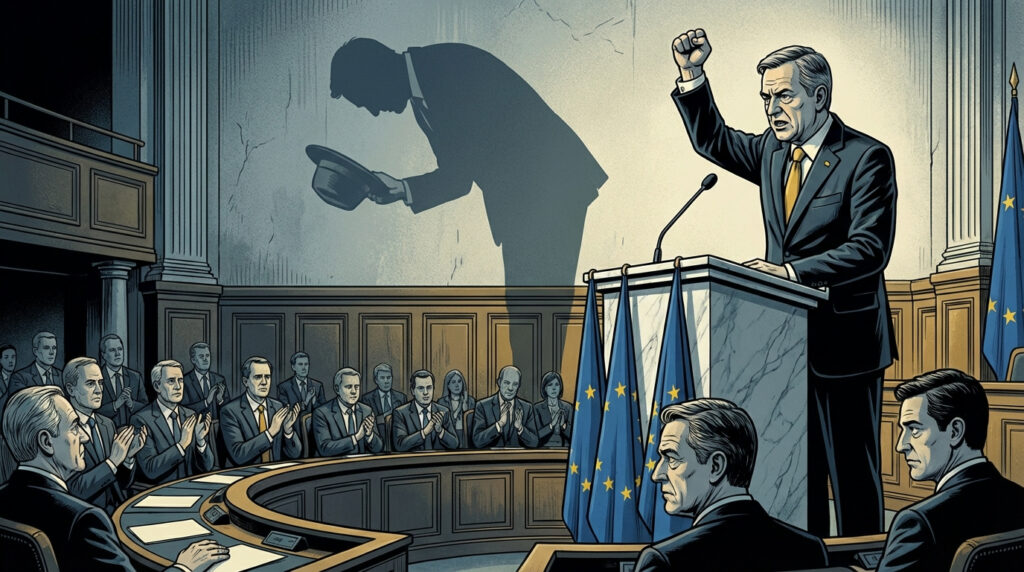
The comparison between Putin and Trump is no longer a polemical device deployed by commentators. It is now a subject of serious structural analysis at the highest levels of European foreign policy research. The European Council on Foreign Relations published a study concluding that Trump’s “illiberal Atlanticism” and Putin’s “Eurasianism” overlap structurally and ideologically in ways that should alarm any genuine defender of the liberal order. [4]
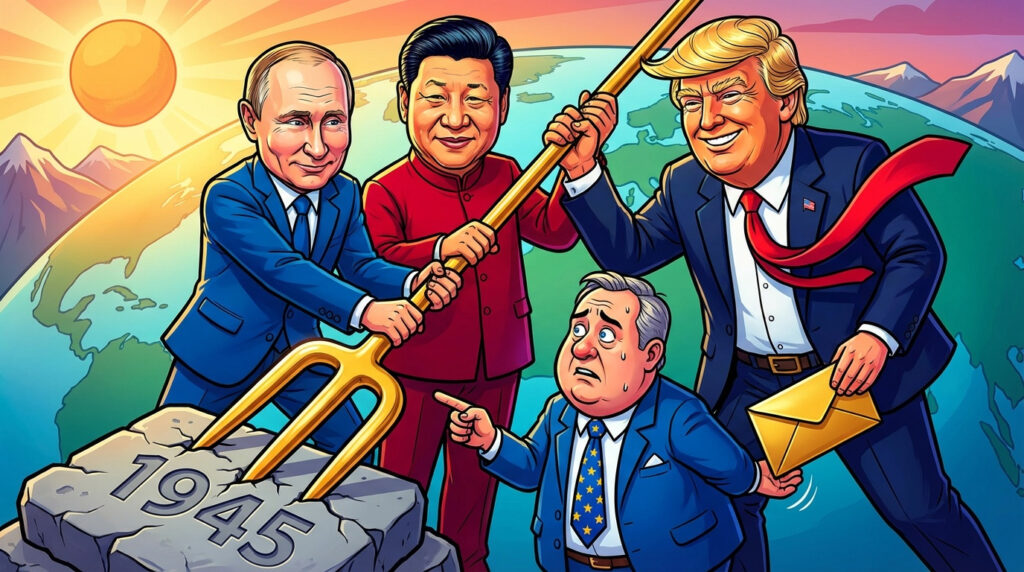
Both leaders define European civilization in ethnic, cultural, and religious terms — explicitly rejecting the EU’s foundational premise that European identity is built on normative values: democracy, rule of law, human rights. Both portray themselves as paternalistic defenders of the “real” Europe against liberal elites and cosmopolitan “outsiders.” Both have systematically cultivated nationalist, Eurosceptic political parties inside EU member states — funneling legitimacy, media oxygen, and in Russia’s case direct financing — to fragment European unity from within. Both treat their respective neighboring regions as imperial backyards governed by the logic of power, not law. Trump’s aggressive revival of the Monroe Doctrine — his open threats over Greenland, his territorial posturing over Canada, his economic coercion of Mexico — is structurally identical to Putin’s doctrine of a Russian “Near Abroad” over Ukraine and the post-Soviet space. Same imperial logic. Different flag. [5]
The American Enterprise Institute — not a publication known for anti-American sentiment — went further still, arguing that Putin, Xi Jinping, and Trump are collectively engaged in a “freedom counterrevolution” — a three-pronged assault on the post-1945 liberal international order, each reinforcing the other’s legitimacy by demonstrating that great powers simply do not answer to international law. Europe solemnly condemns the first two. It writes the third a blank check, renewed quarterly. [6]
The Gaza Verdict
Nothing exposed Europe’s ideological bankruptcy more cleanly than Gaza. The contrast is not subtle — it is a floodlit demonstration of exactly the double standards that authoritarian governments have always accused the West of maintaining.
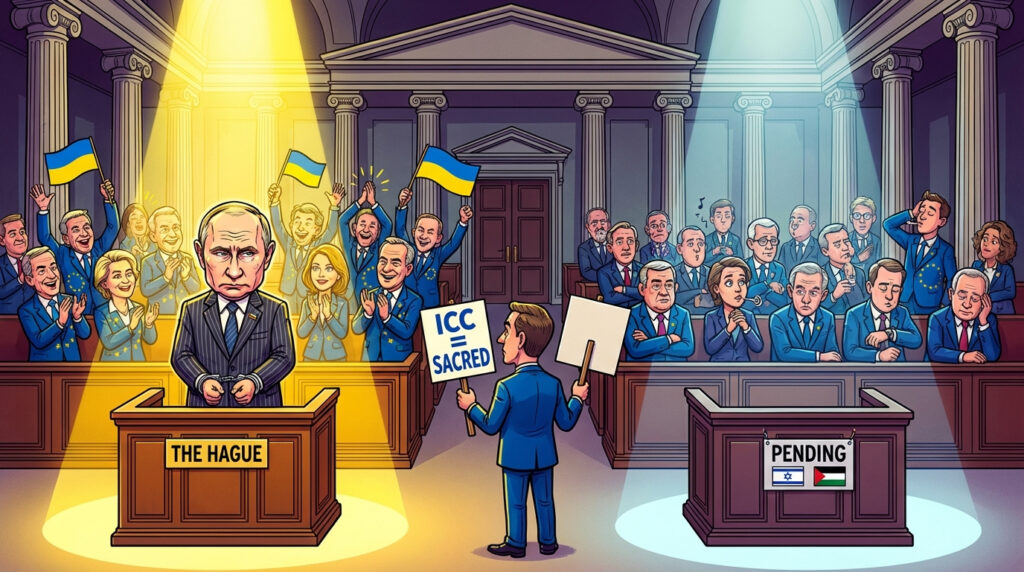
When the International Criminal Court moved against Vladimir Putin, European governments applauded. They had spent years funding and championing the ICC as the institutional cornerstone of international humanitarian law. When the same court turned its attention to the Middle East, the applause stopped. Abruptly. Completely.
Former EU foreign policy chief Josep Borrell — a man not prone to radicalism — stated it with unusual directness:
“If we applaud when the ICC acts against Putin, we should do the same when it acts against other actors in the Middle East”.
His own institution ignored him. Human Rights Watch documented in February 2026 that the European Council had failed even to reaffirm its previously stated support for ICC proceedings — a deliberate, documented retreat from Europe’s own declared principles. [7] [8]
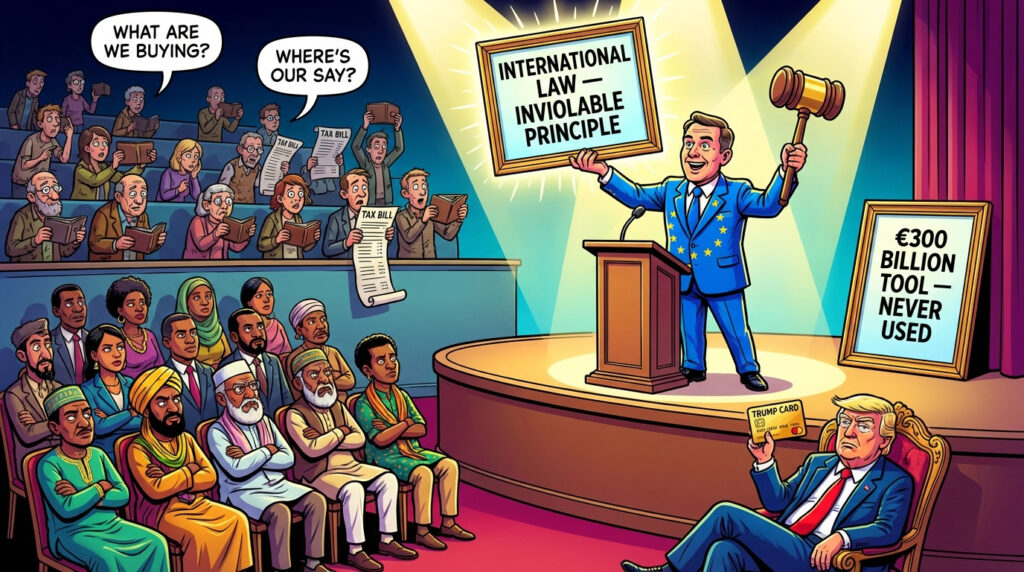
This is not a nuanced policy disagreement. It is a structural double standard, and it matters enormously beyond the immediate humanitarian catastrophe it enables. It hands authoritarian governments — in Moscow, Beijing, and Washington — the most lethal propaganda weapon available: empirical proof that the “rules-based international order” was never a universal principle. It was always Western power wearing legal costume, applied selectively against adversaries and suspended for allies. Every time Europe enforces international law against Russia while excusing violations elsewhere, it validates Putin’s core argument. It validates Xi’s. It now validates Trump’s.
The Courage Deficit
The Verfassungsblog, one of Europe’s most rigorous constitutional law publications, made a point that deserves wider circulation: previous US administrations, even when violating international norms, at least fabricated legal justifications. The creative lawyering was cynical, but it kept international law rhetorically alive — it acknowledged the law’s existence by engaging with it, however dishonestly. The Trump administration has dispensed with that pretense entirely. It simply ignores justification. It does not argue that its actions are legal. It does not argue at all. And Europe — which spent decades insisting that demanding legal justification was the entire point — has chosen silence. [9]
At Munich, Field Marshal Lord Richards framed the stakes with the clarity that European politicians have been studiously avoiding:
“Trump, Xi, Putin and their authoritarian acolytes are seeking to return us to an era of Great Power politics”
— a world governed not by law but by the will of the powerful. Europe nodded. Then went home and negotiated more trade concessions. [10]
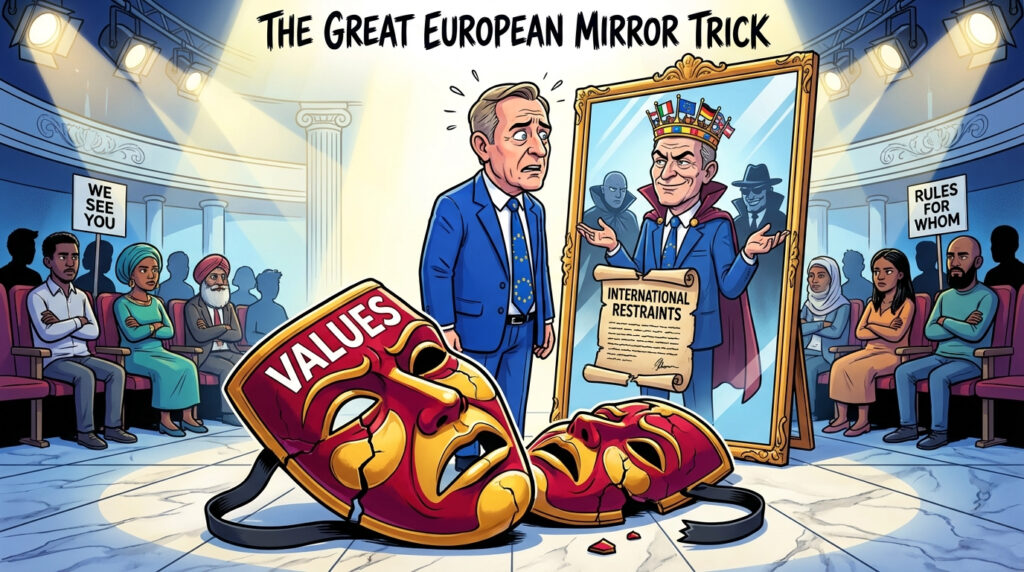
The Middle East Monitor captured the civilizational moment with appropriate severity: the major powers have “openly torn off the mask of hypocrisy in observing international restraints”. The question is not whether the mask has been removed. It has. The question is what Europe intends to do now that everyone can see clearly — and whether its own face beneath the mask is any more honest than the ones it has spent three years denouncing. [11]
The Reckoning
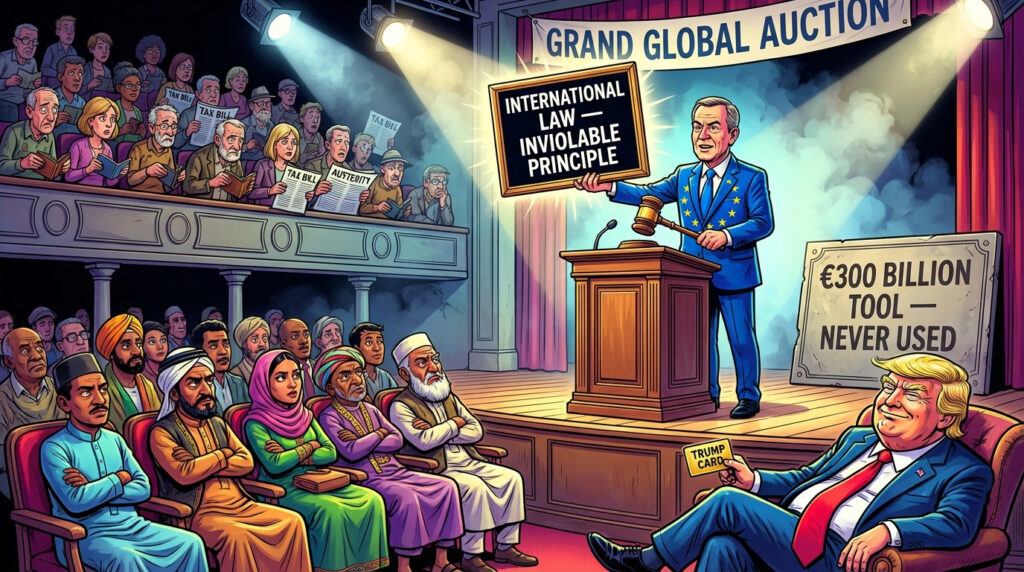
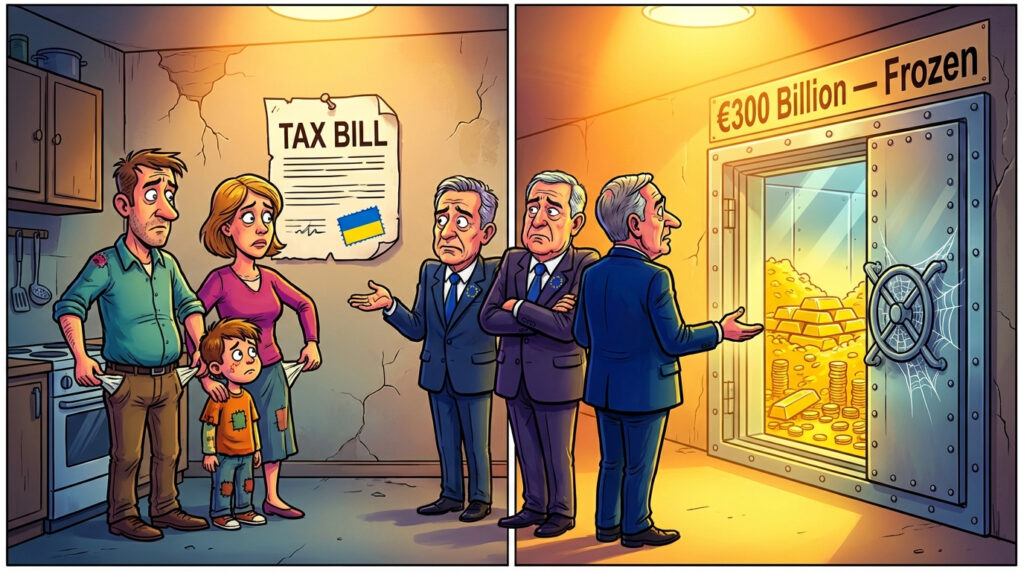
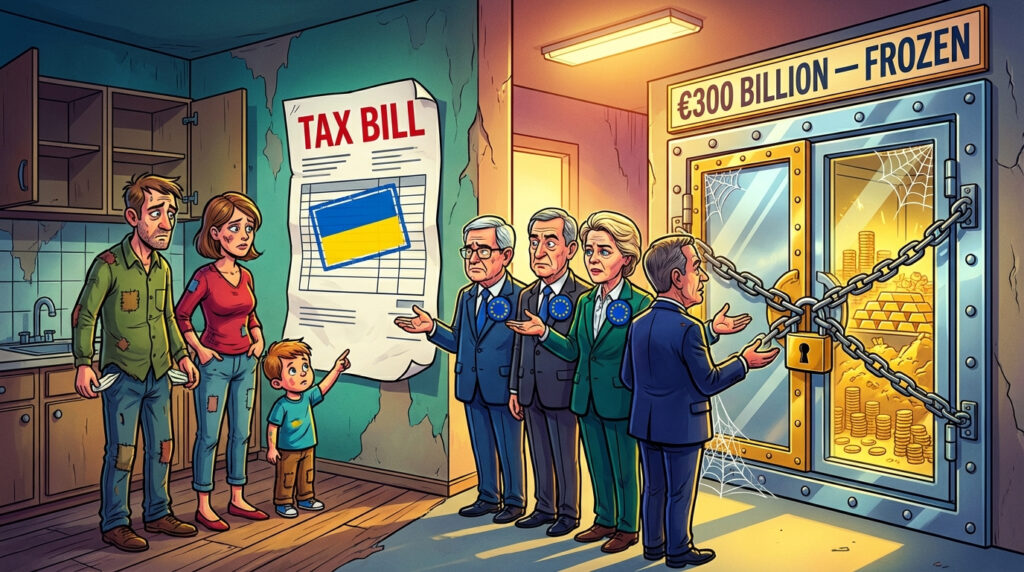
Europe does not lack instruments. Russia’s frozen sovereign assets — approximately €300 billion — sit largely in European financial institutions. The sanctions architecture that is strangling the Russian war economy runs through Brussels and London, not Washington. The EU’s single market remains the world’s largest, and access to it is a privilege, not a right, that can be conditioned on respect for the very norms Europe claims to champion. The tools exist.
What does not exist — or what has atrophied to the point of dysfunction — is the political will to use those tools without first checking Washington’s temperature. That is not a security constraint. It is a moral failure dressed as pragmatism.
And it is the failure that makes Europe’s antifascist posturing not merely hypocritical, but actively dangerous: because a Europe that selectively enforces its principles teaches the world that principles are negotiable, that law is instrumental, and that the only real currency in international relations is power.That is not the lesson of 1938 that European leaders claim to have internalized. That is the lesson that produced 1938 in the first place.
References :
- BBC News — “Trump’s new world order is real and Europe is having to adjust fast” — https://www.bbc.com/news/articles/cddn002g6qzo
- Carnegie Endowment for International Peace — “What Can the EU Do About Trump 2.0?” — https://carnegieendowment.org/research/2026/02/what-can-the-eu-do-about-trump-20
- Yetkin Report — “Munich: The EU’s Effort to Counter U.S. Pressure and Türkiye’s Position” — https://yetkinreport.com/en/2026/02/15/munich-the-eus-effort-to-counter-u-s-pressure-and-turkiyes-position/
- The Loop / ECPR — “Trump’s version of Atlanticism mirrors Putin’s Eurasianism” — https://theloop.ecpr.eu/trumps-version-of-atlanticism-mirrors-putins-eurasianism/
- New York Times — “Trump Has Long Disdained Europe’s Elites. Now, It’s Official.” — https://www.nytimes.com/2025/12/06/world/europe/trump-europe-strategy-document.html
- American Enterprise Institute — “Putin, Xi and Trump Are Launching a Freedom Counterrevolution” — https://www.aei.org/op-eds/putin-xi-and-trump-are-launching-a-freedom-counterrevolution/
- RT / EU Borrell — “No place for double standards on Ukraine and Gaza conflicts” — https://www.rt.com/news/598637-eu-borrell-icc-ukraine-gaza-double-standards/
- Human Rights Watch — “EU: Rights Failings Undermine Democracy, Rule of Law” — https://www.hrw.org/news/2026/02/04/eu-rights-failings-undermine-democracy-rule-of-law
- Verfassungsblog — “Hypocrisy Implies a Moral Code” — https://verfassungsblog.de/venezuela-us-international-law/
- BBC News — “What Trump’s vision of the new world order means for Europe” — https://www.bbc.com/news/articles/c041n3ng03no
- Middle East Monitor — “Objective fallacy: Eulogies on the passing of the law-based international order” — https://www.middleeastmonitor.com/20260214-objective-fallacy-eulogies-on-the-passing-of-the-law-based-international-order/
- Politico — “Europe looks for US resolve as Ukraine talks bog down” — https://www.politico.com/news/2026/02/13/munich-security-conference-ukraine-fate-00779545
- Euronews — “Europe can defend itself against Russia without the US if it wants to” — https://www.euronews.com/2026/02/13/europe-can-defend-itself-against-russia-without-the-us-if-it-wants-to
- Chatham House — “What should a more European NATO look like? The US and Europe disagree” — https://www.chathamhouse.org/2026/02/what-should-more-european-nato-look-us-and-europe-disagree
- Munich Security Conference — “Europe: Detachment Issues — Munich Security Report 2026” — https://securityconference.org/en/publications/munich-security-report/2026/europe/
- The Moscow Times — “At Munich, a U.S. Change in Tone Leaves Ukraine’s Allies Unconvinced” — https://www.themoscowtimes.com/2026/02/15/at-munich-a-us-change-in-tone-leaves-ukraines-allies-unconvinced-a91955
- New York Times — “How Europe Woke Up to Trump” — https://www.nytimes.com/2026/02/12/world/europe-trump-munich-security-canada-minnesota.html
- New York Times — “Europe and Rest of World Try to Come to Terms With Trump the Imperialist” — https://www.nytimes.com/2026/01/07/world/europe/trump-venezuela-greenland-ukraine-europe.html
- Centre for European Reform — “European Security in a Time of War: Standing with Ukraine, Against Russia” — https://www.cer.eu/publications/archive/policy-brief/2025/russia-war-ukraine-future-europe-security
- Austrian Institute for International Politics (OIIP) — “The War in Ukraine: The Moment of Truth in 2026?” — https://www.oiip.ac.at/publikation/the-war-in-ukraine-the-moment-of-truth-in-2026/
- Countercurrents — “The Hypocrisy of a Rules-Based World” — https://countercurrents.org/2026/01/the-hypocrisy-of-a-rules-based-world/
- Internationale Politik Quarterly — “Europe’s Quiet Anchor” — https://ip-quarterly.com/en/europes-quiet-anchor⁂
