




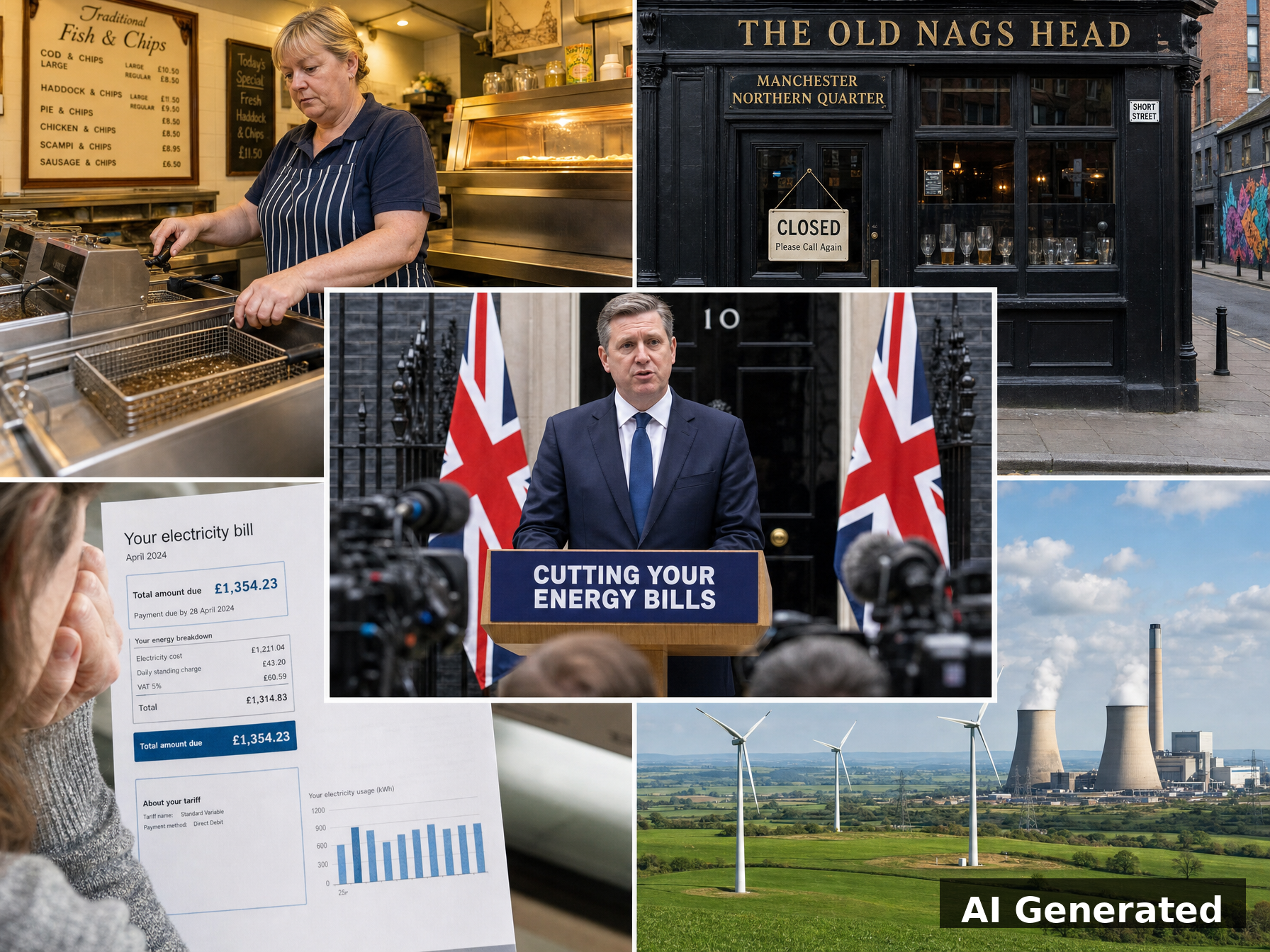

She runs a fish and chip shop in Salford. She has run it for eleven years. Last winter, she turned the fryers off two hours early every night — not because the shop was empty, but because the electricity bill had become the single largest number in her life. Larger than rent. Larger than wages. Larger than the loan she took out to survive COVID.
He took over a pub in Manchester’s Northern Quarter in 2019. By 2024, he was pouring pints for customers who had less money, while paying an energy bill that had doubled, a business rates bill that had not changed, and a landlord who raised the rent regardless. He did not close because he was a bad publican. He closed because the maths stopped working.
You know these people. You may be these people. Energy-intensive industries — paper, petrochemicals, metals, cement, ceramics, glass — saw their combined output fall by a third since 2021, reaching the lowest level since records began in 1990 [4]. Forty per cent of UK firms reported holding back investment because of energy costs alone [4]. The high street is not just losing shops. It is losing the economic logic that made them viable.
And then, on 21 July 2026, a new Prime Minister stood in Downing Street and announced that VAT would be removed from household electricity bills.
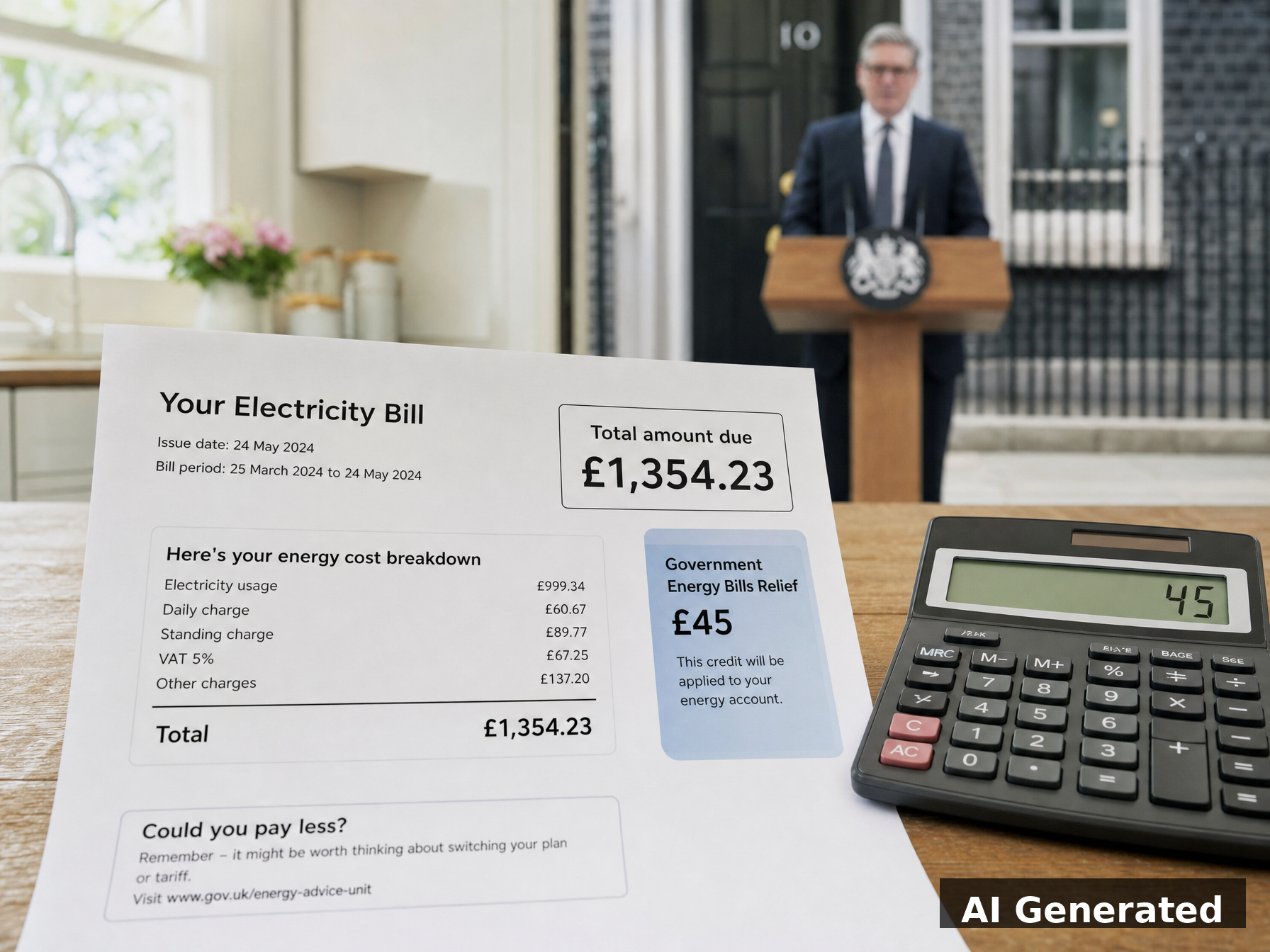
Forty-five pounds a year. Per household [1].
The Arithmetic the Minister Did Not Show You
The gesture was immediate. The optics were clean. Andy Burnham, on his second day in office, declared he would “put more money in people’s pockets and bring back hope” [1]. The VAT cut — from five per cent to zero — was funded by cancelling the £1.8 billion Digital ID programme, and was expected to cost around £850 million for the current financial year [1]. It was timed to coincide with the next Ofgem price cap in October.
But here is the number the press conference did not foreground: in the same quarter, the energy price cap rose by thirteen per cent. A typical household’s annual bill increased by £221 [4]. The Prime Minister’s gift covered barely a fifth of the increase that was already arriving.
The UK has the second-highest domestic electricity prices in the G7 — only Germany is higher [4]. British firms pay the highest industrial electricity prices among all twenty-four member countries of the International Energy Agency. UK manufacturers pay roughly fifty per cent more for electricity than their German and French competitors, and four times as much as companies in the United States [4].
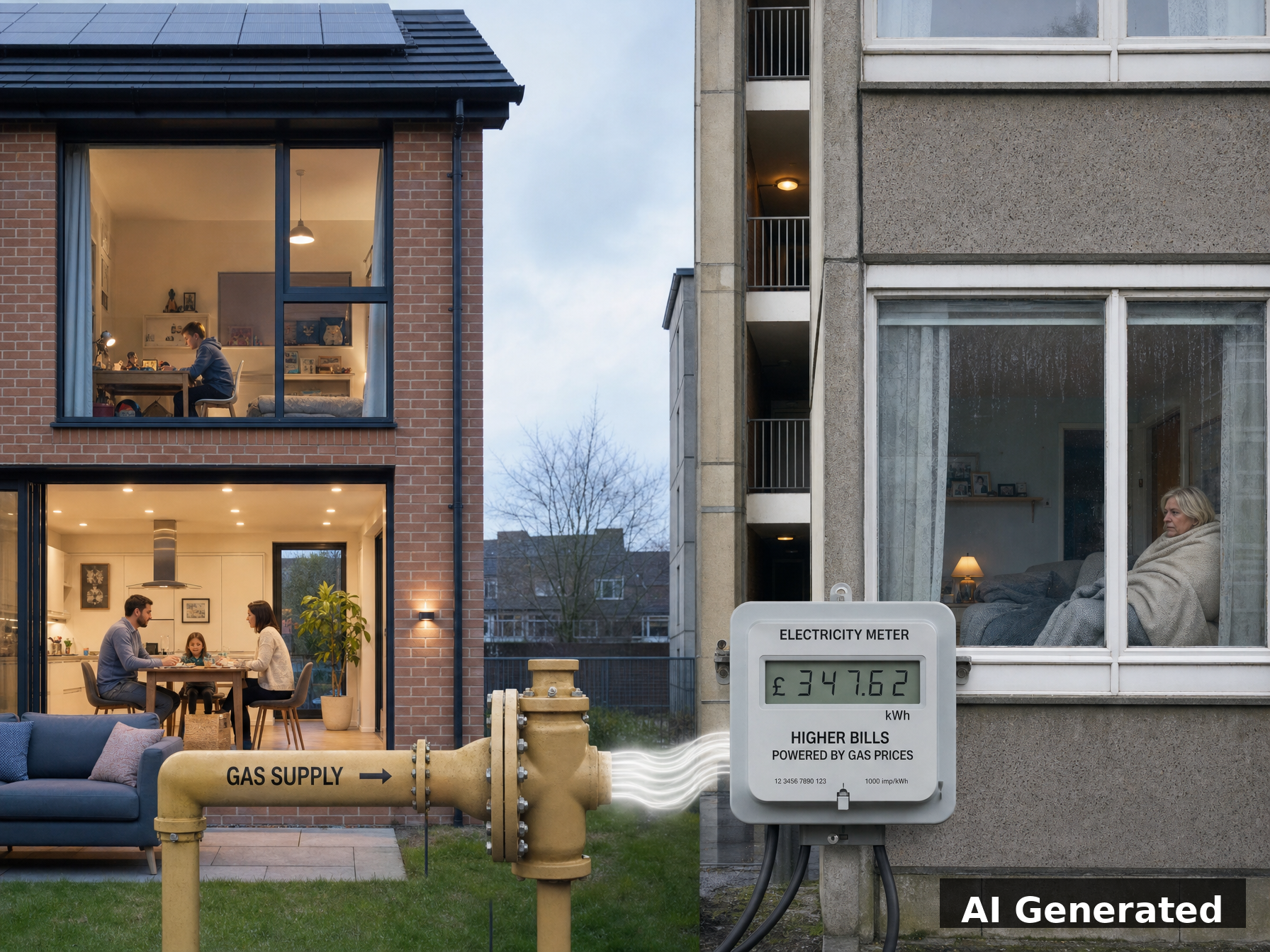
This is not an accident of geography. It is the product of a pricing system that lets a single fuel — gas — set the price for all electricity, even the cheap renewable kind. In 2024, gas determined the market price of electricity eighty-five per cent of the time [4]. Gas accounted for thirty per cent of UK electricity generation, compared to sixteen per cent in Germany and three per cent in France [4]. Every time a war breaks out in the Middle East or a pipeline is threatened in Eastern Europe, your electricity bill carries the geopolitical risk — regardless of how much wind power spins off the Scottish coast.
Green levies — the policy costs that politicians love to blame — accounted for six per cent of the rise in bills since pre-crisis levels. Higher wholesale gas prices accounted for fifty-four per cent [4]. The villain was never the wind turbine. It was the pricing mechanism that ties your bill to a fuel you are trying to leave behind.
The minister called it relief. The spreadsheet called it a rounding error.
The Strongest Case for What the Government Did
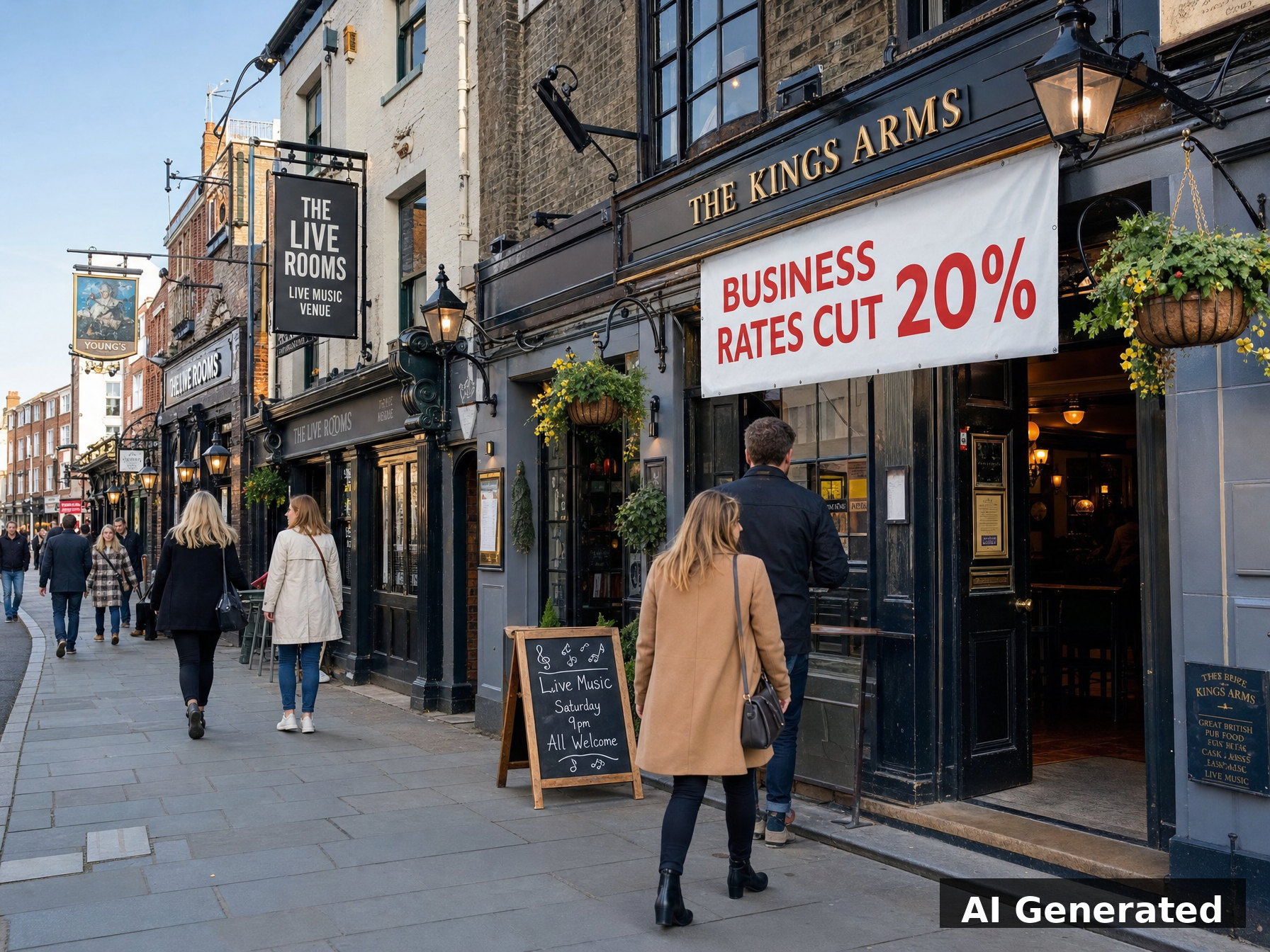
The strongest case for Burnham’s opening moves is this: they were fast, visible, and funded without new borrowing. The VAT cut was paired with a twenty per cent reduction in business rates for pubs, clubs, and live music venues — saving the typical pub an estimated £1,100 per year and reaching nearly 32,000 venues across England [2]. The package was framed as part of a broader “cost-of-living government” [1]. And it was delivered in the first week — a signal to a weary public that someone was paying attention.
There is institutional logic here too. The Ofgem Review — the most comprehensive assessment of Britain’s energy regulator in its twenty-five-year history — found that thirty suppliers had failed during the energy crisis, that household energy debt had grown to over £4 billion, and that the regulator’s powers were outdated and insufficient [3]. These are real structural weaknesses. They take time to fix. A government that begins with immediate consumer relief while pursuing deeper reform is doing what governments should do: managing the present while working on the future.
And yet. Forty-five pounds a year does not restructure a pricing market. A twenty per cent business rates cut does not reverse a decade of high-street collapse. The Ofgem reforms — which include direct consumer enforcement powers, individual accountability mechanisms for energy executives, and the ability to claw back bonuses in cases of serious breach [3] — require legislation. They require parliamentary time. They require a regulator that, by its own admission, has been risk-averse, process-heavy, and slow to act [3].
The question is not whether these measures are well-intentioned. The question is whether they are proportionate to the scale of what is broken.
Who Is Still Warm, and Who Is Still Cold
Follow the mechanism, not the announcement. The UK’s electricity market was designed so that the most expensive source of power — almost always gas — sets the price for everything [4]. This means that renewable generators, whose marginal cost of producing electricity is close to zero, earn revenues linked to the price of a fossil fuel they do not burn. When gas prices spike, those generators receive windfall profits. The Electricity Generator Levy, recently raised from forty-five to fifty-five per cent, attempts to recapture some of this [4]. But the underlying pricing architecture remains intact.
Energy companies, meanwhile, operate within a regulatory framework that the Ofgem Review itself described as inadequate. The regulator’s duties have roughly tripled since 2000, creating confusion and diluting focus [3]. Ofgem cannot currently hold individual senior executives accountable — it can only act against the company as a licensee [3]. When United Gas and Power deliberately overcharged customers to cover a budget shortfall, Ofgem penalised the company. The executives who made those decisions faced no personal consequence [3].
The cost of this regulatory weakness falls where it always falls: on the person paying the bill. Household energy debt stands at over £4 billion [3]. Anxiety about affording energy bills only begins to subside when household income exceeds £100,000 [4]. Energy costs form six per cent of total household expenditure on average — but ten per cent for the lowest-income families [4].
You are not imagining the squeeze. It is measured, documented, and rising.
What This Means at Your Kitchen Table
You do not experience policy papers. You experience the moment when the standing charge on your electricity bill looks larger than the food shop. You experience the child asking why the house is cold. You experience the decision — taken silently, without announcement — to use less, to eat less, to go without, because the alternative is debt you cannot service.
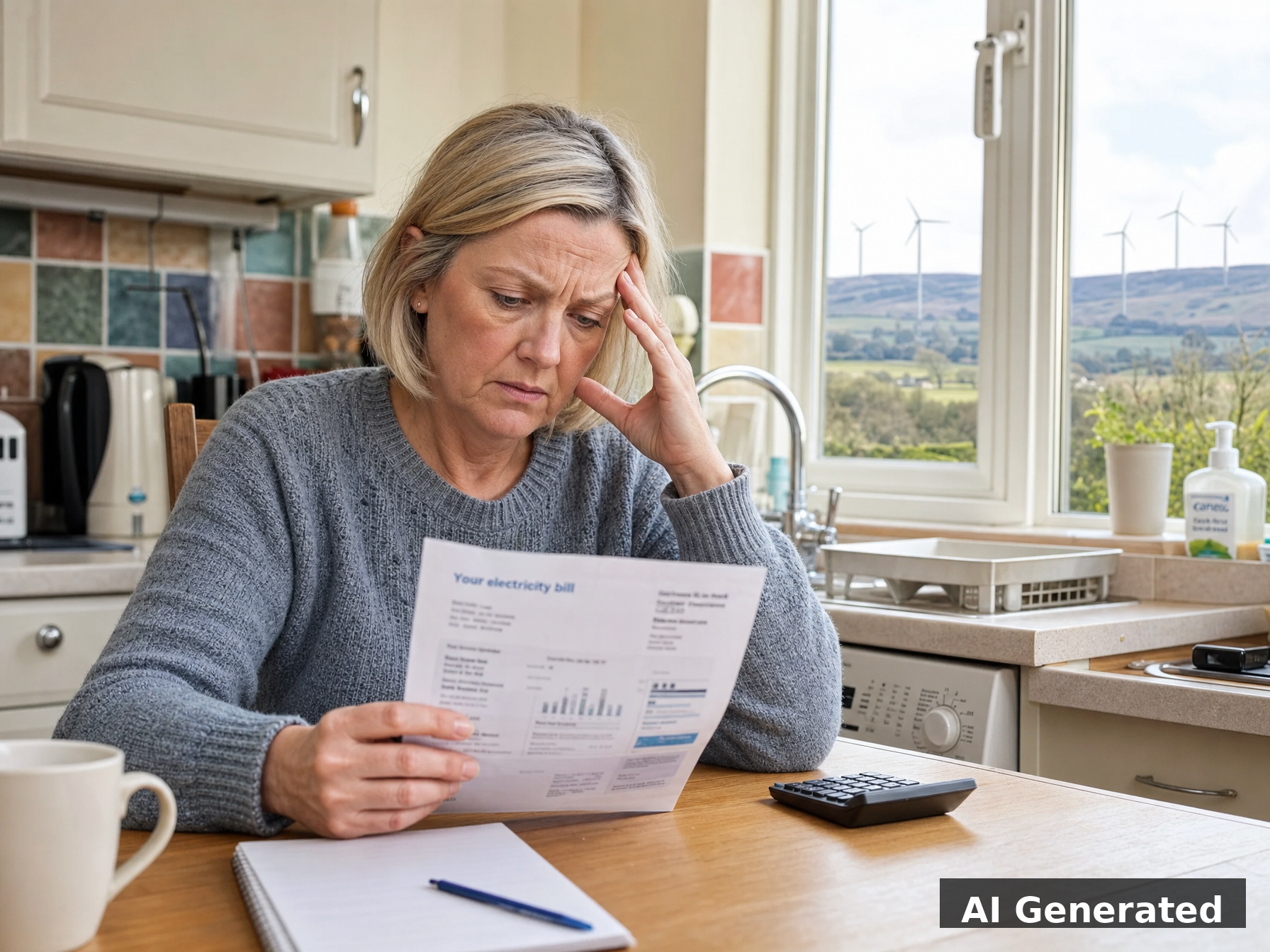
The fish and chip shop owner in Salford turned her fryers off early. The publican in Manchester poured his last pint. These are not anecdotes. They are the lived experience of a pricing system that transfers geopolitical risk from global markets to kitchen tables, while the pricing mechanism that creates this transfer remains essentially untouched.
The path forward is not mysterious. It involves breaking the link between gas prices and electricity prices — something the government has begun through voluntary long-term fixed contracts for low-carbon generators [4]. It involves reforming Ofgem into a regulator that can act pre-emptively, hold individuals accountable, and enforce consumer law without going through the courts [3]. It involves a British Industrial Competitiveness Scheme that cuts electricity bills by up to twenty-five per cent for over ten thousand manufacturers [4]. It involves making the pricing mechanism visible to the people who pay for it.
The structure was built before you arrived. But the next time someone announces forty-five pounds of relief — ask what the structure costs.
When the next price cap rises — and it will — will we celebrate another gesture? Or will we finally ask who designed the mechanism that makes the gesture necessary?
The Ofgem Review recommended thirty-eight specific reforms [3]. How many will survive the legislative process intact — and how many will be softened by the interests that profit from the current architecture?
And when we talk about fixing Britain’s energy crisis — are we asking the people who caused it to change? Or are we asking you to keep paying?
References
[1] Prime Minister’s Office, 10 Downing Street, HM Treasury, Department for Energy Security and Net Zero. (2026). New PM cuts tax on household electricity bills to give breathing space on cost of living. GOV.UK. Link
[2] Prime Minister’s Office, 10 Downing Street, HM Treasury, Department for Business, Innovation, Science and Trade. (2026). Burnham means business: PM slashes business rates bills for pubs, clubs and live music venues. GOV.UK. Link
[3] Department for Energy Security and Net Zero. (2026). Ofgem Review: Final report. GOV.UK. Link
[4] Winchester, N. (2026). Electricity prices in Great Britain. House of Lords Library, In Focus. Link
AI Disclosure: This post was created with the assistance of artificial intelligence. The ideas, analysis, and opinions expressed are my own — AI was used to help compose, structure, and refine my personal notes and thoughts into the final written content. Images and video featured in this post were also generated using AI tools, based on my own creative prompts and direction.
