




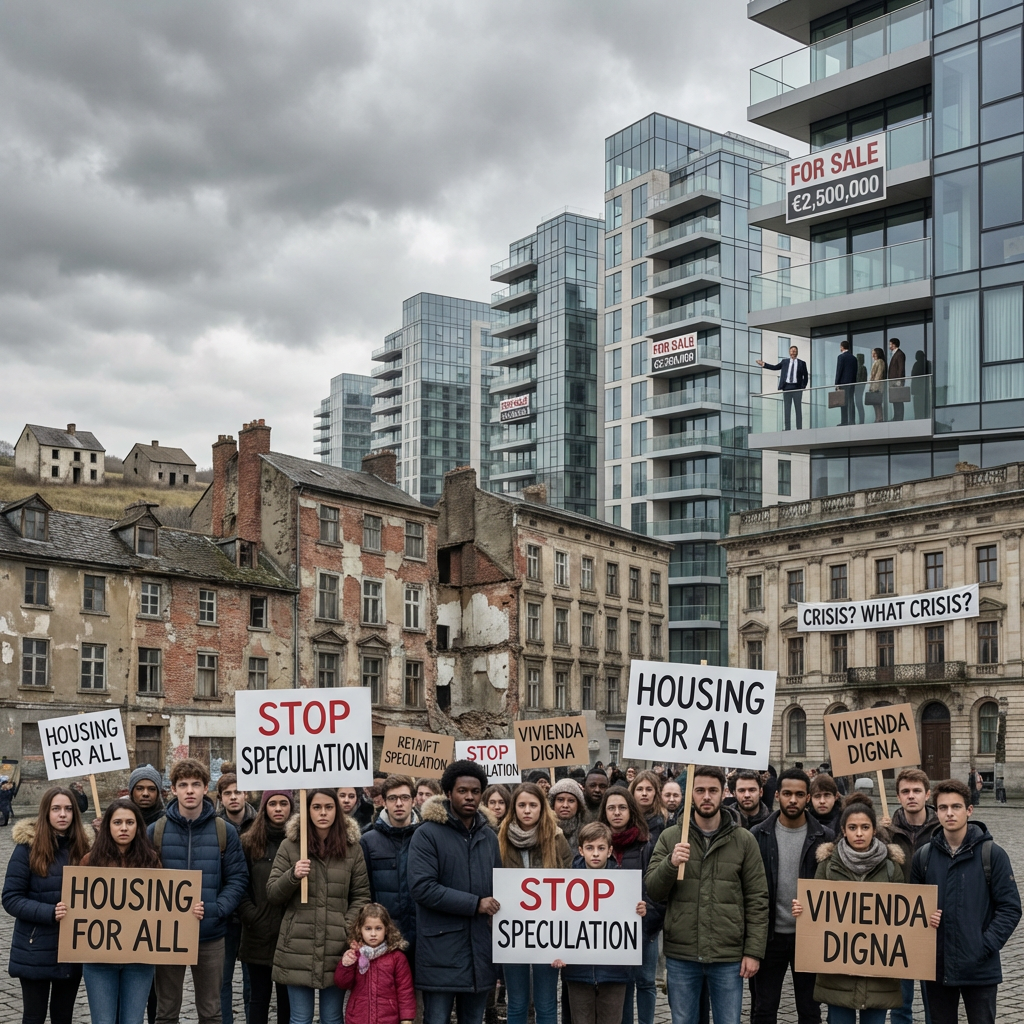


In a continent where the population is dwindling faster than common sense in politics, Europe finds itself in a baffling housing crisis as of March 2026. Who, you ask, is paying the price? Europeans, especially the young and low-income, face skyrocketing rents and unattainable homeownership, while policymakers scramble for answers. What’s happening? A severe shortage of affordable housing. Where? Across the European Union, from Berlin to Barcelona. Why? Despite a shrinking population, speculative investment and regulatory failures have turned homes into assets, not shelters.
Context: The Paradox of Plenty
Europe’s population is projected to decline by 2050, according to Eurostat, with deaths outpacing births in many nations. Yet, housing prices have surged by over 30% in major EU cities since 2020, as reported by the OECD. This contradiction sets the stage for a crisis that defies simple logic.
The Euronews article from March 26, 2026, highlights this irony, questioning who truly benefits when homes sit empty or are priced beyond reach. It’s a classic case of supply and demand gone haywire, where fewer people somehow mean higher costs.
The Paradox of Plenty: Empty Homes, Full Wallets
One might think that a shrinking population would lead to a glut of available housing, driving prices down. Instead, Europe boasts over 11 million empty homes, as per EU housing data, while millions struggle to find affordable accommodation. How does that work? Simple: real estate has become the preferred playground for investors.
Speculative buying, often by foreign funds and domestic elites, has turned housing into a commodity. In cities like Amsterdam, property prices have doubled in a decade, even as population growth stalls. It’s a win-win for investors, but a lose-lose for ordinary citizens.
Unraveling the Causes: Greed, Policy, and Urban Myths
The real reasons behind this shortage are as layered as a poorly baked lasagna. First, regulatory failures: many EU countries have lax rent controls and zoning laws that favor developers over residents. In Germany, for instance, rent caps were struck down by courts, leaving tenants vulnerable.
Second, urbanization continues unabated, with people flocking to cities for jobs, despite remote work trends. This creates micro-shortages in urban centers, while rural areas decay. Eurostat data shows that 75% of the EU population lives in cities, exacerbating local imbalances.
Third, short-term rentals like Airbnb have gobbled up long-term housing stock. In Lisbon, over 20% of properties are listed as tourist rentals, according to a 2025 study by the European Housing Observatory. Who needs locals when tourists pay more?
Lastly, construction hasn’t kept pace, thanks to bureaucratic red tape and rising material costs. The EU’s building permits dropped by 15% in 2025, as reported by the European Commission, while demand for affordable units soars.
Solutions: From Policy to Populism
What can solve this crisis? Proposals abound, but one stands out as the most popular: massive public investment in affordable housing. The European Parliament’s 2026 housing report advocates for a EU-wide fund to build 5 million new social homes by 2030. It’s a crowd-pleaser, but will it work?
Other solutions include stricter regulations on short-term rentals, as seen in Barcelona’s crackdown, and progressive taxation on vacant properties. In Finland, a “housing first” policy has reduced homelessness by 35%, proving that direct intervention can yield results.
However, —that housing should be affordable and available to all to own, not just rent—resonates widely. Yet, in a world where homeownership rates are declining (down to 65% in the EU, per OECD data), this ideal seems increasingly utopian. Critics argue that ownership isn’t always the answer; secure, long-term tenancy could be a bridge.
Expert Insights: Data and Discontent
Economists like Dr. Lena Schmidt from the Berlin Institute for Housing Research point to financialization as the core issue. “Housing is no longer a right; it’s a yield-bearing asset,” she says, citing that real estate constitutes 40% of EU wealth. Data from the European Central Bank shows that mortgage debt has risen by 25% since 2020, even as populations shrink.
Housing activists, meanwhile, decry the social cost. In a 2026 survey by Eurofound, 40% of young Europeans aged 18-34 spend over 40% of their income on rent, leading to delayed family formation and economic stagnation. “We’re creating a generation of permanent renters,” warns activist group Housing for All.
Politicians offer soundbites but little action. The EU’s “Affordable Housing Initiative” launched in 2024 has been criticized for lacking teeth, with only 20% of allocated funds disbursed. It’s a classic case of too little, too late, wrapped in bureaucratic red tape.
Implications: What This Means for You
For readers, this crisis translates into squeezed wallets and deferred dreams. If you’re under 40, homeownership might be a fantasy, unless you inherit or win the lottery. The industry faces turbulence too: construction firms are wary of investing without subsidies, while real estate agents thrive on volatility. Socially, inequality deepens. In cities like Paris, the gap between property owners and renters has widened, fueling protests and political polarization. Economically, high housing costs dampen consumer spending and mobility, potentially slowing EU growth.
Looking ahead, watch for policy shifts. The European Commission’s upcoming “Housing Compact” in 2027 could mandate rent controls, but resistance from member states is assured. Also, keep an eye on demographic trends: if population decline accelerates, will the market self-correct, or will speculation continue to inflate bubbles?
Ultimately, the crisis underscores a fundamental question: in a continent of emptying villages and packed cities, who does housing serve? Until Europe prioritizes people over profits, the price will keep rising—and not just in euros.
