










Contents
- 1. Geopolitics & Defence
- 2. Environment & Climate
- 3. Society & Civil Issues
- America’s Civic Ledger: From Hospital Beds to Brooklyn Streets
- Germany’s Civic Square: Justice, Migration and the Party System
- France’s Republic: Schools, Courts and the Streets
- The British Ledger: Welfare, Health, Digital Abuse and the AI-CSAM Crisis
- The Global Civic Periphery: Elections, Persecution, Labour and Migration
- 4. AI & Technology
- 5. Economy & Business
- 6. Science & Space
- 7. Crypto, Digital Assets & Blockchain
- 8. Correlations & Analysis
- 9. References
Click any heading to jump to that section. Click the section heading to return to this menu.
Geopolitics & Defence ↑ Contents
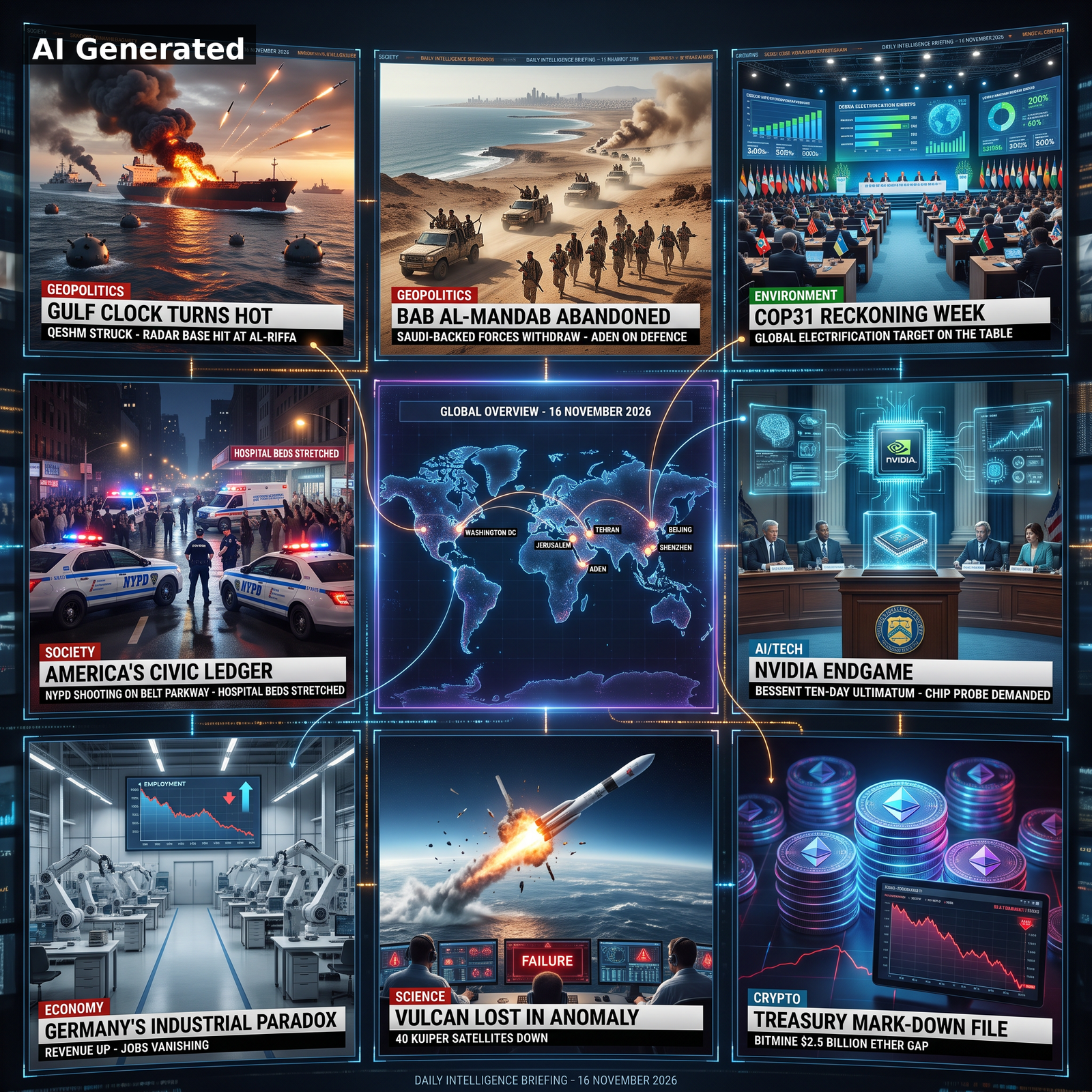
The Gulf Clock Turns Hot: Qeshm, Bahrain and the Third Carrier
The Gulf war’s maritime front crossed a new threshold: after the D168 report documented Iran’s shift to naval mining, the conflict returned to direct strikes within forty-eight hours. Iranian media reported explosions near Qeshm Island and Bandar Kong, with unverified reports of a US Air Force strike on a missile launcher or air-defence battery near Bandar Lengeh, followed by the launch of at least four UAVs and anti-ship cruise missiles from the Iranian coast and explosions inside the Strait[1]. Tehran then formally claimed it destroyed a US air-defence radar at Bahrain’s Al-Riffa base with six kamikaze drones and cruise missiles, framing the attack as retaliation for American strikes on Iranian soil — directly contradicting Manama’s claim that the drones were intercepted[2]. The US Embassy in Manama issued an emergency alert warning of a sharply elevated Houthi threat and advising citizens to prepare for flight cancellations and possible airspace closures[3].
The force posture matches the warnings: the USS Theodore Roosevelt has entered the CENTCOM area to join the George Washington and George H.W. Bush, forming a three-carrier group with roughly seventeen warships and 50,000 US personnel — the largest concentration in the region in years, read by Israeli analysts as an ultimatum[4]. If confirmed, the Qeshm strikes would be the first US attacks on Iranian territory since the war’s opening phases, and Tehran’s Al-Riffa claim converts the Fifth Fleet’s host country into contested battlespace. The “essentially over” framing of D163 has been decisively abandoned by both capitals.
Yemen’s Southern Collapse: The Bab al-Mandab Account Closes
The Houthis achieved their most significant advance since September: Saudi-backed government forces announced withdrawal from the Bab al-Mandab Strait area and the southern coast to concentrate on defending Aden, ending a six-week counter-offensive[5][6]. The “operational redeployment” leaves the Houthis controlling the waterway linking Asia to Europe via the Suez Canal, with their forces within a few dozen kilometres of Aden, where the presidential palace and airport have already been struck[5]. A Houthi missile killed eight civilians and wounded twelve; the rebels also released 600 prisoners[5]. The BBC’s framing is blunt: Western airpower has failed to dislodge the Houthis from a strategic prize[6].
The consequence runs directly into the Gulf escalation: with Bab al-Mandab consolidated, Iran gains a second lever over Red Sea shipping at the moment its own forces trade strikes in Hormuz. Aden’s sandbags and trenches read less like precaution than the beginning of a siege economy, and Riyadh is exposed for spending blood on the southern coast while the northern front demands attention[5].
Jerusalem’s Unravelling Mandate and the Mossad File
Inside Israel, the political clock accelerated toward crisis. Gadi Eisenkot declared that caretaker premier Benjamin Netanyahu “cannot remain” after reports of alleged electoral interference by a Netanyahu aide, calling the premier and his entourage an immediate threat to democracy — hours after unity-government talks had been discussed[7]. The whiplash captures the fragility of a system navigating a two-front war and an unpredictable White House; D168 recorded Netanyahu’s plea for unity, and today’s reversal suggests it has already been rejected in substance. Every military decision — on Iran, Gaza, the north — now filters through this leadership vacuum.
The intelligence file that dominated D168 gained detail: Israeli media report that Mossad chief David Barnea’s Washington trip was specifically to brief the administration on an “imminent attack” by Iran on US officials using drones[8]. The revelation surfacing as the Bahrain alert is issued lends the file operational colour; whether the assessment is accurate or itself an instrument of Israeli pressure remains open, but the observable facts — a Treasury Secretary relocated, emergency alerts, a third carrier — are consistent with a US government that believes the threat is real.
The Shenzhen Summit Firms Up and Europe’s Table Takes Shape
Beijing confirmed what Washington and Moscow had announced: Xi Jinping will host Trump and Putin for their first trilateral summit on Thursday 19 November in Shenzhen, on the margins of APEC[9]. Trump reportedly seeks nuclear-arms reduction and the US-Israel war, but not Ukraine — while German President Steinmeier disclosed Xi’s irritation at trilateral talks on Ukraine, insisting “this is a European war” and Europeans must be at the table[9]. The D167 report identified this door as the week’s highest-leverage development; today’s confirmation makes it a fixture, staged in Shenzhen, the driverless-taxi capital of China’s tech ambitions[10].
Europe is building its own seat. Zelensky announced a “coalition of the willing” meeting that “could prove historic,” aiming to forge a European line “100 percent for victory,” and urged that the trilateral Ukraine-US-Russia format be substantially strengthened[11]. The push follows reports that US officials in Abu Dhabi and Dublin floated Donbas-for-NATO — an idea Kyiv does not take seriously[12]. EU foreign ministers meet to strengthen Ukraine for winter and address Russia’s intensified hybrid attacks[13]. The FT argues Europe must reopen a channel to Moscow before it is too late, citing 1983 as the lesson that deterrence without dialogue risks miscalculation — implicitly critiquing both Moscow’s maximalism and Kyiv’s victory framing[14]. Prince Harry’s surprise two-day visit, telling troops “you will win the war,” supplied the human layer[15].
The Indo-Pacific Ledger: Codes, Windows and Air-Defence Nets
The Indo-Pacific produced three parallel tracks. ASEAN and China failed to agree a South China Sea code of conduct at Manila, while leaders denounced Myanmar violence and extended the junta ban[16]. Admiral Philip Davidson — whose 2021 testimony created the “Davidson Window” for a Chinese invasion capability by 2027 — now hopes he was wrong, crediting US posture, Japan’s doubled defence spending and Taiwan’s conscription extension, while warning the stalled $14 billion Taiwan arms package must move and that the information-warfare domain is deteriorating fastest[17]. And China’s HQ-17A mobile air-defence system was showcased protecting amphibious formations in exercises mirroring a Taiwan-strait assault profile[18].
Two further items complete the ledger. The US Navy completed operational testing of L3Harris’s FleetLink communications system aboard an Arleigh Burke destroyer, an NSA-certified modular radio cluster integrating surface and undersea comms[19]. At the UN, states are preparing a push for binding rules on fully autonomous weapons, with great-power competition paradoxically opening a path to agreement[20]. The Greece-Cyprus interconnector diplomacy continued: Greek coverage details the French note on the Abeille Marengo, Athens’ Washington back-channels, Paris’ neutrality and US support — continuing the Aegean fault line tracked since D162[21]. Algeria escalated rhetoric toward Morocco, with the army “on the front line” against drug networks[22]. And Ecuador’s Noboa denied a second US base near Guayaquil after an AFP investigation documented twenty military flights and tent installations[23].
Environment & Climate ↑ Contents
COP31’s Reckoning Week and the Energy-Infrastructure Ledger
The UN climate conference in Antalya enters its decisive second week exactly as D168 anticipated. German Environment Minister Carsten Schneider joins as co-mediator on emissions reduction alongside India’s Bhupender Yadav, under a Turkish presidency seeking a global electrification target — raising electricity’s share of final energy consumption from roughly 20 percent today to 35 percent by 2035 — while financing negotiations stall as industrialised countries resist concessions[24]. The UN’s framing of 2.6-2.8°C warming by century’s end supplies the gravity; the electrification target is the most concrete instrument on the table. India’s parallel signal — nearly $20 billion in grid upgrades to ease bottlenecks that strand solar and wind, aimed at powering a billion homes by 2035 — confirms the largest developing economy treats grid capacity, not generation, as the binding constraint[25].
Europe’s energy ledger delivered a delayed milestone and a contested one. Germany’s fourth state-run LNG import terminal opened at Stade after a two-year delay, adding to the Wilhelmshaven and Brunsbüttel terminals that covered roughly ten percent of German gas imports last year[26]. The timing captures the dual-track reality the D168 compute-energy analysis described: decarbonisation ambition and fossil infrastructure expanding in parallel. In Britain, gas began flowing from the Jackdaw platform even as Prime Minister Burnham faces a Labour rebellion over Rosebank, exposing the governing party’s fracture between net-zero rhetoric and the case for domestic production[27].
The Corporate-Energy Front: Google’s Gas Deal and Ontario’s SMR Arithmetic
The corporate layer produced two cautionary stories. In Decatur, Illinois, residents and green advocates are pressing Google to break its Broadwing gas deal over carbon-capture, water-safety and pollution concerns — the same gas-for-AI equation that Anthropic’s $3.4 billion order crystallised in D168, now playing out as local social-licence politics[28]. In Ontario, the first Darlington small modular reactor is late and over budget before its design has stabilised, and analysts argue the province should reconsider the next three units when cheaper clean procurement exists — the first serious cost critique of the SMR programme several governments treat as non-negotiable[29]. Both stories share a lesson: the transition’s bottlenecks are no longer technological but institutional — procurement, grid economics and local acceptance.
The Climate-Society Interface: Wine, the Pope and the Living Ledger
The human costs of warming surfaced in concrete form. The Hospices de Beaune auction — the benchmark charity wine sale — was constrained by a harvest halved after summer heatwaves, a commercial quantification of how climate is rewriting Burgundy’s economics[30]. Pope Leo XIV, on the penultimate day of his South American tour, travelled from the Andes into the Peruvian Amazon and delivered his most forceful environmental statement, condemning the murders of Indigenous leaders, denouncing deforestation and illegal mining, and demanding justice for defenders — invoking “the cry of the earth and the cry of the poor” in explicit continuity with Francis’s doctrine[31][32]. The papal intervention elevates environmental defence into the human-rights frame at a moment when the Amazon’s defenders are being killed with impunity.
The Science-of-Systems Ledger: Slag, Sand, Subsurface Fire and the Grid
Three system-level findings rounded out the ledger. A modelling study in Communications Earth & Environment projects that paving China’s urban roads with recycled steel slag could cut pavement emissions by 19 percent — up to 1.92 billion tonnes of CO2-equivalent — but the epoxy-modified asphalt needs seven days of curing versus one, and costs four to five times more, making deployment strategy as important as material performance[33]. UC Santa Barbara and Oxford researchers measured sand hoppers excavating up to 110 pounds of sand per metre of California coastline per night — among the highest bioturbation rates ever recorded, with implications for dunes and the hidden damage of beach-grooming[34]. And the coal seam beneath Burning Mountain in New South Wales — officially estimated at 5,500 years old, though the management plan allows ignition as far back as 500,000 years — continues its slow 3-feet-a-year creep, a geological reminder that combustion need not be anthropogenic to be relentless[35]. New research indicates dietary fibre may help the body resist nanoplastics — the same plant-heavy diet that cuts food emissions fortifying the gut against microplastic pollution — while an IEA report finds Spain’s renewables leadership is strengthening energy security and cutting import costs, but faster electrification and grid modernisation are needed to extend the gains[36][38]. The living-ledger entry is human as much as ecological: marine biologist David Ebert, the “Indiana Jones of lost sharks,” has described and named 56 new shark, ray and chimaera species over four decades of fish-market fieldwork[37].
Society & Civil Issues ↑ Contents
America’s Civic Ledger: From Hospital Beds to Brooklyn Streets
America’s civic record runs from resilience to force. Independent MP Helen Haines, who lost both legs in an alleged car attack four weeks ago, was discharged from Melbourne’s Alfred hospital[53]. In New York, video shows NYPD officers fatally shooting a 26-year-old suspected kidnapper on the Belt Parkway after he rammed police and civilian vehicles while fleeing with a woman in his van; she was found safe, and the officers were placed on modified duty — the latest case in the running national argument over police deadly force[68]. And the Mississippi collision D167 tracked produced its first mechanical finding: the tanker’s voyage-data recorder shows a defective rudder caused the “Atlantic Asphalt” to slam into the anchored cruise ship, shifting scrutiny from crew error to maintenance and inspection regimes[42].
Germany’s Civic Square: Justice, Migration and the Party System
Germany’s institutions produced a dense week. A truth commission on the Islamic State genocide against the Yazidis began work in Berlin, hearing survivors on child enslavement, torture and sexual violence, with Nobel laureate Navi Pillay among its members[48]. The Constitutional Court will rule on cable-TV special termination rights in rental apartments, a telecom-sector case with property-law implications[46]. Interior Minister Dobrindt attended Vienna talks on deportation centres outside the EU, with diplomats saying the first site will open in Rwanda — a concrete step in the externalisation policy Germany, Denmark, Austria, the Netherlands and Greece have built[49].
The party system churned on three fronts. BSW founding members demand distance from the AfD[43]. The AfD’s internal “remigration” dispute escalated into renewed debate about banning the party[55]. And the machinery turned: Chancellor Merz visits the CSU leadership a week after proposing Ilse Aigner for the presidency, while Schwesig seeks re-election at the head of Mecklenburg-Vorpommern’s first red-red-green coalition[45][47].
France’s Republic: Schools, Courts and the Streets
France’s civic square showed simultaneous tightening and testing. The Paris police prefect banned unauthorised gatherings within 100 metres of ten schools and five university sites, citing “numerous excesses and blockades”[59]. Gérard Depardieu’s appeal against his sexual-assault conviction opened, keeping the #MeToo reckoning in the news[39]. And the Blomet preparatory school said it has taken measures after excluding two radicalised students, addressing an antisemitism scandal at one of Paris’s most prestigious institutions[54].
The British Ledger: Welfare, Health, Digital Abuse and the AI-CSAM Crisis
Britain’s social policy machine produced five interlocking stories. Alan Milburn will propose cutting employer National Insurance for 21-to-24-year-olds over five years to tackle the NEET crisis[60]. Currys reports a surge in portable card-payment terminal sales as Britons scale up side hustles — a consumption signal that doubles as a measure of the cost-of-living squeeze[61]. The NHS endorsed the “sponge on a string” oesophageal-cancer test for rollout[64]. Surviving Economic Abuse details how banking apps and online credit are weaponised to control women and girls — digital financial abuse as hidden domestic harm[63].
The most alarming story is the explosion in AI-generated child sexual abuse material: reports surged 8,400 percent between 2023 and 2025, from roughly 4,700 to more than 400,000 cases, a figure that will force platform regulation and detection to move far faster[62]. The government is considering changing the age-of-consent law after allegations against Russell Brand, and Boris Johnson says Britain would vote for Brexit again[52]. A headteacher warns feminism has become “unfashionable” among girls, and research finds the school environment shapes parents’ educational hopes[67][65].
The Global Civic Periphery: Elections, Persecution, Labour and Migration
José Maria Neves was re-elected president of Cape Verde in the first round with more than 63 percent, consolidating one of Africa’s most stable democracies — resolving the contest D168 flagged[66]. The persecution ledger produced two grim data points: roughly 220 million Christians face extreme persecution worldwide, with conditions worsening in 55 percent of high-risk countries, from Fulani massacres in Nigeria to church seizures in Iran and mass abductions in Pakistan[58]; and Amnesty International renewed its attack on Amazon’s Saudi labour practices, documenting how the kafala system leaves migrant workers dependent on agencies that can dismiss them at will[56]. Singapore’s biggest money-laundering case entered forfeiture with a luxury auction of Hermès handbags and Patek Philippe watches[50]. The Czech public-media revolt continued with the largest Prague gathering since 1989 against the Babis government’s state-budget funding plan[57]. Australia added two items: a Hells Angels bikie was charged with threatening to kill journalist Nick McKenzie, and the national medical body advised conditional use of puberty blockers for transgender children after a year-long review, putting it at odds with state hospital bans[51][40]. A new caravan of roughly 100 people left Honduras for the United States, a reminder that the push factors driving Central American migration have not abated[41]. And the death of Miguel Ángel Félix Gallardo, founder of the Guadalajara cartel, closed a 37-year prison chapter in the narcotics ledger[44].
AI & Technology ↑ Contents
The Nvidia Endgame: Bessent’s Ultimatum, Megaspeed’s Answer and the Comeback Lobby
The Nvidia saga — the dominant AI-business story of D160-D168 — entered its most consequential phase, as the US government moved from observing to demanding. Treasury Secretary Scott Bessent issued what amounts to a ten-day ultimatum to Nvidia’s board to hand over its internal investigation into alleged AI-chip diversion to China, asking whether the company had a “culture of compliance” and disclosing that in 2024 more than 20 percent of Nvidia’s global sales were routed through Singapore while only about one percent of chips remained there[76]. Bessent deliberately downgraded the personal scandal — “his weaknesses are his own; what matters is the company’s compliance obligations” — pressed for an outside CEO, and disclosed inter-agency friction: four agencies had pushed to blacklist Megaspeed, but Commerce refused, drawing his criticism of Secretary Lutnick. Congressional scrutiny is scheduled, with Huang to testify before the House on 26 November and the Senate on 3 December[76].
Megaspeed International broke its silence, insisting it is a “legitimate and lawful business” and that its director left in late 2025, dismissing reports as assertions “not supported by verifiable evidence”[73]. The statement does not address the Bloomberg-documented servers carrying banned H100, H200 and H800 chips in a Shanghai data centre, nor the Journal’s reporting of nearly $12 billion in orders for Chinese buyers — making it a holding position rather than a defence[73]. Meanwhile the comeback campaign gathered weight: an open letter with more than 157,000 signatures — including Elon Musk, Epic’s Tim Sweeney and fund managers Gerstner and Baker — demands Huang’s return “while an independent investigation establishes the facts,” arguing he deserves “due process, not mob justice”[75]. A detailed Fortune critique counters that the defence mischaracterises the case: this is a national-security and disclosure failure, with Culper Research estimating more than 20 percent of Nvidia’s fiscal-2026 compute revenue ultimately served Chinese end-users, a vanished Singapore revenue line, and a $4 trillion company whose financing web rests on “handshake deals”[74]. Markets price the uncertainty as contained: Nvidia shares are primed to steady after their worst week since April 2025, with the 17 November earnings report — and whether it restores the Singapore breakout — the first real test[70].
The Frontier Model Race and the Health-AI Frontier
Beneath the drama, the model race continued its eastward tilt. Alibaba unveiled Qwen3.8-Max, a frontier model positioned against Anthropic and OpenAI — the latest iteration of a line tracked since D159, arriving awkwardly for Washington’s export-control narrative given fingerprinting evidence that Chinese labs may have trained on banned Blackwell chips[71]. The APEC host city itself became the stage: Shenzhen’s driverless taxis, robots and tech campuses — Huawei, Tencent, DJI — were showcased to world leaders as proof of Beijing’s automation-first urbanism, framing the trilateral summit’s setting as an argument about technology governance[10]. On the health frontier, Apple launched the Health AI Usage Study, a research app built with clinical-AI platform OpenEvidence that answers medical questions using sources such as the New England Journal of Medicine and asks participants to rate responses — a cautious, evidence-grounded entry that contrasts with the wilder chatbot-health claims of recent years[72].
Cybersecurity’s Retail Front: Coles and the Australian Target List
Australia’s second-largest retailer, Coles, revealed it has been targeted in a cyber-attack, investigating with the Australian Cyber Security Centre and recommending password updates even as it said no data was confirmed compromised[69]. The incident extends the pattern this series has documented across retail, logistics and government — and lands on a week in which Australian institutions have been repeatedly in the crosshairs. As supermarkets accumulate payments, loyalty and delivery data, they become single points of failure for millions of households, and the line between a retail incident and a national-infrastructure event continues to blur.
Economy & Business ↑ Contents
The German Industrial Paradox: Rising Revenue, Vanishing Jobs
The German economy delivered the week’s most pointed contradiction: industry posted its third consecutive quarterly revenue increase — driven in part by the AI boom — while more than 140,000 jobs disappeared across all sectors in the same period[77]. The two facts are causally linked: the AI-driven demand surge is being met through automation and productivity rather than hiring, extending the D160-D168 analysis of the AI capital cycle’s distributional consequences. The Handelsblatt Research Institute adds a confidence dimension: the economy grows, but entrepreneurial confidence remains weak, making the upswing “purchased” rather than organic[80]. Monday’s National Steel Summit in Salzgitter confronts the same arithmetic: high energy prices, US tariffs and the enormous cost of green conversion[78].
The state’s machinery adjusted around the edges. Berlin will forgo the KfW’s dividend and shelve plans for a new KfW law, relieving the 2027-2028 budget by roughly one billion euros through other means[82]. German ports are preparing for nuclear-powered merchant ships, which the IAEA expects within years, fearing political resistance could leave them behind[79]. And Trump posted a Justice Department letter to Senator Elizabeth Warren requesting preservation of records — a document-preservation demand hinting at an investigative thread with regulatory-market implications[89].
Asia’s Twin Speeds: Japan’s Shrink, China’s Slowdown and Thailand’s Bounce
Asia’s major economies continued to diverge. Japan contracted at an annualised 0.1 percent in Q3, missing expectations, as Gulf-war oil prices and weak consumption outweighed yen tailwinds; Economy Minister Kiuchi explicitly blamed Middle East tensions, natural disasters and poor weather[87]. China’s October data showed factories producing but households not consuming: industrial output rose 4.8 percent (below the 5.3 polled), retail sales grew just 0.4 percent, property sales fell 13.7 percent, and private-sector fixed-asset investment declined 11.4 percent year-to-date — the loudest alarm in the set[88]. Thailand accelerated to 2.9 percent GDP growth on strong exports, a reminder that supply-chain reallocation is producing winners even as the giants stall[84]. Taiwan’s stocks fell more than 4 percent in a session, the region’s sharpest equity signal, parsed against both the Nvidia affair and the trilateral summit’s semiconductor agenda[81].
Markets, Trade and the Corporate Ledger
Three corporate stories completed the file. Canada’s Carney warned Ottawa could turn to Chinese automakers if trade talks with Trump fail to preserve the integrated North American auto industry — a threat that signals how dependent the continent’s supply chains have become on Chinese EV technology[85]. Hong Kong’s New World Development plunged to new lows after a $3.2 billion rights issue, the latest distress signal from the Chinese property complex[86]. A judge allowed the DRAM cartel lawsuit against Samsung, SK Hynix and Micron to proceed — scrutiny on memory pricing at a moment when AI demand has made DRAM strategic[83]. Intel, by contrast, faces a shareholder lawsuit alleging it concealed a PC sales slump — the flip side of the AI-driven repricing of the chip sector[90]. The corporate frontier kept building: Oister Global launched a deep-tech fund with a potential 600-crore corpus across semiconductors, defence, aerospace, quantum and advanced mobility, while Bharat Semi raised $24 million for AI-enabled sensor chips with design wins including General Atomics[91][94]. UK housing closed the ledger mutedly: Rightmove recorded a £6,745 fall in average asking prices in November, with 2026 on track to end below last year’s close[93]. Japan’s AI gap rounds out the picture: an Anthropic index suggests Japanese firms adopt AI tools slower than global peers, a competitive lag with macroeconomic consequences[92].
Science & Space ↑ Contents
Vulcan’s Fall: The Orbital Economy’s Setback and Voyager’s Record
The space industry’s most consequential event of the window was a failure. United Launch Alliance’s Vulcan rocket suffered an anomaly roughly ten minutes after liftoff and fell back to Earth with 40 Amazon Kuiper satellites on board — the first of 38 launches Amazon had booked, and a rocket under contract for roughly half of the US military’s national-security missions[95]. The failure is expected to ground Vulcan indefinitely following two earlier booster close calls, reshuffling the orbital-economy ledger: Amazon’s Kuiper timeline is at the mercy of a grounded vehicle, SpaceX’s moat widens, and the military’s assured-access calculus absorbs another variable. The contrast with the D168 Starship catch could not be starker.
The week’s other space story is a record: Voyager 1, the most distant man-made object, will pass roughly 16 billion miles from Earth this Wednesday — a monument to endurance engineering, the 1977 spacecraft still returning data nearly half a century later[96].
The Cosmic Ledger: Disappearing Planets, Aging Stars and Einstein’s Gap
Astrophysics delivered three genuinely new results. Astronomers watched a giant exoplanet disappear: TOI-2535b, a hot Jupiter 1,100 light-years away, has been nudged by a hidden sibling into a wobbling orbit that carried it out of view by March 2026 — the first observed vanishing of a planet’s transit, with 30-50-year wobble cycles and implications for how hot Jupiters migrate[97]. Separately, astronomers identified why aging stars suffer sudden luminosity dips[98]. And MIT researchers probed a 120-year-old gap in Einstein’s physics through gold-ion collisions recreating the quark-gluon fluid of the post-Big-Bang epoch — a missing piece that could explain how matter behaved in the universe’s earliest moments[99]. Two imaging breakthroughs complete the picture: a new way to photograph events vanishing in trillionths of a second using eleven timed images, and a molecular fabric that traps toxic chemicals for lower-energy industrial separations[100][101].
The Deep Archive: Ice-Age Homes, Denisovan Tartar and Neolithic Diets
The archaeological record produced four extraordinary windows. In Spain’s La Garma cave, a rockfall sealed a 16,800-year-old Magdalenian dwelling during the last Ice Age, preserving 4,614 objects — from deer bones to engraved pendants — now studied via padded walkways and a fully digital excavation[102]. In Denmark, “Rødhals Man,” a Mesolithic hunter-gatherer who lived roughly 6,000 years ago, has been shown to have witnessed the arrival of farming and adapted his diet to it — an eyewitness account of humanity’s most consequential dietary transition[103]. In China, the 146,000-year-old “Dragon Man” skull from Harbin — which yielded no DNA from bone or tooth — has been linked to the Denisovans through mitochondrial DNA from hardened dental plaque and protein analysis, giving researchers their first credible picture of a Denisovan head[104]. In Saudi Arabia, a 125,000-year-old lakeside site in Mundafan yielded megafauna remains, stone tools and plant material showing how early humans lived during a greener Arabian period[105]. Mediterranean finds add texture: a 3,300-year-old Bronze Age sword from Lake Mezzano with a razor beside it hinting at its warrior owner, and the first identification of milk and wine in Menorcan funerary vessels[106][107].
The Biomedical Ledger: Bone, Brain, Gut and Cold
Medicine produced results with genuine translational potential. A first-in-human Spanish trial showed engineered stem cells with a sugar-coating “return address” for bone marrow reduced fragility fractures by 94 percent over two years in ten women with advanced osteoporosis — from eight fractures a year to 0.5 — raising the possibility of reversing bone loss, though the lack of a control group leaves the mechanism open[108]. A high-dose flu vaccine was linked to up to 22 percent lower Alzheimer’s risk versus standard-dose shots — nearly 55 percent versus none — in a study of nearly 165,000 older adults, and UVA researchers found the CASS4 gene helps immune cells contain toxic protein buildup in the brain[109][110]. Princeton researchers showed that when fibre runs out, gut bacteria can turn to eating the intestinal mucus lining, while plant proteins that mimic fibre — “Prifs” — push microbial chemistry healthier[111]. Immune cells may help pancreatic cancer hide, and a City of Hope study found a specialised fat’s inner heater weakens with age — but experiments in older mice suggest it can be turned back up[112][113]. The darker side is institutional: research into a childhood brain cancer that kills within a year has stalled after the government shut down the Pediatric Brain Tumor Consortium, a 27-year-old institution disbanded just before a 5-year-old patient’s diagnosis[114]. Industrial-scale science brackets the section: a “zero-emission” aluminium pathway that swaps the century-old Hall-Héroult chemistry, and NOAA’s modernised coordinate system that will shift every official US position by up to 13 feet — a geodesic revolution fundamental to aviation, flood maps and construction[115][116]. In a lighter archival note, an AI-assisted reading of a Napoleon-coded letter from 1809 — unread for 217 years — suggests what lay behind a row of dots in his published correspondence[117].
Crypto, Digital Assets & Blockchain ↑ Contents
The Treasury Mark-Down File: BitMine’s Ether Gap and Solana Company’s Turnaround
The most consequential crypto-structure story of the D169 window is a corporate-treasury mark-to-market gap that converts the sector’s price weakness into balance-sheet arithmetic. BitMine Immersion Technologies valued its 6,070,092 ether at $2,234 per token in its 9 November 8-K; at the $1,821.97 ether traded for on 16 November, the same stack is worth $11.06 billion, roughly $2.50 billion — or 17.5 percent — below the carrying price[118]. The filing is unusually granular: 5,227,037 of the 6.07 million ether are staked, earning a trailing yield of 2.65 percent — about 138,516 ether per year — which the company values at $309 million annually at the $2,234 mark, a figure that falls 18.4 percent at the current price because a token-denominated yield does not offset a repricing of the principal. Chairman Tom Lee’s framing — invoking Buterin’s Devcon 8 declaration that “ETH is a store of value, ETH is money” — is a narrative that does not shorten the 22.61 percent climb required to restore the mark. The company is 39,908 ether short of its stated 5 percent-of-supply goal, roughly four weeks of purchases, so the next four weekly filings will show whether the discipline holds at a $1,700 handle; the comparison to Strategy’s 849,327 bitcoin — worth about $13.84 billion less at $64,944 than the $69 billion cited — confirms a sector-wide phenomenon of treasuries marked above market[118].
Solana Company provided the positive mirror: Q3 revenue jumped to $3.4 million, with staking generating $3.3 million — up from $700,000 a year earlier — and net income swung from a $352.8 million loss to a $105.2 million profit, while SOL holdings grew to roughly 2.4 million tokens worth over $288 million[119]. The contrast between the two firms is the sector’s structural story in miniature: one treasury bleeding paper value on a falling asset while touting its yield, the other converting a falling asset into operational revenue. Solana Company’s 5.9 percent staking yield on treasury holdings versus the 4.9 percent network average, and its 1.3 million SOL delegated including a million from third parties, show the institutional staking economy maturing into a genuine fee business — even as SOL itself struggles near $80[119].
Institutional Flows and Regulatory Fronts: JPMorgan’s 13F, Brazil’s Warning and CZ’s Taxonomy
The institutional and regulatory layer moved on three fronts. JPMorgan’s quarterly 13F shows the bank increased its Strategy holdings by 36 percent to 848,932 shares — worth about $131.3 million — and its BlackRock IBIT holdings by 9.6 percent to roughly 11.4 million shares valued near $540 million at quarter-end[120]. The disclosure is a September-30 snapshot, not a trading signal, but a systemically important bank still carrying half a billion dollars of Bitcoin-ETF exposure is evidence that institutional participation has become a permanent feature of the landscape, to be read alongside D168’s documentation of November’s $2.35 billion in ETF outflows[120].
Regulation took a sharper turn in Brasília: a Central Bank of Brazil official declared that stablecoins are fuelling money laundering, stating that anyone who swaps good money for stablecoins knows it turns “bad,” and flagged the remittance market as a particular concern[121]. The statement is a rhetorical escalation in the global debate over dollar-pegged tokens — Brazil has been among the most active jurisdictions probing stablecoin use in informal finance since D165 documented its capital-rule tightening. Changpeng Zhao offered his own taxonomy of the selloff — IPO demand, fund withdrawals, security fears, inflation and politics — while stressing the relationship to the price decline remains uncertain and disclosing his own purchases; coming from the sector’s most influential operator, the list reads less as analysis than as an attempt to stabilise sentiment by naming the forces at play[126].
The On-Chain Ledger: Whales, Wind and a Hijacked Control Plane
The on-chain data layer painted a market under sustained distribution pressure. Glassnode reports bitcoin short-term-holder whales face a record $8 billion in unrealised losses — the largest cohort of underwater leveraged positions since the cycle began — and that whales are sending $55 million more to exchanges than they withdraw daily, a pattern historically associated with continued selling[122][123]. Both metrics extend the D168 liquidation story with hard data: the sixth weekly loss is now visible in the positioning layer, with the $58,600-$60,000 liquidation cluster within reach of a market near $64,900[122][123].
The security ledger delivered the window’s most technically significant event: Luxor Technology disclosed an unauthorised redirect of bitcoin hashrate through its Commander fleet-management software, affecting just over a dozen client accounts, with the company patching within two hours and promising full compensation[125]. The chain record is the forensic core: the diverted address received exactly two coinbase payments totalling 0.162 BTC — worth about $10,500 — each representing only about 2.6 percent of its block’s outputs, implying roughly 1 EH/s of credited work rather than the 13 EH/s hosting operator CoreX said it observed on the address; the gap suggests either incomplete crediting or a transient peak that decayed before the second payment five-and-a-half hours after Luxor declared the incident patched. The episode matters less for the $10,500 than for the architecture it exposes: mining fleets are managed through software dashboards where a configuration change redirects both work and payment, and the control plane — not the Bitcoin protocol — is the attack surface; the promised post-mortem will determine whether the 13 EH/s figure was real and what the compensation bill actually was[125].
Finally, a policy proposal on the energy frontier: the Bitcoin Policy Institute argues flexible bitcoin mining could consume some of Scotland’s curtailed wind power, which costs the grid more than £1 billion a year in constraint payments — an economics-dependent proposal to be read as part of the miners-to-power-infrastructure pivot tracked since D162[124]. The window’s crypto ledger, in sum, reads exactly as D168’s forward-looking assessment anticipated: a leveraged market unwinding inside a tighter rate environment, with treasuries marked above market, institutional exposure stable but flows pointing out, and the infrastructure layer — from fleet software to stablecoin rails — under intensifying scrutiny from attackers and regulators alike[121].
Correlations & Analysis ↑ Contents
The D169 window’s master variable remains the Gulf war, but its texture has changed from the one D168 described. Yesterday’s report closed on the shift from missile exchanges to naval mining and framed the coming phase as cumulative attrition. Today that prediction has been overtaken: the attrition phase lasted roughly forty-eight hours before the conflict returned to direct strikes, with unverified reports of US attacks near Qeshm and Tehran’s formal claim that it destroyed a US air-defence radar at Bahrain’s Al-Riffa base[1][2]. The escalation ladder the D164-D168 reports traced has now produced the configuration this series repeatedly warned about: three US carriers and 50,000 personnel facing a Tehran that is publicly claiming successful strikes on the Fifth Fleet’s host country[4]. Thursday’s trilateral summit in Shenzhen, which D167 identified as the highest-leverage event of the month, will convene with the Gulf at its most combustible point since the war’s opening weeks[9].
The second correlation is the acceleration of the Yemen front as the Gulf escalates. The government’s withdrawal from Bab al-Mandab hands the Houthis control of the strategic waterway just as Iran tests US defences in the Gulf proper[5][6]. D168 treated Yemen as a parallel front; the D169 evidence shows the two fronts are now synchronised, multiplying pressure on Washington: Iran attacks the US presence in Bahrain while its Yemeni ally tightens the Red Sea noose and threatens Aden. For the oil market, Hormuz mined and under exchange plus Bab al-Mandab under Houthi control is the worst of both worlds, connecting directly to the Fed’s inflation problem identified in D168 as the binding constraint on the December rate decision.
The third through-line is the Nvidia affair’s conversion from corporate scandal into a national-security and disclosure test. D160-D168 tracked Huang’s fall; D169 adds Bessent’s ten-day ultimatum, Megaspeed’s statement, a 157,000-signature comeback petition, and a Fortune analysis arguing the defence campaign is talking its own book[76][73][75][74]. Bessent’s insistence that the compliance question is primary, and his public friction with Lutnick over Megaspeed, turn Nvidia into the test case for whether the US can police its most valuable technology export while its most powerful firms lobby against enforcement. The 17 November earnings — and whether it restores the Singapore revenue breakout — is the first concrete data point[70].
A fourth correlation connects the institutional-fragility theme of D161-D168 to new evidence. D168 argued trust deficits are not resolving but rotating; D169 supplies three fresh confirmations: the Czech public-media revolt, the largest Prague gathering since 1989; the German AfD radicalisation dispute reopening the party-ban question; and the British AI-CSAM explosion — 8,400 percent growth in two years — which tests whether platform regulation can move faster than the harm it must contain[57][55][62]. All three are cases where the state’s response — funding cuts, ban debates, detection mandates — is contested in real time, feeding the argument this series has made since D161: that the binding constraint on Western governance is not capacity but legitimacy.
The fifth correlation is crypto’s integration into the corporate-balance-sheet layer of the AI economy. BitMine’s $2.5 billion mark-to-market gap on its ether treasury, JPMorgan’s $540 million Bitcoin-ETF position, and Solana Company’s staking-driven turnaround are facets of one phenomenon: digital assets have become a balance-sheet asset class interacting with the same rate cycle as frontier AI equities[118][120][119]. The D168 report documented the Fed naming hedge-fund leverage and elevated valuations as top stability risks; the D169 treasury marks are the visible consequence. When a company’s own filing shows its ether position 22.6 percent above the market, the line between crypto speculation and corporate governance has been erased.
What to watch in the next reporting period: (1) The Shenzhen trilateral on Thursday, with the Gulf escalation and AI governance both in the room[9]. (2) Nvidia’s earnings on 17 November and whether the Singapore revenue line returns, as Bessent’s 10-day clock runs[76]. (3) The Gulf’s next 48 hours: whether Washington confirms the Qeshm strikes and whether Tehran’s Al-Riffa claim is verified[1][2]. (4) COP31’s decisive week and the electrification-target negotiation, with the Beaune harvest and India’s grid spend as anchors[24][25]. (5) Whether BitMine’s next weekly filing re-marks its treasury toward the market — the cleanest falsification test of the store-of-value thesis on the calendar[118].
References ↑ Contents
1. Οι ΗΠΑ βομβαρδίζουν το Κεσμ – Ιρανική απάντηση με εκτοξεύσεις cruise by DefenceNet · Source ↑
2. Τεχεράνη: «Διαλύσαμε αμερικανικό ραντάρ στο Μπαχρέιν με drones και cruise!» by DefenceNet · Source ↑
3. Επείγουσα οδηγία ΗΠΑ για Περσικό: «Ετοιμάζει χτύπημα το Ιράν» by DefenceNet · Source ↑
4. Τρία αεροπλανοφόρα των ΗΠΑ και 50.000 στρατιώτες περικυκλώνουν τη Μέση Ανατολή by DefenceNet · Source ↑
5. Υεμένη: Σε άτακτη υποχώρηση οι κυβερνητικές δυνάμεις by DefenceNet · Source ↑
6. Yemeni forces’ retreat leaves Houthis in control of key Red Sea waterway by BBC · Source ↑
7. Eisenkot says Netanyahu ‘cannot remain’ after alleged election interference by aide by France 24 · Source ↑
8. Η Μοσάντ προειδοποίησε την CIA για «επικείμενη επίθεση» του Ιράν στις ΗΠΑ με drone by in.gr · Source ↑
9. Επιβεβαίωση κι από το Πεκίνο της τριμερούς για Ουκρανία by enikos.gr · Source ↑
10. The driverless taxis, robots and tech companies in APEC host city Shenzhen show China’s ambitions by The Independent · Source ↑
11. Ο Ζελένσκι ονειρεύεται «νίκη» κατά της Ρωσίας μαζί με τους «πρόθυμους» by DefenceNet · Source ↑
12. «Δώστε το Ντονμπάς και θα μπείτε στο ΝΑΤΟ» by Ελεύθερος Τύπος · Source ↑
13. EU-Außenminister beraten über Ukraine-Hilfe und hybride Angriffe by Stern · Source ↑
14. FT: «Η Ευρώπη να μιλήσει με την Ρωσία πριν είναι αργά» – Το παράδειγμα του ’83 by DefenceNet (via FT) · Source ↑
15. « Vous allez gagner la guerre » : le prince Harry achève une visite surprise de deux jours en Ukraine by Le Parisien · Source ↑
16. ASEAN, China fall short of agreeing on South China Sea code by Al Jazeera · Source ↑
17. ‘Davidson Window’ Admiral Hopes He Was Wrong On China’s Ability To Take Taiwan By 2027 by The War Zone · Source ↑
18. China’s HQ-17A air-defense network offers mobile missile protection for troops near Taiwan Strait by Interesting Engineering · Source ↑
19. US’ thousands of tons of warship gets new communication boost to operate in extreme condition by Interesting Engineering · Source ↑
20. Verteidigung: Staaten planen bei UN-Konferenz Vorstoß gegen Killerroboter by Handelsblatt · Source ↑
21. 5 το πρωί: Το διπλωματικό θρίλερ του GSI by Το Βήμα · Source ↑
22. « L’armée est en première ligne » : l’Algérie vise le Maroc et menace de s’en prendre aux fabricants de drogue à la « source » by Le Parisien · Source ↑
23. Νομπόα: «Δεν υπάρχει δεύτερη βάση των ΗΠΑ στον Ισημερινό» by Zougla · Source ↑
24. Entscheidende Verhandlungswoche bei der UN-Klimakonferenz in Antalya beginnt by Stern · Source ↑
25. India’s clean energy goal aims to power 1 billion homes by 2035 by AP News · Source ↑
26. LNG-Terminal in Stade geht nach langer Verzögerung in Betrieb by Stern · Source ↑
27. Jackdaw begins gas production as Burnham faces rebellion over Rosebank decision by The Independent · Source ↑
28. Decatur residents, green advocates call on Google to break Broadwing gas deal by Capitol News Illinois · Source ↑
29. Darlington’s First SMR Is Late and Over Budget. Ontario Needs to Rethink the Next Three. by CleanTechnica · Source ↑
30. Burgundy’s Beaune wine auction hit as climate change halves harvest by Euronews · Source ↑
31. Pope condemns murders of Peru’s Indigenous leaders, deforestation of Amazon by Al Jazeera · Source ↑
32. ‘The blood of these brothers cries out’: Pope Leo demands justice for people killed protecting the Amazon by The Guardian · Source ↑
33. China could pave its city streets with recycled steel slag and cut the emissions tied to those roads by 19 percent by EcoTicias (Communications Earth & Environment) · Source ↑
34. Sand hoppers about an inch long can dig up to 110 pounds of sand per meter of California shoreline in one night by EcoTicias (JGR Earth Surface) · Source ↑
35. A farm hand reported a volcano in Australia, but the smoke came from a burning coal seam estimated at 5,500 years old by EcoTicias · Source ↑
36. Nanoplastics and climate change have a common enemy: Fiber by Anthropocene Magazine · Source ↑
37. Indiana Jones at the fish market: David Ebert on a life spent searching for ‘lost sharks’ by Mongabay · Source ↑
38. Accelerating Electrification Can Unlock the Full Benefits of Spain’s Renewables Leadership by CleanTechnica (IEA) · Source ↑
39. Vorfälle am Set: Sexuelle Übergriffe? Depardieus Berufungsprozess beginnt by Die Zeit · Source ↑
40. Australia’s national medical research body advises conditional use of puberty blockers for transgender children by The Guardian · Source ↑
41. Ονδούρα: Νέο καραβάνι περίπου 100 ανθρώπων αναχωρεί με την ελπίδα να φθάσει στις ΗΠΑ by in.gr · Source ↑
42. Fahrtenschreiber ausgewertet: Defektes Steuerruder führte zu Schiffsunglück in New Orleans by Die Zeit · Source ↑
43. Brodeln in der Partei: Gründungsmitglieder des BSW fordern Distanz zur AfD by Die Zeit · Source ↑
44. Πέθανε ο «Νονός» των καρτέλ του Μεξικού: Ποιος ήταν ο Μιγκέλ Άνχελ Φέλιξ Γκαγιάρντο by ProtoThema · Source ↑
45. CDU-Chef Merz bei CSU-Vorstandssitzung in München by Stern · Source ↑
46. Urteil des Bundesverfassungsgerichts über Sonderkündigungsrecht für Kabelverträge by Stern · Source ↑
47. Mecklenburg-Vorpommerns Ministerpräsidentin Schwesig stellt sich zu Wiederwahl by Stern · Source ↑
48. Wahrheitskommission zum Völkermord an den Jesiden nimmt in Berlin ihre Arbeit auf by Stern · Source ↑
49. Dobrindt bei Treffen zu Abschiebezentren außerhalb der EU in Wien by Stern · Source ↑
50. Inside the multimillion-dollar auction turning Singapore’s biggest money-laundering case into a luxury sale by The Independent · Source ↑
51. Senior Hells Angels bikie charged with threatening to kill investigative reporter Nick McKenzie by The Guardian · Source ↑
52. UK papers: Consent law change ‘on cards’ and ex-PM Johnson says ‘Britain would back Brexit again’ by BBC · Source ↑
53. Australian MP ‘full of gratitude’ upon leaving hospital after alleged car attack by BBC · Source ↑
54. Antisémitisme : après l’exclusion de deux élèves radicalisés de la prépa Blomet, la direction a pris des mesures by Le Parisien · Source ↑
55. Migrationspolitik: „Versuch der taktischen Mäßigung ist gescheitert“ – AfD-Abschiebestreit verschärft Verbotsdebatte by Handelsblatt · Source ↑
56. Διεθνής Αμνηστία ξανά κατά Amazon για τις συνθήκες εργασίας στη Σαουδική Αραβία by enikos.gr (via Amnesty International) · Source ↑
57. Les Tchèques manifestent massivement contre la réforme du financement des médias publics by France 24 · Source ↑
58. Έκθεση-σοκ: 220 εκατ. Χριστιανοί υπό διωγμό – Σφαγές, απαγωγές και καταστροφές by DefenceNet (via ACN/Pew) · Source ↑
59. Les rassemblements autour de certains lycées et universités interdits à Paris by France 24 · Source ↑
60. Cut national insurance for under-25s to help tackle Neets crisis, Milburn to say by Evening Standard · Source ↑
61. Britons taking side hustles to the next level as cost of living bites by The Independent · Source ↑
62. Reports of AI-generated child sex abuse images soar 8,400%, Scottish group finds by The Independent · Source ↑
63. Digital financial products used as ‘weapons of abuse’ against women and girls by The Independent · Source ↑
64. ‘Sponge on a string’ oesophageal cancer test endorsed for NHS roll-out by The Independent · Source ↑
65. School environment plays key role in shaping parents’ educational hopes for their children, suggests study by Phys.org · Source ↑
66. Au Cap-Vert, José Maria Neves réélu président dès le premier tour by Le Monde · Source ↑
67. Leading headteacher warns that feminism has become ‘unfashionable’ by Evening Standard · Source ↑
68. Αστυνομικοί σκότωσαν εν ψυχρώ 26χρονο απαγωγέα στο Μπρούκλιν – Δείτε βίντεο by DefenceNet (via NYPD reports) · Source ↑
69. Coles investigates cyber-attack and apologises to customers by The Guardian · Source ↑
70. Nvidia shares primed to steady as investors eye Huang’s comeback report by Business Standard · Source ↑
71. Alibaba unveils Qwen3.8-Max AI model, challenging US rivals Anthropic, OpenAI by Crypto Briefing · Source ↑
72. Apple Launches New App to Study How People Use AI for Health by CNET · Source ↑
73. Megaspeed, the company linked to the downfall of Nvidia boss, says it’s a ‘legitimate and lawful business’ by The Guardian · Source ↑
74. What a Tiny Chorus of the ‘Bring Back Jensen’ Tech Bros Gets Wrong by Fortune · Source ↑
75. Elon Musk et plus de 157 000 signataires réclament le retour de Jensen Huang à la tête de Nvidia by France 24 · Source ↑
76. Μπέσεντ σε Nvidia: «Ξέρατε για την παράνομη διακίνηση AI μικροτσίπ στην Κίνα; by DefenceNet · Source ↑
77. Studie: Industrie steigert Umsatz – doch 140.000 Jobs fallen weg by Handelsblatt (dpa) · Source ↑
78. Stahlgipfel in Salzgitter berät über Zukunft der Branche by Stern · Source ↑
79. Seefahrt: Kontroverse Debatte: Deutsche Häfen bereiten sich auf Atomantrieb vor by Handelsblatt · Source ↑
80. HRI-Konjunkturausblick: Gekaufter Aufschwung – es mangelt am Vertrauen von Unternehmern by Handelsblatt · Source ↑
81. FinancialJuice: Taiwan stocks fall over 4% by FinancialJuice · Source ↑
82. Förderbank: Bund verzichtet auf KfW-Dividende und neues KfW-Gesetz by Handelsblatt · Source ↑
83. Judge lets DRAM cartel lawsuit against Samsung, SK Hynix and Micron move forward by Crypto Briefing · Source ↑
84. Thailand’s GDP growth picks up to 2.9% in Q3 on strong exports by Nikkei Asia · Source ↑
85. Carney says Canada could turn to Chinese automakers if Trump trade talks fail by The Independent (AP) · Source ↑
86. New World stock plunge to new lows after it plans $3.2bn rights issue by Nikkei Asia · Source ↑
87. Japan’s economy contracts slightly in the latest quarter as oil prices remain high by The Independent (AP) · Source ↑
88. China’s factory output grows but household spending remains subdued by Nikkei Asia · Source ↑
89. FinancialJuice: Trump posts on Truth Social letter from DOJ to Senator Elizabeth Warren requesting preservation of certain records by FinancialJuice · Source ↑
90. Intel faces shareholder lawsuit over concealed PC sales slump by Crypto Briefing · Source ↑
91. Oister Global launches deep-tech fund with potential ₹600 crore corpus by Business Standard · Source ↑
92. What an Anthropic index says about Japan’s AI challenges by Nikkei Asia · Source ↑
93. Rightmove records £6,745 fall in the average home asking price in November by The Independent · Source ↑
94. Indian chip startup Bharat Semi lands $24M seed round as it eyes global AI sensor market by TechCrunch · Source ↑
95. Vulcan rocket fails during launch, dealing major blow to SpaceX competitors by Ars Technica · Source ↑
96. Far from home. Voyager 1 is now farther than anything man has sent into space by NPR · Source ↑
97. For The First Time Ever, Astronomers Watched a Giant Planet Disappear. Now They Think They Know Why. by ScienceAlert (ApJL) · Source ↑
98. Why aging stars suffer a sudden luminosity dip by Phys.org · Source ↑
99. A 120-Year-Old Gap in Einstein’s Physics May Hold the Key to the Universe’s Earliest Matter by SciTechDaily (MIT) · Source ↑
100. Scientists Unlock a New Way To Photograph Events That Vanish in Trillionths of a Second by SciTechDaily (University of Tokyo) · Source ↑
101. Chemists Weave Molecules Into a Powerful New Material That Traps Toxic Chemicals by SciTechDaily (UT Austin) · Source ↑
102. A rockfall sealed a cave in Spain during the last Ice Age with a 16,800-year-old home still inside by EcoTicias (University of Cantabria) · Source ↑
103. Archaeologists uncover a witness to the Neolithic revolution by Phys.org · Source ↑
104. A skull known as Dragon Man is at least 146,000 years old, and hardened dental plaque pointed scientists to the Denisovans by EcoTicias (Cell) · Source ↑
105. When the Saudi desert was green: A 125,000-year-old lakeside reveals how early humans lived by Phys.org · Source ↑
106. Divers in an Italian crater lake pulled up a Bronze Age sword about 3,300 years old with an edge that is still sharp by EcoTicias (Italian Ministry of Culture) · Source ↑
107. Milk and wine used in Menorcan funerary rituals over 2,000 years ago by Phys.org · Source ↑
108. Breakthrough to Make Bones Stronger Has The Potential to Reverse Osteoporosis by ScienceAlert (Cell) · Source ↑
109. A High-Dose Flu Vaccine Is Linked to Nearly 55% Lower Alzheimer’s Risk by ScienceAlert (Neurology) · Source ↑
110. Alzheimer’s Breakthrough Reveals What Happens When the Brain’s Cleaning System Fails by SciTechDaily (UVA Health) · Source ↑
111. Without Enough Fiber, Gut Bacteria Can Turn to Eating Your Gut Lining Instead by ScienceAlert (PNAS/Nature Metabolism) · Source ↑
112. Scientists Discover That Immune Cells May Be Secretly Helping Pancreatic Cancer Hide by SciTechDaily (University of Cincinnati) · Source ↑
113. Why Do We Feel Colder As We Get Older? New Study Uncovers a Hidden Mechanism by SciTechDaily (City of Hope) · Source ↑
114. Research Stalls for a Year Into a Cancer That Kills Children in a Year by The New York Times · Source ↑
115. ‘Zero-emission’ aluminum production switches up the chemical equation by New Atlas · Source ↑
116. The United States will change every official coordinate it publishes by as much as 13 feet by EcoTicias (NOAA) · Source ↑
117. Napoleon ordered a coded letter that sat unread for 217 years, and an AI-assisted reading now suggests what may lie behind a row of dots by EcoTicias · Source ↑
118. BitMine Marks 6.07 Million ETH at $2,234. The Market Is Paying $1,822 by Blockchain Reporter · Source ↑
119. Solana Company’s Q3 Revenue Jumps to $3.4M, With Staking Leading the Way by CryptoPotato · Source ↑
120. JPMorgan Filing Shows Bigger Strategy Stake and $540 Million in Bitcoin ETF Shares by NewsBTC · Source ↑
121. Brazil Central Bank Declares Stablecoins Fuel Money Laundering by Bitcoin.com News · Source ↑
122. Bitcoin short-term holder whales face record $8B in unrealized losses by Crypto Briefing · Source ↑
123. Bitcoin whales send $55M more to exchanges than they withdraw daily, Glassnode says by Crypto Briefing · Source ↑
124. Could Bitcoin Mining Use Scotland’s Stranded Wind Power? The Debate Is Heating Up by NewsBTC · Source ↑
125. Luxor Patched Commander in Two Hours. The Diverted Address Earned 0.162 BTC by Blockchain Reporter · Source ↑
126. Why Are Crypto Prices Down? Binance Founder CZ Lists Possible Reasons by Bitcoin.com News · Source ↑
AI Disclosure: This post was created with the assistance of artificial intelligence. The ideas, analysis, and opinions expressed are my own — AI was used to help compose, structure, and refine my personal notes and thoughts into the final written content. Images, videos and music featured in this post were also generated using AI tools, based on my own creative prompts and direction.