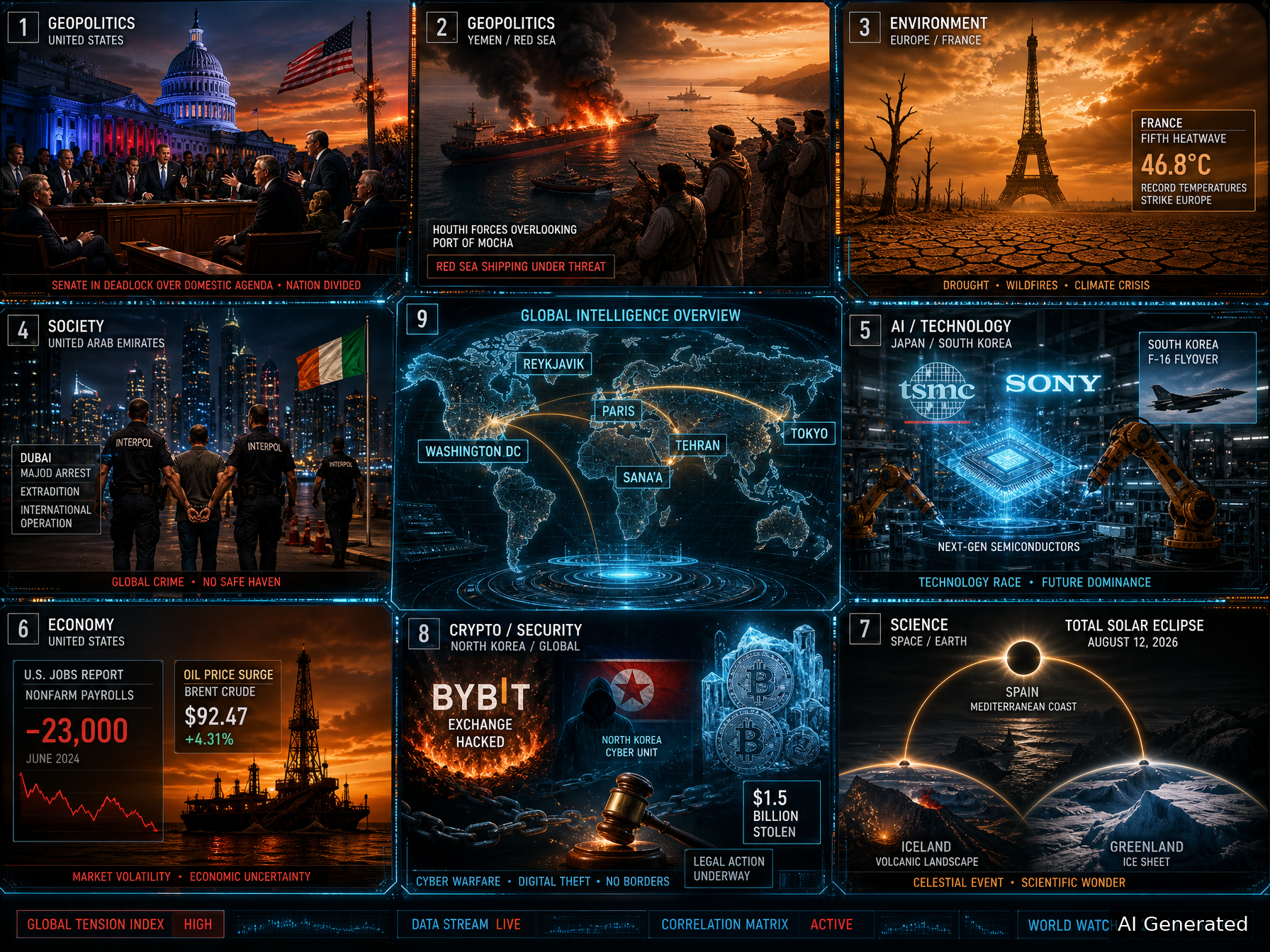


Contents
- 1. Geopolitics & Defence
- Trump faces bipartisan revolt as Democrat senator declares Iran war already lost
- Houthis launch deadly strike on Yemen port of Mocha as Red Sea crisis deepens
- Nepal halts Tibet conference after Chinese objections; Netanyahu rejects Gaza peace plan
- Colombia launches anti-narcoterrorism operations; Russian drones kill 12 in overnight strikes
- Royal Navy USV data scandal; British Ajax armoured vehicles fail exercises
- Germany demands Bundeswehr at airports; drones hover over Patriot base storing parts
- 2. Environment & Climate
- Western Europe experiences hottest June-July on record; France enters fifth heatwave
- Climate change doubled likelihood of Canada’s extreme fire weather; wildfire crisis intensifies globally
- France preparing for nationwide blackout simulation in 2027
- Amazon data centre could become largest US climate polluter; Trump blocks grid grants
- New Jersey landfill emits five times more methane than reported; US wetlands losing race against sea level
- 3. Society & Civil Issues
- Burnham cracks down on subscription traps and fake discounts; UK political landscape shifts
- Daniel Kinahan extradited from Dubai; Ireland marks end of global cat-and-mouse chase
- Sydney airport near-miss exposes systemic air traffic control failures
- Netanyahu’s rejection of Gaza peace plan leaves diplomatic vacuum; al-Aqsa tensions escalate
- Canada deports record number of Indians; migrant athletes vanish after Glasgow games
- 4. AI & Technology
- TSMC and Sony invest $6.3 billion in Japan chip plant; South Korea relocates airbase for chip cluster
- Anthropic enables Claude Code auto mode by default; Cloudflare warns of non-human internet
- Germany launches AI-driven digitisation push; Situational Awareness fund invests $400M in chip startup
- South Australia announces AI royal commission; Framework suffers data breach
- 5. Economy & Business
- US jobs report reveals labour market deterioration; nonfarm payrolls decline 23,000
- Oil prices rise as markets assess Hormuz deal prospects; Norway CPI surprises on the upside
- German Stihl warns against 35-hour week; Boeing 737 Max ordered to inspect 470 aircraft
- German real estate market stalling; housing shortage drives rents sharply higher
- 6. Science & Space
- Total solar eclipse approaches: Spain, Iceland, Greenland in path of totality
- Fructose linked to cancer metastasis in landmark Nature Aging study
- Long COVID patients show 18% fewer dopamine nerve endings; brain scans reveal visible damage
- US laboratory accelerates production of critical nuclear isotope californium-252
- Navy demonstrates Triton-Poseidon interoperability; US unmanned systems advance
- Long COVID dopamine loss persists for years; Denisovan skull confirmed through dental plaque DNA
- 7. Crypto, Digital Assets & Blockchain
- Bybit files civil lawsuit against North Korea over $1.5 billion hack; judge freezes stolen assets
- Trump Media kills CRO treasury deal; corporate crypto treasury thesis under pressure
- Wintermute obtains SEC broker-dealer licence; Polymarket five-second exploit drained $8.2 million
- Ethereum developers propose staking rewards to hit 0% at 50% staked; Aave founder warns of weakening demand
- Bitcoin BIP editor seeks Luke Dashjr’s removal; CYS skyrockets on Upbit listing
- 8. Correlations & Analysis
- 9. References
Click any heading to jump to that section. Click the section heading to return to this menu.
Geopolitics & Defence
Trump faces bipartisan revolt as Democrat senator declares Iran war already lost
Senator Chris Murphy, a Connecticut Democrat, delivered what may be the most pointed congressional critique of the Iran conflict to date, declaring on NBC’s Meet the Press that “Donald Trump has lost this war. America is weaker. Iran is stronger.” Murphy’s intervention crystallised the political danger facing the administration as the Strait of Hormuz remains blocked and the economic consequences ripple through American households. He revealed that the proposed deal would pay Iran approximately $100 billion annually — roughly one-third of Iran’s entire economy — simply to reopen the waterway, and argued this constituted a “victory for Iran” that would fund the reconstruction of the very military apparatus Washington had sought to degrade. Murphy nonetheless declared he would “support a bad deal to end this war” because the alternative — indefinite continuation — was worse for American families already paying elevated fuel and food prices[1]. The senator’s willingness to back a deal he considers catastrophic signals that bipartisan consensus for ending the conflict may be forming even as the diplomatic talks remain deadlocked.
Separately, Trump’s approach to Iran negotiations has come under scrutiny. The president’s strategy of “low-keying” the talks — downplaying their significance while negotiations remain stymied — has sparked a broader US policy debate about whether this approach delays rather than advances a comprehensive resolution[2]. The political dynamics intersect with the broader economic picture: crude oil prices rose Monday as traders assessed whether US-Iran negotiations could pave the way for a Hormuz reopening deal, but the market remains deeply uncertain about the probability of an agreement[3].
Houthis launch deadly strike on Yemen port of Mocha as Red Sea crisis deepens
Yemen’s Houthi rebels launched a deadly attack on the Red Sea port city of Mocha, killing seven people and injuring 30 in what the country’s military described as a significant strike on critical port infrastructure[4]. The attack extends the Houthis’ campaign beyond the shipping lanes they have targeted for months, now striking directly at civilian population centres and economic infrastructure within Yemen itself. This development complicates the humanitarian dimension of the Red Sea crisis, as Mocha serves as a vital commercial gateway for populations already suffering from years of civil war and blockade.
The Mocha strike must be understood in the context of the broader Houthi campaign that D70 documented through the attack on Saudi Arabia’s Jazan refinery. Together, these incidents demonstrate that the Houthis retain significant offensive capability despite months of US-led airstrikes, and that their operations are expanding in both scope and target selection. The group appears to be pursuing a strategy of demonstrating military relevance across multiple theatres simultaneously — attacking Saudi energy infrastructure, targeting shipping through the Red Sea, and now striking within Yemen to consolidate territorial control.
Nepal halts Tibet conference after Chinese objections; Netanyahu rejects Gaza peace plan
Nepal suspended an academic conference on Tibet after China objected, in a diplomatic incident that underscores Beijing’s expanding influence over its neighbours’ cultural and political life. The decision to halt a scholarly event at China’s request illustrates how economic dependency and political leverage can constrain even ostensibly sovereign nations from hosting discussions on topics Beijing considers sensitive[5]. The episode connects to a broader pattern of Chinese diplomatic assertiveness that extends from South Asia through Southeast Asia, where Beijing’s economic gravity increasingly determines what topics are publicly discussable.
Israeli Prime Minister Benjamin Netanyahu rejected a US-backed 15-point Gaza peace plan, dealing a significant blow to diplomatic efforts that had been building momentum. The rejection came as Netanyahu’s government faces pressure from multiple directions: the national elections scheduled for October, ongoing settlement expansion in the West Bank, and the escalating confrontations at al-Aqsa mosque compound. Jordanian officials have warned of an “imminent” Israeli takeover of the holy site, while far-right minister Itamar Ben-Gvir has made repeated provocative visits. The collapse of the peace initiative, combined with the al-Aqsa tensions, suggests that the final months before the Israeli election may see further escalation rather than restraint[6].
Colombia launches anti-narcoterrorism operations; Russian drones kill 12 in overnight strikes
Colombia’s new pro-Trump president Abelardo de la Espriella launched military operations that killed six members of armed groups within hours of his inauguration, signalling an immediate shift from dialogue to confrontation. De la Espriella had campaigned on ending what he termed “narcoterrorism” and declared that the option of dialogue with armed groups was “completely exhausted” — a reversal of the approach favoured by his predecessors[7]. The operations represent the latest in a series of rightward shifts across Latin American politics, where leaders increasingly adopt hardline security postures aligned with Washington’s counter-narcotics agenda.
On the Russia-Ukraine front, the overnight drone barrage continued its escalation pattern. Russia intercepted 456 Ukrainian drones in a single night, with strikes targeting approximately 15 regions including Tatarstan in central Russia and annexed Crimea. At least 12 people were killed and 39 wounded, with industrial and civilian sites among the targets[8]. The 15th Artillery Reconnaissance Brigade “Black Forest” separately destroyed a Russian command-and-staff vehicle of an S-300P/PM surface-to-air missile system, a significant tactical success against one of Russia’s most capable air defence platforms[9]. The scale of the overnight strikes — with hundreds of drones crossing Russian airspace — represents a continued expansion of Ukraine’s ability to project offensive power deep into Russian territory.
Royal Navy USV data scandal; British Ajax armoured vehicles fail exercises
A security revelation rocked the British Ministry of Defence when it was discovered that unmanned surface vessels used by elite Royal Marine units contained cameras with Chinese-origin components that were communicating directly to IP addresses in China. The K3 Scout vessels, revealed by The Telegraph, exposed critical supply chain vulnerabilities in surveillance equipment deployed by frontline units[10]. The incident compounds the broader concern about Chinese-manufactured components embedded in Western military systems — a vulnerability that has been discussed in the context of commercial telecommunications infrastructure but rarely demonstrated so directly in operational military hardware.
Separately, British Ajax armoured vehicles — one of the most expensive and troubled programmes in UK defence procurement — were rendered unfit for operations after sustaining damage during exercises, according to The Telegraph. Some vehicles were classified as “unsuitable for operations” following the exercise failures, raising serious questions about the reliability and combat readiness of a platform that has cost billions and been plagued by delays[11]. The combination of the USV data leak and the Ajax exercise failures exposes parallel vulnerabilities in both the software supply chain and the hardware readiness of Britain’s armed forces.
Germany demands Bundeswehr at airports; drones hover over Patriot base storing parts
Schleswig-Holstein’s Minister-President Daniel Günther called for Bundeswehr deployment at airports to protect against drone threats, and raised the possibility of a constitutional amendment to enable such operations. His intervention follows the discovery of an explosive-laden drone at Leipzig airport that targeted Ukrainian cargo aircraft — an incident that has fundamentally altered Germany’s calculus about civilian infrastructure vulnerability[12]. Separately, reports emerged of unidentified drones hovering over a German military base where Patriot air defence system components are stored, raising the spectre of foreign intelligence gathering or potential sabotage preparations on German soil[13]. The convergence of these incidents — airport targeting, base surveillance, and demands for military protection of civilian infrastructure — marks a new phase in Europe’s hybrid warfare challenge, where the boundary between peacetime and conflict has become increasingly porous.
These developments intersect with Defence Minister Dobrindt’s announcement of plans to expand drone security research at a new facility at the DLR test airfield in Cochstedt, representing Germany’s most comprehensive response yet to the drone threat that has loomed over European infrastructure throughout the summer.
Environment & Climate
Western Europe experiences hottest June-July on record; France enters fifth heatwave
The European Union’s Copernicus Climate Change Service confirmed that Western Europe experienced its hottest June-July period on record, as climate change fuels a historic summer of heat, drought, and wildfires across the region[14]. The announcement arrives as France enters its fifth heatwave of the summer, with Predict Services — a subsidiary of Météo France — forecasting that temperatures will approach 40 degrees Celsius from Wednesday across the country. The firm indicated that “cooler air” would not return for at least 15 days, extending what has already become one of the most punishing European summers in recorded history[15].
The record heat compounds the drought crisis documented across D67-D70, where Rhine and Danube water levels have fallen to navigation-threatening lows. The European river system — which carries approximately 40 per cent of inland freight — faces a crisis that threatens industrial supply chains, energy generation, and agricultural irrigation simultaneously. Serbia has declared a state of emergency around Novi Sad, where the Danube has fallen so low that 90 per cent of the port is effectively dry[16]. The French press has described the situation across Europe’s two great rivers as an “alerte rouge” — a red alert affecting everything from steel production to grain transport.
Climate change doubled likelihood of Canada’s extreme fire weather; wildfire crisis intensifies globally
A rapid analysis by World Weather Attribution found that human-induced climate change more than doubled the likelihood of the extreme weather conditions that fuelled Canada’s destructive 2026 wildfire season. As of early August, thousands of wildfires had burned more than 3.8 million hectares across the country — an area already significantly exceeding Canada’s 30-year annual average of 2.7 million hectares. The study found that approximately 94 per cent of the total burned area accumulated in a brief five-week window between late June and late July, with fires in the Northwest Territories now expected to occur every two to six years under current conditions, compared to every 50 years in the pre-industrial climate[17].
The Canadian fire season connects to the simultaneous wildfire emergencies documented across multiple continents. Greece continues to maintain Red Code fire alerts across multiple regions, while France’s fifth heatwave creates extreme fire risk conditions. In Britain, approximately 100 firefighters battled a large blaze at a waste facility in Dagenham, east London, with residents urged to keep windows and doors closed[18]. The British Columbia emergency, the Greek fires, and the London blaze collectively demonstrate that the fire season is no longer confined to traditionally fire-prone regions but is becoming a feature of summers across the entire Northern Hemisphere.
The World Weather Attribution study is significant because it quantifies what has been qualitatively obvious: climate change is not merely increasing the probability of individual fire events but is fundamentally restructuring the baseline conditions under which fires occur. The geographic spread documented by the researchers suggests that the entire boreal and temperate forest zone is transitioning to a higher-fire-frequency regime.
France preparing for nationwide blackout simulation in 2027
France is reportedly organising a nationwide tabletop exercise in the second half of 2027 to simulate a catastrophic electrical blackout involving the military, multiple energy ministries, and the operators of the national power grid. According to Politico Europe, the planning documents focus on preserving “the continuity of the state” and ensuring access to generators, medicines, telecommunications equipment, emergency supplies, and critical raw materials[19]. The scenario reflects growing alarm about cascading infrastructure failures in an era of extreme heat, cyber threats, and aging grid infrastructure.
The decision to plan for a nationwide blackout — rather than a localized outage — signals that French authorities believe the probability of systemic grid failure has moved beyond theoretical. The exercise draws on lessons from the devastating Spain-Portugal blackout of 2025, which demonstrated how quickly modern societies unravel when power fails for extended periods. In a country where nuclear power provides approximately 70 per cent of electricity, the simulation presumably includes scenarios for reactor shutdowns and the cascading effects on cooling systems, fuel supply chains, and regional power distribution. The timing is notable: France is simultaneously experiencing its fifth heatwave, which is straining exactly the kind of infrastructure the simulation is designed to test.
Amazon data centre could become largest US climate polluter; Trump blocks grid grants
Amazon is investing in an on-site natural gas power plant for a planned Texas data centre that could become the single largest source of climate pollution in the United States. The project represents the collision between two of the most powerful forces in contemporary America: the insatiable electricity demand of artificial intelligence computing and the political commitment to fossil fuel development[20]. The announcement intersects with the Trump administration’s blocking of more than $12.5 billion in Department of Energy grants intended to improve America’s electrical grid, which has left hundreds of infrastructure projects in administrative limbo across both red and blue states. A DOE lawyer confirmed in court testimony that terminations were not “based on any programmatic, statutory, cost-reduction or performance-based factor” but targeted states that voted for Kamala Harris in 2024.
The juxtaposition of a data centre designed to become the nation’s largest climate polluter with the deliberate starvation of grid improvement funding captures the paradox that D69 identified in the Correlations section: the same technology revolution driving unprecedented economic investment is simultaneously creating environmental pressures that undermine the climate commitments necessary to prevent compound crises.
New Jersey landfill emits five times more methane than reported; US wetlands losing race against sea level
A new study published in Environmental Science and Technology revealed that a New Jersey landfill emitted approximately five times as much methane in 2023 as was officially reported to the Environmental Protection Agency. Researchers from Lamont-Doherty Earth Observatory and Rutgers University found that the largest releases occurred during winter and periods of falling air pressure — conditions that conventional measurement campaigns typically avoid[21]. The tower-based monitoring system detected average emissions of approximately 6,000 pounds per hour, compared to the 1,180 pounds per hour reported to the EPA. Two summertime aircraft campaigns also produced estimates 37 per cent below the full-year tower measurement, suggesting that brief surveys systematically underestimate methane emissions.
Separately, a national assessment of US coastal wetlands found that 84 per cent of monitored sites are not gaining elevation fast enough to match rising sea levels. Only 16 per cent of the 442 monitoring stations showed elevation gains exceeding local sea-level rise, with the Gulf Coast showing the fastest submergence. The Gulf’s vulnerability stems partly from shipping canals that have disrupted river sediment flows and oil and gas extraction that lowers underground pressure. The findings suggest that the nation’s natural storm surge defences are increasingly compromised at precisely the moment when rising seas make them more necessary[22].
Society & Civil Issues
Burnham cracks down on subscription traps and fake discounts; UK political landscape shifts
Prime Minister Andy Burnham announced a crackdown on “rip-off discounts and subscription traps” as part of a series of “everyday fixes” designed to ease the cost of living crisis for British households. Under the plans, retailers will be banned from claiming prices have been discounted when they have not been reduced, while new rules taking effect in January 2027 will force companies to provide clearer subscription cost information and make it substantially easier to exit contracts. A new 14-day cooling-off period will allow consumers to cancel when trial subscriptions end or long-term contracts renew, potentially saving UK customers a collective £1.6 billion[23]. The measures represent Burnham’s most ambitious domestic policy initiative since assuming office, and are timed to coincide with his month-long national listening tour designed to reconnect the government with communities that felt ignored by the previous administration.
The consumer protection announcement arrives against a shifting political backdrop. A new poll of polls compiled by Election Maps UK placed Labour on 25.6 per cent with Reform UK trailing at 24.3 per cent, a dramatic reversal from the start of the year when Reform led Labour by 10 points. The shift coincides with Burnham replacing Keir Starmer, with the latest Ipsos survey showing Labour at 28 per cent — a four-point jump since June. The political trajectory has emboldened Burnham’s government, which has already removed VAT from electricity bills, capped bus fares at £2 outside London, and slashed business rates on hospitality businesses by 20 per cent[24].
Daniel Kinahan extradited from Dubai; Ireland marks end of global cat-and-mouse chase
The alleged leader of the Kinahan organised crime group was extradited from Dubai on Sunday and met by a massive security operation in Dublin, marking the end of what authorities described as a “global game of cat and mouse” involving European, US, and Gulf law enforcement agencies. The extradition represents the culmination of years of international cooperation to dismantle one of Europe’s most powerful drug trafficking organisations, which had established a transnational empire spanning Ireland, Spain, the UAE, and South America[25]. The operation’s success demonstrates the growing capacity of international law enforcement to pursue fugitives across jurisdictions that previously offered safe harbour.
Sydney airport near-miss exposes systemic air traffic control failures
A Jetstar plane narrowly avoided hitting a Qatar Airways aircraft that was pulled across the runway in front of it at Sydney airport, in an incident that resulted in two air traffic controllers being temporarily stood down. Transport Minister Catherine King called in Airservices Australia’s chief executive for a meeting in Canberra, describing the delays and near-miss as “unacceptable” and announcing that improved staff rostering would be in place from next month. The incident follows a pattern of air traffic control concerns at the airport, and the investigation has raised questions about whether staffing levels and working conditions at the facility meet the demands of one of the Southern Hemisphere’s busiest aviation hubs[26].
Netanyahu’s rejection of Gaza peace plan leaves diplomatic vacuum; al-Aqsa tensions escalate
Benjamin Netanyahu’s rejection of a US-backed 15-point Gaza peace plan has created a diplomatic vacuum at the worst possible moment, with national elections approaching in October and tensions at al-Aqsa mosque compound reaching dangerous levels. The Guardian’s Monday briefing detailed a new phase of confrontation at Jerusalem’s most sensitive holy site, with Jordanian officials warning of an “imminent” Israeli takeover. Far-right minister Itamar Ben-Gvir has made repeated visits to the compound over the past three years, eroding norms that have maintained relative stability at the site for decades. The convergence of election politics, settlement expansion, and holy site confrontations suggests that the Israeli government may be pursuing maximalist positions precisely because it calculates that international attention is absorbed by the Iran conflict[27].
The diplomatic dynamics connect to the broader regional picture documented throughout the reporting cycle. The Iran-US conflict has diverted American diplomatic bandwidth from the Israeli-Palestinian track, while the Houthis’ expanding operations in the Red Sea and the Mocha attack create humanitarian pressures that compound the Gaza crisis. The result is a region where multiple conflicts are accelerating simultaneously while diplomatic frameworks designed to manage them are failing.
Canada deports record number of Indians; migrant athletes vanish after Glasgow games
Canada deported 3,323 Indians in the first half of 2026, already approaching last year’s record as Ottawa tightens immigration enforcement. The figure represents a significant escalation in Canada’s deportation efforts, reflecting broader political pressure to demonstrate control over immigration flows[28]. Separately, four members of Uganda’s Commonwealth Games boxing team failed to board their return flight after competing in Glasgow, with reports indicating at least one intended to claim asylum. The disappearances represent the latest in a pattern of athletes from developing nations vanishing during or after international sporting events held in Western countries, raising questions about the intersection of sporting competition and migration pressure.
These migration-related stories connect to the broader European migration tensions documented throughout the reporting cycle. The Spain-Italy border dispute, the Ceuta crisis, and now the Clacton-by-election — where 34 candidates including Nigel Farage and Count Binface are competing in a contest that has become a referendum on immigration policy — all reflect a continent where migration has become the defining political issue of 2026. Weber’s call for EU deportation centres in Africa and the German debate about Bundeswehr deployment at airports to manage migration-related security concerns demonstrate that the political response is increasingly securitised.
AI & Technology
TSMC and Sony invest $6.3 billion in Japan chip plant; South Korea relocates airbase for chip cluster
Taiwan Semiconductor Manufacturing Co. and Sony Corporation announced plans to invest approximately $6.3 billion (€5.4 billion) in a joint venture to produce advanced image sensors in Japan, according to Nikkei reporting[29]. The facility, planned for mass production of next-generation imaging sensors by 2029, represents a major acceleration of Japan’s efforts to rebuild its semiconductor manufacturing capabilities after decades of decline. The investment builds on the existing TSMC Kumamoto facility and signals that the global chip supply chain is undergoing a fundamental restructuring driven by geopolitical risk, national security concerns, and the insatiable demand generated by AI computing.
Simultaneously, South Korean President Lee Jung-myung pushed for the relocation of a military airbase by mid-2028 to create space for a massive chip cluster, in a move that directly mirrors the Kaohsiung model where military land was repurposed for semiconductor fabrication. The convergence of Japanese and South Korean investments reflects a broader pattern across the Indo-Pacific, where nations are deploying industrial policy at unprecedented scale to capture positions in the AI-driven chip economy. The competitive dynamics threaten to create both overcapacity in certain segments and critical bottlenecks in others, as multiple countries race to build fabs within overlapping timelines.
Anthropic enables Claude Code auto mode by default; Cloudflare warns of non-human internet
Anthropic announced it is turning Claude Code’s auto mode on by default, meaning that programming with its AI coding assistant will soon require even less human oversight. The change represents a significant philosophical shift in how AI development tools are positioned — from “copilot” models requiring constant human guidance toward increasingly autonomous systems that can execute complex coding tasks with minimal supervision. The decision arrives amid growing debate about the appropriate level of human oversight for AI systems that are progressively capable of operating independently[30].
Separately, Cloudflare’s chief financial officer warned that non-human internet traffic could surpass human traffic at a ratio of 1,000 to one, in a prediction that captures the scale of the transformation underway in digital infrastructure. The implication is that the internet is rapidly becoming a machine-to-machine communication network, with AI agents, automated trading systems, and IoT devices generating the overwhelming majority of traffic. This reality challenges the fundamental assumptions on which internet architecture, security models, and business models were built — assumptions that assumed a human user as the primary endpoint of digital activity[31].
Germany launches AI-driven digitisation push; Situational Awareness fund invests $400M in chip startup
Germany’s Digital Minister Karsten Wildberger unveiled a comprehensive plan to use artificial intelligence as the primary driver of the country’s digital transformation, with municipalities joining the effort at a scale previously unseen in German administrative modernisation[32]. The plan represents Germany’s most ambitious attempt to close the digital gap with both the US and China, where AI adoption in government and business services has proceeded at a much faster pace. The inclusion of municipal governments — which in Germany control substantial portions of public services — suggests that the initiative aims to transform citizen-facing digital infrastructure, not merely central government systems.
Meanwhile, the AI-focused hedge fund Situational Awareness invested $400 million in chip startup Source Foundry, demonstrating continued investor appetite for semiconductor companies despite broader market uncertainty. The investment signals that sophisticated capital is positioning for the physical infrastructure requirements of AI computing, betting that the demand for specialised chips will continue to grow even as questions persist about the pace of AI capability advancement and the return on investment for massive infrastructure buildouts[33].
South Australia announces AI royal commission; Framework suffers data breach
South Australia’s premier announced a royal commission into artificial intelligence and “how it will be deployed,” making it one of the first jurisdictions in the world to establish a formal judicial inquiry into AI’s societal implications. The announcement reflects growing concern among policymakers about the speed at which AI systems are being integrated into critical infrastructure, hiring decisions, healthcare delivery, and law enforcement — domains where errors or biases can have life-altering consequences for citizens[34]. The royal commission model, borrowed from responses to institutional failures in banking and aged care, signals that Australian authorities view AI governance as requiring the same level of independent scrutiny as systemic institutional wrongdoing.
Framework, the modular computer company, disclosed a data breach affecting customer information, adding to the growing list of technology companies experiencing security incidents that expose the vulnerability of digital infrastructure. The breach underscores the irony of a company built on the principle of user control and transparency being compromised by the very digital systems it seeks to democratise. The incident connects to the broader cybersecurity challenges documented across the reporting cycle, from the BTCPay Server exploit to the growing sophistication of state-sponsored attacks on critical infrastructure.
Economy & Business
US jobs report reveals labour market deterioration; nonfarm payrolls decline 23,000
The July employment report confirmed what private-sector data had been signalling for months: the US labour market is weakening beneath the headline numbers. Nonfarm payrolls declined by 23,000 in July, compared with expectations for an increase of approximately 80,000. More critically, May and June were revised downward by a combined 103,000 jobs, reducing average employment growth over the past three months to only 20,000 per month — a pace that barely keeps pace with population growth, let alone the needs of an expanding economy[35].
The unemployment rate’s decline from 4.2 per cent to 4.1 per cent proves misleading: labour participation fell by 0.7 percentage points since January, while the employment-to-population ratio dropped 0.5 point, confirming that people are leaving the labour force rather than finding productive employment. The financial sector has shed 121,000 jobs since May 2025, reflecting a contraction in credit-related activity tied to rising financing costs and the growing sovereign-debt overhang. Local government education lost 50,000 positions, retail trade lost 19,000, and the pace of healthcare hiring — previously a reliable growth engine — has slowed markedly. Wages rose a mere two cents in July, with year-over-year growth at 3.2 per cent, providing no relief for workers facing persistent cost-of-living pressures.
Oil prices rise as markets assess Hormuz deal prospects; Norway CPI surprises on the upside
Crude oil prices gained Monday as traders assessed whether US-Iran negotiations over the Strait of Hormuz reopening could produce a breakthrough. The market remains deeply divided between those who see the diplomatic process as moving toward resolution and those who view the fundamental gap between Tehran’s comprehensive demands and Washington’s willingness to concede as insurmountable[36]. The uncertainty is reflected in the oil market’s inability to establish a clear trend despite the strategic significance of the waterway through which approximately 20 per cent of global oil supplies transit.
Norway’s consumer price index surprised to the upside, with month-on-month inflation hitting 1.0 per cent against expectations of no change, while year-on-year inflation reached 3.0 per cent versus the expected 2.8 per cent. The unexpectedly strong inflation print complicates the Norges Bank’s rate path and provides ammunition for central bank hawks across Europe who argue that premature rate cuts could entrench inflationary pressures. The Norwegian data arrives against a backdrop of Finnish industrial output rising 4.5 per cent year-on-year in June and Dutch manufacturing output falling 1.3 per cent month-on-month, illustrating the divergent economic trajectories across Northern European economies.
German Stihl warns against 35-hour week; Boeing 737 Max ordered to inspect 470 aircraft
Nikolas Stihl, chairman of the advisory board of the chainsaw and garden equipment manufacturer, warned that “Germany can no longer afford a 35-hour week,” adding his voice to a growing chorus of industrial leaders arguing that the country’s competitive position is eroding due to excessive regulation and insufficient working hours[37]. Stihl’s intervention follows Mercedes chief executive Martin Brudermüller’s call for longer working hours without pay compensation, reflecting a broader debate within German industry about whether the country’s social model remains economically sustainable in an era of global competition, energy disruption, and demographic decline. The debate intersects with the broader European labour market tensions documented throughout the reporting cycle, where the post-pandemic normalisation has exposed structural vulnerabilities in employment models designed for a different economic era.
The US Federal Aviation Administration ordered inspections of approximately 470 Boeing 737 MAX aircraft following concerns about potential cracks near the forward door, with the European Union Aviation Safety Agency expected to follow suit. The inspection order recalls the 737 MAX grounding crisis that followed two fatal crashes, and while the current concern involves a different structural element, it adds to Boeing’s ongoing quality and safety challenges that have eroded confidence in the manufacturer. Separately, reports emerged that Boeing’s 777X widebody programme is becoming the company’s largest economic problem, with satellite images showing the aircraft sitting in storage as certification delays extend further[38].
German real estate market stalling; housing shortage drives rents sharply higher
New data from more than 700 German financial institutions revealed that the country’s real estate market is stalling, with particular weakness in commercial property segments. The findings challenge the assumption that interest rate stabilisation would revive the market after the correction triggered by the ECB’s tightening cycle. Meanwhile, rents across Germany rose sharply due to an acute housing shortage, with the statistics office confirming that the supply-demand imbalance continues to drive living costs higher[39]. The housing market dynamics represent a structural challenge for the German economy: insufficient construction activity, combined with immigration-driven population growth and the retirement of the baby boomer generation from the housing market, has created a supply deficit that no near-term policy intervention can resolve.
German business leaders have responded to these pressures with a combination of cost-cutting and strategic repositioning. The Stihl comments about working hours, the ongoing debate about inheritance tax reform that threatens family-owned businesses, and the broader discussion about Germany’s declining competitiveness all point to an economy in structural transition — one where the industrial model that drove prosperity for decades is being challenged by energy costs, demographic change, and the pace of technological transformation.
Science & Space
Total solar eclipse approaches: Spain, Iceland, Greenland in path of totality
The August 12 total solar eclipse is now just two days away, with the path of totality cutting a corridor through Spain, Iceland, and Greenland while hundreds of millions more across Europe, Africa, and the Americas will witness a partial eclipse. Maximum totality will last 2 minutes and 18 seconds, with observers in the path able to view the sun’s corona — the outer atmosphere normally hidden by the solar disk. The event coincides with the peak of the Perseid meteor shower, creating a rare double celestial spectacle. Madrid will experience 99.96 per cent solar coverage at maximum, while London sees 91 per cent and Paris 92 per cent[40].
Eclipse chasers face a potential challenge from wildfire smoke: British Columbia’s ongoing fires and the European fire season have injected particulate matter into the atmosphere that could obscure views along parts of the path. Space agencies are attempting to monitor the atmospheric conditions to determine whether smoke will significantly affect the viewing experience. The eclipse arrives as a potent metaphor for the reporting cycle’s central finding — that the crises we can see clearly are the ones we have already failed to prevent. After the August 12 event, the next total solar eclipse visible from Europe will not occur until 2027.
Fructose linked to cancer metastasis in landmark Nature Aging study
Researchers at The Wistar Institute published a striking finding in Nature Aging: fructose, a sugar ubiquitous in modern diets, appears to act as a signal that loosens cancer cells and helps them spread. The study focused on ovarian cancer cells treated with cisplatin chemotherapy, which induces a state called cellular senescence in which cells remain metabolically active despite no longer dividing. These senescent cells secreted elevated levels of fructose, which altered mitochondrial metabolism and reduced cholesterol production in neighbouring cells — making them less adhesive and more likely to detach and metastasise[41].
In mouse models, animals fed a high-fructose diet developed substantially more metastatic tumours than those receiving glucose, while disabling the cancer cells’ ability to metabolise fructose reduced cell movement. The researchers cautioned that the findings are preclinical and should not be interpreted as evidence that dietary fructose alone causes ovarian cancer metastasis in humans. However, given that a third of American teenagers consume 15 per cent or more of their calories from sugar — particularly high-fructose corn syrup — the study raises the possibility that dietary intervention could complement existing cancer treatments. Lead researcher Aidan Cole noted that “this is the first time anyone has shown, in a preclinical model, that it’s the molecules these cells release — not the cells themselves — that drive the cancer’s spread.”
Long COVID patients show 18% fewer dopamine nerve endings; brain scans reveal visible damage
A Canadian research team demonstrated that people who experienced persistent apathy and depression for the first time after a COVID-19 infection have approximately 18 per cent fewer dopamine nerve endings in their brains than healthy individuals. The study, published in eBioMedicine, used PET scans to measure VMAT2 — a well-established biomarker for dopamine neurons — in 24 adults with long COVID and 24 healthy controls[42]. The damage was detectable in people who had lived with long COVID for up to 4.6 years, suggesting persistent neurological effects rather than temporary disruption.
The finding is particularly significant because the changes were visible on brain scans — translating a clinically elusive neuropsychiatric condition into a measurable biological signal. Loss of dopamine nerve endings in the ventral striatum was linked to lower motivation, while loss in the putamen correlated with slower movement and task completion, and loss in the caudate nucleus was tied to memory decline. Jeffrey Meyer, a neurochemist at the University of Toronto, indicated that the VMAT2 biomarker could potentially be used to diagnose long COVID and that upcoming clinical trials will test whether dopamine-modulating medications can improve symptoms.
US laboratory accelerates production of critical nuclear isotope californium-252
Oak Ridge National Laboratory developed a new chemical processing technique that could save a week or more from the production schedule for californium-252, a rare radioactive isotope used to initiate nuclear reactors and support national security applications. ORNL is currently the sole Western producer of the isotope, and demand is expected to increase as the United States expands its nuclear energy programme — including plans for 10 new large reactors by 2030 and military deployment of nuclear reactors at domestic Army bases[43]. The breakthrough, originated from a nearly decade-old idea by radiochemist Lætitia Delmau, replaces a processing step that required approximately one week with a more efficient solvent extraction technique. The improvement is significant because californium-252 is produced on a two-year cycle and the isotope’s relatively short half-life limits stockpiling.
Navy demonstrates Triton-Poseidon interoperability; US unmanned systems advance
Northrop Grumman and Boeing demonstrated enhanced interoperability between the MQ-4C Triton unmanned maritime surveillance aircraft and the P-8A Poseidon maritime patrol aircraft, showing how a manned aircraft can issue machine-readable mission instructions to an unmanned platform through standards-based interfaces. During the laboratory demonstration, a P-8A operator directed a Triton toward a designated area, with the unmanned aircraft autonomously planning its transit, employing sensors, processing collected information, and transmitting findings back[44]. The demonstration represents a significant step toward the distributed, networked warfare model that both navies have identified as essential for countering peer adversaries.
The interoperability milestone arrives alongside broader advances in unmanned systems across multiple nations. India successfully tested an indigenous swarm drone system by Aerostem Technology, validating autonomous coordination and resilience under jamming conditions[45]. Germany announced plans to expand drone security research at a new facility, while China’s Y-20B transport aircraft has been revealed as a multi-role platform capable of conversion into aerial tankers, electronic warfare systems, and other specialised configurations. The convergence of these developments across multiple countries underscores the global nature of the unmanned systems revolution reshaping military doctrine.
Long COVID dopamine loss persists for years; Denisovan skull confirmed through dental plaque DNA
Two major scientific discoveries illuminate different aspects of the natural world’s hidden complexity. In neuroscience, the Canadian long COVID study revealed that neurological damage from COVID-19 persists far longer than previously understood — the 18 per cent reduction in dopamine nerve endings was measurable years after initial infection, suggesting that the pandemic’s neurological legacy may be substantially larger than acute case counts imply[46]. The finding also raises the possibility that dopamine depletion could contribute to the broader societal trends of declining cognitive performance documented in recent years, though such connections remain speculative.
In paleoanthropology, researchers confirmed that the Harbin skull — one of the most complete ancient human skulls ever found — belongs to the Denisovans, the mysterious archaic human species first identified from a single finger bone in Siberia. The identification was achieved through analysis of just 0.3 milligrams of dental plaque preserved on the skull’s remaining tooth, from which mitochondrial DNA sequences were extracted that matched other Denisovan specimens[47]. The technical achievement demonstrates how far ancient DNA analysis has advanced, enabling identification from samples that would have been impossible to analyse a decade ago. The finding gives the Denisovans a face for the first time — revealing a large, heavy-boned individual with thick brow ridges who lived in northern China at least 146,000 years ago.
Crypto, Digital Assets & Blockchain
Bybit files civil lawsuit against North Korea over $1.5 billion hack; judge freezes stolen assets
Cryptocurrency exchange Bybit filed a civil lawsuit in US federal court against North Korea, its intelligence agency, and the Lazarus Group over the $1.5 billion hack of February 2025, in what represents one of the most ambitious legal actions in crypto history. A federal judge has already frozen stolen assets, raising the possibility that substantial portions of the stolen funds could be recovered through the US legal system. The case tests whether the long arm of American civil jurisdiction can reach state-sponsored actors who operate behind the veil of national sovereignty[48].
The Bybit case is significant beyond its immediate financial stakes. If successful, it could establish a legal precedent for holding state intelligence agencies liable for cryptocurrency theft under civil law, potentially opening a new avenue for recovering stolen digital assets. The Lazarus Group, linked to North Korea’s Reconnaissance General Bureau, has been responsible for some of the largest cryptocurrency thefts in history, with proceeds reportedly funding the regime’s weapons programmes. The lawsuit’s focus on civil rather than criminal jurisdiction avoids the diplomatic complexities of criminal prosecution while potentially achieving practical asset recovery.
Trump Media kills CRO treasury deal; corporate crypto treasury thesis under pressure
Trump Media and Technology Group terminated its planned Cronos treasury venture with Crypto.com and Yorkville on August 7, in a retreat that signals broader difficulties with the corporate cryptocurrency treasury thesis. The concept — that publicly traded companies can enhance shareholder value by holding digital tokens on their balance sheets — had attracted considerable attention and investment, but the Trump Media withdrawal suggests that the practical challenges of volatility, regulatory uncertainty, and accounting treatment may be proving more difficult than proponents anticipated[49].
The termination arrives as the broader crypto treasury boom faces questioning. The fundamental premise — that holding tokens constitutes a balance sheet strategy comparable to holding cash or treasuries — has struggled to survive contact with reality. Corporate boards must contend with mark-to-market volatility that can swing quarterly earnings, regulatory uncertainty about how to classify digital assets, and shareholder pressure to explain why corporate capital is being allocated to speculative assets rather than productive business investment. The Trump Media decision may accelerate a broader reckoning with the corporate treasury trend.
Wintermute obtains SEC broker-dealer licence; Polymarket five-second exploit drained $8.2 million
Wintermute, the largest cryptocurrency liquidity provider, registered with the Financial Industry Regulatory Authority on August 6, obtaining SEC approval to trade stocks in addition to digital assets. The move signals a fundamental shift in the crypto market structure: the infrastructure that runs digital asset markets is migrating onto traditional financial rails. Wintermute’s dual registration as both a crypto market maker and a registered broker-dealer positions it to offer seamless cross-asset liquidity, potentially blurring the distinction between crypto and traditional financial markets[50].
Separately, researchers identified an exploit that drained $8.2 million from Polymarket through manipulation of bitcoin prices in the final seconds before settlement of short-dated contracts. The study found 821 accounts that systematically profited from the five-second window between contract settlement snapshots, highlighting a structural vulnerability in prediction market design. Polymarket has since replaced instant snapshots with time-weighted averages, but the incident raises broader questions about market integrity in prediction markets that increasingly intersect with political outcomes and financial instruments[51].
Ethereum developers propose staking rewards to hit 0% at 50% staked; Aave founder warns of weakening demand
Ethereum developers proposed a mechanism that would gradually reduce validator issuance as more ETH is staked, ultimately reducing net rewards to zero when approximately 50 per cent of the total supply is locked in staking. Aave founder Stani Kulechov argued the plan could weaken institutional demand, reduce DeFi activity, and undermine Ethereum’s competitiveness against rival platforms that offer more attractive staking economics[52]. The proposal addresses a genuine protocol-level challenge — the security model requires sufficient staked ETH to prevent attacks, but excessive staking reduces the circulating supply available for economic activity — but the specific parameters chosen could have significant unintended consequences.
The staking debate arrives as Bitcoin consolidated above $65,000, with US inflation data and Iran-related geopolitical risks dominating market attention. Implied volatility fell to a new 2026 low even as spot Bitcoin ETFs attracted approximately $1 billion in weekly inflows — the strongest week since April — suggesting institutional accumulation is occurring against a backdrop of declining uncertainty. The juxtaposition of low volatility and strong inflows may indicate that institutional investors are treating the current price level as a strategic accumulation zone rather than a tactical trading opportunity.
Bitcoin BIP editor seeks Luke Dashjr’s removal; CYS skyrockets on Upbit listing
Bitcoin improvement proposal editor Murch called for the removal of Luke Dashjr from his editorial role, citing concerns about the BIP-110 process that created a minority chain. The governance dispute extends the conflict documented in D70 over the activation mechanism for consensus rule changes, where the community remains divided between those who favour speed and those who prioritise caution[53]. The dispute highlights the ongoing challenge of Bitcoin governance: a system designed to resist centralised control must somehow resolve technical disagreements about the protocol’s future direction.
The Cysic token experienced a dramatic surge following its listing on South Korea’s Upbit exchange, rising more than 60 per cent from $0.80 to a new all-time high of $1.30 before retreating sharply. The timing of the price spike — several hours before Upbit’s official announcement — raised eyebrows about potential insider trading, connecting to the broader concern about information asymmetry in crypto markets that the Kalshi enforcement actions and Polymarket exploit also illustrate. Upbit listings have a well-documented history of producing immediate pumps followed by sharp retracements, and the CYS episode appears to follow the established pattern precisely.
Correlations & Analysis
D71 captures a moment when multiple crisis trajectories documented across D67-D70 are converging into a pattern that transcends any individual conflict or economic data point. The day’s most consequential development may not be the single largest headline but the accumulation of structural pressures that are simultaneously reshaping the geopolitical, economic, and technological landscape. Senator Murphy’s declaration that “America is weaker, Iran is stronger” represents more than partisan critique — it articulates the emerging consensus that the post-February 2026 conflict has produced outcomes diametrically opposed to its stated objectives[1]. The Strait of Hormuz remains blocked, global energy supply chains are being rerouted, and the proposed $100 billion annual payment to Iran would constitute one of the largest transfers of wealth from a conflict’s instigator to its target in modern history.
The economic dimensions of the crisis extend far beyond the Hormuz disruption. The US jobs report’s revelation that nonfarm payrolls declined by 23,000 — with the previous two months revised down by 103,000 — suggests that the cumulative impact of energy price inflation, supply chain disruption, and geopolitical uncertainty is now manifesting in the labour market data that the Federal Reserve uses to calibrate monetary policy[35]. The financial sector’s loss of 121,000 jobs since May 2025 tracks the credit contraction that accompanies rising financing costs, while Germany’s simultaneous housing crisis, industrial malaise, and political debate about the sustainability of the 35-hour week illustrate how the compound pressures documented across the reporting cycle are now producing visible structural stress in Europe’s largest economy[37]. The German real estate market’s stalling, the acute housing shortage, and the baby boomer demographic transition are not discrete problems but interconnected manifestations of an economic model struggling to adapt to conditions fundamentally different from those under which it was designed.
The AI dimension continues to expand along the trajectory that D68-D70 identified. TSMC and Sony’s $6.3 billion Japan investment, South Korea’s military airbase relocation for chip manufacturing, and Situational Awareness’s $400 million chip startup investment collectively demonstrate that the physical infrastructure requirements of artificial intelligence are reshaping national industrial strategies across the Indo-Pacific[29]. The race for semiconductor capacity has moved beyond commercial competition into the realm of national security, with Japan, South Korea, and Taiwan deploying industrial policy at scales previously reserved for wartime mobilisation. Meanwhile, Cloudflare’s warning that non-human internet traffic could reach 1,000-to-1 ratios against human traffic suggests that the digital ecosystem these chips will power is evolving faster than the governance frameworks designed to regulate it[31].
The environmental and infrastructure crisis documented across the reporting cycle has acquired new dimensions in D71. Western Europe’s hottest June-July on record, France’s fifth heatwave, and the Danube’s collapse to 90 per cent dry at Novi Sad represent not anomalies but the new baseline against which European economies must operate[14]. The France blackout simulation planned for 2027 signals that governments are beginning to prepare for scenarios that would have been considered implausible five years ago[19]. The convergence of extreme heat, drought-strained rivers, overtaxed power grids, and the AI data centre boom — which D70 documented through the Amazon Texas facility and D71 extends through the TSMC-Sony investment — creates a feedback loop where the technology driving economic growth simultaneously degrades the infrastructure on which both the technology and the economy depend. Canada’s wildfire season, which climate attribution analysis confirmed was made twice as likely by climate change, demonstrates that the environmental crisis is no longer a future threat but a present reality reshaping emergency management, mutual aid resources, and international relations[17].
What to watch in the next reporting period: First, whether the Iran diplomatic stalemate produces a breakthrough or a further hardening of positions — Murphy’s willingness to accept a “bad deal” suggests political space exists for a compromise that would have been politically impossible weeks ago, but Iran’s comprehensive demands may exceed what any US administration can accept. Second, the August 12 total solar eclipse will serve as both a scientific event and a metaphorical punctuation mark for the summer’s compound crises, with wildfire smoke potentially obscuring the view across the path of totality. Third, whether the US jobs data accelerates the Federal Reserve’s shift toward rate cuts, and whether European central banks follow — the divergence between weakening employment and persistent inflation creates a policy trap that no monetary authority has yet navigated successfully. Fourth, the corporate crypto treasury retreat signalled by Trump Media’s withdrawal from the CRO deal, and whether the broader market interprets this as a healthy correction or the beginning of a more fundamental reassessment of digital assets as corporate reserves. Fifth, whether Germany’s digital transformation initiative under Minister Wildberger produces measurable progress or becomes another well-intentioned plan that stalls against the country’s notoriously slow implementation capacity[19][14][35][29][17].
References
1. Trump ally Warns: Democrats say Trump has already lost the war on Iran Huffington Post UK ↩
2. Trump’s ‘low-keying’ Iran talks sparks US policy debate Crypto Briefing ↩
3. Oil prices rise as traders assess US-Iran talks on Strait of Hormuz deal Euronews ↩
4. Middle East live: Houthis launch deadly strike on port city of Mocha in Yemen France 24 ↩
5. Nepal halts Tibet academic conference after China objects Nikkei Asia ↩
6. Monday briefing: How the new phase of confrontation at al-Aqsa signals a challenge to the status quo The Guardian ↩
7. En Colombie, six membres de groupes armés tués lors d’opérations lancées par le nouveau président pro-Trump FranceInfo ↩
8. Hundreds of Ukrainian drones target Russia in deadly overnight strikes France 24 ↩
9. 15th Artillery Reconnaissance Brigade Destroys S-300 Command-and-Staff Vehicle Militarnyi ↩
10. Royal Navy: Φιάσκο ολκής, τα βρετανικά USV ενημέρωναν κατευθείαν την Κίνα! Defence Point GR ↩
11. Βρετανικά Ajax εκτός μάχης λόγω βλαβών σε άσκηση; Σε πόλεμο τι θα γίνει; Defence Point GR ↩
12. Hybride Kriegsführung: Daniel Günther fordert Bundeswehr an Flughäfen zum Schutz vor Drohnen Die Zeit ↩
13. Νέα ανησυχία στη Γερμανία – Drones πάνω από βάση όπου φυλάσσονται ανταλλακτικά Patriot Defence ReDEFINED ↩
14. Western Europe experienced hottest June-July on record: EU monitor Phys.org ↩
15. Le retour d’un ‘air un peu plus frais’ pas avant 15 jours en France FranceInfo ↩
16. Le niveau du Danube au plus bas : en Serbie, la région de Novi Sad où ‘90% du port est à sec’ en état d’urgence Le Parisien ↩
17. Climate change doubled likelihood of Canada’s extreme fire weather, study finds Mongabay ↩
18. 100 firefighters tackle large blaze in east London Evening Standard ↩
19. Why Is France Preparing for a Nationwide Blackout in 2027? Armstrong Economics ↩
20. Jeff Bezos Plans To Enrich Himself With Mammoth Carbon Dioxide Emissions In Texas CleanTechnica ↩
21. New Jersey landfill emitted five times as much methane in 2023 as officially reported Ecoticias ↩
22. Eighty-four percent of U.S. coastal wetlands are not keeping pace with rising seas Ecoticias ↩
23. Burnham Announces Crackdown On ‘Rip-Off Discounts And Subscription Traps’ Huffington Post UK ↩
24. Labour stretches lead over Reform UK as Burnham surges in polls Huffington Post UK ↩
25. Daniel Kinahan returned to Ireland ends global game of cat and mouse The Guardian ↩
26. Two workers were temporarily stood down after near-miss collision at Sydney Airport The Guardian ↩
27. Monday briefing: How the new phase of confrontation at al-Aqsa The Guardian ↩
28. Canada’s Indian deportations hit record: 3,323 removed in 6 months Business Standard ↩
29. Tech giants TSMC and Sony to invest billions in advanced chip sensor plant Euronews ↩
30. Anthropic is turning Claude Code’s auto mode on by default TechCrunch ↩
31. Cloudflare CFO warns non-human traffic could surpass human traffic 1,000-to-1 Crypto Briefing ↩
32. Plan des Digitalministers: So soll Künstliche Intelligenz nun Deutschland digitalisieren FAZ ↩
33. Embattled hedge fund Situational Awareness invests $400M in chip startup Source Foundry TechCrunch ↩
34. Australia news live: SA premier announces royal commission into AI The Guardian ↩
35. July Jobs Report Confirms the Trend Already in Motion Armstrong Economics ↩
36. Oil prices rise as traders assess US-Iran talks Euronews ↩
37. Industrie: Unternehmer Stihl mahnt: Können uns eine 35-Stunden-Woche nicht mehr leisten Handelsblatt ↩
38. Luftfahrtindustrie: US-Aufseher lassen gut 470 Boeing-Flugzeuge auf Risse prüfen WirtschaftsWoche ↩
39. Immobilien: Dreht der Kaufmarkt? Was neue Daten der Banken verraten Handelsblatt ↩
40. What time is the total solar eclipse on Aug. 12, 2026? Space.com ↩
41. Common Sugar Appears to Loosen Cancer Cells And Help Them Spread ScienceAlert ↩
42. Long COVID Patients Have 18% Fewer Dopamine Nerve Endings, Brain Scans Reveal ScienceAlert ↩
43. US lab’s new technique could accelerate production of critical nuclear isotope Interesting Engineering ↩
44. US’ unmanned plane shares intelligence with submarine-hunter aircraft in landmark collaboration Interesting Engineering ↩
45. Aerostem Technology Successfully Tests Indigenous Swarm Drone System Indian Defence News ↩
46. Long COVID Patients Have 18% Fewer Dopamine Nerve Endings ScienceAlert ↩
47. Denisovan skull confirmed: 0.3 milligrams of dental plaque solves 85-year mystery ScienceBlog ↩
48. Bybit is suing North Korea, and it might actually work Crypto News ↩
49. Trump Media killed the CRO treasury deal, and the entire crypto treasury boom may be next Crypto News ↩
50. Wintermute just got SEC approval to trade stocks Crypto News ↩
51. The five second trick that drained millions from Polymarket Crypto News ↩
52. Ethereum Devs Want ETH Staking Rewards to Hit 0% at 50% Staked Bitcoin.com News ↩
53. Bitcoin BIP editor seeks Luke Dashjr’s removal Crypto News ↩
AI Disclosure: This post was created with the assistance of artificial intelligence. The ideas, analysis, and opinions expressed are my own — AI was used to help compose, structure, and refine my personal notes and thoughts into the final written content. Images, videos and music featured in this post were also generated using AI tools, based on my own creative prompts and direction.