










Contents
- 1. Geopolitics & Defence
- The Gulf Clock: A New Year Deadline and Tehran’s Underground Reply
- Ukraine’s Winter Escalation: Kyiv’s Deadliest Night and the Assassination Files
- NATO’s Emergency Session and the Alliance’s Response Ladder
- The Mediterranean Periphery: Libya’s New Front and Israel’s Southern Operations
- South Asia’s Diplomatic Week: Nepal, Pakistan, the SCO and the LeT Threat
- Africa’s Security Ledger: Sudan, Nigeria and the Congo’s Electoral Doubts
- 2. Environment & Climate
- COP31’s Collapse: The Longest Summit Ends With Nothing Adopted
- America’s Weather Extremes: Floods, Drought and the King Tides
- The Pollution Ledger: Gaza’s Long Contamination and America’s Regulatory Wins
- The Energy-Transition Ledger: Ports, Hydrogen and the Money That Moves
- The Climate-Economy Interface: Insurance Retreat and Wildfire Litigation
- The Living Ledger: Pupfish, Orcas, Bird Flu and a Reef’s Defenders
- 3. Society & Civil Issues
- Europe’s Civic Square: Austerity Strikes, Farmers and the Social Squeeze
- France’s 2027 Chessboard and the Cost-of-Living Ledger
- The British Ledger: Brussels, Bereavement and Defence Strikes
- America’s Civic Ledger: ICE, Lead Azide, Property Taxes and the Courts
- The Global Civic Periphery: Istanbul, Breaches and Public Safety
- 4. AI & Technology
- The Nvidia File: A Founder’s Return, Export-Controls Fallout and the Smuggling Ledger
- AI Capital and the Regulatory Front: California Sues OpenAI
- The Fragility Wave Continues: Outages, Hospital Cyberattacks and the Trust Deficit
- Industrial AI and the Digital State: Siemens, MeitY and the Musk Question
- 5. Economy & Business
- 6. Science & Space
- 7. Crypto, Digital Assets & Blockchain
- 8. Correlations & Analysis
- 9. References
Click any heading to jump to that section. Click the section heading to return to this menu.
Geopolitics & Defence ↑ Contents
The Gulf Clock: A New Year Deadline and Tehran’s Underground Reply
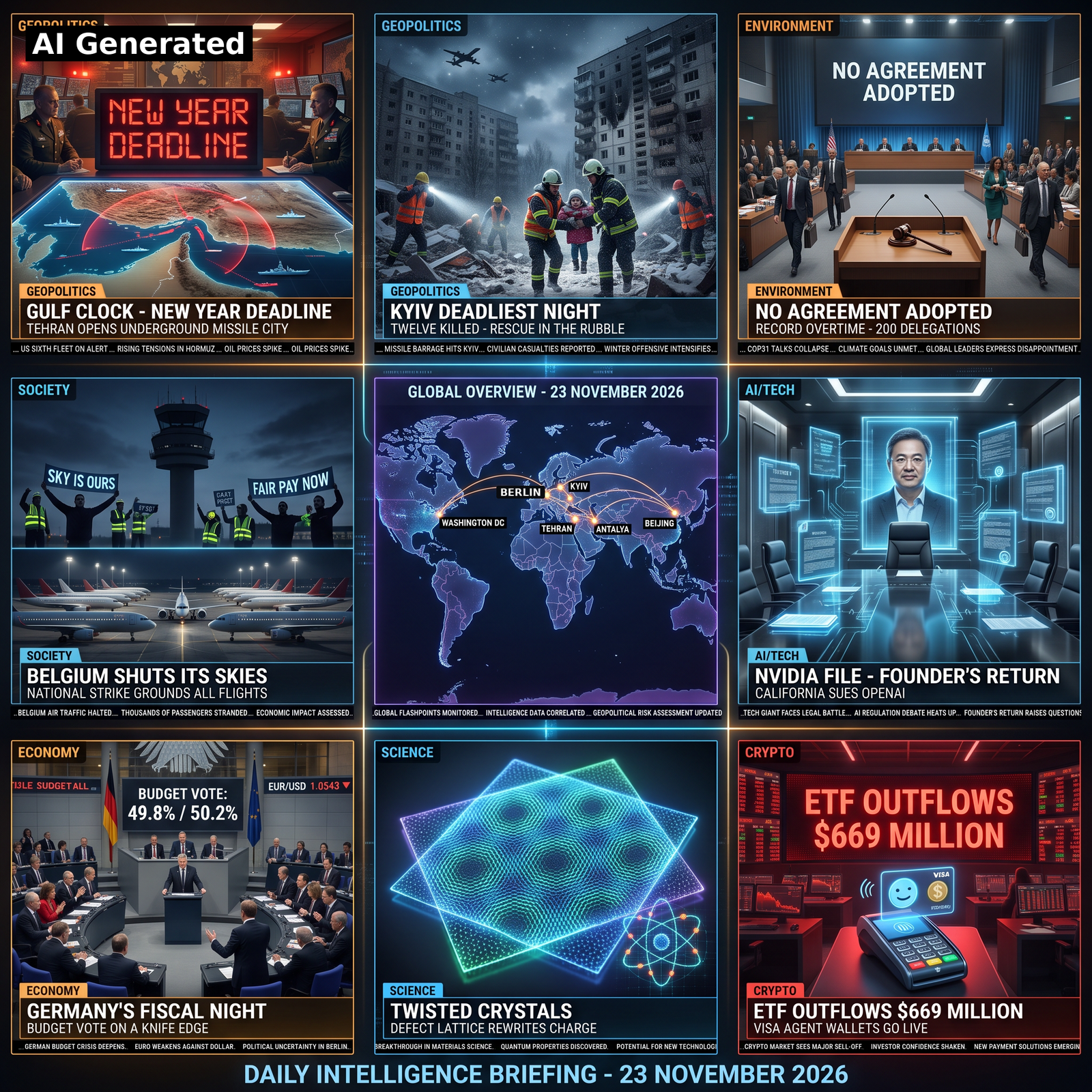
President Donald Trump has attached a hard deadline to the Gulf confrontation that has dominated this report series since D169: he is “inclined” to authorise renewed military action against Iran after the New Year if ongoing negotiations fail to produce an agreement, accusing Tehran’s negotiators of prolonging talks without delivering results[1]. The ultimatum lands exactly one week after the IRGC’s direct missile-and-drone assault on the US Fifth Fleet headquarters in Bahrain, the event that closed D175’s window, and it converts a tactical escalation into an explicit countdown. Tehran’s answer was a deliberate visual provocation: IRGC commander General Ahmad Vahidi toured an underground “missile city” and unveiled a launcher capable of firing two missiles simultaneously, declaring that “the damage suffered by the enemy is only the beginning”[2]. The staging matters: the tour came as negotiations remain deadlocked, mirroring Tehran’s autumn pattern of pairing battlefield pressure with framed diplomatic openings. The Gulf clock is now a calendar.
Ukraine’s Winter Escalation: Kyiv’s Deadliest Night and the Assassination Files
Russia’s winter campaign has resumed with a mass-casualty signature unseen in recent weeks. At least 12 people were killed in new strikes on the Kyiv region, eight in a residential block that collapsed, while strikes also hit a supermarket and energy infrastructure; a seven-year-old boy was pulled alive from the rubble[3]. The pattern matches the strategy identified in D175: deliberate pressure on civilian infrastructure and urban centres as winter deepens, testing Ukrainian air-defence coverage and Western resolve. The intelligence war is escalating on a separate track. Polish authorities confirmed that Russian intelligence attempted to assassinate a Ukrainian rapper twice on Polish soil, following Copenhagen’s disclosure of an alleged Russian plot to kill a US-Ukrainian citizen in Denmark[4]. These attempts against Ukrainian public figures on NATO soil are precisely the grey-zone activity that forces allies to define red lines. Washington’s messaging remains dissonant: DNI Jay Clayton publicly defended Trump’s decision to call Putin his “friend” during the Shenzhen summit[5], even as historian Anne Applebaum, wife of Polish Foreign Minister Radosław Sikorski, provoked a storm by suggesting a mass-casualty event might be needed to convince European publics that war with Russia is necessary — a remark revealing how far elite escalation discourse has moved, immediately condemned as ghoulish[6].
NATO’s Emergency Session and the Alliance’s Response Ladder
NATO has moved from rhetoric to institutional machinery. The North Atlantic Council convened an emergency session after Warsaw lodged formal complaints over Russian missile and possible manned-aircraft incursions into Polish airspace during the mass strike on Ukraine[7]. The session follows Secretary-General Mark Rutte’s weekend visit to Warsaw — where he insisted the Alliance “will defend every inch of Polish territory” — and it converts the D175 SACEUR review into a live political process[8]. Chancellor Friedrich Merz then received Rutte at the Chancellery on Monday, with Ukraine support and “efforts to end the Russian war of aggression” on the agenda[8]. The speed of the sequence — incursion, emergency session, Berlin summit — signals the Alliance is treating the airspace violations as a deliberate Russian probe rather than an accident. The key question is whether the emergency machinery produces tangible changes to eastern-flank air-defence posture, or remains declaratory.
The Mediterranean Periphery: Libya’s New Front and Israel’s Southern Operations
Libya has emerged as a new flashpoint in the Russia-Ukraine conflict’s geographic expansion. The United Nations intervened after naval drones targeted a Russian ship docked at Benghazi’s naval base and a commercial vessel off Libya’s eastern coast, warning the country must not “be turned into an arena for settling scores”[9]. Libya’s eastern military declared Benghazi port “under control” and “fully prepared” to respond[10], and satellite imagery has confirmed a Russian warship sank after the suspected Ukrainian strike — the first major Russian naval loss in the Mediterranean theatre[11]. The episode extends the D175 pattern of Ukrainian strikes on Russian shipping beyond the Black Sea and hands Tripoli and Benghazi leverage they have not possessed in a decade. Meanwhile, Israel’s southern operations continue at persistent intensity: forces are demolishing homes in Zawtar ash-Sharqiyah in southern Lebanon[12], a Physicians for Human Rights-Israel report documents rising settler attacks against Palestinian medics in the West Bank[13], and government-former Gadi Eisenkot condemned settler vehicle-burnings and graffiti as “Jewish terrorism” — a striking phrase from a figure negotiating with Likud to form the next government[14].
South Asia’s Diplomatic Week: Nepal, Pakistan, the SCO and the LeT Threat
South Asian diplomacy is moving on multiple tracks. Nepal’s Prime Minister Balendra Shah arrived in New Delhi for his first bilateral visit since March 2026, holding talks with Modi and Jaishankar on trade, connectivity and energy[15]; Kathmandu is balancing its two giant neighbours, and the reconstruction agenda after August’s floods gives India a concrete entry point. At the SCO Civilisational Dialogue Forum, Pakistan’s Climate Minister Musadik Masood Malik faced intense scrutiny over Islamabad’s record on terrorism while appealing for bilateral dialogue, declining to take responsibility for earlier remarks on the Indus Waters Treaty[16]. The contrast between the two delegations’ reception underscores how New Delhi is using multilateral platforms to reset the regional hierarchy. In parallel, India and the Netherlands reaffirmed a strategic partnership spanning technology, semiconductors, defence and clean energy at their inaugural foreign ministers’ meeting[17]. The security track is less benign: Hyderabad was placed on high alert after an email claiming to be from Lashkar-e-Taiba threatened a 26/11-style attack with mass casualties[18] — even an unverified threat forces a counter-terror mobilisation, which is precisely the intent.
Africa’s Security Ledger: Sudan, Nigeria and the Congo’s Electoral Doubts
Africa’s instability ledger is filling again. In Sudan, drone bombardment hit homes and a UN building in Khartoum, reigniting the diplomatic crisis over a conflict that has already displaced millions[19]. In Nigeria, at least 35 members of the Peul ethnic group were killed in reprisal attacks in the central-west after a raid that killed 11 people, with security reports warning the toll could more than double[20] — the recurring communal-violence dynamics that climate stress and resource scarcity keep inflaming. The Democratic Republic of Congo faces a different crisis: the Symocel electoral observation mission doubts the country can hold general elections by December 2028, raising the prospect of another postponement[21]. Against this backdrop, German President Frank-Walter Steinmeier’s Africa tour — Côte d’Ivoire, Ghana and Kenya with a business delegation — reads as Europe’s attempt to re-anchor economic partnerships on a continent where Chinese and Gulf influence is deepening[22].
Environment & Climate ↑ Contents
COP31’s Collapse: The Longest Summit Ends With Nothing Adopted
The UN climate process has suffered its first wholesale failure of the current cycle. COP31 in Antalya, Türkiye, prolonged into record-breaking overtime, ended Sunday without an overarching agreement as nearly 200 delegations failed to find consensus on climate finance, fossil fuels and carbon capture[23]. The summit’s president acknowledged the deal was “not adopted” after the EU and others rejected the final text, with Australia’s Murray Watt calling the outcome “deeply disappointing” and warning the failure reflects “a very challenging international environment to reach agreement on almost anything”[23]. The collapse closes the arc tracked since D170, when drafts began omitting the fossil-fuel phase-out language that defined the COP28 consensus; D175’s “overtime vote” has now resolved into outright failure. The consequence is structural: with no cover decision, the UNFCCC’s authority over the next cycle is weakened, and the “no deal is better than a deal that locks in failure” framing is cold comfort to small-island states that need the process to deliver.
America’s Weather Extremes: Floods, Drought and the King Tides
The United States entered Thanksgiving week bracketed by two hydrological emergencies. Florida’s Atlantic coast absorbed more than 24 inches of rain near Cocoa Beach, and Governor DeSantis expanded the state flood emergency to 21 counties from Duval to Monroe, with the St. Johns River basin facing weeks of tidal flooding[24]. Simultaneously, North Carolina’s drought sharpened violently: extreme drought jumped from about 10% to more than 26% of the state in one week, and Durham reported just 76 days of easily accessible water supply[25]. The simultaneity of flood and drought is the signature of a warming hydrological cycle: the atmosphere holds more moisture, so rain falls harder when it comes and evaporation accelerates when it does not. On the West Coast, king tides — the highest predicted tides of the year — peak around November 24-26, with NOAA predicting about 7 feet in San Francisco, Caltrans closing the Posey Tube for five days and Washington cancelling ferry sailings; the Coastal Commission wants citizens to photograph the event because it previews the shoreline at higher sea levels under the record-strength El Niño[26]. Hawai’i’s Kilauea, meanwhile, is forecast to produce a 57th lava-fountain episode between November 22 and 26 after the summit reinflated by about 14.7 microradians — a reminder that the geological ledger remains active[27].
The Pollution Ledger: Gaza’s Long Contamination and America’s Regulatory Wins
A report published Monday by Oxfam and the Observatory of Conflicts and the Environment documents that three years of Israeli bombardment have durably polluted nearly the entire Gaza Strip — air, water and soil — with consequences the NGOs say could persist for decades[28]. The finding converts a humanitarian catastrophe into an environmental legacy claim: even after a ceasefire, reconstruction will be shadowed by unexploded ordnance, contaminated groundwater and toxic rubble, and no mechanism exists to fund environmental remediation in active-conflict zones. In the United States, the ledger is more encouraging: the EPA will classify every state as meeting its 2024 secondary sulfur-dioxide standard, with all 292 monitors with complete data complying and the closest call at a Howard County, Texas site sitting exactly at the 10-ppb limit[29]. The milestone is real — median SO2 concentrations fell from about 50 ppb in 2000 to under 10 in 2021 — but soils acidified over decades recover slowly, meaning the ecosystem ledger lags the air-quality ledger by years. Delaware offers a counter-current: investigators are probing high pesticide levels in surface water near Chorman Airport, with well owners within five miles told not to boil water (boiling concentrates pesticides) while private-well testing begins[30].
The Energy-Transition Ledger: Ports, Hydrogen and the Money That Moves
New York is investing $228 million in five offshore-wind port projects — heavy-lift wharves at the Ports of Coeymans and Albany, a shipyard modernisation, and two Brooklyn firms building a subsea-cable repair hub and a precast waterfront platform — creating more than 1,000 jobs and fixing the supply-chain bottleneck that has constrained US offshore wind[31]. In Southern Africa, the Green Climate Fund approved $140 million for green-hydrogen projects in South Africa and Namibia under a programme targeting $1.2 billion and 30-40 projects, including roughly 1.52 GW of renewable capacity feeding green ammonia and methanol production[32]. The investment pattern is telling: while COP31’s political process failed over fossil fuels, the capital pipeline for green industrialisation is being assembled by investors who do not need a consensus text to move money. The risk is a two-speed transition in which bankable projects in stable jurisdictions proceed while the countries most exposed to climate shocks — most in need of the finance COP31 could not agree on — are left behind.
The Climate-Economy Interface: Insurance Retreat and Wildfire Litigation
The insurance affordability crisis is now a structural feature of the US property market, with NRDC documenting how climate risk is making coverage unavailable or unaffordable in fire- and flood-prone areas and arguing for resilience investment as the only durable remedy[33]. Insurance is the mechanism through which climate losses are socialised or privatised: when insurers exit, homeowners lose mortgage eligibility and the state becomes the insurer of last resort. Running in parallel, wildfire litigation has become a multibillion-dollar industry: more than $18 billion has been awarded or agreed in settlements since 2017 against utilities including PG&E, whose Camp Fire settlement alone reached $13.5 billion, and 2026 — already among the worst fire years on record with over 9 million acres burned — is generating new suits[34]. California’s inverse-condemnation doctrine assigns liability for ignition alone, converting utilities into default underwriters of wildfire risk while hedge funds begin financing plaintiff-side litigation. The deeper question — whether it is just to hold one utility responsible for fires enabled by a century of fossil-fuel emissions, fire suppression and wildland-urban development — will shape climate-liability politics for the next decade.
The Living Ledger: Pupfish, Orcas, Bird Flu and a Reef’s Defenders
Federal biologists have proposed listing the White Sands pupfish as threatened under the Endangered Species Act — a fish under two inches long found only in seven springs in New Mexico’s Tularosa Basin, mostly on military land — where drying springs, floods and heat are projected to erode its habitat through 2099; notably, all qualifying critical habitat sits on Department of War facilities and is exempt from designation[35]. In the Pacific Northwest, the Southern Resident killer whale population has fallen to 74 in NOAA’s new draft count, down from 99 in 1995 and declining about 1% a year, with the permitted human-caused death threshold calculated at just 0.13 whales per year — roughly one whale every seven years[36]. Delaware has confirmed the first fall cases of highly pathogenic avian influenza — in seven hunter-harvested ducks and a commercial Sussex County flock that was culled — marking the return of H5 with the autumn migration[37]. And in the Gulf of Mexico, Sea Shepherd crews patrol with the Mexican Navy inside Alacranes Reef National Park — Scorpion Reef, the Gulf’s largest coral reef — to intercept illegal sport fishing on a reef already stressed by warming waters[38]. These four stories share a thread: species protection is being managed at the margins — designations without habitat, tiny populations, and enforcement requiring private conservation navies — because the systemic drivers, from drought to vessel traffic to climate stress, are not being addressed at scale.
Society & Civil Issues ↑ Contents
Europe’s Civic Square: Austerity Strikes, Farmers and the Social Squeeze
Belgium’s airports shut down on Monday as Skeyes, the air-traffic-control authority, halted services in a national strike against government austerity — grounding nearly all flights across the country[39]. It is the sharpest expression yet of the European protest wave tracked since D174, and the timing, on the eve of the EU budget battle, is not coincidental. In Berlin, farmers with Deutscher Bauernverband president Joachim Rukwied gathered outside the Chancellery to demand Merz push for a substantially larger EU budget and defend Common Agricultural Policy funds against the net-payer coalition seeking deep cuts to the 2028-2034 framework[40]. Bavaria is managing a succession: the Free Voters will announce who takes over the government posts of Hubert Aiwanger, the deputy premier who died on 4 November, with party leadership roles to follow[41]. Beneath the headlines, the social infrastructure is fraying: institutions in Saxony-Anhalt report declining donations, rising costs and more people in need — the Halle homeless shelter sees intake rise while funding falls, food banks report fewer donations, and even a cat shelter is at risk as owners surrender pets they cannot afford[42]. And in Berlin-Lichtenberg, a hospital fire injured 15 people, one critically, forcing evacuation of the whole building[43].
France’s 2027 Chessboard and the Cost-of-Living Ledger
France’s presidential campaign is consolidating earlier than usual, with pollsters noting the “useful vote” dynamic is expressing itself very early[44]. Jean-Luc Mélenchon continues to rally the left, while Dominique de Villepin and David Lisnard disrupt the right; the Rassemblement National, weakened by scandals, is pressed from both directions. Lisnard’s rise is significant enough that Marine Le Pen attacked his “radical ambition to de-bureaucratise France” — a pique analysts read as recognition of his new credibility on the right[45]. The street politics remain volatile: in Angers, about 200 far-right identitarian activists and antifascist counter-protesters faced off on the margins of a banned rally against “anti-white racism,” following the October assault on three students[46]. The economic anxiety feeding both dynamics is quantified by a new study: seven million people in France are caught between the necessity of car ownership and its cost, with transport consuming 13% of budgets earning €1,000-2,000 per month versus 3.5% above €5,000 — a mobility divide that is also a political fault line[47].
The British Ledger: Brussels, Bereavement and Defence Strikes
Prime Minister Andy Burnham is selling his Brussels agreement domestically, arguing at a supermarket visit that the EU deal is “taking pressure off the cost of food” while welcoming a Morrisons initiative offering thousands of apprenticeships to tackle youth unemployment[48]. The regulatory state is also auditing the human interface of finance: the Financial Conduct Authority reviewed how advisers and platforms support bereaved families and concluded firms must do more to help people dealing with a death, criticising confusing communications and fees for advice no longer received[49]. A strategically significant labour dispute is underway in Scotland: Unite members at the Royal Naval Armaments Depot at Coulport began strike action Monday over pay, with the union warning the action could affect the UK’s nuclear and defence response capabilities — a direct intersection of industrial action and strategic deterrence[50].
America’s Civic Ledger: ICE, Lead Azide, Property Taxes and the Courts
America’s immigration enforcement has produced a viral flashpoint: masked ICE agents detained a father and daughter on the jet bridge at Seattle-Tacoma International Airport as they boarded an Alaska Airlines flight, footage of which sparked protests, with Governor Bob Ferguson and Mayor Katie Wilson condemning the tactics as “un-American”[51]. A different state-power question is playing out in Iowa: the US Army plans to invoke emergency powers to detonate more than 4 tonnes of degraded lead azide at the Iowa Army Ammunition Plant despite a court-ordered stay, with 68 barrels reported unstable and officials calling the plan “extremely concerning”[52]. In Florida, the consequences of Amendment 3 — the property-tax cut approved this month — are becoming concrete: Deltona cancelled its Christmas parade and expects $23 million in cuts by 2030, with Commissioner George Kruse warning “this is a permanent, structural shift in how government functions”[53]. The executive is also tightening its grip on oversight channels: Trump has ordered federal contractors to report any inquiries from Congress[54]. And in Ohio, three people were killed at a baby shower in Parma — an uninvited 19-year-old father among the dead — the latest data point in America’s gun-violence ledger[55].
The Global Civic Periphery: Istanbul, Breaches and Public Safety
Turkey’s crackdown on independent media has drawn its largest street response yet: thousands marched in Istanbul on Sunday against the widening repression of opposition and press, days after police raided Sözcü TV and arrested senior staff, with the Yeni Parti organising the protest after authorities installed a government-appointed trustee at the broadcaster[56]. In the corporate-security ledger, Samsung Securities disclosed a breach affecting 8,000 clients — a reminder the fragility wave extends beyond tech platforms into financial infrastructure[57]. Delta Air Lines delayed more than 1,000 flights after an automated-system issue, adding another chapter to the outage wave tracked since D174[58]. In Manchester, more than 12,000 people were safely evacuated from rapper Don Toliver’s concert at the Co-op Live arena after an “unknown substance” was released in the crowd, with one person hospitalised[59]. And in Indonesia, police removed 24 body bags from the PT Fonusa Agung Mulia candy factory in Banten after a fire, with dozens of workers still missing as search teams battled hotspots[60].
AI & Technology ↑ Contents
The Nvidia File: A Founder’s Return, Export-Controls Fallout and the Smuggling Ledger
The Nvidia governance crisis that began with Jensen Huang’s forced resignation continues to reshape the company’s political and commercial position. President Trump has called on Nvidia’s board to bring back Huang, saying his return would be “the best thing for the USA” — a sharp reversal from his earlier suggestion that former Apple CEO Tim Cook should take over, and a sign the administration treats the chip champion’s leadership vacuum as a national-security problem[61]. The corporate damage is compounding: Nvidia’s server partners have suspended shipments to Southeast Asia amid the tightening US export-control regime, a move that will ripple through the region’s AI-data-centre buildout[62]. A shareholder lawsuit has dragged the smuggling scandal deeper into the executive suite: Cenly Chen, former chief growth officer of Super Micro Computer and wife of ex-Nvidia executive vice-president Jay Puri, is alleged to have directed which customers received Nvidia chips in a $2.5 billion server-diversion scheme to China — allegations the company denies and which have not been proven in court, but which have already cost Puri his operational role[63]. The strategic question is whether Anthropic’s reported multi-chip procurement strategy accelerates the erosion of Nvidia’s pricing power at the very moment its governance is in flux[64] — the answer will determine whether the current market rout is a correction or a structural repricing of AI infrastructure.
AI Capital and the Regulatory Front: California Sues OpenAI
California Attorney General Rob Bonta announced this week that he has filed a lawsuit against OpenAI for “neglecting model security and endangering public safety,” opening a new legal front against the industry leader at the state level[65]. The suit lands as AI capital is already under stress: Anthropic’s record-breaking IPO has been followed by a second-day slide of roughly ten percent toward its issue price, and the Wall Street narrative has shifted from euphoria to questions about whether the AI boom is over[66]. The irony is that institutional conviction in Anthropic was built on the frontier-lab model: Notable Capital, GIC and Baillie Gifford poured billions into its Series E at a $61.5 billion valuation despite its trailing position behind OpenAI and the DeepSeek shock — a bet that looked prescient at the IPO and now looks exposed to the same repricing hitting the whole sector[67]. Meta’s chief AI officer has publicly warned society against handing control to AI — an unusual caution from inside one of the largest deployers, and a signal that the industry’s internal consensus is fracturing over governance[68].
The Fragility Wave Continues: Outages, Hospital Cyberattacks and the Trust Deficit
The infrastructure-failure wave tracked since D174 shows no sign of abating. The Verge, surveying the FAA ground stop, the multi-day Outlook outage and the JPMorgan banking failure, concludes that “we haven’t seen the last of the major tech outages,” citing DNI Jay Clayton’s warning that step changes in compute will produce continuing “bumps in the road”[69]. The health sector is now a direct victim: the CHU university hospital in Guadeloupe triggered its “plan blanc” emergency protocol after a large-scale cyberattack hit its information systems, forcing the deprogramming of non-urgent care for the coming week[70]. Hospital cyberattacks are among the most dangerous manifestations of the fragility wave because the failure mode is clinical, not economic: when systems go down, care continuity depends on manual fallbacks that strain staff and delay treatment. The deeper social cost is captured by Mateusz Łabuz in The End of Reality: the danger of generative AI is “the slow erosion of our ability to tell what’s real, to trust our institutions and to think for ourselves”[71] — an epistemic erosion that compounds the institutional-trust deficits documented across D170-D175, and suggests the outages are symptoms of a systemic fragility that regulation has not yet begun to address.
Industrial AI and the Digital State: Siemens, MeitY and the Musk Question
Siemens CEO Roland Busch has declared that the global AI competition has reached “the endgame,” warning that European over-regulation is the greatest handicap while marvelling at China’s genuine innovation speed — but insisting Germany’s “century opportunity” lies in industrial AI, where proprietary data, domain knowledge and predictable execution give European manufacturers a defensible niche[72]. His prescription — a real European single market, product-data usage rights, “reinforced cooperation” coalitions of at least nine willing states — is a concrete industrial-policy agenda in sharp contrast to the regulatory posture he criticises. India is pursuing the same logic through procurement: MeitY’s revised local-content framework boosts the weight of Indian design and R&D in six categories of IT hardware under the Make-in-India order[73]. The third strand is the confrontation brewing in Washington over Elon Musk: the incoming Democratic Congress plans to call Musk to account for allegedly manipulating SpaceX Starshield satellite services in Ukraine — a test of whether the state can govern the private infrastructure on which its own security now depends[74].
Economy & Business ↑ Contents
Markets, Rates and the AI-Capital Question
Global markets entered the shortened Thanksgiving week in violent two-way motion. Dow futures jumped 800 points and Nasdaq futures soared nearly 3% as investors bought the dip after the S&P 500 and Dow joined the Nasdaq in correction territory — the worst weekly losses since the early COVID era and the steepest S&P drop since Trump’s “Liberation Day” tariffs of April 2025[75]. Wall Street’s 2027 forecasters remain upbeat — Morgan Stanley and Goldman see the S&P at 8,700, UBS and Wells Fargo at 8,200 — but Moody’s Mark Zandi warned the wealth effect will subtract nearly 0.3 percentage points from GDP growth, arguing “the easy money in the AI trade has been made”[75]. Asia captured the same whiplash: US futures rose while the AI selloff pressured Asian markets, and China’s CSI Semiconductor Index slid 4.5%[76][77]. The credit market is registering stress at the riskiest end: junk bonds suffered their biggest spread blowout of 2026[78]. Bill Ackman warned the Fed risks pushing the US and world into recession if it raises rates in December, insisting financial conditions have already tightened “massively”[79]. The dollar edged off a 19-month high as confidence recovered while the yen softened[80]. The second day of Anthropic’s public life captured the mood: the stock slid roughly ten percent toward its issue price, feeding fears the AI boom’s biggest capital event is deflating[66].
Europe’s Fiscal Night and the Industrial Front
Germany’s budget crisis has crossed a threshold of democratic concern. A Handelsblatt commentary argues the coalition is destroying established democratic procedures — the CDU by damaging the budget-drafting process, Finance Minister Lars Klingbeil by compromising his office — with the AfD the only beneficiary[81]. The intra-Union row is sharpening: the CDU workers’ wing criticised Markus Söder’s demand for full compensation of “cold progression” tax drag as right in substance but “weeks too late,” questioning how it could be implemented within five days of the planned Friday budget vote[82]. Grid operators BDEW and VKU are demanding a “crisis summit” because data centres and industry wait years for grid connections — a structural constraint threatening the AI buildout’s European leg[83]. The automotive sector is fighting a two-front war: Ford’s Europe chief Jim Baumbick warned the new EU industrial policy must strengthen European manufacturers against Chinese competition[84]; a Dutch court blocked BYD’s “copycat Defender” Ti7 SUV across all 27 EU states on design-right grounds — though not Britain, where JLR will litigate separately — while Xiaomi launched its 1,548-horsepower SU7 Ultra in the UAE, its first overseas market, with Europe targeted for 2027[85][86]. Even Germany’s mineral-water industry has become a “culture war” over who drinks what[87].
Trade, Energy and the Corporate Ledger
India and the European Union are poised to formally sign their long-awaited Free Trade Agreement on 16 December during Modi’s European visit — a milestone binding two of the world’s largest markets at a moment of transatlantic fragmentation[88]. India is simultaneously boosting Venezuelan crude purchases while deepening US energy ties — a hedging strategy that captures discounted barrels without breaking with Washington[89]. The energy-supply ledger turned fragile in Libya: the National Oil Corporation said an unlawful group closed a valve on the Sharara pipeline, cutting about 350,000 barrels per day — the largest supply disruption of the week and a direct consequence of the Benghazi instability[90]. In corporate governance, Noel Tata has asked the Tata Sons board to defer its 26 November meeting — the first since September’s directors’ face-off — over the mandatory-listing question[91]. South Korea’s finance minister flagged chip-sector volatility as the key growth risk[92]. Britain’s CBI chief Rain Newton-Smith will tell her annual conference the country must take off its “gloom-tinted glasses” and pursue investment as the escape from the “financial straitjacket” of high taxes[93]. US business applications hit 501,609 in October, extending the streak above 500,000[94]. And a revealing consumer story: more than 9,600 US pizza restaurants have closed since 2019, driven by delivery-market consolidation and the GLP-1 weight-loss revolution — a microcosm of how pharmacology and platform economics rewrite even basic consumer industries[95].
Science & Space ↑ Contents
The Physics and Materials Frontier: Twisted Crystals and a New Theory of Charge
Materials science has produced a finding with quiet implications for electronics: Technical University of Denmark researchers showed that twisting two ultrathin crystal sheets together creates a hidden grid of atomic defects that reorganises how electrical charges are distributed, with the grid spacing controllable by the twist angle[96]. The discovery adds a design axis to the moiré-materials playbook driving two-dimensional electronics — not just band-structure but defect-lattice engineering. The same week, University of Queensland physicists reported sending messages using gravity alone for the first time, exploiting the gravitational field as a communication channel that cannot be shielded or intercepted like electromagnetic signals[97]. The demonstration is laboratory-scale and years from application, but the principle matters strategically in a world where undersea cables and satellite links are increasingly contested. At the cosmic scale, a Caltech-led analysis of 257 black-hole mergers found a surprising mass gap suggesting many black holes are born from stars that collapse silently — never producing the supernova explosions that anchored stellar-death theory for a century[98]. Interstellar propulsion theory also advanced: diffractive solar sails would paradoxically begin to decelerate near 75% of light speed because scattered light starts producing drag — a constraint any interstellar-sail programme must engineer around[99].
The Biomedical Ledger: Alzheimer’s, Diabetes, the Microbiome and a Hidden Eye Disease
Alzheimer’s research produced three advances this window. A Neurology Open Access study of the Framingham cohort found that healthy vitamin D levels in midlife (average age 39) are associated with lower tau-protein deposits — a core Alzheimer’s biomarker — at 16-year follow-up, with no such link for amyloid beta; the authors position midlife as the “window of opportunity for risk modification”[100]. University of Virginia Health researchers identified a gene that helps the brain’s immune cells contain Alzheimer’s plaques; when it malfunctions in mice, toxic buildup accelerates and cognition declines, offering a new drug target[101]. And a Curtin University review of 40 studies quantified the metabolic link: type 2 diabetes carries a 53% higher risk of Alzheimer’s, with nearly five cases per 1,000 diabetics per year[102]. The microbiome ledger added a cautionary finding: a University of Tartu study of more than 2,500 people found common medications — antidepressants, blood-pressure drugs, anxiety treatments — leave lasting “fingerprints” on the gut microbiome years after patients stop taking them, some comparable to broad-spectrum antibiotics[103]. A Science-published Heidelberg study identified a thalamus-to-amygdala circuit driving female-specific vulnerability to chronic pain after early-life stress, with silencing the pathway reversing the amplified sensitivity[104]. Two translational findings complete the ledger: a University of Plymouth AI tool identifies bladder-cancer warning signs up to five years before diagnosis, flagging 85% of cases in a near-70,000-patient study[105], and a University of Pennsylvania-led team identified a genetic eye disease that silently erodes night and peripheral vision, with difficulty adapting to darkness as the early warning sign[106].
The Brain, Consciousness and the Deep Archive
Consciousness research advanced on two fronts. University of Southern Denmark researchers scanned rat brains after LSD, psilocybin and 2C-B, finding the three psychedelics produce surprisingly different activity patterns — and that some changes persist a full week after the drugs wear off, with direct implications for psychedelic-assisted therapy design[107]. Two decades of research into near-death experiences, synthesised by ScienceAlert, shows these memories are consistently rated as more vivid, more detailed and more central to identity than real or imagined waking memories — even controlling for rehearsal — with fMRI work showing they engage autobiographical-memory networks when recalled[108]. Peking University researchers developed JONR, a single fluorescent dye distinguishing at least 14 membrane-bound structures in living cells through solvatochromic differences, a leap from the one-dye-one-structure norm[109]. And Texas A&M scientists provided evidence that a key DNA component acts as a “secret sunscreen,” converting destructive ultraviolet damage into a form the early-repair machinery could fix — a mechanism that may explain how life survived Earth’s intense early UV flux[110].
Crypto, Digital Assets & Blockchain ↑ Contents
Institutional Flows Bleed While Compliance Architecture Hardens
The institutional channel that carried crypto into the mainstream is now transmitting the risk-off signal in reverse. Bitcoin spot ETFs recorded $669 million in net outflows, extending a four-day streak that has coincided with the broader AI-led equity correction and the collapse in risk appetite across every asset class[111]. The symmetry with the equity ledger is analytically important: the ETF structure was designed as a regulated on-ramp, and it is now functioning exactly as designed in reverse — providing the fastest exit for the marginal investor who bought the dip narrative. The outflows matter less for their size than for what they reveal about positioning: the funds that entered during the 2025 cycle treated bitcoin as a risk-on trade, not a hedge, which means crypto now correlates with the AI-capital cycle dominating D171-D176’s market narrative. The regulatory perimeter, meanwhile, is tightening in Asia. South Korea has strengthened oversight of crypto fund transfers to high-risk exchanges, targeting the arbitrage channels used to move liquidity toward unregulated venues and forcing Korean banks to screen a wider set of counterparties[112]. Seoul’s approach is notable for its mechanics: rather than banning transfers outright, it imposes differential compliance burdens that make high-risk destinations progressively more expensive to use — a cost-based enforcement model other regulators may copy. Compliance architecture is widening even as the price channel narrows, and the two forces together suggest the industry’s centre of gravity is shifting from speculation toward infrastructure.
The Institutional-Onramp Front: Visa’s Agent Wallet and the Exchange Collapse in Asia
Payments infrastructure is moving to solve the AI-economy’s identity problem. Visa launched an upgraded command-line interface (CLI) agent wallet for US users designed to verify AI agents, enabling machine-to-machine commerce where the counterparty is a software agent rather than a person — with stablecoin rewards (OUSD) built into the mechanism to incentivise adoption[113]. The significance is structural: the agentic economy anticipated in the AI & Technology section needs a payment rail that can authenticate non-human actors, and Visa’s move treats stablecoin settlement as the natural ledger for that market. It is the clearest sign yet that the card networks, having spent years exploring stablecoin pilots, are now productising agent identity as a commercial service. The reverse side of the ledger is retail-investor damage from unregulated venues. Nikkei reports that a crypto exchange’s collapse has hit Chinese investors who had been hunting for yield through offshore platforms — a reminder that Beijing’s capital controls are porous precisely where digital assets are concerned, and that each such failure strengthens the case for the very regulatory tightening that reduces retail access[114]. The pattern is familiar from D169-D172’s enforcement ledger: when unregulated platforms fail, the victims are disproportionately retail users in jurisdictions with limited legal recourse, and the political response is usually more control rather than more protection.
Protocol Mechanics: Solana’s Memory-Check Break and the Validator Data Question
Solana’s protocol-development pipeline produced a compatibility story with real deployment risk. A replay of mainnet traffic exposed that the network’s new memory checks — which tighten how account data is handled — can cause some older Anchor-based application transactions to fail, specifically through an account-handoff pattern the stricter checks reject[115]. The checks have not yet activated on mainnet, giving developers a window to patch, but the episode illustrates the perennial tension in Solana’s engineering culture: speed of innovation versus the cost of breaking the long tail of deployed applications. The same report notes a separate change that would remove the work validators currently do to copy data, a meaningful operational simplification for a network whose validator economics are a recurrent governance theme. The broader lesson is that the industry’s post-D171 focus on security hardening — memory checks, replay audits, validator data hygiene — is producing real breakage risk at the application layer, and the migration cost is now borne by developers who built on top of old semantics. Protocol upgrades are exercises in ecosystem management as much as engineering, and the “protocol security ledger” theme of D172-D175 is now entering its compatibility phase.
Correlations & Analysis ↑ Contents
The D176 window’s master variable is unchanged from D171-D175 — the gravitational pull of war on every other system — but its geometry has shifted. D175 closed on Iran’s direct missile-and-drone assault on the US Fifth Fleet headquarters in Bahrain. This window, both Tehran and Washington converted that escalation into strategic calendar: Trump’s “inclined” New Year deadline meets the IRGC’s staged tour of an underground missile city with its twin-missile launcher [1] [2]. Neither side is escalating now; both signal readiness for the next phase, making the diplomacy before 1 January the real battlefield. The Gulf clock, tracked since D169, has become a countdown [8].
The Ukraine-Russia theatre has expanded laterally rather than vertically, confirming D173-D174’s observation that escalation is migrating outward. D175 reported the first Ukrainian strike on Kaliningrad; this window adds three new rings: mass-casualty strikes on Kyiv apartment blocks (12 dead), confirmed Russian assassination attempts against Ukrainian public figures on Polish and Danish soil, and the sinking of a Russian warship by suspected Ukrainian drones off Benghazi — the first major Russian naval loss in the Mediterranean [3] [4] [9] [11]. The Benghazi episode is the most significant development: it opens a Libyan front in a war already touching the Baltic, the Black Sea and the Atlantic approaches, and it prompted an explicit UN warning that Libya must not become “an arena for settling scores” [9]. The assassination attempts on NATO territory are the more insidious escalation, converting allied soil into a battlefield without triggering Article 5 — precisely Moscow’s grey zone since D167. NATO’s emergency session over Polish airspace violations, followed by the Merz-Rutte meeting in Berlin, shows the Alliance responding with process rather than posture: sessions, statements and reviews, but no visible change to eastern-flank air-defence configuration yet [7] [8].
The second great through-line is the collapse of the multilateral machinery that D170-D175 tracked with mounting alarm. COP31 ended without agreement — the first failed COP of the current cycle [23]. The timing is brutal: the summit collapsed the same week the AI-capital complex entered its sharpest correction since 2025, with Anthropic sliding ten percent on day two, bitcoin ETFs bleeding $669 million, junk-bond spreads blowing out and the S&P 500 in correction territory [75] [78] [66] [111]. The correlation is structural: both systems were sustained by the post-2025 assumption that growth would keep outrunning risk. When the AI trade repriced, the risk appetite underwriting speculative capital and diplomatic optimism evaporated together. The German budget crisis — “dangerously harmful to democracy” per Handelsblatt — is the third leg: a net-payer state unable to resolve its fiscal politics cannot fund either the EU budget farmers are protesting about or the defence increases NATO requests [81] [40].
The fragility wave that D174 identified in the technology layer has spread into institutions and infrastructure. DNI Clayton’s “bumps in the road” warning has been validated by Delta’s 1,000-flight failure and the Guadeloupe hospital cyberattack that deprogrammed a week of care [69] [70] [58]. The deeper pattern is the interaction between fragility and trust: the Verge’s conclusion that we “haven’t seen the last of the major tech outages” [69], Mateusz Łabuz’s warning that AI erodes our ability “to tell what’s real” [71], and the ICE-Seattle detentions that sparked protests [51] all point to a society whose confidence in its own systems — technical, financial, administrative — is the scarcest resource. That is the trust deficit that ran through D167’s airspace standstill and D171’s outage taxonomy, now compounding the polarisation visible in the Florida tax-revolt aftermath [53], the Turkish crackdown protests [56] and France’s early 2027 campaign [44].
Two environmental stories complete the picture. COP31’s failure lands precisely as the physical ledger deteriorates: Florida’s 21-county flood emergency, North Carolina’s 26% extreme-drought expansion in one week, king tides closing a Bay Area tunnel, and Gaza’s documented decades-long contamination [24] [25] [26] [28]. The disconnect between physical reality and institutional response is the defining environmental fact of D176 — the same disconnect D175 captured in the COP “overtime” metaphor, now resolved into outright failure. Yet the capital pipeline continues to move independently of the politics: New York’s $228 million port awards and Southern Africa’s $1.2 billion green-hydrogen programme are being built by investors who do not need a COP consensus to deploy money [31] [32]. The transition’s future will be determined less by the UNFCCC and more by the balance sheets of utilities, funds and courts — including the $18 billion wildfire-litigation industry reshaping US electricity pricing [34].
What to watch in the next reporting period: (1) Whether the Trump New Year deadline on Iran produces a breakthrough or a resumption of strikes — the IRGC’s missile-city tour suggests Tehran is preparing for both. (2) Whether the Benghazi front expands: the Sharara pipeline closure cutting 350,000 bpd [90] and the UN warning [9] give the Libyan file volatility that could move oil markets before Christmas. (3) Whether the German coalition passes its budget on Friday after Söder’s cold-progression gambit [82] — a failure would trigger the earliest election scenario yet. (4) Whether the AI-capital correction deepens or finds a floor in the holiday-shortened week; the Dow’s rebound [75] versus Anthropic’s slide [66] will tell if buyers are genuine or reflex. (5) Whether the Indian Ocean diplomatic week — Nepal’s visit, the SCO forum, the India-EU FTA countdown [88] — produces a December signing that would rebalance trade politics as COP31’s collapse weakens the multilateral brand.
References ↑ Contents
1. Trump Says He Is ‘Inclined’ To Resume Military Action Against Iran If No Deal Is Reached By New Year by Indian Defence News · Source ↑
2. Iran: In the underground missile city, the IRGC commander by DefenceNet.gr · Source ↑
3. At least 12 dead from Russian strikes on Kyiv, eight in a collapsed apartment block by ProtoThema · Source ↑
4. Poland says Russia tried to assassinate Ukrainian rapper twice by Al Jazeera · Source ↑
5. US intelligence chief defends Trump’s comments calling Putin his ‘friend’ by Al Jazeera · Source ↑
6. Shock statement on war with Russia: ‘We want a catastrophic event’ by DefenceNet.gr · Source ↑
7. NATO: Emergency session on Polish airspace violations and the Alliance’s response by Ethnos · Source ↑
8. Merz receives NATO Secretary-General Rutte for talks at the Chancellery by Stern · Source ↑
9. UN intervention over strikes on ships in Benghazi – Risk of international conflict by Zougla · Source ↑
10. Libya’s military says ‘fully prepared’ after Benghazi attacks by Al Jazeera · Source ↑
11. Ukraine-Russia war latest: Satellite images shows sunken Russian warship after suspected Ukrainian strike off Libya by The Independent · Source ↑
12. Israeli forces continue house demolitions in southern Lebanon by Al Jazeera · Source ↑
13. In the occupied West Bank, medics face settler violence: ‘Every time I open the ambulance doors, I wonder if I’ll go home’ by Libération · Source ↑
14. Occupied West Bank: Eisenkot condemns settler attacks and denounces ‘Jewish terrorism’ by France 24 · Source ↑
15. Nepal Prime Minister Balendra Shah Begins First Bilateral India Visit, Holds Talks With PM Modi by Indian Defence News · Source ↑
16. Pakistan Minister Faces Fresh Scrutiny In New Delhi Over Terror Accountability, Begs For Talks With India by Indian Defence News · Source ↑
17. India, Netherlands Deepen Strategic Partnership Across Technology, Defence And Clean Energy by Indian Defence News · Source ↑
18. Hyderabad On High Alert After Alleged LeT Email Threatens 26/11-Style Attack And Mass Casualties by Indian Defence News · Source ↑
19. Sudan: Drone strikes – Homes and a UN building hit by Zougla · Source ↑
20. Nigeria: At least 35 dead in bloody reprisals against Peul tribe members by Enikos · Source ↑
21. General elections in DR Congo: Symocel doubts the possibility of meeting deadlines by France 24 · Source ↑
22. Steinmeier begins Africa trip in the Ivory Coast by Stern · Source ↑
23. UN’s COP31 Climate Conference Fizzles Out as Global Policy Divides Deepen by Inside Climate News · Source ↑
24. Florida flooding: rain reports topped 24 inches near Cocoa Beach this week as the state of emergency grew to 21 counties by ECOticias · Source ↑
25. North Carolina drought: extreme drought jumped from 10% to 26% of the state in one week, Durham had 76 days of water by ECOticias · Source ↑
26. King tides hit the West Coast over Thanksgiving week: Caltrans closing a Bay Area tunnel, Washington cancelling ferry runs by ECOticias · Source ↑
27. Kilauea eruption could restart in Hawaii this week as scientists set a November 22 to 26 window for a 57th lava fountain by ECOticias · Source ↑
28. Gaza: Israeli bombardments have durably polluted nearly the entire enclave, according to several NGOs by Libération · Source ↑
29. Sulfur dioxide levels now meet the EPA’s tougher acid rain standard at every U.S. monitor with complete data by ECOticias · Source ↑
30. Delaware pesticide contamination probe: high levels in surface water near Chorman Airport, federal investigators involved by ECOticias · Source ↑
31. New York offshore wind ports get $228 million: two ports near Albany, a shipyard and two Brooklyn firms by ECOticias · Source ↑
32. Inside the $1.2 billion plan to build Southern Africa’s green hydrogen industry by EcoNews Kenya · Source ↑
33. The Insurance Affordability Crisis: Risks, Resilience, and Solutions by NRDC via CleanTechnica · Source ↑
34. How wildfire litigation became big business in America by Grist / Inside Climate News · Source ↑
35. The White Sands pupfish lives in just seven spots in a New Mexico desert, federal biologists proposing to list it as threatened by ECOticias · Source ↑
36. Southern Resident killer whales are down to 74 in NOAA’s new draft count by ECOticias · Source ↑
37. Delaware bird flu is back for the fall: seven ducks and a commercial poultry flock tested presumptive positive by ECOticias · Source ↑
38. The Defenders of Mexico’s Scorpion Reef by Inside Climate News · Source ↑
39. Belgium’s airports set to shut down due to anti-austerity strike by Al Jazeera · Source ↑
40. Farmers want to protest in front of the Chancellery by Stern · Source ↑
41. Bavarian Free Voters want to fill Aiwanger’s government posts by Stern · Source ↑
42. Social affairs: Money, sleeping bags, cat food: restraint in donations by Stern · Source ↑
43. Berlin-Lichtenberg: 15 injured in hospital fire by Der Spiegel · Source ↑
44. Présidentielle 2027: ‘The useful vote dynamic is expressing itself very early’ by France 24 · Source ↑
45. ‘He has crossed a step’: David Lisnard, a threat to Marine Le Pen? by Le Point · Source ↑
46. In Angers, identitarian and antifascist militants face off on the margins of a banned rally against ‘anti-white racism’ by Le Monde · Source ↑
47. Car: seven million people in France caught between necessity and cost, study shows by Le Monde · Source ↑
48. Burnham to say EU deal ‘taking pressure off cost of food’ in supermarket visit by Evening Standard · Source ↑
49. Bereaved families should not have to battle with paperwork, says FCA by The Independent · Source ↑
50. Union warns strike action could hit nuclear and defence response capabilities by The Independent · Source ↑
51. Video of ICE detaining father and daughter while boarding flight sparks protests in Seattle by The Guardian · Source ↑
52. ‘Extremely concerning’: Inside a US Army plan to detonate Iowa lead stores by Al Jazeera · Source ↑
53. Florida slashed property taxes. Now cities must cut services and ‘niceties’ like Christmas parades by Fortune · Source ↑
54. Trump orders contractors to report Congress inquiries by Investing.com / Reuters · Source ↑

55. Unimaginable crime in Ohio: 3 people killed at a baby shower by DefenceNet.gr · Source ↑
56. Thousands rally in Istanbul against Turkey’s crackdown on opposition and media by France 24 · Source ↑
57. Samsung Securities reports security breach affecting 8,000 clients by Crypto Briefing · Source ↑
58. Over 1,000 Delta flights delayed nationwide after issue with automated system by Business Insider · Source ↑
59. One person taken to hospital after ‘unknown substance’ sparks concert evacuation by Evening Standard · Source ↑
60. Indonesian police remove 24 body bags from factory fire site by Al Jazeera · Source ↑
61. Nvidia Stock News: Trump Wants Jensen Huang Back by Coinpedia · Source ↑
62. Nvidia server partners suspend shipments to Southeast Asia amid US export controls by Crypto Briefing · Source ↑
63. Chinese wife of former Nvidia executive linked to smuggling case by DefenceNet.gr · Source ↑
64. SA Asks: How much of a threat is Anthropic’s multi-chip strategy to Nvidia? by Seeking Alpha · Source ↑
65. California Attorney General Bonta: This week I filed lawsuit against OpenAI for neglecting model security and endangering public safety by FinancialJuice · Source ↑
66. Markets: Anthropic stock plunges toward issue price – Is the AI boom after the mega-IPO over? by Handelsblatt · Source ↑
67. How Notable Capital, GIC, and Baillie Gifford bet big on Anthropic before its IPO by TechCrunch · Source ↑
68. Meta’s Chief AI Officer warns society against handing control to AI by Crypto Briefing · Source ↑
69. We haven’t seen the last of the major tech outages by The Verge · Source ↑
70. Le CHU de Guadeloupe déclenche le plan Blanc après avoir été ciblé par une cyberattaque de grande ampleur by Le Parisien · Source ↑
71. Reliance on technology is eroding trust in one another and ability to tell what is even real, expert warns by Phys.org · Source ↑
72. AI and the future of industry: Siemens CEO on the AI competition: ‘This is now the endgame’ by Stern · Source ↑
73. MeitY’s New Local Content Framework Boosts Weightage For Indian Design And R&D In IT Hardware by Indian Defence News · Source ↑
74. Memo To Musk: Denial Is Just The First Step On The Long Road To Recovery by CleanTechnica · Source ↑
75. Dow futures jump 800 points and Nasdaq soars nearly 3% as stocks rebound from correction with Wall Street still upbeat on 2027 by Fortune · Source ↑
76. US stock futures rise as AI selloff pressures Asian markets by Crypto Briefing · Source ↑
77. China’s CSI Semiconductor Index slides 4.5% as chip stocks face fresh selling by Crypto Briefing · Source ↑
78. Junk bonds suffer their biggest spread blowout of 2026 by Crypto Briefing · Source ↑
79. Billionaire Bill Ackman warns Fed will make a rate ‘mistake’ in December by Cointelegraph · Source ↑
80. Dollar edges off 19-month high after market rout; yen softens by Reuters via Investing.com · Source ↑
81. Commentary: This budget is dangerously harmful to democracy by Handelsblatt · Source ↑
82. CDU workers’ wing criticises Söder’s tax relief proposal as ‘too late’ by Stern · Source ↑
83. Energy industry applies pressure: a crisis summit for the power grids by Frankfurter Allgemeine Zeitung · Source ↑
84. Automotive industry: Ford Europe chief: ‘We would wish the same competitive conditions applied to everyone’ by Handelsblatt · Source ↑
85. Dutch court blocks BYD’s ‘copycat Defender’ across all 27 EU countries by Business Matters · Source ↑
86. China’s 217-mph speeding electric supercar goes global, hits 0-62 mph in two seconds by Interesting Engineering · Source ↑
87. Dispute over mineral springs: the culture war over drinking water by Frankfurter Allgemeine Zeitung · Source ↑
88. India-EU Free Trade Agreement Poised For December Signing During PM Modi’s Europe Visit by Indian Defence News · Source ↑
89. India boosts Venezuelan oil imports, strengthens US energy ties by Crypto Briefing · Source ↑
90. Libya’s NOC: valve closure on Sharara oil pipeline by unlawful group to cut about 350,000 bpd of output by FinancialJuice · Source ↑
91. To list or not to list: Noel Tata wants Tata Sons Nov 26 board meet deferred by Business Standard · Source ↑
92. South Korea’s finance minister sees solid growth next year, flags chip volatility risks by Reuters via Investing.com · Source ↑
93. We must take off ‘gloom-tinted glasses’ to boost economic growth, says CBI by The Independent · Source ↑
94. US business applications hit 501,609 in October, extending streak above 500,000 by Crypto Briefing · Source ↑
95. Pizza: the thousands of closures in the US, the delivery battle and the GLP-1 diet by Oikonomikos Tachydromos · Source ↑
96. A Tiny Twist Reveals a Hidden Atomic Grid That Changes How Electricity Behaves by SciTechDaily / Technical University of Denmark · Source ↑
97. Gravity sends unstoppable messages for the first time by New Atlas / University of Queensland · Source ↑
98. A mysterious gap hints at black holes born from stars that never exploded by ScienceDaily / Caltech · Source ↑
99. Interstellar solar sails hit a bizarre problem at 75% of light speed by ScienceDaily / Universe Today · Source ↑
100. One Common Vitamin May Lower Toxic Alzheimer’s Proteins, Research Suggests by ScienceAlert / Neurology Open Access · Source ↑
101. Alzheimer’s breakthrough exposes a hidden flaw in the brain’s cleanup system by ScienceDaily / University of Virginia Health · Source ↑
102. Type 2 diabetes linked to 53% higher Alzheimer’s risk, major review finds by ScienceDaily / Curtin University · Source ↑
103. Common medications may secretly rewire your gut, with effects lasting for years by ScienceDaily / University of Tartu · Source ↑
104. Thalamus-to-amygdala circuit drives female vulnerability to chronic pain after early-life stress in animal study by Science Blog / Science · Source ↑
105. AI uncovers hidden bladder cancer warning signs years before diagnosis by ScienceDaily / University of Plymouth · Source ↑
106. Scientists discover a hidden eye disease that slowly steals night vision by ScienceDaily / University of Pennsylvania · Source ↑
107. Psychedelics May Leave a Lasting Mark on the Brain, New Research Reveals by SciTechDaily / University of Southern Denmark · Source ↑
108. Decades of Research Suggest Near-Death Experiences Can Leave Eerie Memories More Vivid Than Reality by ScienceAlert · Source ↑
109. A Single Fluorescent Dye Can Now Reveal 14 Different Structures Inside Living Cells by SciTechDaily / Peking University · Source ↑
110. DNA’s secret sunscreen may have helped life survive on early Earth by ScienceDaily / Texas A&M University · Source ↑
111. Bitcoin spot ETFs bleed $669 million as outflow streak stretches to four days by Crypto Briefing · Source ↑
112. South Korea tightens oversight of crypto fund transfers to high-risk exchanges by Crypto Briefing · Source ↑
113. Visa launches upgraded CLI agent wallet for US users to verify AI agents by Crypto Briefing · Source ↑
114. Crypto exchange’s collapse hits Chinese investors hunting for yield by Nikkei Asia · Source ↑
115. Solana’s new memory checks could make some older app transactions fail by CryptoSlate · Source ↑
AI Disclosure: This post was created with the assistance of artificial intelligence. The ideas, analysis, and opinions expressed are my own — AI was used to help compose, structure, and refine my personal notes and thoughts into the final written content. Images, videos and music featured in this post were also generated using AI tools, based on my own creative prompts and direction.