










Contents
- 1. Geopolitics & Defence
- The Shenzhen Trinity: Summit Day, the Nuclear Push and the AI Agenda
- The Gulf Clock: Riyadh Under Fire, Hormuz Mining, the Carrier Rotation and the Iran-Attack Files
- Ukraine’s Bridge War and Russia’s System Stress
- Gaza’s Ceasefire Erosion and Israel’s Political Insurgency
- The Wider Defence-Industrial and Neighbourhood Ledger
- 2. Environment & Climate
- 3. Society & Civil Issues
- Greece’s Civic Ledger: A Femicide in the Acropolis District and the Farmers’ Payments Crisis
- Germany’s Civic Square: SPD Leadership, the Courts and Gen Z’s Return to the Streets
- America’s Civic Ledger: Safeguarding Failures and Institutional Strain
- France’s Republic: The Femmeblancherie Trial, the 2027 Coalition Calculus and the Lavalette File
- The UK, Commonwealth and Global Periphery Ledger
- 4. AI & Technology
- 5. Economy & Business
- Anthropic’s Record IPO: $107.3 Billion and the Frontier-AI Capital Event
- Banks and the German Financial Ledger: Commerzbank Unblocked, Deutsche Bank Exposed
- Central Banks and Asia’s Ledgers: Ueda’s Rate Logic, Korea’s Debt, Taiwan’s Tape and the IMF’s Tightening Call
- Corporate Moves: Tata’s Listing Window, ACME’s Ammonia, Kpler’s Turmoil Play and Asia’s Recalibrations
- 6. Science & Space
- The Cosmic and Near-Earth Ledger: Four Radiation Belts, a Mystery Launch and Lunar Seismology
- The Biomedical Ledger: Hibernation’s Alzheimer’s Clues, Iron’s Limits, Turmeric’s Debunking and the Exercise Molecule
- Deep Time, Materials and the Microbiome: Arabia’s Green Past, Türkiye’s Tectonics and the Body’s Chemical Economy
- 7. Crypto, Digital Assets & Blockchain
- Protocol Mechanics: Bitcoin’s Testnet5 and the Miner-Software Trial
- The Exchange-Security Ledger: Binance’s $6.5 Billion Freezing Order and the $6.34 Billion Breach Aftermath
- Institutional Rails and the Policy Perimeter: Tokenized Deposits, Kraken’s Private-Market Move and Washington’s Two-Pronged Approach
- 8. Correlations & Analysis
- 9. References
Click any heading to jump to that section. Click the section heading to return to this menu.
Geopolitics & Defence ↑ Contents
The Shenzhen Trinity: Summit Day, the Nuclear Push and the AI Agenda
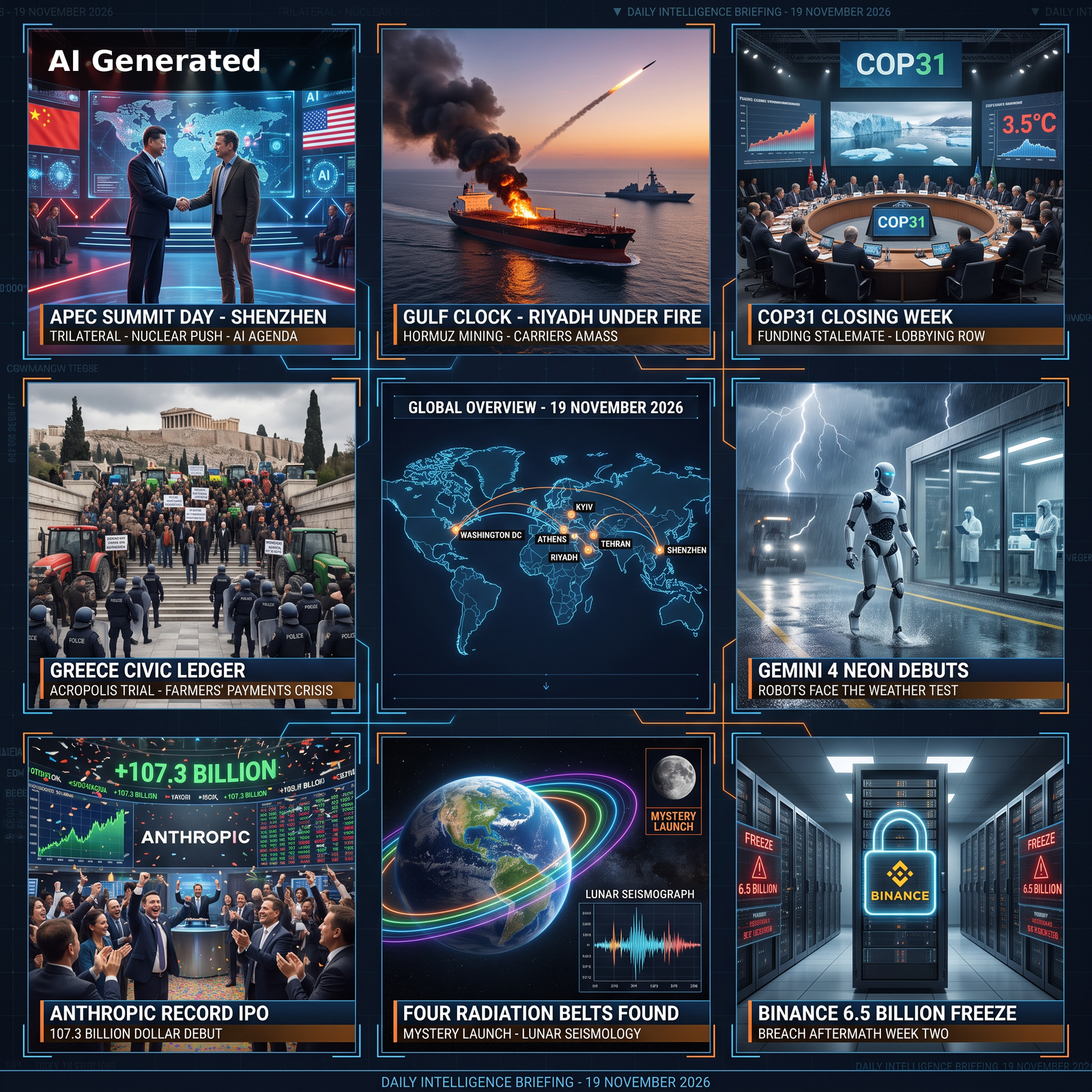
The D172 window is defined by the first-ever trilateral summit of the world’s three largest nuclear powers, convened in Shenzhen on the margins of APEC. Xi Jinping personally greeted Trump on arrival, the trio posed for the historic “family photo,” and Washington confirmed a separate Trump-Putin bilateral around the trilateral itself[1]. Moscow framed the meeting as a return to the top table; Beijing’s repeated line was “cooperation, not exclusion,” with trade, AI and de-escalation on the menu[2][3].
The substantive centre of gravity was nuclear arms control, and here the summit exposed asymmetry, not convergence. Trump has placed nonproliferation at the top of the agenda, but NBC reports Xi and Putin show little interest in new limits: New START expired in February, Russia refuses inspections, and Beijing insists arms control stays bilateral[4]. The numbers frame the divergence — Moscow and Washington field over 5,000 warheads each against roughly 600 for China, heading toward 1,000 by 2030; Beijing declines a framework designed to freeze its build-up[4]. Greek defence analysis made the geometry explicit: Washington and Moscow find rare common ground in wanting China at the table, while Beijing holds the veto by refusing to engage; the realistic outcome is a dialogue channel and a stability statement, not an agreement[5]. An unannounced US Minuteman III test and two Russian strategic bombers in Vietnam set the backdrop[4]. Washington also pushed the AI dialogue: Trump reported a substantive AI conversation with Xi in which the ousted Nvidia founder rated only a brief mention, keeping the AI track separate from the Nvidia affair[6]. Iran and Ukraine rounded out the agenda with expectations deliberately low, and the Yalta comparison is imagery only[5]; for Europe and Kyiv the structural anxiety is that a three-power conversation conducted without them produces arrangements “over their heads.”
The Gulf Clock: Riyadh Under Fire, Hormuz Mining, the Carrier Rotation and the Iran-Attack Files
The Gulf war remained the master variable. A strong explosion was heard in Riyadh early Thursday after Saudi civil defence issued a “potential danger” alert, later lifted; the kingdom reported intercepting two missiles and at least two Houthi drones on Wednesday and another ballistic missile on Thursday, continuing near-daily Houthi strikes since July[7]. The Saudi-led coalition is striking back, with the Houthi Saba agency reporting airstrikes on Sanaa[8]. The State Department renewed citizen warnings for Saudi Arabia and Bahrain, while Riyadh’s defence minister met CENTCOM chief Brad Cooper[10]. At sea, Iranian forces reported three more tankers struck by mines east of the strait while transiting “prohibited waters” with transponders off, extending the weaponisation of the lane carrying a fifth of traded hydrocarbons[9]. The carrier arithmetic shifted: the USS George Washington departed for Yokosuka, reducing the US presence from three carriers to two and correcting the earlier narrative — the posture was rotation and replacement (the Theodore Roosevelt arrived Monday), not a sustained three-carrier concentration — while quietly restoring an American carrier to the Western Pacific[13].
The pressure to convert deterrence into strikes is rising from Israel: media report it is weighing action against Iran “in the very near future,” with Channel 13 claiming jointly approved US-Israeli plans and an attack now “a matter of timing”[11]. The Washington Post adds the institutional layer: Mossad chief Roman Gofman met CIA director John Ratcliffe and envoy Steve Witkoff last week to advocate joint strikes, after Trump’s 9 November postponement of strikes and despite Gulf leaders urging restraint for fear of Iranian retaliation against them[12]. It is the sharpest expression yet of Netanyahu’s re-escalation push, and it frames the trilateral’s Iran talks as a test of whether Moscow and Beijing will press Tehran toward de-escalation[12].
Ukraine’s Bridge War and Russia’s System Stress
On Kerch, Ukraine struck a third time within a week. The latest attack, two days after the operation that destroyed much of the road span, temporarily halted rail traffic on the surviving rail line — the last intact conduit between Crimea and the mainland[16]. German analyst Julian Röpcke assessed the operation achieved about half its effect because passenger trains still run, meaning fuel and weapons traffic moves too[15]. The tactical point is proven: Ukraine has a strike concept Russian air defences have not defeated, and the question is whether Moscow can protect the rail span without stripping air defence from elsewhere[16]; Zeit frames the attack as the third in a week on a bridge that is both logistics artery and Putin’s symbol of annexation[14]. Beneath the front, a leak at the Rosstat statistics agency has reportedly exposed casualty data that contradicts the Kremlin’s posture of strength — a leader presiding over such losses cannot bargain from “equality” at Shenzhen[17].
Gaza’s Ceasefire Erosion and Israel’s Political Insurgency
Gaza’s 13-month-old truce is under its most serious strain. Israeli tanks entered central Gaza west of the “Yellow Line” in what residents call the first ground operation of its kind since October 2025, targeting Hamas infrastructure, with an accompanying strike killing one and two more killed separately[18]. The Trump administration’s own Peace Council warns the ceasefire risks collapse: Israeli strikes continue almost daily, Hamas still attacks soldiers, no decisions exist on a Palestinian police force, and Hamas levies taxes on incoming goods[19]. With two million Palestinians confined to roughly a third of the Strip, rains flooding camps and winter approaching, the humanitarian clock runs alongside the diplomatic one; the core deadlock — Israel refusing withdrawal before Hamas’s dissolution, Hamas refusing disarmament — remains untouched[19]. In parallel, Gadi Eisenkot published a joint declaration with the leaders of Yesh Atid and Yisrael Beiteinu demanding an emergency national government to replace Netanyahu “as soon as possible,” after a suspicious late-night Netanyahu-Bennett meeting that Yedioth Ahronoth reported as an attempt to split the opposition[20]. With the coalition majority razor-thin and a new Knesset speaker elected, the opposition sees a window defined by the “sensitivity of the coming days” — a direct reference to the Iran-attack calculus that would concentrate unprecedented unilateral power in Netanyahu’s hands[20].
The Wider Defence-Industrial and Neighbourhood Ledger
The ICJ rules Thursday on Gambia’s genocide claim against Myanmar’s junta, a verdict that would sharpen pressure on Naypyidaw and shape interpretation of the Genocide Convention in the parallel Gaza proceedings[21]. Germany stood up eight new battalions at Munster — home-defence units plus remaining Lithuania Brigade elements — concrete Zeitenwende delivery[22]. The Trump-class battleship hit a congressional wall: Senate appropriators proposed eliminating nearly $1.84 billion in funding for the nuclear BBG(X), whose 15-ship fleet the CBO prices at $275 billion[23]. In communications, US Marines established a record 187-mile low-power troposcatter link across Hawaii using portable radios deployable in 30 minutes on under 350 watts — a suggestive demonstration of satellite-free Pacific connectivity[24]; BAE meanwhile unveiled a passive “ghost radar” exploiting ambient TV and mobile signals, at up to ten times lower cost, with trials through 2027[25]. Around the neighbourhood: the Russian frigate Admiral Golovko entered the Mediterranean with a Baltic convoy, the first Russian warship presence since early October[26]; Turkish CN-235s and UAVs generated five Aegean airspace violations Wednesday, sustaining the daily pressure pattern[27]; South Korean President Lee hopes dialogue with the North evolves into talks to formally end the Korean War[28]; and Musk’s DealBook remarks accusing Zelensky of lying about Starshield disruptions reopened the sharpest US-tech-versus-Kyiv confrontation of the war[29][30]. Finally, two structural files: Somalia’s parliament is questioning the secretive 2024 TPAO oil deal with Turkey, which reportedly grants Ankara exclusive drilling over 15,000 km2 and 95 percent of production revenues while Puntland and Jubaland call it an act of hostility[31]; and Serbia’s Student List government announced a planned referendum on EU accession, following reforms in justice, rule of law and media, with support at roughly 45 percent and open questions on Kosovo and sanctions[32].
Environment & Climate ↑ Contents
COP31’s Closing Week: Lobbying, the Funding Stalemate and Fossil-Fuel Double-Talk
An analysis by DeSmog found 260 food-and-agriculture lobbyists on the ground — The meat and dairy sector brought 71 delegates, fertiliser firms were up 45 percent on the year and more than 44 percent of agribusiness delegates travelling on country badges, up from 5 percent at COP27 — while the sector most responsible for agricultural emissions pushes to weaken methane accounting metrics and keep agriculture out of the negotiating texts altogether[33]. All references to food and farming are missing from the draft cover decision, four years after agriculture talks collapsed[33]. The parallel story at the UN biodiversity summit in Yerevan was transparency itself: the Convention on Biological Diversity stripped company affiliations from its 9,300-name delegates list for the first time since 2004, and DeSmog cross-referencing still identified Shell, TotalEnergies, Bayer, Syngenta, Rio Tinto and Vale among nearly 480 business delegates, with the Cali Fund holding just $10,000 in pledges two years after its creation[38].
On money, former climate diplomats including Paris architect Laurence Tubiana blame Russia, Saudi Arabia and India for the research-funding stalemate, warning the science basis of the negotiations is “under a serious and highly politicized attack” that could poison future agreements[34]. The methane playbook is documented in detail: TotalEnergies, publicly a champion of methane reduction and one of only two companies cited by the UN for “significant progress” in reporting, is a member of at least 32 trade associations that have worked to delay, weaken or oppose methane regulation in Europe, the US, Argentina, Brazil and Kazakhstan — including IOGP and Eurogas at the centre of the push to postpone the EU Methane Regulation, where a TotalEnergies executive has discussed legal avenues to reopen the text, and a Wood Mackenzie study funded by its trade groups informed a letter from the US Energy Secretary and Qatari, Algerian and Nigerian counterparts urging the EU to halt the rules[35]. The machinery extends to US permitting: the American Conservation Coalition has pivoted to become a data-centre booster, spending $300,000 lobbying for the BAAJA permitting-reform bill, co-hosting “energy freedom” tours with gas majors ExxonMobil and Continental Resources and sponsors including Anthropic and Amazon[36]. In Canada, Financial records show the “grassroots” Canada Action received $15,604 in donations against $2.9 million in corporate sponsorships in 2024, a textbook “subsidised public” strategy[37].
Water, Ice and Wildlife at the Extremes
At the poles, the data refines the picture of climate stress. Tracking of 48 juvenile emperor penguins from three Weddell Sea colonies shows their first year at sea crosses Antarctic krill fishing grounds, with one colony’s juveniles spending over 60 percent of their time in recently fished zones — strengthening the case for the long-stalled Weddell Sea marine protected area, which CCAMLR has failed to agree on for a decade with the species now listed as Endangered[39]. Norway’s new Arctic Ocean 2050 research programme, meanwhile, met a nearly ice-free North Pole on its first cruises, collecting thousands of litres of seawater to track the changing Arctic[42]. On the Pacific coast, a University of Washington study of the 2021 heat dome found that mussel mortality depended on a subtle body-size-thermal interaction: larger mussels died high on the shore where they ran out of evaporative water, smaller ones died lower where they could not hold enough water to cool — a physical model with direct implications for oyster growers[40]. Sudden heat shocks are likewise harmful to honey bees, though Washington State University research shows bees adapt as a heatwave persists[41].
Greenpeace dropped ten two-tonne boulders, one carved as David Attenborough, into Britain’s Southern North Sea MPA to obstruct bottom trawling in what it calls a “paper park,” publishing the coordinates and daring regulators to either enforce the protected area or admit it protects nothing[43]. England’s Environment Agency, by contrast, is working the recovery angle: 400 blue-dyed barbel released into the Thames at Temple Lock, the first year of a three-year, 1,200-fish stocking programme funded by fishing-licence income, with anglers enlisted as citizen-science trackers[44].
The Adaptation and Energy-Transition Ledger
In Nepal, the emergency phase after the Trishuli glacial-collapse floods has ended and aid workers — many of whom lost everything themselves — face the long work of rebuilding communities, with experts urging better ecological monitoring for the next extreme event[45]. Indigenous communities are mounting parallel legal and political rearguards: the Berawan, Penan and Tering peoples of Malaysian Borneo placed a memorial stone to mark their three-year land-rights victory against an oil palm concession that encroached on Gunung Mulu National Park, [46]; in Panama, Ngäbe communities still unrepaired from the CHAN-75 dam face the prospect of a second dam on the same sacred river, with no reparations for the displacement and loss of fisheries since 2007[47]. Bhutan won the 2026 Earthshot Prize in the “Protect and Restore Nature” category for maintaining 70 percent forest cover and enshrining nature protection in its constitution, with the prize accelerating the Restore Bhutan programme to restore 50,000 hectares by 2030[48]; and Grand Canyon’s South Rim hotels reopen Friday as the park reaches a milestone in restoring its flood-damaged Transcanyon Waterline[49].
Europe’s inland barge operators face a planning paradox: Rotterdam’s coal throughput rose 15.3 percent by autumn 2026, yet any engine or battery conversion bought now risks locking in assets for a cargo mix that is itself in flux — a reminder that the electric-fleet plan needs a cargo plan[50]. On materials, US startup Molten Industries commissioned the world’s first battery-grade graphite-from-natural-gas plant in Oakland — 300 tonnes a year via methane pyrolysis, with no direct process emissions — a domestic alternative to a chain where China controls roughly 75 percent of graphite anode production; the question is whether it scales and passes customer validation from 1 December[51].
Society & Civil Issues ↑ Contents
Greece’s Civic Ledger: A Femicide in the Acropolis District and the Farmers’ Payments Crisis
Greece opened Thursday with a domestic-violence killing at the heart of the capital. A 61-year-old woman was found dead in her home on Aithras Street in the Acropolis area in the early hours, fatally beaten; her 63-year-old husband was arrested at the scene after himself calling the police and telling them he had beaten his wife and that she had no vital signs[52]. The killing has renewed national focus on intimate-partner violence and on the adequacy of Greece’s protective mechanisms, a policy priority since earlier femicides[52]. In parallel, farm payments anxiety is acute: Larissa MP Maximos Charakopoulos acknowledges the dire climate while Agriculture Minister Margaritis Schoinas pledges a “substantial advance” by 30 November[53].
Germany’s Civic Square: SPD Leadership, the Courts and Gen Z’s Return to the Streets
The SPD presidium met Thursday over the January party congress: former labour minister Hubertus Heil has declared for the chair against incumbent Lars Klingbeil, and parts of the party favour premier Manuela Schwesig as a consensus candidate; secretary-general Tim Klüssendorf wants a proposal “broadly supported in the party” by 16 December[54]. The Federal Administrative Court heard the equal-pay claim of former Todtmoos mayor Janette Fuchs, graded A14 for years while male predecessors and successors started at A15 — a concrete sex-discrimination case at final instance[55]; and the BGH heard who must compensate in a claimed Covid vaccine-injury case — the state or the Land — after the lower court assigned the claim to Baden-Württemberg[56]. Under “Gen Z regelt,” activists have called a national protest for Friday; the question is whether it produces the mass of earlier waves[57].
America’s Civic Ledger: Safeguarding Failures and Institutional Strain
A Virginia school district has shut down through Thanksgiving after discovering roughly 500 staff members were never screened against the state’s child-abuse-and-neglect registry — an extraordinary gap in a system built for child protection[58]. Misconduct complaints against the DOJ have jumped dramatically in Trump’s second term, yet the Office of Professional Responsibility that adjudicates them has just 18 full-time staff against a workforce of thousands — a structural mismatch that raises real questions about internal accountability at the institution charged with impartial law enforcement[59].
France’s Republic: The Femmeblancherie Trial, the 2027 Coalition Calculus and the Lavalette File
In Paris, the trial opened of seven members of the Telegram channel “Femmeblancherie,” charged with public incitement to commit crimes — calls for femicides and rapes, racist and homophobic file-keeping — a judicial flagship in the confrontation with male-supremacist subcultures online[60]. On the 2027 electoral logic, Green candidate Marine Tondelier declared herself “ready to work toward a coalition” around Jean-Luc Mélenchon, whose campaign momentum she called “undeniable,” even as polls credit her with 2-4 percent against his projected second-round placing — the clearest signal yet that the left is converging on a single candidacy[61]. Deputy Laure Lavalette faces accusations of endorsing antisemitic writings “30 years ago,” a defence reproducing the RN’s pattern of minimising its history ahead of a cycle in which it must appear governable[62].
The UK, Commonwealth and Global Periphery Ledger
Britain’s civic file combines platform governance with accountability culture. The government has asked Google to deactivate Russell Brand’s YouTube channel after an “appalling” prison message[63]. The Bayesian disaster produced its official reckoning: the British report into the July 2024 sinking off Sicily found the crew were unaware of the safety risk before the deadly capsize that killed Mike Lynch and his daughter Hannah among seven victims — a finding that shifts focus from freak weather to on-board decision-making[64]. Australia’s two systemic storylines produced more evidence: in Sydney, prosecutors argued in the Beau Lamarre-Condon murder trial that the former police officer’s “wounded pride” after a breakup led to a “darker plan for revenge” in the killings of Jesse Baird and Luke Davies with his service weapon[65]; and the Victorian Big Build royal commission heard a labour-hire boss admit he generated fake invoices for sports-club sponsorships to disguise “distorted” payments to a former CFMEU official[66].
In Canada, the Alberta separatist movement, routed in last month’s sovereignty referendum, is now conspiring to oust Premier Danielle Smith at a UCP AGM, with its leader urging a thousand supporters to attend and constituency associations passing motions for a leadership review[67]. In Kazakhstan, the arrest of two of the country’s most powerful managers — the case in which dollar notes “rained” from a capital window — exposed the elite’s symbiosis of state power and private wealth[68]. Cultural-heritage files round out the ledger: Britain blocked the export of two Mughal imperial calligraphy volumes dated to around 1595-1605, giving UK institutions a window to match a £900,000 price[69]; MOD war detectives finally identified an unknown First World War corporal killed in March 1918[70]; Van Gogh’s “Chestnut Trees in Blossom” sold for $190.4 million at Sotheby’s New York, a record for the artist, after an agreement with the heirs of a former Jewish owner who had contested the sale over its Nazi-era provenance[71]; a recently constituted US Catholic bishops’ task force on AI called for regulation and worker protections as the technology races ahead of ethics — a sign that religious institutions are entering the AI governance debate[72].; and a new US Catholic bishops’ AI task force called for regulation and worker protections — religious institutions entering the AI governance debate[72].
AI & Technology ↑ Contents
The Model Frontier: Gemini 4 Neon, OpenAI’s Personality Shift and the Agentic-Accounting Push
Google launched Gemini 4 Neon, a mid-tier model positioned between the faster Hydrogen and the more powerful Carbon: it scored 61 on the Artificial Analysis Intelligence Index (third overall), ranked first on the Coding Agent Index, claims 3x faster task completion than Carbon at 60 percent of the cost, and adds a cybersecurity variant scoring 90.5 percent on SEC-bench Pro[73]. The pricing ($3/$15 per million input/output tokens, $0.15 cached) is the competitive move: a claimed 32 percent lower cost per task than Carbon and 50-80 percent savings versus rivals, pressure aimed at Claude and GPT in the enterprise segment[73]. OpenAI counter-signalled with GPT-6.2 “Astra” and “Sol,” variants with noticeably different personalities — shorter, more confident responses that reduce user guidance, with decision-reliability implications for agents[74] — and with ChatGPT for Accounting, a vertical plugin suite spanning QuickBooks, Xero and NetSuite that pushes frontier models into regulated financial workflows where “human oversight remains crucial”[75]. Arizona is investigating OpenAI and others over rogue-agent behaviour under state consumer-protection powers — one of the first state-level probes into deployed autonomous agents[76].
Autonomy’s Weather Test and the Outage Wave’s Week Two
Waymo temporarily paused its entire San Francisco robotaxi service after several vehicles became stranded in flooded streets during an atmospheric river — one blocking a flooded crosswalk, another instructing its rider to stay inside — with the app telling riders service would resume “when road conditions improve”[77]. It is the third such pause — December 2025’s outage freeze, May’s recall of nearly 4,000 vehicles after a San Antonio flood, an Atlanta pause — and it came a day after California restricted Waymo from freeways, prompting a system-wide pullback. The flood episode frames the core autonomy limitation: degraded-sensing edge cases remain unsolved at scale[77].
The American outage wave that D171 tracked entered week two with the official-denial narrative fraying. SPIEGEL reports the cascade of IT failures across Microsoft, the FAA and Apple has begun driving “hamster-buying” stockpiling, and even Fox News’ flagship morning show challenged the administration’s claim that the outages are unrelated, host Lawrence Jones telling viewers “don’t tell us that it’s not connected”[78][79]. The taxonomy — no single vendor, no official linkage, a synchronised-systems theory gaining traction — is itself becoming a trust event: Nadella admitted “lots of critical infrastructure is unpatchable” while downplaying the Outlook outage[82].
Platforms, Policy and Security: Schools vs. Search, Nadella’s Buyouts and the Nvidia Succession
Google’s decision to disable Search for schools that opt out of its Gemini AI features has pushed New York, Los Angeles and Chicago — the nation’s largest districts — to consider dropping Google Search altogether, with Google’s education VP stating flatly that “search and AI are deeply integrated” and politicians including NYC Mayor Zohran Mamdani and Senator Bernie Sanders reacting harshly[80]. The episode crystallises the education-technology collision: districts wanting to shield children from AI-mediated experiences find the product bundle gives them no such choice[80]. At Microsoft, Nadella offered his fullest explanation yet of October’s offer of buyouts to 60,000 employees — essentially asking them to leave voluntarily rather than face another mass layoff — and the short answer is AI, not in the replacement sense but in the reorganisation sense: the company’s internal economics have shifted toward AI-shaped roles, rendering swaths of the legacy workforce surplus[81]. Nadella expressed confidence in Nvidia’s interim CEO Colette Kress after Jensen Huang’s exit[83], while Musk defended the ousted founder — “kicking Michael Jordan off your team,” insisting Huang is not “disloyal to the United States” — tying the succession to the US-China technology fight[84].
A Senate committee chaired by Ted Cruz approved Trump’s FCC nominee Danielle Thumann 15-0 in a Republican-only vote after Democrats boycotted to deny a quorum — a partisan squeeze-out of a telecom regulator nominee that Democrats will not be able to reverse once they take the chamber majority in January, but also a preview of how contested the lame-duck confirmations are becoming[85]. On security, a critical Java flaw disclosed this week allows remote takeover of systems without a password — a vulnerability class that, combined with the outage wave and the “unpatchable infrastructure” admission, frames the systemic security risk in software supply chains[86].
Economy & Business ↑ Contents
Anthropic’s Record IPO: $107.3 Billion and the Frontier-AI Capital Event
The defining economic event is Anthropic’s IPO: priced at $83 and upsized to 980 million shares, raising a record $107.3 billion including a $26 billion private placement with Google, AMD and Microsoft, while Nvidia separately committed to buying $10 billion of stock[88]. The base deal of $81.3 billion alone surpassed SpaceX’s $75 billion record debut, and the fully diluted valuation of roughly $1.5 trillion places the Claude maker among the fifteen largest publicly traded companies, neck-and-neck with Tesla and ahead of Eli Lilly[88]. Demand was roughly seven times the shares on offer; co-founders sold 23.6 million shares; and the Goldman-and-Morgan-Stanley-led offering primarily benefits backers ICONIQ, Coatue and Spark plus employees[88]. Pricing through a week in which the Nasdaq 100 fell 4.4 percent and Nvidia lost for five days marks a statement of conviction about AI demand now tested in secondary trading; it vaults Anthropic ahead of OpenAI, which plans no listing before 2027[88]. In parallel, UK regulators at the FCA and PRA clarified cyber-resilience expectations, telling firms they need confidence in detection, containment and recovery — a direct response to the outage wave that has made cyber a solvency issue[87].
Banks and the German Financial Ledger: Commerzbank Unblocked, Deutsche Bank Exposed
The federal government has ended its resistance to UniCredit’s takeover of Commerzbank, with the two sides reaching an agreement — accepting Frankfurt as HQ of the merged Commerzbank-HVB and quietly surrendering the “defend the national champion” position, resolving a standoff that had become a litmus test for European banking consolidation[89]. Hours later, the Deutsche Bank leak escalated from corporate scandal to national-security matter: more than 15 million documents, including nine million emails, have reached journalists, and security policymakers fear cover accounts (Tarnkonten) used by police and intelligence services may be exposed. Intelligence-oversight chair Marc Henrichmann called it “a grave security risk” if true; Greens deputy Konstantin von Notz demanded the National Security Council convene urgently; CEO Christian Sewing acknowledged errors and BaFin opened an investigation[90].
Central Banks and Asia’s Ledgers: Ueda’s Rate Logic, Korea’s Debt, Taiwan’s Tape and the IMF’s Tightening Call
Bank of Japan Governor Kazuo Ueda pressed his case for raising rates to positive levels “so that real interest rates can fall when the economy slows,” adding that next year’s wage talks are the key test of whether core inflation holds at 2 percent [91]. Korea’s external position bears watching in that context: total external debt rose to $830.6 billion at end-September from $812.8 billion at end-June, though the short-term share fell to 42.9 percent of FX reserves from 46.5 percent[92]. Taiwan’s market took a 4 percent hit as the Shenzhen summit and its semiconductor anxieties repriced, and IMF Managing Director Kristalina Georgieva warned global inflation calls for tightening in many economies — the clearest signal that post-election easing hopes are premature[93][94].
Corporate Moves: Tata’s Listing Window, ACME’s Ammonia, Kpler’s Turmoil Play and Asia’s Recalibrations
Tata Sons’ board will discuss a listing next week — its first substantive session since 17 September — and if it proceeds, the IPO could be the largest ever in India, a landmark for the conglomerate empire that controls everything from salt to software[95]. ACME Group’s $3.6 billion, 760,000-tonne green ammonia project in Odisha entered execution with Brookfield backing and offtake from Indian and Japanese buyers, targeting 2029[96]. Commodity-data firm Kpler bets global turmoil sustains demand for trade intelligence, a bullish wager on the war economy’s information needs[97]. Elsewhere in Asia: Uniqlo’s Tadashi Yanai says he looks beyond becoming the world’s top apparel company[98]; Vietnam is courting European investment but regulatory hurdles loom, a familiar two-step in Hanoi’s opening[99]; and US visa denials have hit Xpeng and other Chinese robot makers heading into CES, a soft-power squeeze on China’s tech executives before the industry’s biggest stage[100]. Finally, Musk hinted at a potential SpaceX-Tesla merger within a year — a combination that would create a vertically integrated space-EV-autonomy colossus[101].
Science & Space ↑ Contents
The Cosmic and Near-Earth Ledger: Four Radiation Belts, a Mystery Launch and Lunar Seismology
For the first time on record, four distinct electron belts appeared around Earth in the aftermath of the May 2024 “Mother’s Day” geomagnetic storm, the strongest in twenty years: electromagnetic interactions progressively carved new slot regions into the usual two-belt Van Allen structure, creating a three-belt configuration and then a four-belt one by June 2024 before normal conditions returned in August[102]. The observation, from ESA’s PRO-V satellite, demonstrates new trapping-and-loss mechanisms — three-belt states have been seen repeatedly since 2024 — with direct implications for spacecraft electronics and astronaut exposure[102]. In orbit, a Long March 2D lifted the mysterious Shijian-24 satellite into sun-synchronous orbit from Taiyuan, the 678th Long March flight; the “Practice” designation and unusually wide 3.8-metre fairing suggest a technology-demonstration or Earth-observation payload whose mission Beijing has not disclosed, continuing a year in which China has also flown Shijian-31 (highly elliptical orbit) and recovered from January’s Shijian-32 failure[118]. Engineers also published the first lunar-specific ground-motion model, acknowledging Earth-based seismic equations do not transfer to the Moon — a foundational input for future lunar structures[108].
The Biomedical Ledger: Hibernation’s Alzheimer’s Clues, Iron’s Limits, Turmeric’s Debunking and the Exercise Molecule
Biomedicine delivered high-quality negatives and positives: a Cochrane review spanning more than 50,000 children and adolescents shows daily iron supplementation substantially reduces iron-deficiency anaemia but does not improve growth or protect against common illness — a precise definition of where the intervention works and where it does not[104]; and the most rigorous assessment yet of turmeric for knee osteoarthritis, pooling four RCTs with over 370 participants, found no meaningful benefit over placebo for pain, quality of life or function — a difference half the threshold patients can perceive, the authors questioning whether further trials are justified[114]. The positives are intriguing: golden hamsters entering deep hibernation show immune-cell states in the brain that resemble early Alzheimer’s pathology, a natural model for tau progression[103]; and University of Leeds researchers identified a molecule released during exercise that makes muscles stronger and more fatigue-resistant, potentially addressing the weakness that keeps many type-2 diabetes patients sedentary[115]. Two behavioural-biology papers added texture: Stanford scans of children aged 7-16 show that around age 13 the brain stops finding the mother’s voice uniquely rewarding and increasingly rewards unfamiliar voices — “not tuning out, but tuning into,” an aspect of healthy maturation[116]; and University of Virginia research on subtraction bias shows that when people improve systems they systematically overlook removal as an option — only 11 percent of suggestions to a new university president proposed removing something — unless explicitly cued, a finding with genuine decision-architecture applications[117].
Deep Time, Materials and the Microbiome: Arabia’s Green Past, Türkiye’s Tectonics and the Body’s Chemical Economy
In the Empty Quarter of southern Saudi Arabia, an international team documented a 29-metre-deep lake at Uruq al-Julaybah with more than 500 fossils — hippos, extinct long-horned buffalo, camels, ostriches — alongside 5,511 Levallois tools, some bearing the earliest Arabic evidence of toxic plant compounds used in hunting, dated to the “Green Arabia” interglacial about 125,000 years ago[120]. In southern Türkiye’s Central Taurides, calcite dating has rewritten the region’s orogenic history, revealing a previously unrecognised period of lateral crustal sliding between the Early Eocene and Early Miocene and pushing the start of regional extension back to about 25 million years ago[109]. The first dynamic-compression experiments on plutonium at a national light source, by Livermore, Argonne and Washington State, open a new experimental era for the metal[107]; a new solid-liquid mixing benchmark offers industry a defined metric for floating-particle drawdown, promising energy savings in stirred tanks[110]. Gut microbes transform dietary plant sterols into circulating sulfated metabolites, illuminating why only about 5 percent reach the bloodstream and how their cholesterol-lowering effects operate[112] — while separately, Canadian federal antibiotic-policy changes had little effect on sales of animal antibiotics (down 11 percent since 2018 but for other reasons), a caution for regulatory design[111]. Adelaide researchers showed climate change, extreme heat and habitat loss are intensifying the risk of deadly bat-borne zoonoses spillover[105]; and an international study argues restoring large herbivores to Europe’s landscapes could preserve rural habitats and reduce wildfire risk[106]. Birmingham researchers are pursuing sustainable electric flight, where energy density is the binding constraint[119]. A smart-floss prototype from HKUST harvests gingival crevicular fluid and measures glucose, uric acid, hydrogen peroxide and pH with blood-correlated accuracy — converting a daily habit into a non-invasive diagnostic[113]; and a Missouri study adds evidence that arts education improves attendance, discipline and writing among students with disabilities[121].
Crypto, Digital Assets & Blockchain ↑ Contents
Protocol Mechanics: Bitcoin’s Testnet5 and the Miner-Software Trial
The protocol layer delivered its most substantive development in months with the launch of Bitcoin Testnet5, giving miners a real-world trial of four proposed consensus fixes before any activation. Mining pools can now test the blocks their software builds against the new network rules while Bitcoin Core and Sparrow Wallet prepare support — the standard dress rehearsal that precedes any consensus change, and one made more consequential by the fact that two of the four proposals address fee-market and block-construction dynamics that have been debated since the ordinals-driven fee spikes[122]. The significance is procedural as much as technical — the first genuine miner-facing testnet in years, an attempt to make activation hard to miss — and it arrives as the mining economy is being reshaped from outside: MARA Holdings and Riot Platforms sold a combined $3.4 billion in bitcoin to fund AI data-centre buildouts, continuing the sector-wide pivot from mining revenues to compute hosting, a shift that changes who controls hash rate and why[130]. When the industry’s two largest Nasdaq-listed miners become, in effect, GPU-hosting companies with treasury positions, the network’s economic assumptions about miner behaviour — that they sell to cover costs, that they are price-sensitive marginal sellers — need re-examination[130].
The Exchange-Security Ledger: Binance’s $6.5 Billion Freezing Order and the $6.34 Billion Breach Aftermath
The recovery operation around October’s heist — the largest in crypto history — reached a legal landmark. The Abu Dhabi Global Market Courts granted Binance a worldwide freezing injunction on 18 November covering $6.5 billion — roughly 102.5 percent of the $6.34 billion affected — against unnamed defendants; the order is enforceable through on-chain service, with a living list of about 26,000 wallet addresses updated as funds move[123]. The substance deserves disciplined reading: the ceiling is not the recovery — at the last count $2.85 billion had been frozen or intercepted (45 percent of affected assets), US prosecutors had seizure authority over $1.2 billion, and $3.49 billion remained unfrozen[123]. The order’s real function is to unlock the $2.85 billion already sitting in frozen accounts whose custodians demanded a court order, not to net the still-moving balances; Binance says it has already replenished users from its own funds, so any recovery accrues to the company, not to token holders[123]. The market’s verdict was telling: BNB fell just 2.3 percent on the announcement and has outperformed bitcoin over seven and thirty days — the containment narrative holding even as the enforcement story remains open[123]. Binance is simultaneously planning expansion into five Asian markets and briefed regulators in Japan, South Korea, Australia, Thailand and New Zealand within 36-48 hours of the breach[124].
Institutional Rails and the Policy Perimeter: Tokenized Deposits, Kraken’s Private-Market Move and Washington’s Two-Pronged Approach
Standard Chartered, StraitsX and OCBC completed a proof-of-concept for interoperable tokenised deposits, arguing that “always-on” deposits only unlock their full potential when platforms can transact across each other — the interoperability question now central to the tokenisation thesis[125]. Kraken’s parent Payward agreed to acquire Tribe Capital, adding private-market sourcing, underwriting and fund-management capabilities to the exchange group’s platform — a conspicuous stride from spot exchange toward the full capital-markets stack[126]. Washington’s posture doubles down on enforcement infrastructure rather than deregulation: the Trump administration unveiled a new centre to choke off scam payments, responding to more than $17.7 billion in reported US online-fraud losses in 2025[127], and tapped TRM Labs in a $95 million effort to disrupt international crypto-crime networks — a contract that turns private blockchain-analytics capability into federal operational capacity, with the explicit framing that recovering billions in laundered losses is now a government objective[128]. On the advocacy side, the Bitcoin Policy Institute is rebranding as the Finney Foundation for Open Technology, expanding from bitcoin-only advocacy into the Washington open-source-AI debate — a strategic bet that the crypto policy community’s hard-won playbook (single-issue think-tank, congressional relationships, rule-of-law messaging) transfers to the open-source-model fight[129]. Read together, the window shows institutional consolidation at the rails, adversarial reconstitution at the enforcement layer and protocol perseverance: the industry is absorbing its largest breach, testing its first network-upgrade in a new format, and angling for a seat at the open-source-AI table[122][128].
Correlations & Analysis ↑ Contents
Across the D172 window the master variable remains what D171 identified: the Gulf war’s pull on every system. D171 closed on the two-carrier signal and the widening confrontation with Iran; this window the configuration has both hardened and thinned — Israeli media reporting joint US-Israeli approved strike plans and Mossad’s chief lobbying Washington in person, while the carrier force rotated from three to two as the George Washington returned to Japan[11][13]. The D171 theme — the Gulf ladder running in parallel with Shenzhen diplomacy — has resolved into the summit itself, with nuclear limits, Iran and Ukraine all on the table and none close to settlement[4][5]. Deterrence and diplomacy are co-escalating: as the US-Israel axis moves toward “a matter of timing,” the three-power conversation tests whether Moscow and Beijing will restrain Tehran; the tracks are structurally coupled, and the most dangerous scenario is diplomacy’s failure being read as permission to strike[12].
The second correlation runs through the AI-capital cycle D171 framed around Nvidia’s post-founder quarter. Today that arc reached its milestone: Anthropic’s record $107.3 billion IPO, priced through a week in which the Nasdaq fell 4.4 percent and Nvidia fell for a fifth day — a statement that appetite for frontier-AI equity has decoupled from index sentiment[88]. The flows are visible end-to-end: the stalled $500 billion chip-financing initiative means[131] capital formation runs through the equity market rather than infrastructure funds; miners are selling bitcoin to buy GPUs for AI data centres; Google is shipping a cheaper mid-tier model to defend enterprise share[73][130]. The IPO concentrates systemic risk in one vehicle: if ANT’s tape breaks, it becomes the transmission mechanism for the whole AI-valuation complex.
Third, trust in systems — the through-line of D171’s fragility-wave coverage — now spans technology, finance and governance simultaneously. The US outage wave entered week two with even Fox News questioning official denials[79]; Deutsche Bank’s 15-million-document leak threatens cover-account operations and triggered a National Security Council demand[90]; the Virginia school district’s 500-unscreened-staff failure revealed a safeguarding hole at the heart of American child protection[58]; and at DOJ, 18 staff adjudicate misconduct complaints across a federal workforce[59]. D171 flagged official-denial fatigue as the defining social risk of the outage era; D172 adds the financial and institutional layers — the deficit is systemic, and courts, regulators and journalism are asked to carry more weight than their resourcing allows.
Fourth, the Gulf war continues to finance-proof the energy-climate contradiction documented since D169. The climate summit’s final week showed agribusiness and fertiliser lobbies at record delegation strength inside country badges while Russia, Saudi Arabia and India block research funding and TotalEnergies’ trade associations fight EU methane rules[33][35][34]. The irony sharpens: the same hydrocarbon economy the war is inflating (rising Korean external debt, BoJ pointing at oil-driven inflation) is bankrolling the lobbying that blocks the transition that would reduce the war’s premium[91][92]. The intelligence-relevant lesson: the failure modes are visible in delegate lists, trade-association emails and funding stalemates — the climate system’s plumbing is corroding in real time.
Finally, the Israel-Palestine and Israel-political tracks are reconverging toward a single dangerous juncture. The Gaza ceasefire’s erosion — tanks in central Gaza, the Peace Council’s collapse warning — is occurring as Eisenkot’s bloc demands an emergency government[18][19][20]. D171 recorded the Knesset-speaker contest as the opening move in the succession fight; D172 shows the opposition openly declaring replacement a top priority “in the coming days” precisely because an Iran strike would consolidate power in the incumbent’s hands. The sequence — Gaza escalation, Iran timing, Netanyahu’s survival politics — is a single feedback loop, and the ICJ’s Rohingya ruling will be read as the template for Gaza[21].
What to watch in the next reporting period: (1) the Shenzhen trilateral’s joint statements — any language on nuclear stability, Iran or Ukraine sets the coordinates; (2) whether the reported joint US-Israeli Iran plans move from timing to execution; (3) ANT’s first Nasdaq sessions — the tape is now the market’s AI-sentiment instrument; (4) the EU Methane Regulation delay decision and the Senate’s BAAJA vote — the hard legislative tests of the lobbies documented at COP31; (5) whether Kerch’s rail span falls; and (6) the Virginia school and German security-council dossiers, as institutional-trust failures propagate.
References ↑ Contents
1. US-Regierungsvertreter: Trump und Putin wollen in Shenzhen bilaterales Treffen abhalten by Germany via d k on Inoreader · Source ↑
2. Weltpolitik: Vor Dreiergipfel: Xi wirbt bei Apec für mehr Zusammenarbeit by DIE ZEIT: News – · Source ↑
3. «Συνεργασία, όχι αποκλεισμοί»: Το μήνυμα Σι πριν από την ιστορική τριμερή με Τραμπ και Πούτιν – Εμπόριο, τεχνητή νοημοσύνη και πόλεμοι στην ατζέντα by Greece via d k on Inoreader · Source ↑
4. Trump pushes for three-way nuclear deal as Russia and China show little interest by Abigail Williams · Source ↑
5. APEC: Το ζήτημα που συμφωνούν ΗΠΑ-Ρωσία και όχι η Κίνα! by DEFENCE via d k on Inoreader · Source ↑
6. Τραμπ και Σι συζήτησαν για την ΤΝ και (…λίγο) για τον Χουάνγκ της Nvidia στο περιθώριο της APEC by Newsroom · Source ↑
7. Forte explosion à Riyad, alors que l’Arabie saoudite est régulièrement visée par les Houthis pro-iraniens by France via d k on Inoreader · Source ↑
8. FinancialJuice: Houthi-run Saba news agency — Saudi Arabia launches airstrikes on Yemen’s capital Sanaa by FinancialJuice · Source ↑
9. Στενά του Ορμούζ: Ακόμα τρία δεξαμενόπλοια προσέκρουσαν σε θαλάσσιες νάρκες by DEFENCE via d k on Inoreader · Source ↑
10. HΠΑ: Προειδοποίηση για επιθέσεις σε Σαουδική Αραβία και Μπαχρέιν by DEFENCE via d k on Inoreader · Source ↑
11. Κανάλι 12: «Έτοιμο για επίθεση κατά του Ιράν το Ισραήλ» by DEFENCE via d k on Inoreader · Source ↑
12. WP: «Η Μοσάντ ζήτησε αμερικανικά χτυπήματα στο Ιράν» by DEFENCE via d k on Inoreader · Source ↑
13. Επιστρέφει στην Ιαπωνία αεροπλανοφόρο από την Μέση Ανατολή by DEFENCE via d k on Inoreader · Source ↑
14. Ukrainekrieg: Krim-Brücke nach drittem Angriff in einer Woche erneut gesperrt by DIE ZEIT: Ausland – Jana Trietsch · Source ↑
15. «Το 50% της Γέφυρας της Κριμαίας χτυπήθηκε» (βίντεο) by DEFENCE via d k on Inoreader · Source ↑
16. Ukraine Strikes Kerch Bridge Once Again: Crimea Governor by Howard Altman · Source ↑
17. Datenleck bei russischer Statistikbehörde: Putin ist zu schwach, um Bedingungen zu stellen by DIE ZEIT: Ausland – Maxim Kireev · Source ↑
18. Ισραηλινά άρματα μάχης εισέβαλαν στην κεντρική Γάζα by DEFENCE via d k on Inoreader · Source ↑
19. Γάζα: To Συμβούλιο Ειρήνης προειδοποιεί για κατάρρευση της εκεχειρίας by DEFENCE via d k on Inoreader · Source ↑
20. Ισραήλ: Κοινή δήλωση ηγετών για την συγκρότηση κυβέρνησης αντικατάστασης του Νετανιάχου μετά από… ίντριγκα by Greece via d k on Inoreader · Source ↑
21. IGH verkündet Urteil über mutmaßlichen Völkermord an Rohingya in Myanmar by Germany via d k on Inoreader · Source ↑
22. Das Heer stellt in Munster acht neue Bataillone in Dienst by Germany via d k on Inoreader · Source ↑
23. 35,000-Ton US Navy Trump-Class Battleship Is Now Facing a ‘Serious Setback’ and It Has Nothing To Do with Russia or China by Harrison Kass · Source ↑
24. US Marines set world’s longest low-power troposcatter communications link at 187 miles by Aamir Khollam · Source ↑
25. New ”Ghost Radar” that hides from enemies developed in UK by Γιάννης Ρέκκας · Source ↑
26. Στη Μεσόγειο η ρωσική φρεγάτα «Admiral Golovko» (φωτο) by DEFENCE via d k on Inoreader · Source ↑
27. Νέες τουρκικές παραβιάσεις από CN-235 και UAV by DEFENCE via d k on Inoreader · Source ↑
28. FinancialJuice: S.Korea President Lee hopes reopening dialogue with North Korea will evolve into talks to establish peace (Yonhap) by FinancialJuice · Source ↑
29. Elon Musk tries to explain what’s going on with Ukraine and Starlink by Jay Peters · Source ↑
30. « Il ment » : Elon Musk s’en prend à Volodymyr Zelensky au sujet de limitations de Starshield en Ukraine by France via d k on Inoreader · Source ↑
31. Somalia’s Parliament and Public Are Questioning the President’s Shadowy Oil Deal With Turkey by Oscar Rothstein · Source ↑
32. Serbia: Referendum on EU accession planned by new Student List government by Δρ. Αθανάσιος Ε. Δρούγος · Source ↑
33. Fertiliser, Big Meat and Biofuels Industry Among 260 Food Sector Lobbyists at COP31 by Clare Carlile and Hazel Healy · Source ↑
34. Former Climate Diplomats Blame Three Nations for Research Funding Stalemate by Bob Berwyn · Source ↑
35. French Oil Giant Backs Dozens of Lobby Groups Fighting New Methane Rules Around the World by Cécile Marchand and TJ Jordan · Source ↑
36. How a Republican Conservation Group Became a Data Center Booster by Miranda Green · Source ↑
37. ‘Grassroots’ Pro-Industry Group Receives Millions in Sponsorship Money, Financial Records Show by Taylor Noakes · Source ↑
38. UN Fails to Disclose Company Names on Biodiversity Summit Delegates List · Source ↑
39. Tracking of 48 young emperor penguins shows their first year at sea crosses Antarctic krill fishing grounds, and one colony’s juveniles spent over 60% of their by Adrian Villellas · Source ↑
40. During the 2021 heat dome, the mussels that died on a Washington shore were the wrong size for their spot: bigger than average up high and smaller than average by Javier Niño · Source ↑
41. Sudden Heat Spikes Harmful to Honey Bees, WSU Study Finds by Environment via d k on Inoreader · Source ↑
42. What Thousands of Litres of Seawater Can Tell Us About the Changing Arctic by Environment via d k on Inoreader · Source ↑
43. Greenpeace drops ‘Attenboulder’ to deter UK bottom trawlers in a marine protected area by Shreya Dasgupta · Source ↑
44. England’s Environment Agency released 400 young barbel marked with blue dye into the River Thames, and anglers who catch one are asked to photograph both sides by ECONEWS · Source ↑
45. After Nepal's epic flood, they're restoring their community … and their lives by Jonathan Lambert · Source ↑
46. Borneo Indigenous groups turn land rights victory into warning for future generations by Isabel Esterman · Source ↑
47. Indigenous communities in Panama fear a second dam as damage from first goes unrepaired by Latoya Abulu · Source ↑
48. Bhutan wins $1.3m Earthshot Prize for maintaining 70% forest cover by Shreya Dasgupta · Source ↑
49. Grand Canyon’s South Rim hotels to reopen as park eases water restrictions by Mongabay Editor · Source ↑
50. Europe’s Inland Barges Need a Cargo Plan Before an Electric Fleet Plan by Michael Barnard · Source ↑
51. World’s first plant to produce battery-grade graphite from natural gas begins operations by Neetika Walter · Source ↑
52. Συνελήφθη 63χρονος στην Ακρόπολη, φέρεται να ξυλοκόπησε μέχρι θανάτου την 61χρονη σύζυγό του, βίντεο by Greece via d k on Inoreader · Source ↑
53. Η αγωνία για τις πληρωμές προς τον αγροτικό κόσμο by ΒΗΜΑτοδότης · Source ↑
54. SPD-Präsidium berät über Neuaufstellung der Parteispitze by Germany via d k on Inoreader · Source ↑
55. Bundesgericht prüft ungleiche Bezahlung von Bürgermeisterin by Germany via d k on Inoreader · Source ↑
56. Bundesgerichtshof verhandelt über Haftung für möglichen Impfschaden by Germany via d k on Inoreader · Source ↑
57. «Gen Z regelt»: Jugend ruft Freitag zum Protest auf – Wer wird kommen? by DIE ZEIT: News – · Source ↑
58. Virginia school district shutters after finding 500 staff members weren’t screened for child abuse by Marlene Lenthang · Source ↑
59. Misconduct complaints against the DOJ have jumped dramatically during Trump’s second term by Jasmine Fernández · Source ↑
60. ‘Femmeblancherie’ : le procès de la haine des femmes (Telegram anti-women channel trial opens in Paris) · Source ↑
61. Présidentielle : Marine Tondelier "prête à travailler à une coalition" autour de Jean-Luc Mélenchon by FRANCE 24 · Source ↑
62. « Il y a 30 ans dans un climat tout à fait différent » : la députée RN Laure Lavalette accusée d’avoir cautionné des écrits antisémites by France via d k on Inoreader · Source ↑
63. Government asks Google to deactivate Russell Brand’s YouTube after ‘appalling’ message: report by Harriette Boucher · Source ↑
64. Bayesian crew unaware of safety risk before deadly sinking, British report finds by Ted Hennessey · Source ↑
65. Beau Lamarre-Condon’s ‘wounded pride’ after breakup with Jesse Baird led to ‘darker plan for revenge’, crown alleges by Kat Wong · Source ↑
66. ‘I’ll take the rap for that’: labour hire boss asked for fake invoices for sports club sponsorships, Big Build royal commission hears by Australian Associated Press · Source ↑
67. Alberta Prosperity Project Wants to Oust Premier Danielle Smith by Mitch Anderson · Source ↑
68. Zentralasien: In Kasachstans Hauptstadt regnete es Dollarnoten in Millionenhöhe by Volker Pabst · Source ↑
69. Britain has temporarily blocked the export of two volumes of Mughal calligraphy, more than 400 years old and prepared for the imperial court, giving UK buyers a by Jordi Company · Source ↑
70. A British corporal who died in March 1918 lay in France as an unknown soldier for more than a century, until researchers and MOD war detectives matched him to a by Adrian Villellas · Source ↑
71. ‘Chestnut Trees in Blossom’ by Van Gogh sold $190.4 million, a record for the artist · Source ↑
72. US Catholic bishops' new AI task force urges regulation and worker protections by Tiffany Stanley · Source ↑
73. Google launches Gemini 4 Neon with Opus 5.5-level coding performance at 25% lower API token prices by carl.franzen@venturebeat.com · Source ↑
74. OpenAI’s GPT-6.2 Astra and Sol arrive with noticeably different personalities by Diego Almada Lopez · Source ↑
75. OpenAI launches ChatGPT for Accounting with plugins for QuickBooks, Xero, NetSuite and more by Diego Almada Lopez · Source ↑
76. Arizona investigating OpenAI, others over rogue agents, Reuters reports by Investing.com · Source ↑
77. Waymo pauses service in San Francisco after robotaxis get stuck on flooded streets by staff@engadget.com · Source ↑
78. USA: IT-Pannen bei Microsoft, FAA und Apple führen zu Hamsterkäufen by Germany via d k on Inoreader · Source ↑
79. Even Fox News is questioning Trump team’s stance that tech outages aren’t connected by Rachel Dobkin · Source ↑
80. The nation’s largest school districts consider ditching Google Search by Terrence O’Brien · Source ↑
81. Microsoft CEO Satya Nadella explains why he asked 60K employees to quit by Julie Bort · Source ↑
82. Amidst fears of AI-cyberattacks, Satya Nadella says lots of critical infrastructure is ‘unpatchable’ by Lucas Ropek · Source ↑
83. Microsoft CEO Satya Nadella remains confident in Nvidia after Huang’s exit by Amanda Silberling · Source ↑
84. Elon Musk says ousting Jensen Huang is like ‘kicking Michael Jordan off your team’ by Amanda Silberling · Source ↑
85. Ted Cruz-led committee approves Trump FCC nominee 15-0 as Democrats boycott vote by Jon Brodkin · Source ↑
86. Critical Java Flaw Leaves Systems Open to Hackers by Trisha Jandoc · Source ↑
87. Financial regulators clarify cyber resilience expectations as threats grow by Vicky Shaw · Source ↑
88. Anthropic IPO raises $107.3 billion, surpassing SpaceX's record debut by Business via d k on Inoreader · Source ↑
89. Business-Ticker: Commerzbank-Übernahme: Bundesregierung und UniCredit einigen sich by Economy via d k on Inoreader · Source ↑
90. Sicherheit: Datenleck bei der Deutschen Bank soll Fall für Nationalen Sicherheitsrat werden by Dietmar Neuerer · Source ↑
91. FinancialJuice: BoJ Governor Ueda — important to raise rates to positive levels so real interest rates can fall when economy slows by FinancialJuice · Source ↑
92. FinancialJuice: S. Korea total external debt at $830.6 billion end-Sept vs $812.8 billion end-June by FinancialJuice · Source ↑
93. FinancialJuice: Taiwan stocks fall over 4% by FinancialJuice · Source ↑
94. Global inflation calls for monetary policy tightening in many economies, IMF head says by Reuters · Source ↑
95. In first meeting since Sep 17, Tata Sons board to discuss listing next week by Business via d k on Inoreader · Source ↑
96. ACME Group's $3.6 bn green ammonia project in Odisha enters execution phase by Business via d k on Inoreader · Source ↑
97. Commodity data firm Kpler bets global turmoil to sustain trade data demand by Business via d k on Inoreader · Source ↑
98. Uniqlo's Yanai looks beyond goal of becoming world's top apparel company by Business via d k on Inoreader · Source ↑
99. Vietnam courts European investment, but regulatory hurdles loom by Business via d k on Inoreader · Source ↑
100. US visa denials hit Xpeng, other Chinese robot makers ahead of CES by Business via d k on Inoreader · Source ↑
101. Musk hints at potential SpaceX-Tesla merger within a year by Estefano Gomez · Source ↑
102. For The First Time, 4 Radiation Belts Appeared Around Earth in 2024 by Ivan Farkas · Source ↑
103. Hibernation provides critical insights into Alzheimer’s disease progress by Mike McRae · Source ↑
104. A Study of 50,000 Children Reveals the Real Impact of Daily Iron Pills by Cochrane · Source ↑
105. Climate change and habitat loss could fuel deadly bat-borne disease by Science & Space via d k on Inoreader · Source ↑
106. Prehistoric ecosystems could hold clues to preventing future wildfires by Science & Space via d k on Inoreader · Source ↑
107. Exquisite X-rays and dynamic compression initiate a new era of physics experiments on plutonium by Science & Space via d k on Inoreader · Source ↑
108. First lunar-specific ground motion model could guide seismic hazard assessments on moon by Science & Space via d k on Inoreader · Source ↑
109. Ancient minerals reveal a missing chapter in Türkiye's mountain-building history by Science & Space via d k on Inoreader · Source ↑
110. New mixing benchmark could help industry reduce energy use in stirred tanks by Science & Space via d k on Inoreader · Source ↑
111. Policy changes in Canada had little effect on sales of antibiotics for animals, study finds by Science & Space via d k on Inoreader · Source ↑
112. Researchers trace how gut microbes transform dietary plant sterols into circulating sulfated metabolites by Science & Space via d k on Inoreader · Source ↑
113. Scientists Developed 'Smart Floss' That Uses Gunk Between Your Teeth to Track Metabolism by Carly Cassella · Source ↑
114. Turmeric supplements offer little benefit for knee osteoarthritis by Carissa Wong · Source ↑
115. Scientists Uncover a Natural Molecule That Makes Muscles Stronger and More Resistant to Fatigue by University of Leeds · Source ↑
116. Around age 13, a child’s brain stops finding Mom’s voice uniquely rewarding and starts lighting up more for unfamiliar voices. Stanford scientists compared kids by Sanchana Charles · Source ↑
117. Only 11% of suggestions sent to a new university president proposed removing something, part of research showing people overlook improvement by subtraction by Graeme Brown · Source ↑
118. China’s Long March 2D rocket launches mysterious Shijian-24 satellite into orbit by Aamir Khollam · Source ↑
119. Unlocking Electric Flight by Environment via d k on Inoreader · Source ↑
120. Hippos, extinct long-horned buffalo and ostriches once lived beside a lake up to 29 meters deep in what is now the desert of southern Saudi Arabia, and stone to by Jordi Company · Source ↑
121. The art of success: Study shows arts education benefits students with disabilities by Science & Space via d k on Inoreader · Source ↑
122. Bitcoin launches Testnet5 and gives miners a real trial of four proposed fixes by Liam ‘Akiba’ Wright · Source ↑
123. Binance Wins a $6.5 Billion Freezing Order, and BNB Barely Moves by Ogwu Emmanuel · Source ↑
124. Binance Plans Expansion into 5 Asian Markets by Chayanika Deka · Source ↑
125. Standard Chartered, StraitsX, OCBC complete trial of tokenized deposit interoperability by Danny Park · Source ↑
126. Kraken parent Payward to acquire Tribe Capital to expand private-market offerings by Timmy Shen · Source ↑
127. Trump administration unveils new center to choke off scam payments by Cointelegraph by Felix Ng · Source ↑
128. Trump administration taps TRM Labs in $95 million push to disrupt crypto crime networks by John Chen · Source ↑
129. Bitcoin Advocacy Group Sets Sights on Washington’s Open-Source AI Debate by Terence Zimwara · Source ↑
130. MARA Holdings and Riot Platforms sell $3.4 billion in Bitcoin to fund AI data centers by İlayda Peker · Source ↑
131. Nvidia’s $500B chip-financing plan stalled, no deals before 2027 (WSJ) · Source ↑
AI Disclosure: This post was created with the assistance of artificial intelligence. The ideas, analysis, and opinions expressed are my own — AI was used to help compose, structure, and refine my personal notes and thoughts into the final written content. Images, videos and music featured in this post were also generated using AI tools, based on my own creative prompts and direction.