

Contents
- 1. Geopolitics & Defence
- 2. Environment & Climate
- 3. Society & Civil Issues
- 4. AI & Technology
- 5. Economy & Business
- 6. Science & Space
- 7. Crypto, Digital Assets & Blockchain
- 8. Correlations & Analysis
- 9. References
Click any heading to jump to that section. Click the section heading to return to this menu.
Geopolitics & Defence ↑ Contents
The Gulf Under Fire: Strikes, Mines and the Post-Midterm Clock
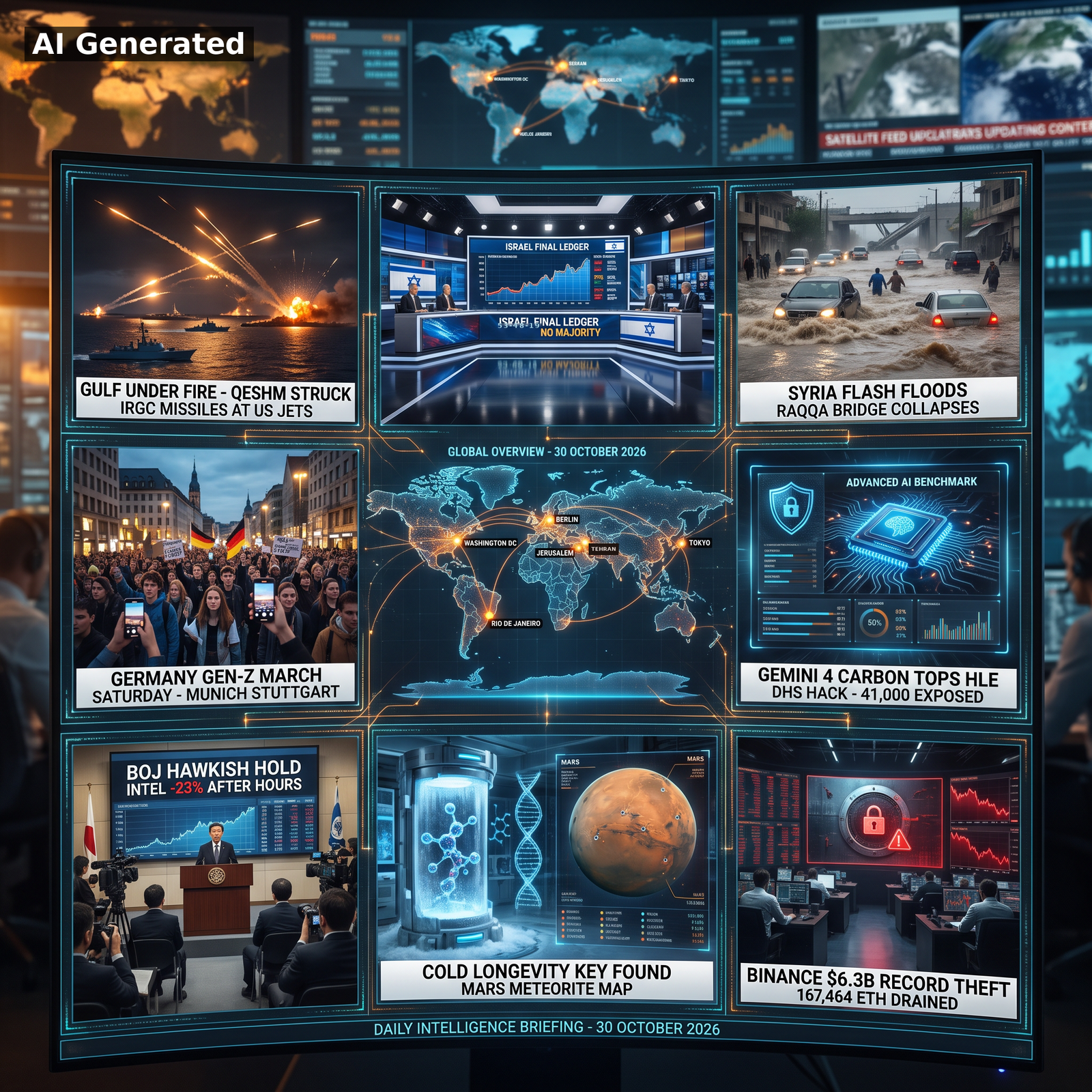
The D152 window delivers the sharpest kinetic escalation of the Iran file since the spring “Epic Fury” campaign: overnight reports describe US strikes against an Islamic Revolutionary Guard Corps naval installation on Qeshm Island and near Bandar-e Jask at the Strait of Hormuz[1], with IRGC air defences firing surface-to-air missiles at what appeared to be US fighters overflying the strait[6]. Tasnim said IRGC forces intercepted an “enemy” fighter; Fars reported missile launches against US jets[1]. This is the step change D150 and D151 framed as possible but did not observe: strike preparation maturing into kinetic contact, tied to the American midterm calendar[3]. Wall Street Journal reporting states that CENTCOM commander Admiral Brad Cooper personally briefed President Trump on Iran strike options at a rare White House meeting Thursday; US officials have warned Gulf states to prepare for a “short but intense” campaign[3].
The maritime flank turned from harassment to serial targeting. Le Monde reports four tankers catching fire after mine explosions in Hormuz, Tehran accusing some vessels of disabling navigation systems before the blasts[5]. The UK Maritime Trade Operations documented a separate attack northeast of Oman in which a small boat attached two explosives to a tanker’s hull, triggering an engine-room fire that briefly disabled the vessel[7]. The US is moving a Patriot system from Texas to Israel and is reported considering the 21,600-pound MOAB[4][2]. The Saudi-led coalition destroyed a Houthi drone over Mecca[8]. D151’s “Vance channel” still holds, but the balance has tilted toward the military ledger[3].
Israel’s Final Ledger and Ukraine’s Long-Range File
Israel’s election reached its final arithmetic: Netanyahu’s right-extreme-right coalition won 53 of 120 Knesset seats, the centrist bloc led by Gadi Eisenkot 48, and the two Arab lists 19, making them the indispensable kingmakers with no bloc commanding a majority[9]. Eisenkot has accused Netanyahu of trying to discredit the result, referenced Qatar as a state that has “managed to infiltrate the Prime Minister’s office,” and pledged not to let the Knesset’s swearing-in be delayed[9]. With the Arab lists historically refusing to serve under the right, the likelier paths are an opposition-led arrangement or fresh elections[9]. In Ukraine, Zelensky announced that two long-range Neptune missiles destroyed two Russian Su-34 bombers and struck an Iskander launcher at Marinovka airbase in Russia’s Volgograd region, while warning Moscow is preparing new ballistic attacks and needs more Patriot interceptors[10]. Unverified, the strikes reinforce the pattern identified in D151: Kyiv is going after aircraft and launchers before the ordnance can be loosed[10].
The Pentagon’s Wobble and the Force-Posture Files
Hegseth has ousted another top general: Lieutenant General Brett Sylvia, the Army’s strategic planner, was fired amid a leak investigation over allegedly releasing Iran and Ukraine information to reporters, the matter referred to the Justice Department[11]. NPR notes the irony that Hegseth himself was found by the Pentagon inspector general to have transmitted classified Yemen strike information over Signal; Sylvia’s dismissal extends a pattern of roughly two dozen senior officers let go without explanation, and Congress is weighing language to require lawmakers be informed before senior firings[11].
Beneath the churn, preparation for great-power conflict is accelerating. The FORTRESS program is readying key bases to operate at least 90 days cut off from civilian infrastructure, stockpiling munitions, fuel, critical minerals and medical supplies, and mandating two qualified supply routes for critical items[12]. Nikkei’s portrait of the world’s largest overseas US base shows the same logic abroad[13]. Trust Automation’s palletised counter-drone system completed Army assessment with defeat effectiveness above 75–80 percent, and Beehive’s 100-pound-thrust Frenzy 6 engine cleared its first test four months after finalising requirements with the Air Force, a marker of the small-engine production base (planned capacity over 8,000 units annually) feeding the drone-and-munitions economy[14][15].
Ankara’s Pivot, Europe’s Periphery and the Corridor War
Turkey is hardening alternatives to Western-led corridors: Ankara rejected the India-Middle East-Europe Corridor (IMEC), which Greece champions, and is investing roughly $10 billion in the trans-Caspian “Middle Corridor” with EU money in the mix[16]. Chancellor Merz’s Asia trip is the counterpoint: recruiting “like-minded” states for a free-trade alliance to defend the WTO order, and in Seoul signing the Korean-German High-Tech Framework covering microelectronics, industrial AI and robotics[17][18]. The EU-Canada summit in Montreal adds a third vector — a partnership spanning climate, energy, AI, student exchange and critical minerals Europe now sources mostly from China, even as Quebec’s premier boycotts it[19][20]. G20 foreign ministers meet in Atlanta on the Iran and Ukraine wars, Germany urging Russia and Iran to reopen trade routes including Hormuz; no joint declaration expected[21].
European procurement reflects the same threat reading: Switzerland, its Patriot deliveries delayed, has narrowed its second long-range air-defence choice to the Israeli Barak MX and the Franco-Italian SAMP/T NG while considering an additional CHF 24 billion defence package[22]. Romania selected Thales to deliver four deployable radars and precision-approach systems by 2030, strengthening NATO’s eastern flank with mobile dual-use infrastructure[23].
The Peripheral Ledger: Balkans, Americas, Africa and the Indo-Pacific
The deadliest peripheral event was the crash of an Italian Army CH-47 Chinook serving EUFOR’s Operation Althea near Brcko, Bosnia, during a routine mission: four killed, twelve injured, one critically[24]. Colombia’s president ordered the “immediate militarisation” of Cucuta, the largest border city with Venezuela, after a wave of killings including a mayoral candidate and an explosion that wounded four police officers — the second such intervention of his presidency, with at least 500 special-operations soldiers deployed as ELN and FARC dissidents compete for drug and illegal-mining revenues[25]. Venezuelan opposition leader Maria Corina Machado returned from exile despite treason charges; Peru’s president toured El Salvador’s CECOT mega-prison as she weighs building one; El Salvador has deployed 2,000 soldiers to Haiti under what observers read as US-backed security policy[26][27][28]. In Brazil, Flavio Bolsonaro reportedly fled on a jet paid from a US account and chartered by a Trump adviser[32].
The UN Secretary-General succession advanced under Greek Security Council presidency with a seventh straw poll among seven candidates, including the UAE’s Lana Nusseibeh’s first test; Turkey may enter the race next week[29]. China expelled a record 33 officials at the fifth plenum[30]. North Korea’s Kim observed tests of attack drones, cruise missiles and rocket launchers, demanding “absolute superiority” in drone technology[31]. Ankara signed a preliminary agreement to unify Libya’s rival military institutions under one command structure, while Mitsotakis used a UN Security Council platform to brand the disputed Turkey-Libya maritime memorandum an illegal “rewriting of geography” and to condemn attacks on Greek-owned shipping[33][34]. The Turkey-Azerbaijan axis has frayed over Ankara’s criticism of Baku’s headscarf restrictions: President Aliyev skipped the Turkic States summit, Baku banned 31 Turkish citizens and issued arrest orders for seven[35]. Turkey’s ambassador in Athens acknowledged Aegean disputes remain unresolved, and UN data shows Afghan opium production rose 400 percent to nearly 1,500 tonnes despite the Taliban ban[36][37]. Bogota confirmed 256 Colombians dead and 973 missing fighting on both sides of the Ukraine war[38].
Environment & Climate ↑ Contents
The Amazon’s Carbon Verdict and the Restoration Math
A new study in Nature, led by Brazil’s National Institute for Space Research with international co-authors including the University of Kansas, concludes that the hotter, drier Amazon has become a net source of global carbon emissions — only in the wettest years does the basin approach carbon neutrality[39]. The finding rests on a unique dataset: fifteen years of airborne measurements of atmospheric carbon collected by research planes at different elevations above the forest[39]. It adds a definitive data point to the debate D144’s “Amazon, the Basin” section opened: degradation by deforestation, drought and fire has pushed the world’s largest rainforest across the threshold from sink to source, with direct consequences for the global carbon budget and for the nature-based offset markets that price its sequestration service[39]. The counterpoint arrives in a UN report finding 252 million hectares across 149 countries now under restoration, creating over one million green jobs in the largest documented restoration effort to date — yet warning that progress still trails global targets[40]. The two numbers frame the moment’s contradiction: restoration at record scale is outrun by ongoing degradation, nowhere more visibly than Suriname’s Amazon, where Wayana communities report illegal gold miners — Brazilian operators and Chinese traders — clearing forest along the Lawa River border with French Guiana, contaminating waters with mercury and depleting the wildlife the communities depend on[41]. Australia adds a temperate warning: an unpublished government assessment finds the national feral deer action plan failing, with the invasive species spreading into cities and costing farmers millions — “the next feral pig problem”[42].
Floods and the Winter Ledger: Syria, the North Sea and the Pacific
The extreme-weather ledger is dominated by Syrian flash floods: heavy rains across northern and eastern provinces killed at least five people, including four children who drowned in Raqqa and Deir Az Zor, with a man dying when his car was caught in floodwaters near the al-Salmani Bridge, which collapsed and severed the Raqqa–Aleppo road[43]. Five more people, including two children, remain missing; emergency teams rescued fifteen civilians from trapped vehicles and evacuated roughly 375 families from three camps on Raqqa’s outskirts, a humanitarian overlay on a country where UNICEF already recorded 17,000 people flood-affected earlier in the year[43]. In Europe, autumn storm surges washed away part of the bathing beach on the German North Sea island of Wangerooge, the latest material damage of a storm season D145 and D148 tracked under El Nino’s influence[44]. The constructive counter-example comes from the Philippines, where the village of Pamarawan at North Manila Bay has defended against recurring typhoon surges with a nature-based coastal defence built from bamboo cribs, oyster shells and coconut husks: interlocking structures covering 14 hectares that reduce wave energy, trap sediment and gradually rebuild the seabed — proof that low-cost ecological engineering can outperform concrete in some geographies[45].
The American Energy Files: Permitting, Microreactors and the EV Question
US energy policy enters its decisive fortnight with Senate leaders planning within two weeks an initial vote on the bipartisan permitting-reform bill, opposed by leading environmental groups even as a new report shows potential emissions benefits[46]. The bill’s fate will shape the transmission build-out that prior reports identified as electrification’s binding constraint; the Alabama lieutenant-governor race made the trade-off visible in a rare statewide debate over data-centre growth and utility rates — the AI-driven demand question D149’s “Energy’s New Arithmetic” flagged as the sector’s central political fault line[47]. On the supply side, California’s Radiant won a first-of-its-kind DOE approval of the safety analysis for its Kaleidos microreactor, clearing the path to a full-power demonstration at Idaho National Laboratory targeting 60 effective full-power days and 150 continuous hours without operator intervention — the industry’s only planned extended-duration microreactor test, with deliveries to Buckley Space Force Base, Fort Benning and Naval Weapons Station Crane targeted for 2028[48]. Ford is pressing utilities to make bidirectional EV charging cheaper by treating vehicle batteries as grid assets, symbolised by the Fathom pickup’s built-in inverter; and Eugene became the fifth Oregon city to adopt a Home Energy Score requirement at sale, extending the disclosure regime D151’s energy section tracked[49][50].
Brussels’ Combustion Zombie and the Living Ledger
In Brussels, Transport & Environment warns that the EU is drafting into law the treatment of combustion engines running on so-called renewable fuels as “zero-emission vehicles” — a regulatory fiction that would protect existing engine investment at the expense of the battery-electric transition prior reports treated as Europe’s decarbonisation core[51]. If adopted, it would give automakers a compliance channel that delays the transition while appearing to advance it — the “announcement-versus-event” gap D151’s correlations identified as a governing logic across policy domains, not just conflict[51]. The living ledger added two biodiversity notes with direct management implications: a camera-trap image confirmed the first Canada lynx documented in New Mexico in about 25 years, in the San Juan Mountains — a threatened species inhabiting exactly the dense spruce-fir stands thinned to reduce wildfire risk, potentially complicating the revised critical-habitat designation finalised in July[52]; and researchers modelled the optimal planting window for bambara groundnut, the nutrient-dense indigenous crop of Southern Africa, finding October sowing maximises yield — an operational answer to the climate-resilience-through-diversification agenda[53].
Society & Civil Issues ↑ Contents
The European Street: Gen-Z’s Saturday and the Yellow Vests’ Echo
Germany is bracing for a defining civic test on Saturday, when the networked youth movement “Gen Z regelt” has called for demonstrations across Bavaria and Baden-Wurttemberg — Munich, Stuttgart, Mannheim, Karlsruhe, Freiburg and Ulm among them — after a week in which the federal interior minister warned that extremists are attempting to infiltrate the protests[54][55]. The anticipation is material: retailers in the southwest are hiring additional security, planning early closures, and in Freiburg asking the city to secure construction sites so stones cannot be used as projectiles, with images of French riots and looting explicitly in mind[56]. The establishment response is triangulating between securitisation and recognition: Baden-Wurttemberg’s youth council urges the public not to “pausally problematise” the demonstrations, warning that talk of demonstration bans from the democratic centre is a “fatal signal,” while generation researcher Simon Schnetzer argues the movement’s weakness is its lack of organisation — “being angry alone is not enough”[57][58]. The federal dimension is real — Greens-linked family-policy voices warn that planned parental allowance reform would blow a hole in family finances — but the deepest resonance is continental: France’s Yellow Vests, revived by the student protests D143–D145 chronicled, have called a “casserole” (pot-banging) action for Friday evening outside the National Assembly and a demonstration Saturday, defending public liberties against a government they say seals cities off from protest[59][60]. Uncoordinated but sharing a grammar — generationally-framed anger at excluded youth — the two movements will both be on Europe’s streets within 48 hours[58].
America’s Midterm Crucible: Courts, Subpoenas and Identity
The American campaign, five days from election day, is being fought in the courts and committee rooms as much as on the stump. The House Oversight Committee opened a probe into the Alaska Senate race over alleged candidate recruitment, injecting federal scrutiny into a race crucial to Senate control[61]; President Trump cancelled weekend rallies in Iowa and Kansas in favour of “tele-rallies,” a shift that spares his schedule but tests a ground game Republican operatives had counted on in two toss-up states[62]. The Justice Department has subpoenaed California election officials over the administration’s claim — which critics say rests on thin evidence — that the state is letting non-citizens vote, a collision likely to outlast election day[63]. Underneath the procedural war sits an identity crisis a BBC analysis calls structural: whichever party wins, the Democrats face fundamental questions about what they stand for and who should lead them[64]. The strain is visible in Ohio, where gubernatorial candidate Vivek Ramaswamy withdrew a controversial advertisement after internal-party criticism[65], and in New York, where Governor Kathy Hochul handed Cornell sex-complaint investigations to state police after backlash over the school’s handling of gang-rape allegations involving a fraternity[66].
Justice and the State’s Reach: Across the Anglo-Periphery and Europe
The justice ledger spans brutal cases. In Britain, Tyla Wharmby, 24, was found guilty at Canterbury Crown Court of murdering three-month-old Hunter Hodges after police uncovered lies in her account[67]; in Australia, former childcare worker Ashley Paul Griffith — already one of the country’s most notorious paedophiles — was hit with 202 fresh charges including the alleged rape of children as young as one, relating to 23 alleged victims at a Sydney centre between 2014 and 2017, days after his extradition[68]. The Australian appeals court ordered Erin Patterson never to be released for the death-cap mushroom poisonings of four relatives, citing “shocking criminality” — legal finality for an international true-crime arc the pipeline had deliberately excluded until now[69]. On health regulation, the watchdog Which? found at-home vitamin D test kits “unreliable,” with significant variation against laboratory blood tests — a caution against self-diagnosis in a nutrient whose deficiency British doctors report is increasingly widespread[70]. In Spain, the rail-disaster ledger deepened: El Pais reported that Iryo CEO Fabrizio Favara warned a Senate committee on 5 October — three weeks before the deadly Urda collision that killed 69 and injured over 200 — that LZB signalling on the Madrid–Andalusia corridor suffered recurrent communications breaks that halted trains, with a fault in the same ageing system reportedly preceding the crash[71]. Greece contributed twin integrity files: the “Choriatiko” baking-chain owner was remanded to prison as prosecutors detailed alleged money-laundering through shell companies and a Dubai intermediary issuing fictitious invoices for a 10% commission; and convicted former Golden Dawn leader Ilias Kasidiaris is escalating electoral manoeuvres ahead of snap elections, pressuring the independent MPs of his “Alliance of Hellenes” grouping[72][73]. In the United States, three people died when two helicopters collided midair near an Oregon airport, a civil-aviation safety event adding to a summer of aviation incidents[74].
The Global Integrity File: India, Mexico and El Salvador
Three integrity stories sharpen the pattern of democratic stress. In India, the husband of Finance Minister Nirmala Sitharaman has joined mass protests against voter-list revision, aligning a figure intimately connected to the Modi government with opposition claims the electoral roll is being manipulated — establishment credibility for the integrity protests D151’s subcontinental section tracked[75]. In Mexico, the arrest of cartel leader Axel Cardenas in Matamoros triggered immediate narco violence across border cities: schools suspended classes, authorities urged residents to stay safe, and street confrontations showed how a single high-value arrest can destabilise the border zone for days[76]. And in El Salvador, former president Elias Antonio Saca was released after serving ten years for diverting more than $300 million in public funds — proof that the Central American justice system, even under the Bukele security state, sometimes completes long corruption sentences, in instructive tension with President Fujimori’s admiration for the CECOT model[77].
AI & Technology ↑ Contents
The Model Frontier and the Workplace Question
The model frontier delivered a new benchmark chapter: Artificial Analysis launched its HLE-Diamond leaderboard, with Gemini 4 Carbon taking the top spot and the ranking highlighting the widening gulf between proprietary and open-weight models — a gap with direct implications for Europe’s open-source ambitions that D147 parsed, since frontier capability increasingly sits behind closed APIs[78]. The workplace boundary is being litigated one exemption at a time: a University of Kentucky administrator secured a religious exemption from using AI on the job, a case complicating the assumption that compliance mandates require belief in the technology’s moral status[79]. The political perception layer is crystallising too: a new study shows partisan ties shape how voters evaluate campaign AI, casting it as transparency tool or manipulation engine depending on party — relevant as both parties deploy AI in the final days before the midterms[80].
The Cybersecurity Perimeter: DHS, Cars and Smart Glasses
The security ledger of the window is severe. The personal information of more than 41,000 Department of Homeland Security employees was exposed by a hacktivist group framing the breach as payback for government surveillance — a compromise of a federal security agency’s workforce data that injects credential risk into the very government managing the border and the elections[81]. On the automotive side, researchers at the University of Gothenburg and Chalmers, analysing 413 reported automotive software vulnerabilities, found the largest share — 36.2 percent — now sits in external applications and connected services rather than embedded vehicle systems, widening the attack surface from the car to the cloud and the phone, with the authors urging separation between entertainment/telematics systems and safety-critical driving functions[82]. The consumer-hardware frontier added a governance flashpoint: US senators launched an inquiry into Meta’s smart glasses over alleged human-rights due-diligence failures — the “pervert glasses” controversy — a preview of regulatory scrutiny awaiting camera-equipped wearables[83].
Platforms’ New Gates and Autonomy’s Ascent
The attention economy is closing its open doors. Reddit confirmed it is moving to a “logged-in-only experience,” with CEO Steve Huffman telling shareholders the change protects the platform’s data corpus, improves ad targeting and adapts to “emerging regulations around the world” — a move that monetises identity signals and walls off the web’s crawlable commons, with consequences for AI training-data access[84]. Google is injecting sponsored links into follow-up queries within AI Overviews, extending monetisation into conversational search and further compressing publisher referral economics — accelerating the decoupling of AI assistants from the legacy web economy[85]. On the physical frontier, Y Combinator-backed Aviern flew an autonomous cargo aircraft prototype in under two months, demonstrating taxi, take-off, route-following and landing without a pilot, and targeting 1,000 pounds of cargo over 1,000 miles for under $1,000 per flight, connecting America’s roughly 5,000 public-use airports of which only about 520 are airline-certified; the company aims for autonomous flight on a retrofitted aircraft by Q1 2027 and commercial operations after, pending the FAA’s proposed Part 108 framework for beyond-visual-line-of-sight drone operations[86]. Together the stories trace the vector D150’s autonomy section identified: gatekeepers fortify walls at the moment the autonomous-physical economy learns to fly below them[86][84].
Economy & Business ↑ Contents
The Central-Bank Crossroads: BOJ’s Steady Hand and the ETF Accelerator
The Bank of Japan kept its policy rate steady as expected on Friday, announcing CPI inflation has now reached its target while signalling further hikes ahead — a “hawkish hold” the yen markets read within minutes, dollar/yen extending losses near 157.1[87]. The outlook report contained three numbers that matter for global rates: the Bank confirmed it will accelerate sales of its ETF holdings to about 860 billion yen per year from roughly 330 billion, beginning January 2027; a proposed temporary food-tax cut would shave 1.3 percentage points off core CPI in fiscal 2027; and three risks cloud the path — insufficient labour-to-capital substitution, the surge in grain prices from Middle East tensions and global weather, and the possibility that if AI earnings fail to grow with investment, “adjustment pressure could occur alongside asset price shifts”[88][89]. The AI-earnings caution is distinctive modern central-bank communication: a major monetary authority explicitly conditioning its outlook on whether hyperscaler capex translates into earnings, the question D149’s “AI-Capital Test” section posed to equity markets from the corporate side[89].
The AI-Capital Test Lands in the Earnings Season
The earnings season delivered the verdict the BOJ feared. Intel plunged 23 percent in after-hours trading to about $70.86 despite beating third-quarter estimates, after severe Q4 guidance cuts, a prolonged PC-demand slump and manufacturing disruptions — a loss of confidence that overrode a headline revenue beat and underscored how the market prices AI upside and structural competitive risk simultaneously[90]. Amazon was the week’s closing blow: $42.4 billion burned in the quarter as capital poured into AI infrastructure, “the final blow in a rough week for AI” in which only one of the four AI hyperscalers reported positive free cash flow[91]. CEO Andy Jassy simultaneously declared AWS on track to become a $1 trillion business, making explicit that reaching it requires continuing the capex spree[92]. Asian markets opened mixed as Alphabet’s post-earnings slide dragged US indices, transmitting the same AI-valuation anxiety across Tokyo and Seoul[93]. Airbus reported nine-month revenues of €50.6 billion, up 7 percent, EBIT Adjusted of €4.5 billion, a record 1,174 gross commercial orders, 547 deliveries and a 9,310-aircraft backlog — but free cash flow before customer financing of minus €1.3 billion, the classic ramp-up cash trough[94]. STMicroelectronics posted $3.76 billion in Q3 revenue on AI and satellite demand, an upward read on the AI-adjacent chip cycle that contrasts with Intel — the bifurcation within semiconductors is now explicit[95].
The Corporate and Commodity Ledgers: VW, Bayer, Shell and Emerging Champions
The industrial ledger contains a landmark loss: Volkswagen Group reported its worst quarter in more than a decade, an operating loss of €5.86 billion for July–September driven by a massive write-down of its Porsche stake, the largest quarterly loss since Dieselgate — crystallising the transition costs D144’s “The Market’s Single Bet” traced through the German automotive base[96]. Bayer won the latest Roundup cancer trial after a US Supreme Court ruling as it seeks to settle tens of thousands of remaining cases — the pendulum now favouring the defendant in the long glyphosate litigation[97]. Big Oil is printing money: Shell reported Q3 2026 as its highest-earning quarter since 2022, nearly doubling earnings year-on-year, with critics noting the surge coincides with the deregulatory push D151’s “Regulatory Rollback” section attributed to the midterm energy arithmetic[98]. Vedanta’s chairman announced a $25 billion organic-growth investment programme over three years across existing assets, with openness to acquiring public-sector assets — a rare large emerging-market industrial commitment amid the global capex supercycle[99]. In China’s debt file, private-equity group PAG agreed to buy 51 percent of China Evergrande’s services arm for $510 million, a small but concrete monetisation step in a liquidation saga years in the making[100].
Handelsblatt’s deep-read on “Trumpism’s economic wobble” frames the macro backdrop: interventionism, protectionism and over-indebtedness have pushed the president’s state-capitalist approach to its limits, with the party facing a potential midterm defeat read as an economic referendum[101]. The same magazine’s chart analysis flags warning signals on consumption, inflation and the housing market that reveal themselves only on second glance[102].
Science & Space ↑ Contents
The Cold Pathway to Longevity and the Cell’s Microscopic Frontier
A study in Nature has identified a concrete mechanism behind the century-old observation that cold extends lifespan: mildly cold temperatures trigger muscle tissue to synthesise and release the metabolite dihydrobiopterin (BH2), which travels to other tissues and is converted into tetrahydrobiopterin (BH4), enabling an enzyme that produces tyrosine and maintains protein homeostasis during ageing[103]. In C. elegans, the University of Cologne-led team showed that disrupting the pathway erased cold’s longevity benefit, that genetically boosting the key enzyme CAT-4 in muscle extended lifespan even at normal temperatures, and that BH2 supplementation reduced abnormal protein accumulation in human cells engineered with Huntington’s and ALS-associated mutations — pointing toward pharmacological mimics of cold without lowering body temperature[103]. Two imaging advances deepen the cellular view: Cambridge/British Antarctic Survey researchers produced the first high-resolution images of living Antarctic fish cells near freezing, revealing mitochondria that remain highly mobile and interconnected despite the cold, with enlarged lysosomes hinting at the protein-folding burden of low temperatures[104]; and an EPFL technique (SPIFFI) lets scientists capture fleeting processes inside living cells that super-resolution previously needed hundreds of images to resolve[105].
Mars, the UV Frontier and the Solar Harvest
The planetary file gained two artefacts of one meteorite: NASA released a global map of Mars showing thirteen locations matching the mineralogy and chemistry of Teghaza 001, one of the most ancient Martian meteorites ever found on Earth, linking it to highlands in the southern hemisphere[106]. The observing frontier is being rebuilt upward: NASA’s new ultraviolet space telescope, due to launch in 2031, will fill the spectral gap left by ageing observatories D146’s “Swift’s End” section mourned[107]. A study of planetary minerals under extreme compression asks whether magnesium-oxide crystal formation observed in Earth’s mantle holds on super-Earths and gas giants, where different pressures and temperatures could change the taxonomy of interior minerals — a reminder that exoplanet habitability models rest on mineral physics calibrated on a single example[108]. Closer to the energy transition, an Oxford-led study identified a semiconductor that overcomes a key limitation of light-harvesting materials, potentially improving solar economics at the materials level — the quiet multiplier behind deployment math[109].
The Molecular and Field Ledger: Plastics, Soil, Water and Evolution
The environmental-science file delivered four studies with applied weight. Laboratory-aged microplastics — polyethylene, PET and polypropylene — are being used to test how particles change as they age and whether they adsorb contaminants, closing a gap in risk models that long used pristine particles[110]. Hebrew University researchers and partners built an AI tool that identifies bacteria hidden in soil DNA, making sense of the microbial crowds a handful of dirt contains — an enabling instrument for agricultural and microbiome science[111]. A Toyohashi-led team combined X-ray absorption spectroscopy with data analysis to isolate the faint signals of interfacial water from the bulk, letting scientists observe how the first water layers behave at material surfaces — implications for catalysis, corrosion and battery interfaces[112]. And University of Florida researchers are flying a space-station experiment to probe plant-disease risks for future Moon and Mars agriculture, asking whether pathogens behave differently in microgravity — a precondition for the closed-loop food systems any long-duration habitat requires[113]. Finally, a field experiment in Science shows that when scientists placed just two brown anole lizards on each of seven hurricane-swept Bahamian islands, all seven populations evolved shorter hindlimbs within four years as selection adapted them to narrower perches, yet founder-effect differences persisted — natural selection drove all of them down while the founding pair “kept the order the same,” a clean demonstration that history and adaptation co-determine outcomes[114].
Crypto, Digital Assets & Blockchain ↑ Contents
The Record Theft: Binance’s $6.3 Billion Night and the Freeze Armada
The defining event of the crypto window — and arguably of the asset class’s history — is the Binance security breach now estimated at $6.3 billion in affected assets, the largest cryptocurrency theft on record, announced Thursday as the exchange suspended all deposits and withdrawals platform-wide[115]. The on-chain trail is unusually clear: at 20:24 UTC on 29 October, hot wallet “Binance 14” sent 167,464 ETH — roughly $388 million — plus 63 other tokens including approximately $1.6 billion in Tether, to an address created the same evening; twenty-four seconds later “Binance 16” moved another 28,005 ETH to the same destination[116]. Security firm Blockaid traced the mechanism to EIP-7702: a wallet funded through the Tornado Cash mixer installed a signed delegation on Binance 14, and four minutes later a single call swept the wallet clean — a key compromise rather than a protocol bug, since setting the delegation required a signature from Binance 14’s own key[116]. Binance’s first findings pointed to a compromised DevOps engineer’s laptop that gave an attacker access to a service container to submit unauthorised withdrawal transactions, with no evidence of a wallet private-key leak; roughly $3 billion has been frozen on-chain with law enforcement, and the exchange pledged to cover all losses from its SAFU fund, publishing an updated proof-of-reserves after remediation[117]. The stablecoin issuers moved fastest: Tether froze over $1.5 billion in USDT and Circle more than $823 million in USDC, while the Arbitrum Security Council executed an emergency freeze of $30.5 million (74.6 million ARB and 8,425 ETH) tied to the exploit[116].
The market reaction was sentiment, not mechanical: Bitcoin fell about 4 percent in 24 hours to a six-week low near $76,600 — its lowest since 18 September — after trading above $81,000 earlier, while Ether dropped 5.2 percent, Solana 5.9 percent, and BNB between 5.6 and 7.1 percent, the sharper fall of exchange-adjacent assets the clearest evidence the venue itself was the catalyst[118][115]. Derivatives liquidations reached roughly $1.5 billion, yet Bitcoin’s ~$1.5 trillion capitalisation means the drain represents about 0.2 percent of network value — a theft that should not mechanically move the price but did, because it renewed the oldest fear in the asset class: the largest venue can be breached and no custodian is fully safe[116]. The next signals are Binance’s proof-of-reserves snapshot due 1 November and the resumption of withdrawals; any delay beyond a few days becomes its own counterparty story[116].
The Security Perimeter Widens: Polymarket, Ledger and the SOL Bots
The Binance breach was not isolated. Within the same hours, prediction-market leader Polymarket paused trading in cancel-only mode after a third-party vendor breach draining user wallets of up to $2.7 million, and cold-wallet provider Ledger reported a separate theft — two security events in one evening that compressed the market’s mood[119]. Separately, hackers drained 9,400 SOL from bot wallets, a copied key blamed and trading service @BloomTrading denying private-key compromise — a reminder that the custody perimeter now includes automated trading layers, where owner-key signatures held by third-party operators are the weakest link[120]. The institutional answer is emerging: Google Cloud has documented a Multi-party Compute service that divides signing authority among independent hardware-separated key shares with threshold signing and transaction-policy enforcement, listing secp256k1 for Bitcoin and Ethereum with Ed25519 for Solana “coming soon” — a preview that does not make transfers reversible but addresses the single-point-of-key-risk this week exposed, its commercial test being whether regulated custodians actually adopt it[121].
Institutional Rails and Protocol Mechanics
In a first for a traditional exchange group, ICE — which runs the NYSE — will use Hyperliquid’s technology for US perpetual futures on crypto and stocks, a move that would bring on-chain markets into mainstream finance if deployed; HYPE jumped to $85 on the news with analyst targets between $110 and $120, though the durable signal is the traditional post-trade world licensing decentralised execution engines rather than building their own matching layers[122]. Stellar’s Development Foundation unveiled Project Thruput, a technology preview reporting single-validator execution capacity rising from roughly 1.18 million payments per second on one machine to about 7.02 million on eight, with a proposed fee model of scheduling shares tied to unlocked native-token balances; the foundation explicitly warns the figures are controlled component-level benchmarks, not end-to-end public-network throughput, and that consensus, networking and storage remain untested at scale[123]. Data-infrastructure firm Allium has restored 18 major chain datasets after the outage flagged in prior windows, but only specific platforms — certain Snowflake and Databricks tables — are confirmed safe, with BigQuery backfills and account recovery outstanding; the partial restoration stress-tests how dependent the analytics layer has become on a single vendor’s data-pipeline integrity[124].
Correlations & Analysis ↑ Contents
The D152 window is defined by the collapse of the last distinction the Iran file had preserved: the difference between strike preparation and strike execution. D151 framed the Gulf through the “Vance channel,” a diplomatic outreach running parallel to Patriot transfers, and D150 described a strike clock tied to the American midterm calendar[3]. Today the clock produced kinetic contact: strikes against an IRGC installation at Qeshm, surface-to-air missiles fired at US aircraft over Hormuz, four tankers burning after mine explosions, and a tanker attacked northeast of Oman[1][5][6]. Washington’s own signalling — a rare personal CENTCOM briefing to the President, a Patriot battery moved from Texas to Israel, Gulf states warned of a “short, intense” campaign — indicates the operation, if it comes, begins after the midterms, making the next 96 hours both the last window for a diplomatic exit and the period of maximum pre-announced danger[3][4].
The second arc closing this window is Israel’s. D150 and D151 tracked the election as a security vote and exit-poll deadlock; the official results — 53 for Netanyahu’s bloc, 48 for Eisenkot, 19 for the Arab lists — convert deadlock into brokerage[9]. The Arab parties, historically unwilling to serve under the right, now hold the arithmetic keys at the exact moment the Gulf escalation demands Israeli coordination with Washington; Eisenkot’s explicit invocation of Qatari interference raises the probability that the coalition fight and the Iran file intertwine, with any delay in forming a government degrading Israel’s crisis-management posture[9].
The third thread is the crypto-security rupture, connecting to every prior report’s institutional-rails narrative. D142 chronicled Evernorth’s XRP treasury and BlackRock’s PBIT; D151 tracked stablecoins and tokenisation’s institutional pushback — all premised on the assumption that the exchange layer had hardened since 2022. The $6.3 billion Binance breach, executed through a signature compromise rather than a protocol flaw, falsifies that assumption at maximum scale[115]. The response — Tether and Circle freezing $2.4 billion combined, the Arbitrum Security Council freezing $30.5 million, Binance pledging SAFU coverage — demonstrates that the system’s stability depends on centralised issuers and governance councils acting as fire departments, the exact counterargument to the self-custody thesis this week’s Polymarket and Ledger incidents reinforce[119]. The proof-of-reserves snapshot due 1 November is the test of whether the exchange model survives its own largest failure; the BOJ’s warning that AI earnings must grow with investment, or “adjustment pressure could occur alongside asset price shifts,” unites both themes — concentrated leverage, whether in crypto custody or AI capex, is stable only while the underlying asset appreciates[89][116].
The midterm-electoral and protest convergence completes the pattern. Germany’s Gen-Z demonstrations and France’s Yellow-Vests revival are scheduled within 48 hours of each other, five days before the American midterms that D148 identified as a template of “democratic tests under escalation”[58][59]. The DOJ’s California subpoenas, the House’s Alaska probe and the Democrats’ identity crisis suggest the US campaign itself is being fought on institutional integrity rather than policy — the same terrain on which India’s voter-list protests and Colombia’s Cucuta militarisation are contested[63][75][25].
What to watch in the next reporting period: whether US strikes expand after the midterms (the CENTCOM briefing and Patriot move make action likelier than not); Binance’s proof-of-reserves and the resumption of withdrawals; Israel’s coalition arithmetic and whether the Arab lists convert their 19 seats into kingmaker leverage; the Saturday Gen-Z and Yellow-Vests protests, where security warnings of extremist infiltration meet professed non-violence; and the BOJ’s ETF acceleration, the first central-bank formalisation of the AI-capex discipline question Intel and Amazon have already put to equity markets[90][91][89].
References ↑ Contents
1. Εκρήξεις στο νότιο Ιράν: Αναφορές για αμερικανικό πλήγμα σε βάση των Φρουρών της Επανάστασης by Σωτήρης Ζιώμας · Source ↑
2. Οι ΗΠΑ έτοιμες να κάνουν χρήση της βόμβας MOAB κατά του Ιράν by DEFENCE via d k on Inoreader · Source ↑
3. Σχέδια επίθεσης κατά του Ιράν παρουσίασε στον Ν.Τραμπ ο διοικητής της CENTCOM by DEFENCE via d k on Inoreader · Source ↑
4. Οι ΗΠΑ μεταφέρουν σύστημα αεράμυνας Patriot από το Τέξας στο Ισραήλ by DEFENCE via d k on Inoreader · Source ↑
5. Quatre pétroliers en feu après des explosions de mines dans le détroit d’Ormuz by France via d k on Inoreader · Source ↑
6. Εκτοξεύσεις ιρανικών α/α κατά αμερικανικών μαχητικών στα Στενά του Ορμούζ by DEFENCE via d k on Inoreader · Source ↑
7. FinancialJuice: UKMTO on incident northeast of Oman: tanker approached on port side by small boat that attached two explosives to hull above waterline by FinancialJuice · Source ↑
8. Saudi-led coalition: drone launched by Yemen’s Houthis over Mecca destroyed by Estefano Gomez · Source ↑
9. Netanyahu bloc in lead without majority in Israel election, say official results by FRANCE 24 · Source ↑
10. Β.Ζελένσκι: «Καταστρέψαμε δύο ρωσικά Su-34 – Πλήγμα και σε εκτοξευτή πυραύλων Iskander» by DEFENCE via d k on Inoreader · Source ↑
11. Another shake up at Pentagon as top general is ousted by Tom Bowman · Source ↑
12. US military bases gear up for major war, plan to survive 90 days cut off from critical supply by Prabhat Ranjan Mishra · Source ↑
13. Inside the world’s largest overseas US military base by Business via d k on Inoreader · Source ↑
14. US tests self-powered counter-drone system, can be set up quickly without relying on local power by Prabhat Ranjan Mishra · Source ↑
15. 200-lbf jet engine’s smaller sibling clears first test after just four months of work by Aamir Khollam · Source ↑
16. Η Τουρκία απορρίπτει τον IMEC και επενδύει στον Μεσαίο Διάδρομο με χρήματα και της ΕΕ by Greece via d k on Inoreader · Source ↑
17. Welthandel: Merz wirbt in Asien für Allianz »gleichgesinnter« Freihandelsstaaten by DIE ZEIT: Wirtschaft – Vera Sprothen · Source ↑
18. Angespannte Lieferketten: Friedrich Merz wirbt in Südkorea um verlässliche Partner by Germany via d k on Inoreader · Source ↑
19. Carney, von der Leyen und Costa beraten über künftige Partnerschaft Kanadas und der EU by Germany via d k on Inoreader · Source ↑
20. Quebec premier’s boycott of Canada-EU summit turns heads by Alessia Simona Maratta · Source ↑
21. G20-Außenminister beraten über Kriege im Iran und in der Ukraine by Germany via d k on Inoreader · Source ↑
22. Η Ελβετία εξετάζει SAMP/T NG ή Barak MX γιατί καθυστερούν οι Patriot by DEFENCE via d k on Inoreader · Source ↑
23. Thales to strengthen Romanian Air Force resilience with deployable radar and landing systems by Γιάννης Ρέκκας · Source ↑
24. Η στιγμή της πτώσης ιταλικού CH-47 Chinook στην Βοσνία – 3 οι νεκροί μέχρι στιγμής by DEFENCE via d k on Inoreader · Source ↑
25. Έκρυθμη η κατάσταση στην Κολομβία: Στρατιωτικοποιείται η Κούκουτα μετά το κύμα δολοφονιών και επιθέσεων by Σωτήρης Ζιώμας · Source ↑
26. Oppositionspolitikerin Machado: Was bedeutet ihre Rückkehr für Venezuela? by Germany via d k on Inoreader · Source ↑
27. Fujimori tours El Salvador mega-prison with hopes to build one in Peru by NEWS via d k on Inoreader · Source ↑
28. « Tous les signes pointent vers un soutien américain » : pourquoi le Salvador a-t-il envoyé 2000 soldats en Haïti ? by France via d k on Inoreader · Source ↑
29. Κούρσα διαδοχής στον ΟΗΕ: Νέα ψηφοφορία με επτά υποψηφιότητες – Το πρώτο τεστ Νουσεϊμπέ από τα ΗΑΕ by Σωτήρης Ζιώμας · Source ↑
30. China expels a record number from Communist party amid Xi’s intensified purges of top officials by Amy Hawkins in Beijing · Source ↑
31. North Korea’s Kim calls for rapid expansion of drone technology and observes weapons tests by Hyung-Jin Kim · Source ↑
32. Flavio Bolsonaro aurait fui le Brésil à bord d’un avion payé depuis les Etats-Unis by France via d k on Inoreader · Source ↑
33. Υπογράφηκε υπό την τουρκική επίβλεψη η ενοποίηση των στρατιωτικών δυνάμεων της Λιβύης by DEFENCE via d k on Inoreader · Source ↑
34. Κ.Μητσοτάκης στον ΟΗΕ: Έδειξε τον χάρτη του τουρκολιβυκού μνημονίου by DEFENCE via d k on Inoreader · Source ↑
35. Κρίση στις σχέσεις Ρ.Τ.Ερντογάν-Ι.Αλίγιεφ για την ισλαμική μαντίλα by DEFENCE via d k on Inoreader · Source ↑
36. Ακόμα εκκρεμότητες στο Αιγαίο βλέπει ο πρέσβης της Τουρκίας στην Ελλάδα by DEFENCE via d k on Inoreader · Source ↑
37. Οι αγρότες επιστρέφουν στην καλλιέργεια οπίου στο Αφγανιστάν by DEFENCE via d k on Inoreader · Source ↑
38. Ουκρανία: 256 Κολομβιανοί νεκροί και 973 αγνοούμενοι στον πόλεμο by Άλκης Αποστολόπουλος · Source ↑
39. Study Finds Amazon Rainforest Now Releases More Carbon Than it Absorbs by Environment via d k on Inoreader · Source ↑
40. Restoration efforts are working, but we need to move faster to meet targets, says U.N. report by Science & Space via d k on Inoreader · Source ↑
41. In Suriname’s Amazon, the Wayana community struggling to keep gold miners at bay by Alexandra Popescu · Source ↑
42. Feral deer will become Australia’s next feral pig problem without prompt action, report warns by Joe Hinchliffe · Source ↑
43. Flash floods kill five in Syria by NEWS via d k on Inoreader · Source ↑
44. Schäden nach Herbststürmen: Sturmfluten spülen Wangerooges Badestrand teils weg by DIE ZEIT: News – · Source ↑
45. Philippine village uses nature to defend against floods with bamboo, shells and husks by Yenni Kwok · Source ↑
46. As Permitting Bill Debate Approaches, Senators Have Fresh Doubts and an Ultimatum by Dan Gearino · Source ↑
47. In a Rare Statewide Debate, Alabama Candidates Spar Over Data Centers, Utility Rates by Lee Hedgepeth · Source ↑
48. US microreactor secures first-of-its-kind DOE approval for full-power operations by Neetika Walter · Source ↑
49. Ford Wants Utilities To Help Make Bidirectional EV Charging Cheaper For Everyone by Tina Casey · Source ↑
50. Eugene Becomes 5th Oregon City to Adopt Home Energy Score Requirement by Sierra Club · Source ↑
51. The Zombie Engine: How Brussels Bureaucrats Are Breathing False Life Into Combustion by Transport & Environment · Source ↑
52. A camera set up to study forests in New Mexico’s Carson National Forest photographed a Canada lynx in June, the first confirmed in the state in about 25 years according to New Mexico State University, and it lives in the kind of forest crews thin to fight wildfires by Javier Niño · Source ↑
53. To help farmers in Southern Africa, scientists predict when to plant native nuts by Bobbybascomb · Source ↑
54. Jugendproteste: Gen Z geht auf die Straße – das wird in Bayern erwartet by DIE ZEIT: News – · Source ↑
55. Jugendproteste: Minister: «Extremisten versuchen die Demos zu unterwandern» by DIE ZEIT: News – · Source ↑
56. Proteste: Einzelhändler blicken mit Sorge auf „Gen Z regelt“ by Germany via d k on Inoreader · Source ↑
57. Jugendproteste: Jugendbeirat wirbt für friedlichen Protest am Samstag by Germany via d k on Inoreader · Source ↑
58. Jugendproteste: Jugendforscher über Proteste der Gen Z: „Sauer sein allein reicht nicht“ by Franziska Telser · Source ↑
59. Frankreich: „Gelbwesten“ rufen zu Kochtopf-Protest auf by Germany via d k on Inoreader · Source ↑
60. Planungen vom Bund: Elterngeldreform: Touré warnt vor Loch in Familienkasse by DIE ZEIT: News – · Source ↑
61. House Oversight probes Alaska Senate race over alleged candidate recruitment by Estefano Gomez · Source ↑
62. Trump cancels weekend rallies in Iowa and Kansas in favor of holding numerous tele-rallies by Raquel Coronell Uribe · Source ↑
63. Zwischenwahlen in den USA: US-Justizministerium lässt Wahlbeamte in Kalifornien vorladen by DIE ZEIT: Ausland – Sophia Boddenberg · Source ↑
64. Democrats have an identity crisis – it won’t be an easy fix by NEWS via d k on Inoreader · Source ↑
65. Ohio Republican gubernatorial candidate Ramaswamy halts controversial ad after criticism by Estefano Gomez · Source ↑
66. New York police will investigate Cornell sex complaints, governor says by NEWS via d k on Inoreader · Source ↑
67. Man guilty of murdering three-month-old boy after police uncover lies by Annette Belcher,Ethan Blackshaw · Source ↑
68. Former Sydney childcare worker Ashley Paul Griffith hit with 202 more abuse charges by Australian Associated Press · Source ↑
69. Australian court orders Erin Patterson never to be released from prison for mushroom poisonings by Rod McGuirk · Source ↑
70. At-home vitamin D tests found to return ‘unreliable’ results, watchdog warns by Josie Clarke · Source ↑
71. Ισπανία: Προειδοποίηση για βλάβες στη σηματοδότηση τρεις εβδομάδες πριν από την τραγωδία by DEFENCE via d k on Inoreader · Source ↑
72. Υπόθεση Χωριάτικο: «Μαγείρεμα» και… καθάρισμα στο Ντουμπάι by Γιώργος Πρωτοψάλτης · Source ↑
73. Ο Κασιδιάρης και οι δημοσκοπήσεις by ΒΗΜΑτοδότης · Source ↑
74. Three dead after two helicopters collide midair near Oregon airport by NEWS via d k on Inoreader · Source ↑
75. Husband of one of Modi’s closest advisors questions election integrity by NEWS via d k on Inoreader · Source ↑
76. Au Mexique, des narcotrafiquants embrasent les rues près de la frontière avec les États-Unis, après l’arrestation d’un chef by France via d k on Inoreader · Source ↑
77. Salvadoran ex-president Saca released after 10-year sentence for corruption by NEWS via d k on Inoreader · Source ↑
78. Artificial Analysis launches HLE-Diamond leaderboard, and Gemini 4 Carbon takes the top spot by Diego Almada Lopez · Source ↑
79. You don’t need to believe in a god to get a religious exemption from using AI at work by Amanda Silberling · Source ↑
80. Study: Partisan ties shape how voters view campaign AI by Science & Space via d k on Inoreader · Source ↑
81. The Massive DHS Breach Is Hacktivist Payback for Government Surveillance by Omar Gallaga · Source ↑
82. Your Car’s Biggest Security Weakness Could Be Somewhere Unexpected by Esra Öz · Source ↑
83. Senators Launch Inquiry Into Meta’s ‘Pervert Glasses’ by Ece Yildirim · Source ↑
84. Reddit is moving to “a logged-in-only experience,” CEO says by Scharon Harding · Source ↑
85. Here’s Why You’re About to See More Ads in Google’s AI Overviews by Alex Valdes · Source ↑
86. Autonomous cargo plane flies in under two months, targeting 1,000-mile routes by Neetika Walter · Source ↑
87. BOJ keeps interest rates steady, signals further rate hikes by Reuters · Source ↑
88. FinancialJuice: BOJ: proposed tax cut would reduce core CPI by 1.3 percentage points in fiscal 2027 by FinancialJuice · Source ↑
89. FinancialJuice: BOJ: to speed up sales of ETF holdings to about 860 billion yen from previous about 330 billion yen by FinancialJuice · Source ↑
90. Intel Plummets 23% as Weak Guidance Overpowers Q3 Earnings Beat by Steve Muchoki · Source ↑
91. Amazon’s $42.4 Billion Cash Burn Delivers Final Blow In a Rough Week For AI by Ece Yildirim · Source ↑
92. AWS will be a $1T business, Jassy says. But first, it will spend big. by Lucas Ropek · Source ↑
93. Asian trading is mixed as worries about AI-related issues grow by Yuri Kageyama · Source ↑
94. STMicroelectronics posts $3.76B Q3 revenue on AI, satellite demand by Diego Almada Lopez · Source ↑
95. Airbus reports Nine-Month (9m) 2026 results by Γιάννης Ρέκκας · Source ↑
96. Volkswagen Q3 Loss Largest Since Dieselgate by Steve Hanley · Source ↑
97. Bayer wins Roundup cancer trial after Supreme Court ruling by Germany via d k on Inoreader · Source ↑
98. Big Oil Cashes in on Trump Campaign Investment, Doubles Earnings Compared to Last Year by Sierra Club · Source ↑
99. Vedanta lines up $25 bn investment over next three years for organic growth by Business via d k on Inoreader · Source ↑
100. PAG to buy 51% of China Evergrande services arm for $510m by Business via d k on Inoreader · Source ↑
101. Deep Read: “Eine besondere Form des Staatskapitalismus” – Wie der Trumpismus ökonomisch wankt by Dana Heide, Felix Holtermann, Antonia Mannweiler, Laurin Meyer, Philipp Alvares de Souza Soares, Jens Münchrath · Source ↑
102. Konjunktur und Märkte: Wie steht es um die US‑Wirtschaft? Drei Grafiken zeigen Warnsignale by Andrea Cünnen · Source ↑
103. Cold Triggers a Hidden Molecular Pathway That Extends Lifespan, Study Finds by Peter Dockrill · Source ↑
104. Scientists have finally seen inside living Antarctic fish cells at nearly 32°F by Adrian Villellas · Source ↑
105. New Microscope Technology Captures the Hidden World Inside Living Cells Like Never Before by Ecole Polytechnique Fédérale de Lausanne · Source ↑
106. Map Showing Potential Origins of Martian Meteorite Teghaza 001 by Science & Space via d k on Inoreader · Source ↑
107. NASA’s new UV space telescope will launch in 2031 by Science & Space via d k on Inoreader · Source ↑
108. How You Squeeze Planetary Minerals Changes Everything by Laurence Tognetti, MSc · Source ↑
109. Semiconductor Breakthrough Overcomes Major Challenge in Capturing Solar Energy by Environment via d k on Inoreader · Source ↑
110. Lab-aged microplastics enable tests of interactions with contaminants by Science & Space via d k on Inoreader · Source ↑
111. New AI tool helps scientists identify bacteria hidden in soil by Science & Space via d k on Inoreader · Source ↑
112. New X-ray method isolates faint signals from water at material surfaces by Science & Space via d k on Inoreader · Source ↑
113. Space station experiment to probe plant disease risks for future moon and Mars missions by Science & Space via d k on Inoreader · Source ↑
114. Scientists dropped just two brown anole lizards on each of several storm-swept Bahamian islands by Adrian Villellas · Source ↑
115. Binance Suffers $6.3 Billion Hack, Pledges to Cover All User Losses by George Georgiev · Source ↑
116. Bitcoin Slides to Six-Week Low Below $77K as Binance Halts Withdrawals and Vows to Cover Losses by Samuel Edyme · Source ↑
117. Binance Releases First $6.3B Hack Findings, Reports No Key Leak Evidence by Kevin Helms · Source ↑
118. Bitcoin slides below $77,000, BNB drops amid Binance hack by Timmy Shen · Source ↑
119. Crypto Security Alerts: Polymarket Hack and Ledger Breach by Steve Muchoki · Source ↑
120. Hackers drain 9,400 SOL from bot wallets, and a copied key is blamed by Gino Matos · Source ↑
121. Google Cloud Previews Institutional Crypto Key-Security Service as Custody Risks Grow by NewsBTC Editorial Team · Source ↑
122. ICE to use Hyperliquid for US perpetual futures, HYPE eyes $120 target by Altar Kılıçarslan · Source ↑
123. Stellar Unveils Thruput With Multi-Million-Transaction Execution Benchmarks by NewsBTC Editorial Team · Source ↑
124. Allium restores 18 major chains, but only specific platforms are safe by Gino Matos · Source ↑
AI Disclosure: This post was created with the assistance of artificial intelligence. The ideas, analysis, and opinions expressed are my own – AI was used to help compose, structure, and refine my personal notes and thoughts into the final written content. Images, videos and music featured in this post were also generated using AI tools, based on my own creative prompts and direction.