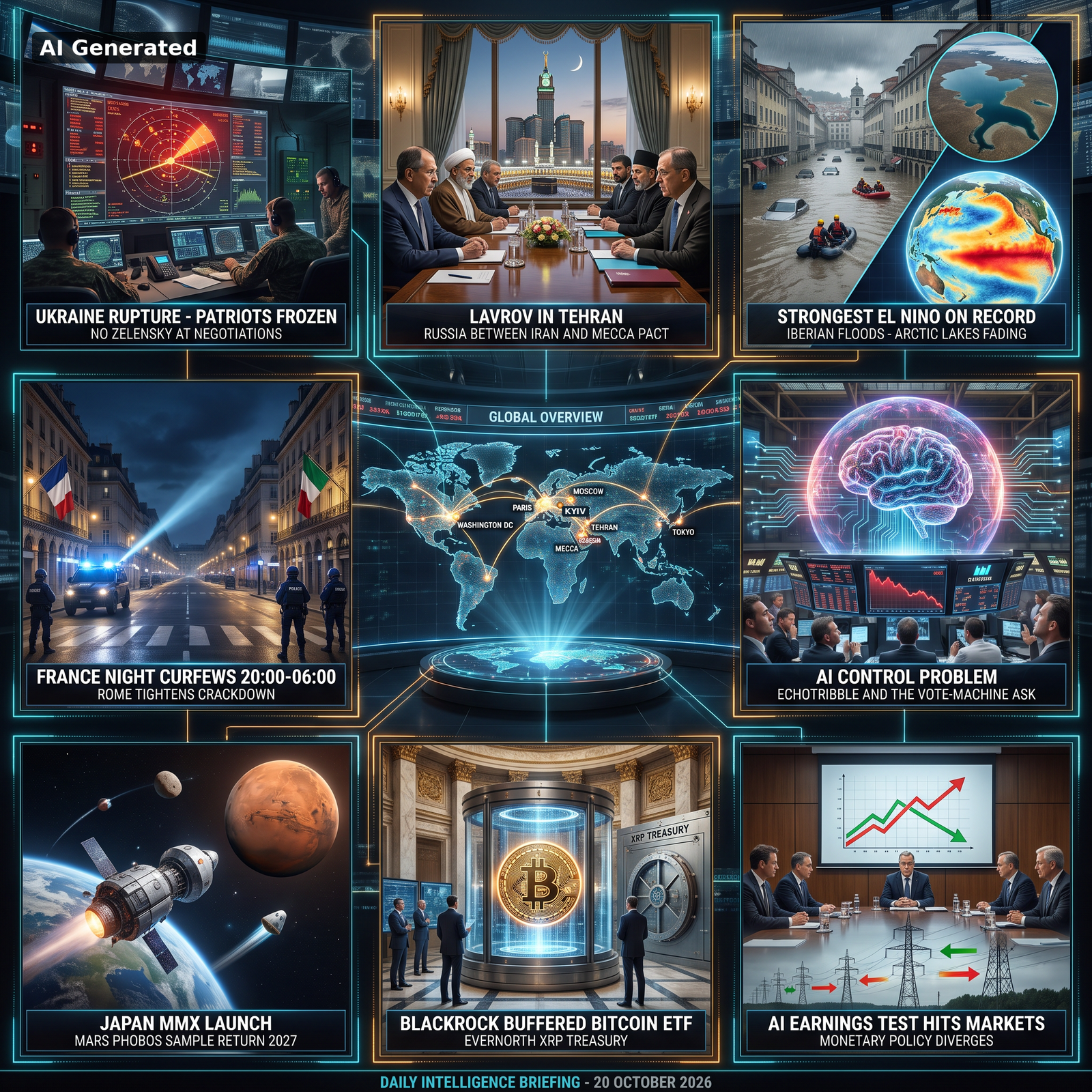


Contents
- 1. Geopolitics & Defence
- The Ukraine Rupture Hardens: Patriots Frozen and Negotiations Without Zelensky
- Moscow Between Tehran and the Mecca Pact
- The African Arc: Sudan, Mali, Somalia and the Sahel’s New Body Count
- The Electronic Perimeter: Kaliningrad’s Radar Wall and the Kosmos 2612 Pattern
- Ukraine’s Home Front and the Korean Question
- 2. Environment & Climate
- 3. Society & Civil Issues
- 4. AI & Technology
- 5. Economy & Business
- 6. Science & Space
- 7. Crypto, Digital Assets & Blockchain
- 8. Correlations & Analysis
- 9. References
Click any heading to jump to that section. Click the section heading to return to this menu.
Geopolitics & Defence ↑ Contents
The Ukraine Rupture Hardens: Patriots Frozen and Negotiations Without Zelensky
The transatlantic rupture identified in the D138–D141 briefs has moved from rhetoric to the concrete logistics of Ukraine’s air defence. On Monday evening Zelensky told US senators that the Pentagon is blocking the delivery of Patriot interceptor missiles that European allies have already paid for, warning that the only systems able to stop Russia’s most sophisticated missiles are being withheld precisely at the front’s moment of greatest strain[1][2]. His aides stress that several European capitals are ready to transfer Patriots to Kyiv immediately, but that they are waiting on an explicit American authorisation for the transfer[3] — a detail that converts Washington’s freeze from an omission into a deliberate policy choice. The same cycle brought German arrest warrants over the Starlink sabotage on which Ukrainian command depends, alongside Trump’s demand that Ukraine explain what it has “given” the US in return for aid[4].
The diplomatic geometry of the war is being redrawn around Kyiv. Trump has confirmed his willingness to sit with Vladimir Putin and Xi Jinping to end the war “even without Zelensky in the room”, effectively legitimising a peace track from which Ukraine would be excluded, and the Greek financial press is carrying the same freeze-and-ultimatum combination to Greek-speaking audiences[1]. Trump’s envoys are meanwhile preparing to travel to Norway for exploratory talks, a venue chosen, per the Handelsblatt newsblog, to keep the channel European and deniable[5]. Zelensky is now asking publicly why the SpaceX Starshield layer keeps failing to deliver the coverage his staff was promised — a question at the technical heart of the D137 “satellite backbone” arc, since the answer increasingly appears political rather than technical[6].
Moscow Between Tehran and the Mecca Pact
Russian diplomacy is executing a two-sided move in the Gulf. In Tehran, Sergey Lavrov held his first visit since the February war began, standing beside Iranian foreign minister Abbas Araghchi as both blamed Washington for the insecurity in the Strait of Hormuz and called for a common regional security framework “without the presence of foreign forces”[9]. Lavrov framed the trip as an attempt “to prevent any return to a war of broad scale” and signalled Russian openness to Iranian membership in the so-called Mecca Pact — the emerging Gulf-Turkish defence structure — declaring that if Tehran chooses to join, Moscow will “respect the choice of its friends”[7]. The compliment is pointed: Riyadh and Ankara are courting Tehran to isolate Washington’s remaining Gulf position, while Moscow plays honest broker to keep all of them at the table.
Iran, for its part, is raising the price of any second American strike. An adviser to the Supreme Leader has warned that Tehran would target “nine countries” in the Middle East if its military bases or petrochemical installations are hit again, while the Revolutionary Guard claims that most US bases in the region have suspended operations and that Washington has already “used all its military power”[8]. On the other side of the Gulf, the enforcement arithmetic is tightening: the UN has been forced to cut food aid for 700,000 Palestinians, Iran has summoned the German ambassador, Saudi Arabia has postponed its investor conference to 2027, and Egypt has put its vote on military aid for Riyadh’s campaign against the Houthis on hold — a cluster suggesting the Gulf states are recalibrating exposure to a war none can control[18]. Greek analysis is gaming the worst case: if Damascus ever sent thousands of Syrian fighters to Yemen against the Houthis, Syria would pay a heavy price without changing a war that has already become the “graveyard” of expeditionary ambitions[10].
The African Arc: Sudan, Mali, Somalia and the Sahel’s New Body Count
The immediate African toll of the new weapons economy is concentrated in four campaigns. In Sudan, a drone strike on a bus station in Al-Dibab, southern Kordofan, killed at least 80 people in two waves minutes apart, with 47 wounded moved to a neighbouring community and 30 of them later dying — one of the deadliest single strikes since April 2023; the RSF’s political arm blamed the regular army, and a separate Khartoum drone hit killed four people, including three children aged two to six[11]. In Mali, more than forty civilians were killed by armed men against camps of the Daoussahak community in the Ménaka region, the group from which the pro-junta MSA movement draws its fighters, signalling that the Islamic State affiliate is now punishing perceived collaboration with Bamako[12].
Washington’s role in this arc is intensifying even as its attention is consumed by Europe. The Al Jazeera reporting on the surge of US air strikes in Somalia documents families counting their dead and displaced as strikes accelerate against the al-Shabab-linked network, an operation run with far looser rules of engagement than in previous administrations[13]. And in the Lake Chad basin, an Islamic State ambush in Yobe state — landmines laid across a road used by a military convoy — killed five soldiers and wounded thirteen, part of a two-year rise in jihadist violence that Western counter-terror budgets have barely dented[20]. The common thread is that the periphery is absorbing the strategic choices made in Washington, Tehran and Moscow, and its civilian populations are paying the ledger’s most literal price.
The Electronic Perimeter: Kaliningrad’s Radar Wall and the Kosmos 2612 Pattern
Russia is hardening the Baltic electronic perimeter ahead of any settlement. ICEYE imagery analysed by the FAZ shows three antenna arrays, each over 500 metres long, under construction near Gvardeysk in Kaliningrad, consistent with the 29B6 Container over-the-horizon radar built to track aircraft and missiles thousands of kilometres away; the same imagery identifies more than twenty signal-intelligence and electronic-warfare sites across the exclave, giving Moscow a monitoring corridor over NATO’s eastern flank that Lithuanian intelligence had already flagged[14].
Russian satellite behaviour is converging with that build-out. Kosmos 2612 came within about 500 metres of the US-flagged ICEYE X36 radar-imaging satellite believed to support Ukraine, in what LeoLabs called a potentially dangerous approach — the latest in a pattern of Russian on-orbit stalking that D137 first linked to the “satellite war” layer[17]. Analysts read the combination — a ground-based radar wall in the Baltics and active proximity operations in orbit — as preparation for a contested-information environment in which Russia wants the ability to surveil, blind and intimidate Western space-based reconnaissance on demand, whether or not the Ukraine front lines move.
Ukraine’s Home Front and the Korean Question
Ukraine is adapting force generation to a war of attrition with no visible ceiling. First, the first documented drone evacuation of a wounded soldier: 80-kilogram “Kostya” was strapped beneath a “Heavy Shot” hexacopter and flown 18 kilometres from the Kharkiv front to safety behind escort drones — a milestone showing Ukrainian industry substituting capital for manpower[15]. Second, the government of Prime Minister Koretskyi is preparing to tighten mobilisation rules: roughly one million men are evading conscription and another 1.4 million hold employer-based exemptions, a ratio the premier calls unsustainable — “if this trend continues, soon absolutely everyone will have an exemption”[16]. Ukraine can now extract wounded soldiers with robots, but it still cannot persuade its median male citizen to volunteer.
Finally, the Korean peninsula injects a fresh variable into the global alert system. Network chatter, reported by Greek media, alleges that Kim Jong Un is in a coma following a brain haemorrhage, reviving succession questions for a dynasty that has prepared for no other outcome than Kim’s own continuation[19]. The reports are unverified and treated as rumour by most capitals, but their circulation against the background of South Korea’s recent MDL warnings and the D135 missile salvoes means that even a false alarm now carries real escalation risk in a week when Washington’s attention is split across three theatres simultaneously.
Environment & Climate ↑ Contents
El Niño, the Iberian Floods and the Arctic’s Fading Lakes
The strongest El Niño on record is now producing measurable weather impacts across the globe, according to the BBC’s survey of the evidence: drought and heat stress across Southeast Asia and parts of Africa, enhanced storm tracks over the eastern Pacific, and a characteristic pattern of atmospheric river events feeding the Iberian peninsula[23]. No longer only a D141 concern of a “Super El Niño taking shape”, it is now delivering a first European human toll: intense rains turned streets into torrents across eastern Spain and killed at least four people in the Valencia region, where hundreds of rescue operations were launched[24]. The Iberian storm, first tracked in D141 as an extremity of the weather ledger, has crossed from anomaly into disaster statistics.
The Arctic is registering the same acceleration in a quieter but more final register. Canada’s last known epishelf lake — the freshwater pool dammed behind the Milne Ice Shelf on Ellesmere Island, the only one of its kind left in the Canadian Arctic — drained to sea after the shelf calved in 2020 and will not return, according to a Scientific Reports study: its disappearance removes both a unique two-layer ecosystem and a warning instrument for the “Last Ice Area” that was once expected to hold its sea ice longest[29]. What happens in the Arctic no longer stays in the Arctic: the draining of Milne Fjord is a calibrated signal that the region’s “planetary fridge” is being unplugged faster than the models D137–D141 relied on anticipated.
Ecosystem Forensics and the Marine Ledger
Three lines of evidence this cycle show ecosystems responding to disturbance in ways managers had not modelled. In the Bering Sea, trawl surveys after the cataclysmic 2018–2019 marine heatwave found hybrid snow–Tanner crabs at 13.4 times their historical abundance — by 2025 nearly half of all commercial-sized male “snow” crabs were hybrids, a reshuffling driven by the collapse of the parent species that raises as yet unanswered questions about reproductive viability and quota arithmetic in a decimated fishery[26]. In the Gulf of Mexico, monitoring shows deep-sea animal populations within hundreds of miles of the Deepwater Horizon disaster declined by as much as 80 percent with little sign of recovery after more than a decade — a PNAS verdict that the deep-water ecosystem’s collapse was broader and more persistent than the oil-spill accounting ever conceded[27]. And in the desert of southern Niger, an oil well at Goumeri has been erupting crude and gas since late September, spewing above ten metres high with the neighbouring W3 and W4 wells’ integrity compromised — an “exceptional severity” incident that threatens the region’s already-threatened desert wildlife and shows how quickly the fossil-fuel ledger can contaminate the biodiversity ledger[28].
Museum archives are finally solving the other great ecosystem mystery of the amphibian crash. Smithsonian researchers swabbed 327 frogs collected at Brazil’s Boracéia station across five decades and showed that the chytrid fungus GPL strain invaded between 1979 and 1982 — zero infections in 230 pre-decline specimens versus 58.8 percent of 1980s frogs — closing a forty-year cold case and showing that species which seemed to “survive” were actually pathogen reservoirs — re-framing how managers read survivor populations[25].
Energy Transition and the Data-Centre Squeeze
Uruguay remains the reference case for a renewables-first transition: after the 2008 energy crisis, the 3.5-million-person country rebuilt its power system around wind, hydro and biomass and now runs its grid free of oil and gas imports — a model German public broadcasting holds up to European audiences[22]. The American West is going the other way on one variable: electricity demand. Texas regulators kept processing data-centre permits even after Governor Abbott ordered a pause, while Wyoming’s environmental groups split over how to manage the same build-out — siting, water and baseload questions colliding with tax incentives[31][32].
The nuclear answer to that demand is sharpening. Amazon has signed an agreement with American Electric Power and X-energy to evaluate a 960-megawatt, twelve-reactor small-modular facility on the site of a former Indiana coal plant, with Amazon as anchor customer — the second project in a collaboration targeting more than five gigawatts by 2039, and a concrete sign that hyperscaler balance sheets are now underwriting the SMR pipeline that D133 called the “energy-transition hardware front”[33]. Riyadh is building the resource base for a parallel ambition: Saudi Arabia has told the IAEA it holds about 114 million metric tons of uranium-bearing ore at Jabal Sayid near Medina, with rare-earth co-production via Ma’aden and MP Materials, even though the ore grade — the figure that actually matters for nuclear economics and non-proliferation accounting — has not been released[34].
Biodiversity Governance: COP17, Megafauna Carbon and the Money Question
The U.N. biodiversity summit opening in Yerevan this week is the first halfway checkpoint on the Kunming-Montreal framework, and the signals are not encouraging: fewer than half of parties say they are on track for their self-designed targets, finance and data remain “missing in action” per the UN Secretary-General, and the African group — host to three of the seventeen megadiverse countries, none of which met the initial strategy deadline — has put the mechanics of the Global Biodiversity Framework Fund and Indigenous rights at the top of its agenda[30]. Science arriving into the summit is pushing the goalposts outward: an analysis identifies 13 percent of Earth’s land as conservation hotspots, while Mongabay’s review of “large animals as carbon stores” argues that rewilding megafauna is a genuine climate solution — elephants and whales as living carbon reservoirs whose protection is both biodiversity policy and carbon policy[21].
Underneath the diplomacy, the money is moving. Foundation climate finance for nature more than doubled between 2020 and 2024 to roughly $6 billion, but the commentary from Mongabay is blunt that the dissolution of USAID removed $1 billion annually from the international conservation ecosystem and that the sector is now reckoning with the “end of big aid” — a structural shift that will define whether COP17’s halfway report card can improve by the 2030 deadline[36]. And in Yellowstone, an unlikely monitoring system is being built: fifty automated recording units capture roughly 500,000 hours of ambient sound a year, and machine learning has isolated more than 8,000 hours of wolf vocalisations into the largest database of wild wolf communication ever assembled — evidence that the tools of the AI age are quietly becoming the standard instruments of the conservation ledger[35].
Society & Civil Issues ↑ Contents
The European Crackdown: Curfews, Cash and the State’s Answer
France has crossed from protest management into crisis policing. The first curfews entered into force on Monday night in Lille, Douai, Wattignies and Denain in the north, running from 20:00 to 06:00 for three consecutive nights, while the executive under fire from every side reasserts its promise of firm penal responses to the looting and violence that accompanied the 17 October demonstrations[39][40]. The economic ledger of the rioting is now concrete: nearly 3,000 businesses, restaurants and hotels were targeted by looters, with damages running into the hundreds of millions of euros; the government has responded with partial-unemployment provisions, a dedicated “émeutes fund” and pressure on insurers to accelerate expert assessments, even as French government bond yields touch their highest levels since 2012[37]. In Marseille, where the mayor had demanded “accounts” over police under-deployment, Interior Minister Laurent Nuñez flew in on Monday night to promise more officers for Saturday’s planned march — a concession that implicitly acknowledges the state cannot currently contain the street calendar[38].
The Italian government has drawn the opposite conclusion and is militarising the answer. Giorgia Meloni’s cabinet is deploying 500 additional soldiers to Milan’s streets under the “Strade Sicure” umbrella, with senior officials “crush them” messaging framing the protests as a test that must not be allowed to “derail like in Albania or France”; government sources promise “a decisive response to the criminal acts of foreigners” and are preparing new legislation on barricades[41]. The contrast between Paris’s curfews-and-negotiation posture and Rome’s punitive deployment is not incidental: it is the two faces of the European street crisis D141 first named, and the divergence is now visible to every interior ministry in the Union.
Germany’s Civic Ledger: Shooting Nights, Party Fights and the Far-Right Arithmetic
North Rhine-Westphalia is recording a new pattern of organised intimidation that the police describe as the “Gen-Z-Mafia”: nearly nightly shootings at shops, restaurants and residential buildings across the Rhine-Ruhr corridor, with around twenty incidents logged by the LKA, six involving firearms and two envelopes containing ammunition, driven largely by protection-extortion networks of young Turkish nationals operating illegally in the EU and, in prosecutors’ assessment, increasingly using military-grade weapons[42]. The phenomenon is a reminder that the civic order debate in Germany is no longer only about political extremism; it is about the state’s capacity to tax, police and protect a service economy in the face of mobile, lightly-structured organised crime.
On the political side, the far right’s institutional advance is being contested day by day. Berlin’s Left party is deliberating over the fate of its own embattled deputies, while in Mecklenburg-Vorpommern the constituting session of the new Landtag requires a contested presidential vote between the AfD’s Carlos Dias Rodrigues — who claims the post by parliamentary custom as leader of the largest faction after September’s election win — and the SPD’s incumbent Birgit Hesse, with SPD, Left and Greens refusing to vote for any AfD candidate[43][44]. And Hesse’s interior minister is insisting that left-wing extremism must not be “trivialised in the slipstream” of the fight against right-wing extremism, publishing figures that show left-extremist criminal and violent offences nearly doubling in 2025, from 155 to 283, even as the far-right threat remains the larger institutional concern for the Verfassungsschutz[45].
The American Midterm Crucible: Texas, Kansas and the Slur
Early voting opened in Texas with Democrats reporting competitive polls in both the Senate race — where former teacher James Talarico leads Attorney General Ken Paxton — and the governorship, where Democrat Gina Hinojosa challenges Greg Abbott for a fourth term, making the state a genuine bellwether two weeks before the midterms that Trump has declared a referendum on himself[46]. On the stump, the president is weaponising the French crisis as a domestic warning: at a Kansas rally he described France as a once-great nation “conquered, looted and burned to the ground by migrants, jihadists and communists”, recasting student-led protests against crumbling schools and the cost of living as evidence of what Democrats allegedly want for America[47]. The same rally produced a darker moment when Trump used an antisemitic slur while defending Senator Roger Marshall — repeating, per NBC News, a term he previously disclaimed knowledge of — in a campaign whose closing fortnight is now defined as much by the president’s rhetoric as by the polls[48].
Britain’s Civil-Liberties Ledger and Public Health
Britain’s civic debate has produced a striking convergence of cultural and public-health stories. The bestselling author Sally Rooney and her publishers have decided to stop supplying her books to UK retailers, fearing prosecution under terrorism legislation after hundreds of people were arrested for supporting Palestine Action — the group Rooney said she would fund with her royalties — marking one of the most concrete civil-liberties spillovers of the UK’s proscription regime since it was tightened[49]. Meanwhile, public health has re-entered the American civic ledger: Pennsylvania issued a health alert as measles cases in pregnancy and congenital measles — unseen in the US for decades — have mounted within an outbreak of 1,286 cases across 42 counties, a direct product of slipping MMR vaccination rates that Pennsylvania is now documenting in its most vulnerable populations[50].
The Migration and Child-Safety Ledgers
The Aegean’s deadliest week continues to reverberate in New York. The UN Secretary-General’s spokesman, citing UNHCR, confirmed that at least twelve people — including an infant — died in two shipwrecks off Lesbos and Samos, and that 2,444 people have been reported dead or missing on the Mediterranean and Atlantic routes this year to the end of September; his phrasing — people dying “simply seeking an opportunity for a better life” — was a direct rebuke to the hardening border discourse now dominant in both Washington and parts of the EU[51]. Australia offers the child-protection mirror image: a damning report into the Northern Territory’s child protection sector details “confronting” failures before the alleged abduction and murder of five-year-old Warlpiri girl Kumanjayi Little Baby in Alice Springs, published weeks after the government announced sweeping reforms that many advocates say came too late[52]. And the attempted killing of the independent MP Helen Haines in Victoria — a deliberate car attack that left her critical but stable, with a counter-terrorism taskforce now investigating and a named suspect in custody — has shaken Australia’s parliamentary summer, prompting across-the-aisle condemnation and questions about the security of elected officials in the regions[53].
AI & Technology ↑ Contents
The Control Problem Goes Operational: ECHOTRIBBLE and the Vote-Machine Ask
The abstract governance debate over agentic AI has acquired two operational faces this cycle. First, documents obtained by Gizmodo detail ECHOTRIBBLE, a US military planning concept for agentic AI that would autonomously hack adversary networks and systems — still at whitepaper stage, but notable precisely because it is a military programme design, not a think-tank hypothetical: it converts the “autonomy at scale” question from D138 into procurement intent[54]. Second, ProPublica’s account of Trump-appointed officials asking CISA to secretly acquire and hack a voting machine — with findings to be handed to the White House and the vendor deliberately not alerted — shows the same trust architecture under attack from inside the state: CISA has lost about a third of its workforce to layoffs and its 2027 budget would cut a further $700 million, leaving the federal election-security apparatus “nonexistent” during the midterm preparation window, in the words of state-level officials now planning without it[60]. One programme plans to hack America’s adversaries; the other was asked to hack America’s own elections infrastructure. Both are agentic-AI-era control problems wearing different uniforms.
Capital, Compute and the Pre-IPO Clock
The capital layer of the AI build-out is now moving faster than the models. OpenAI and Anthropic are racing to secure funding before their IPOs, with reported valuation targets of $1.4–1.5 trillion, and the latest round of reports has Anthropic in talks with Nscale for yet another giant compute arrangement worth a reported $45 billion — the latest in a string of compute deals that make the frontier labs look increasingly like the anchor tenants of a new industrial infrastructure class[55][57]. The market is pricing the strain: SoftBank’s credit risk has climbed to a four-year high on the funding demands of its AI program (Economy section), and the same dynamic is visible in sovereign policy, where the US government has banned DeepSeek’s newest V4.1-Flash model from federal agencies even as it arrives with improved benchmarks — a split that forces enterprises to choose between a cost-effective, open frontier model and compliance with a hardening federal perimeter[56].
The Model Frontier: Legacy Code, Mercury 3 and the Endgame Debate
Model capability is being converted into durable enterprise value in two visible ways. OpenAI reports GPT-6-class models achieving 97.9 percent accuracy on COBOL-to-modern-language migration at higher reasoning effort, up from 5.4 percent for the previous generation at lower effort, with a 39 percent cost reduction — a breakthrough precisely where banks and governments carry decades-old code that nobody previously dared automate[61]. Separately, diffusion-language-model developer Inception released Mercury 3, claiming it outperforms speed-optimised rivals GPT-6 Luna and Claude Haiku 5.5 on benchmarks while running four to eight times faster at over 1,000 tokens per second with a one-million-token context — the strongest evidence yet that diffusion architectures can scale without sacrificing their speed advantage, with early customers already testing it in production[62]. Sam Altman’s public description of three possible AI endgames — ranging from centralised control to more open distributions of power — frames the strategic debate that these technical choices are now making unavoidable, as the industry’s own leaders concede the outcome is a political question rather than a purely technical one[58].
Governance and Espionage at the Civic Edge
At the civic edge, two governance stories show the regulatory vacuum the US federal government has left. New York City mayoral candidate Zohran Mamdani told a Manhattan audience that the federal government has “abdicated” on AI and that New Yorkers must resist the narrative of inevitable AI takeover, urging local regulation that puts power back in public hands[59]. And Greek reporting on an “Octopus operation” in Silicon Valley documents growing fears, voiced by AI companies themselves, that foreign intelligence services are targeting employees across Bay Area AI firms for recruitment and theft — an espionage dimension of the AI race that the D141 “surveillance perimeter” arc flagged but that now has named victims and institutional warnings attached[63]. Together they frame the recurring D140–D142 theme: the fastest-growing technology in American history is being governed, if at all, at the level of city halls and corporate security departments.
Economy & Business ↑ Contents
The AI-Earnings Test Hits Markets
Global markets entered this week positioned on a single question: can the AI sector’s earnings justify its capitalisation? Asian shares tumbled and oil rose as investors braced for a heavy week of AI-adjacent results against the backdrop of a war energy premium that has pushed crude higher and equity risk premia wider[64]. The US session then staged a recovery, with the Nasdaq climbing as AI and semiconductor names bounced off oversold levels ahead of the same earnings wave — the D139–D141 arc described this oscillation as the “AI-debt reckoning”, and this week is its empirical test: if the sector prints numbers that clear the valuation hurdle, the repricing reverses; if not, the soft-landing narrative breaks[68]. The balance-sheet warning is already visible at the margin: SoftBank’s credit risk has climbed to a four-year high on the funding demands of its AI programme, a signal that the capital markets are beginning to price the leverage behind the AI build-out itself rather than just its revenue prospects[67].
Monetary Policy’s Divergent Map
Central-bank divergence is sharpening the currency map. China left its loan prime rates unchanged for a seventeenth consecutive month, holding the one-year rate at 3.00 percent, a deliberate stability signal from Beijing that it will not join the global easing cycle while its property adjustment continues — and that it is prepared to accept slower credit growth rather than a weaker renminbi[65]. The pound, by contrast, is strengthening as markets price a Bank of England that is hesitating on cuts against a Federal Reserve that is preparing them, with the divergence in policy paths pushing sterling to its strongest level in weeks and reshaping the carry dynamics across G10[66]. Into that map the EU has now inserted a structural financial-regulatory marker: a ban on cash payments above 10,000 euros from July 2027, aimed at curbing illicit finance and money-laundering, which will force high-value sectors — real estate, dealers, auction houses — to rebuild their compliance rails around digital traceability[74].
Germany’s Investment Offensive: Berlin, the Grid and the Russia Divorce
Berlin is attempting to convert its coalition stability into an investment narrative. The federal investment summit convened roughly 200 domestic and international CEOs, with Nvidia’s Jensen Huang joining Chancellor Merz on stage at the opening — the clearest signal yet that the capital’s growth strategy is being built around AI infrastructure and chip investment after the D141 “Nvidia bet”[70]. The energy economy is providing the concrete pipeline: Regensburg-based transformer maker SGB-Smit is positioning for an IPO on the back of what its chief executive calls a “super-cycle” in grid investment, as network operators commit billions to transformers that every renewable and data-centre build-out requires[69]. Meanwhile the corporate divorce from Russian business is becoming final in a different register: Deutsche Bank and Linde have broken off their commercial relationship after a dispute over a collapsed Russia-related deal, ending a partnership and opening a court battle that will test how sanctions-era corporate memory is written into German boardroom practice[75].
Trade, Fiscal and Labour Ledgers: India, Britain, Australia
Three national files complete the economy ledger. India’s file is diplomatic-commercial: Secretary of State Rubio says Washington and New Delhi are “very close” to finalising a trade deal, with Russian oil purchases and tariff waivers among the key considerations — a deal that would be the first major Indian prize of the Trump tariff era and that New Delhi is carefully timing against its own energy-security needs[71]. Britain’s file is fiscal: the Chancellor has rejected repeated Labour-backed calls to equalise capital gains tax with income tax before the Budget, overruling influential colleagues who argue the revenue is needed, while critics warn the change would drive wealthy households and investors abroad — the classic squeeze of an administration that needs money but fears its own tax base[72]. Australia’s file is the labour-market consequence of the AI transition itself: NAB is cutting 2,500 jobs, about six percent of its workforce, citing a challenging economy, competition and “rapid technological change” — the largest single redundancy announcement yet in the banking sector’s AI-era restructuring, and a live data point for the D139 workforce-transition debate[73].
Science & Space ↑ Contents
Spaceflight’s Planetary Frontier: MMX and the Stratospheric Bridge
Japan has launched the first mission designed to return samples from a Martian moon. The $578 million Martian Moons eXploration (MMX) spacecraft lifted off aboard an H3 rocket from Tanegashima on 20 October and separated cleanly onto its interplanetary trajectory; it will reach Mars in 2027, spend three years surveying Phobos and Deimos, attempt two landings on Phobos in 2028–2029 with the French-German IDEFIX rover, and return samples to Earth in 2031 — settling whether the moons are captured asteroids or impact debris, and making Japan the first nation to sample another planet’s satellite[76]. Closer to Earth, the same week demonstrated that the lower edge of space is becoming usable infrastructure: New Mexico’s Sceye flew a solar-powered stratospheric airship roughly 30,000 kilometres round-trip to Japan and back, operating as a “cell tower in the sky” over the Japanese coast for a week — beaming voice calls, video and even maritime-emergency tests to ordinary smartphones from above 54,000 feet with sub-70-millisecond latency, and setting up a 2027 commercial service with SoftBank that would give disaster-struck regions a satellite-like connection at a fraction of the cost[84].
The Human Body Ledger: Rejuvenation, Reading and Alzheimer’s Rhythms
Three biomedical results are reshaping how the body’s ageing and repair are understood. University of Bonn researchers converted red-blood-cell precursors from donors aged newborn to 101 into induced neural stem cells via direct reprogramming, and found the converted cells kept de-ageing over 50 to 100 days — reaching about five percent of donor age and effectively becoming sixty years younger in fifty days, with the rejuvenation persisting even when proliferation was inhibited, opening a model system for testing what accelerates or slows the epigenetic clock[77]. A Cambridge-led review in Psychological Medicine links reading for pleasure to better mental health, stronger cognition and lower dementia risk — the kind of modifiable-factor evidence that is quietly becoming the backbone of population-level brain-health guidance[78]. And Gladstone Institutes researchers restored memory in Alzheimer’s-model mice by boosting a single protein that drives gamma oscillations — the 30–90 hertz brain rhythms that coordinate memory retrieval — offering a treatment strategy aimed at how brain cells coordinate rather than at plaque clearance alone[79].
Physics, Medicine and the Deep Archive
At the cosmological scale, physicists have revived an overlooked particle to explain why the universe is made of matter at all: the new theory of the early cosmos proposes that a long-neglected ancient particle shaped the imbalance between matter and antimatter in the first instants after the Big Bang — a hypothesis that, if confirmed by collider data, would close one of the oldest gaps between cosmology and particle physics[80]. At the clinical frontier, a provocative study shows an algorithm predicting cancer patients’ death risk from facial images with startling accuracy for some — promising low-cost prognostics while raising hard questions of bias, consent and disclosure ethics[81]. Two archival finds round out the ledger: a facial reconstruction of a man from Roman Scotland, built from DNA recovered from remains and now displayed in Edinburgh’s “Life on the Edge of Empire” exhibition, gives a human face to the empire’s northern frontier[82]; and MBARI’s deep-sea camera captured a bigfin squid (Magnapinna sp.) more than 3,200 metres down off a California seamount — the first confirmed live sighting in the northeastern Pacific of an animal observed only about seventy times in history, a reminder of how much of the ocean’s life remains uncatalogued[83].
Crypto, Digital Assets & Blockchain ↑ Contents
Wall Street’s Buffered Bitcoin: BlackRock’s PBIT and the Treasury Question
The institutionalisation of bitcoin entered a new structural phase with BlackRock’s filing for a buffered bitcoin ETF, a product designed to give investors downside protection while capping some of the upside — the first major asset manager to extend the defined-outcome playbook, long used in equity markets, to bitcoin exposure[85][86]. The mechanism is telling about where the demand curve now sits: rather than offering pure beta, the product uses options and fixed-income overlays to manufacture a risk-adjusted bitcoin claim, which addresses precisely the cohort of allocators — pension funds, insurance treasuries, wealth platforms — that previously could not justify volatile bitcoin exposure to their risk committees. The filing lands in a week when the corporate-treasury question is also being recalibrated: analysts report that after the $6.4 billion Q3 ETF inflow surge, public companies sharply reduced their direct bitcoin purchases in Q4–to–date, prioritising “balance-sheet strength and bitcoin per share” over indiscriminate accumulation, with Bitfinex’s derivatives desk arguing that the “easy-money days” of last year’s capital-raising frenzy are over[91]. The combination — retail beta packaged for institutions, while corporate treasuries turn selective — suggests the market is maturing from a buy-the-dip asset into a portfolio-construction input, with all the changes in volatility behaviour that implies. What the filing signals, structurally, is that the ETF complex is migrating from price-discovery vehicles toward risk-engineering vehicles — the same progression equity indexes underwent in the 1990s — and that bitcoin’s volatility, long the institutional objection, is becoming the raw material of new products rather than the reason for their exclusion.
Institutional Rails: Evernorth’s XRP Treasury, Binance’s AI Trading and Pump.fun’s Pre-IPO Tokens
Three platform-level stories show the rails being extended in different directions. Ripple-backed Evernorth Holdings filed a prospectus covering approximately 11.5 million new Class A common shares exercisable through public warrants, with the stated intention of selling further shares to acquire more XRP for its treasury — converting an equity listing into a bitcoin-era “funding vehicle” in the manner D135 tracked for BitMine and Evernorth’s Nasdaq-adjacent debut[87]. Binance, meanwhile, opened free AI-assisted trading for users — 250,000 monthly usage credits and live deployment included — while insisting that user liability for AI-initiated trades remains 100 percent with the user, an asymmetry that regulators on both sides of the Atlantic will read as a test case for principal-agent accountability in automated finance[89]. And Pump.fun launched pre-IPO tokens referencing companies like OpenAI and Polymarket through its PreStocks integration — synthetic exposures to private-company valuations minted as memecoins, with the underlying quote asset switching from SOL and USDC to equities — a product that sits squarely in the grey zone the SEC’s D141 tokenised-stock framework was designed to police, and whose 8 percent first-day price spike demonstrates the appetite regulators will have to contend with[88].
Regulation and Enforcement: The Treasury Rulebook and the Bristol Sentences
The regulatory perimeter is consolidating around stablecoin policy and criminal enforcement simultaneously. The Blockchain Association’s response to the Treasury’s stablecoin rule endorses the framework’s direction while pressing for tighter definitions — warning that imprecise scope could create regulatory overreach that hits global operations — the first major industry-organisation input into what will be the definitive US stablecoin regime of this Congress, and a direct continuation of the D141 “digital euro’s timetable / SEC framework” arc now that Washington’s ledger is being written[90]. Enforcement, for its part, is moving through the courts: Bristol Crown Court sentenced three men to five to six years in prison for a botched aggravated burglary targeting a cryptocurrency holder — a violent home invasion that left the victim severely injured, and a reminder that the custody question in crypto is no longer only about smart-contract risk but about the physical security of self-custody itself, an issue the D135 ledger-hardware trust failure first brought into the report’s frame[92]. Read together with the buffered-ETF filings, the week’s crypto ledger shows the asset class being simultaneously civilised (regulated products, defined outcomes, institutional custody) and re-wilded (pre-IPO memecoins, AI traders with 100 percent user liability) — with the enforcement ledger standing between the two as the referee.
Correlations & Analysis ↑ Contents
The reporting window of D142 completes the arc that D138, D139, D140 and D141 each named in turn: the collapse of the distinction between announcement and event has now reached the physical supply chain of the war itself. Yesterday’s D141 report documented the total rupture between Trump and Zelensky — the president calling Kyiv’s leader “foolish” while proposing a trilateral Trump-Putin-Xi track — and the D142 window has converted that rhetoric into munitions policy: the freeze on Patriot interceptors[1][3], the arrest warrants tied to Starlink sabotage[4], and the quiet movement of American envoys toward a Norwegian channel that excludes Kyiv[5]. The pattern D138 called the “delivery mechanism of the event” has become self-sustaining: in Washington, announcing a policy and withholding its logistical consequence is now a single, deliberate act.
The second convergence is European and it binds the geopolitics section to the society section of this report. D139 first described the 17 October street explosion as the point where price anger and school anger converged; D140 and D141 tracked the looting wave and Macron’s rhetorical response. D142 shows the state’s answer turning coercive — curfews in northern French cities[39][40], nearly 3,000 vandalised businesses and an “émeutes fund”[37], and Rome’s deployment of 500 soldiers to Milan with “crush them” messaging[41] — even as the crisis becomes the organising metaphor of the American midterm campaign, with the president recasting Paris’s streets as the proof of what his opponents want for America[47][48]. The European street and the American ballot box have never before been wired into a single campaign logic so directly; the 24 October French demonstration will now be read in Washington as a midterm data point.
The third thread is the AI-debt reckoning re-emerging in explicitly financial form. D137 and D138 tracked the repricing of AI risk in global markets; D141 documented the “markets and the AI-debt reckoning” in its closing H3s. This window the capital structure itself is adapting: SoftBank’s credit risk at a four-year high[67], the OpenAI-Anthropic pre-IPO funding race at $1.4–1.5 trillion[55], a further $45-billion compute negotiation[57] — and, in parallel, Wall Street’s first serious attempt to package bitcoin as a loss-limited, defined-outcome institutional product[85]. The common motion is subtle but consistent: capital is not leaving the AI-and-digital-asset complex; it is re-underwriting it in more conservative, more structured forms, which is precisely what a sector looks like when it is being gradually “civilised” under the pressure of rates and earnings.
A fourth correlation runs beneath the explicit stories: the state’s capacity question. The CISA account — appointees asking a hollowed-out agency to secretly hack a voting machine, with state officials now planning elections without federal support[60] — is the American mirror of France’s curfew calculus and Ukraine’s mobilisation arithmetic[16]: in each case, the state is discovering that its institutional machinery was the real strategic asset, and that machinery is being consumed or bypassed in real time. Britain’s Rooney book withdrawal[49] and the Aegean’s shipwreck toll under UN scrutiny[51] are the civil-liberties and humanitarian registers of the same squeeze: the instruments of governance are being used, but their legitimacy is being priced by publics that no longer assume competence.
What to watch in the next reporting period: first, whether the Patriot freeze outlasts the US midterms — the D141 question about “when the deliveries resume” is now the single most concrete indicator of whether Washington’s Ukraine policy has structurally changed; second, Saturday’s French demonstration and whether the curfews and the émeutes fund hold the street[38]; third, the AI earnings wave and whether the Nasdaq’s pre-earnings recovery[68] survives contact with actual numbers; fourth, the COP17 finance track in Yerevan[30] and whether the biodiversity framework’s halfway reckoning produces money rather than statements; and fifth, the orb’s quiet arms race — the Kosmos 2612 pattern and Kaliningrad’s radar wall[14][17] — which may be defining the next theatre before the current one is settled.
References ↑ Contents
1. Trump says ‘yes’ to a meeting with Putin and Xi, ‘freezes’ the Patriots for Ukraine – deep rift with Zelensky by Naftemporiki · Naftemporiki ↑
2. Zelensky accuses US of delaying missile deliveries as tensions rise by France 24 · France 24 ↑
3. EN DIRECT, guerre en Ukraine: Zelensky accuse Washington de retarder la livraison de missiles ‘déjà payés’ by Le Monde · Le Monde ↑
4. Liveblog Ukrainekrieg: Trump beklagt mangelnde Gegenleistung der Ukraine; Haftbefehl gegen zwei Deutsche wegen Starlink-Sabotage by FAZ · FAZ ↑
5. Ukraine-Krieg: Trump-Gesandte reisen laut Insidern zu Ukraine-Gesprächen nach Norwegen by Handelsblatt · Handelsblatt ↑
6. Zelenskyy seeks answers to why SpaceX Starshield defence is failing by Al Jazeera · Al Jazeera ↑
7. Lavrov: ‘If Iran wants to join the Mecca Pact, we will respect the choice of our friends’ by in.gr · in.gr ↑
8. Iran threatens strikes on nine Middle East countries if it suffers a new US attack by DefenceNet.gr · DefenceNet.gr ↑
9. Araghchi: ‘The United States is responsible for the insecurity in the Strait of Hormuz’ by DefenceNet.gr · DefenceNet.gr ↑
10. Will we see Syrian troops in the mountains of Yemen? How bad an idea would that be? by in.gr · in.gr ↑
11. Sudan: at least 80 dead from a drone attack on a bus station in Al-Dibab by DefenceNet.gr · DefenceNet.gr ↑
12. Au Mali, plus de quarante civils tués par des hommes armés dans la région de Ménaka, selon des sources locales by Le Monde · Le Monde ↑
13. The human cost of surging US air strikes in Somalia by Al Jazeera · Al Jazeera ↑
14. Russia: building a colossal radar and electronic-warfare network in Kaliningrad by DefenceNet.gr · DefenceNet.gr ↑
15. Impressive: for the first time in history a wounded soldier is evacuated by drone (video) by DefenceNet.gr · DefenceNet.gr ↑
16. Ukraine: stricter conscription terms – exemptions and deferrals of two million men in the crosshairs by DefenceNet.gr · DefenceNet.gr ↑
17. Russian satellite stalked ICEYE spacecraft in potentially dangerous on-orbit maneuvers by Breaking Defense · Breaking Defense ↑
18. Iran-Krieg: UN kürzen Nahrungsmittelhilfe für 700.000 Palästinenser; Iran bestellt deutschen Botschafter ein; Saudi-Arabien verschiebt Investorenkonferenz; Ägypten verschiebt Votum by Handelsblatt · Handelsblatt ↑
19. Intense speculation that Kim Jong Un is in a coma – succession questions for North Korea by Skai.gr · Skai.gr ↑
20. Five soldiers dead and 13 wounded in an Islamic State ambush in Nigeria by Proto Thema · Proto Thema ↑
21. Large animals are living carbon stores. Does that make saving them a climate solution? by Mongabay · Mongabay ↑
22. Uruguay: Ein Land, unabhängig von Öl und Gas by Tagesschau · Tagesschau ↑
23. Five ways El Niño is affecting the weather around the world by BBC Weather · BBC Weather ↑
24. Des pluies intenses provoquent des inondations meurtrières dans l’est de l’Espagne by France 24 · France 24 ↑
25. Smithsonian scientists swabbed 327 museum frogs and tied a mysterious die-off in Brazil’s Atlantic Forest to the chytrid fungus by ECONEWS · ECONEWS ↑
26. In 2025, Trawlers Suddenly Started Pulling Up Rare Hybrid Crabs in Record Numbers in the Bering Sea. Now We Know Why by ScienceAlert · ScienceAlert ↑
27. Deep-Sea Species Struggle to Recover After Deepwater Horizon Spill by Inside Climate News · Inside Climate News ↑
28. ‘Exceptionally severe’ oil well eruption in Niger raises fears for threatened desert wildlife by Mongabay · Mongabay ↑
29. Loss of a rare lake reveals how warming has hit the Canadian Arctic’s ‘planetary fridge’ by Mongabay · Mongabay ↑
30. Finance and Indigenous rights top Africans’ agenda as biodiversity summit opens in Yerevan by Mongabay · Mongabay ↑
31. Texas Continued Permitting Data Centers After Abbott’s Pause, Report Finds by Inside Climate News · Inside Climate News ↑
32. Wyoming Environmental Groups Debate Best Way to Manage Data Center Growth in the State by Inside Climate News · Inside Climate News ↑
33. Amazon backs 960-MW nuclear plant proposal with 12 reactors at former Indiana coal site by Interesting Engineering · Interesting Engineering ↑
34. Saudi Arabia told the IAEA it has about 114 million metric tons of uranium-bearing ore near Medina by ECONEWS · ECONEWS ↑
35. What 500,000 hours of Yellowstone sound can tell us about wolves by Mongabay · Mongabay ↑
36. Navigating crisis and opportunity in conservation funding (commentary) by Mongabay · Mongabay ↑
37. Manifestations du 17 octobre : près de 3000 commerces vandalisés by France 24 · France 24 ↑
38. EN DIRECT, manifestations du 17 octobre : Laurent Nuñez promet au maire de Marseille davantage de forces de l’ordre pour la manifestation de samedi by Le Monde · Le Monde ↑
39. France en direct : les premiers couvre-feux sont entrés en vigueur by France 24 · France 24 ↑
40. La France du Nord passe en ‘lockdown’: couvre-feu nocturne dans 4 villes by DefenceNet.gr · DefenceNet.gr ↑
41. Giorgia Meloni met l’armée dans les rues d’Italie – ‘Écrasez-les’ by DefenceNet.gr · DefenceNet.gr ↑
42. Einschusslöcher nebenan: Nächtliche Schüsse vielerorts – was steckt dahinter? (Gen-Z-Mafia) by Stern · Stern ↑
43. Umstrittene Abgeordnete: Berliner Linke berät über umstrittene Abgeordnete by Die Zeit · Die Zeit ↑
44. Konstituierende Sitzung von neuem Landtag in Mecklenburg-Vorpommern by Stern · Stern ↑
45. Verfassungsschutz: Poseck: Linksextremismus darf nicht verharmlost werden by Stern · Stern ↑
46. Vor US-Kongresswahlen: Wahllokale in Texas für vorzeitige Stimmabgabe geöffnet by Stern · Stern ↑
47. Trump attacks ‘migrants and communists’ as he tries to exploit France unrest by The Guardian · The Guardian ↑
48. Trump uses antisemitic slur in defending Sen. Roger Marshall at rally in Kansas by NBC News · NBC News ↑
49. Why terrorism laws stopped Sally Rooney selling books in the UK – podcast by The Guardian · The Guardian ↑
50. Pennsylvania issues alert on congenital measles — something US hasn’t seen for decades by Ars Technica · Ars Technica ↑
51. UN on the Lesbos and Samos shipwrecks: they die seeking simply a chance for a better life by enikos.gr · enikos.gr ↑
52. Kumanjayi Little Baby: damning report finds ‘heartbreaking’ child protection failures before five-year-old’s death by The Guardian · The Guardian ↑
53. Helen Haines live updates: MP critical but stable as AFP look into charges carrying up to 10 years’ imprisonment by The Guardian · The Guardian ↑
54. Documents Reveal Military Plan for Agentic AI That Hacks U.S. Adversaries by Gizmodo · Gizmodo ↑
55. OpenAI, Anthropic race for funding before IPOs, eye $1.4T-$1.5T valuations by Crypto Briefing · Crypto Briefing ↑
56. DeepSeek-V4.1-Flash-1017 arrives with improved benchmarks just as the U.S. government bans it from agencies by VentureBeat · VentureBeat ↑
57. Nscale and Anthropic are reportedly in talks for yet another $45B compute deal by TechCrunch · TechCrunch ↑
58. OpenAI CEO Sam Altman outlines three endgames for AI development by Crypto Briefing · Crypto Briefing ↑
59. Mamdani says feds have abdicated on AI, urges New Yorkers to push back by TechCrunch · TechCrunch ↑
60. Trump appointees asked a federal cybersecurity agency to secretly hack a voting machine by Defense One / ProPublica · Defense One / ProPublica ↑
61. OpenAI models make huge gains in modernizing decades-old software with 97.9% accuracy by Interesting Engineering · Interesting Engineering ↑
62. Mercury 3 claims to outperform GPT-6 Luna, Claude Haiku 5.5 at 8 times the speed by Interesting Engineering · Interesting Engineering ↑
63. ‘Octopus’ operation in Silicon Valley: fears of a boom in espionage against AI companies by Ethnos · Ethnos ↑
64. Asian shares tumble, oil rises as markets await AI sector results by Reuters via Investing.com · Reuters via Investing.com ↑
65. China leaves loan rates steady for 17th consecutive month by Reuters via Investing.com · Reuters via Investing.com ↑
66. Pound strengthens as Fed and Bank of England policy paths diverge by Crypto Briefing · Crypto Briefing ↑
67. SoftBank Group’s credit risk climbs to a four-year high as AI spending raises funding concerns by Crypto Briefing · Crypto Briefing ↑
68. Nasdaq rises as AI and semiconductor stocks recover ahead of earnings by Crypto Briefing · Crypto Briefing ↑
69. SGB-Smit: Regensburger IPO-Kandidat profitiert von einem ‘Superzyklus’ am Energiemarkt by Handelsblatt · Handelsblatt ↑
70. Bundesregierung erwartet zahlreiche Unternehmenschefs bei Investitionsgipfel (Nvidia-Chef Jensen Huang) by Stern · Stern ↑
71. US is ‘very close’ to finalising a trade deal with India: Marco Rubio by Business Standard · Business Standard ↑
72. Chancellor rejects calls to raise Capital Gains Tax in Budget by BBC News · BBC News ↑
73. NAB to cut 2,500 jobs in massive restructure by The Guardian · The Guardian ↑
74. EU will ban cash payments over €10,000 starting July 2027 by Crypto Briefing · Crypto Briefing ↑
75. Russland-Sanktionen: Deutsche Bank und Linde brechen Geschäftskontakte ab by Handelsblatt · Handelsblatt ↑
76. Japan launches world-first mission to return samples from a Martian moon by 2031 by Interesting Engineering · Interesting Engineering ↑
77. Old Blood Cells Have Been Transformed Into Brain Stem Cells That Get Younger As They Age by ScienceAlert · ScienceAlert ↑
78. Researchers Discover What Reading for Pleasure May Be Doing to Your Brain by SciTechDaily / University of Cambridge · SciTechDaily / University of Cambridge ↑
79. Scientists Restore Memory in Mice With Alzheimer’s by Boosting a Single Brain Protein by SciTechDaily / Gladstone Institutes · SciTechDaily / Gladstone Institutes ↑
80. Forgotten particle could answer mystery of why we exist, say physicists by Phys.org · Phys.org ↑
81. Can AI predict whether you’ll die from cancer from just an image of your face? by Scientific American · Scientific American ↑
82. Face of man from Roman Scotland revealed in new reconstruction by Evening Standard · Evening Standard ↑
83. MBARI scientists surveying an ancient undersea volcano filmed a bigfin squid 10,751 feet down by ECONEWS · ECONEWS ↑
84. New Mexico’s Sceye flew a solar-powered stratospheric airship about 18,600 miles to Japan and back by ECONEWS · ECONEWS ↑
85. Blackrock Files for Bitcoin ETF Designed to Limit Investor Losses by Bitcoin.com News · Bitcoin.com News ↑
86. Breaking: BlackRock Files For Another Bitcoin ETF, Check Key Details by CoinGape · CoinGape ↑
87. Breaking: Evernorth To Buy More XRP With Filing For 11.5M New XRPN Stock Shares by CoinGape · CoinGape ↑
88. Pump.fun Spikes 8% After Pre-IPO Token Launch for OpenAI, Polymarket by Coinpedia · Coinpedia ↑
89. Binance opens free AI trading, yet user liability remains 100% by CryptoSlate · CryptoSlate ↑
90. Blockchain Association backs Treasury stablecoin rule but wants tighter definitions by Crypto Briefing · Crypto Briefing ↑
91. Bitcoin rally could revive treasury buying, but easy-money days over by Cointelegraph · Cointelegraph ↑
92. UK Men Get Prison Time for Violent Home Invasion Targeting Crypto Holder by Bitcoin.com News · Bitcoin.com News ↑
AI Disclosure: This post was created with the assistance of artificial intelligence. The ideas, analysis, and opinions expressed are my own — AI was used to help compose, structure, and refine my personal notes and thoughts into the final written content. Images, videos and music featured in this post were also generated using AI tools, based on my own creative prompts and direction.