

Contents
- 1. Geopolitics & Defence
- 2. Environment & Climate
- 3. Society & Civil Issues
- 4. AI & Technology
- 5. Economy & Business
- 6. Science & Space
- Life’s Molecular Ledger: Squid Hair Cells and the Solar Crystal
- The Human Body Ledger: Cancer’s Many Doors
- The Deep Archive: Fossils, Combustible Rocks and the Survival Ledger
- Fusion, Loneliness and the Cosmic Feast
- The Clinical Frontier: Bowel Cancer, Diabetic Wounds and Ketamine
- The Deep Archive, Quantum Materials and the Applied Ledger
- Space Infrastructure and the Research-Policy Front
- 7. Crypto, Digital Assets & Blockchain
- 8. Correlations & Analysis
- 9. References
Click any heading to jump to that section. Click the section heading to return to this menu.
Geopolitics & Defence ↑ Contents
The Riyadh Assault and the American Option
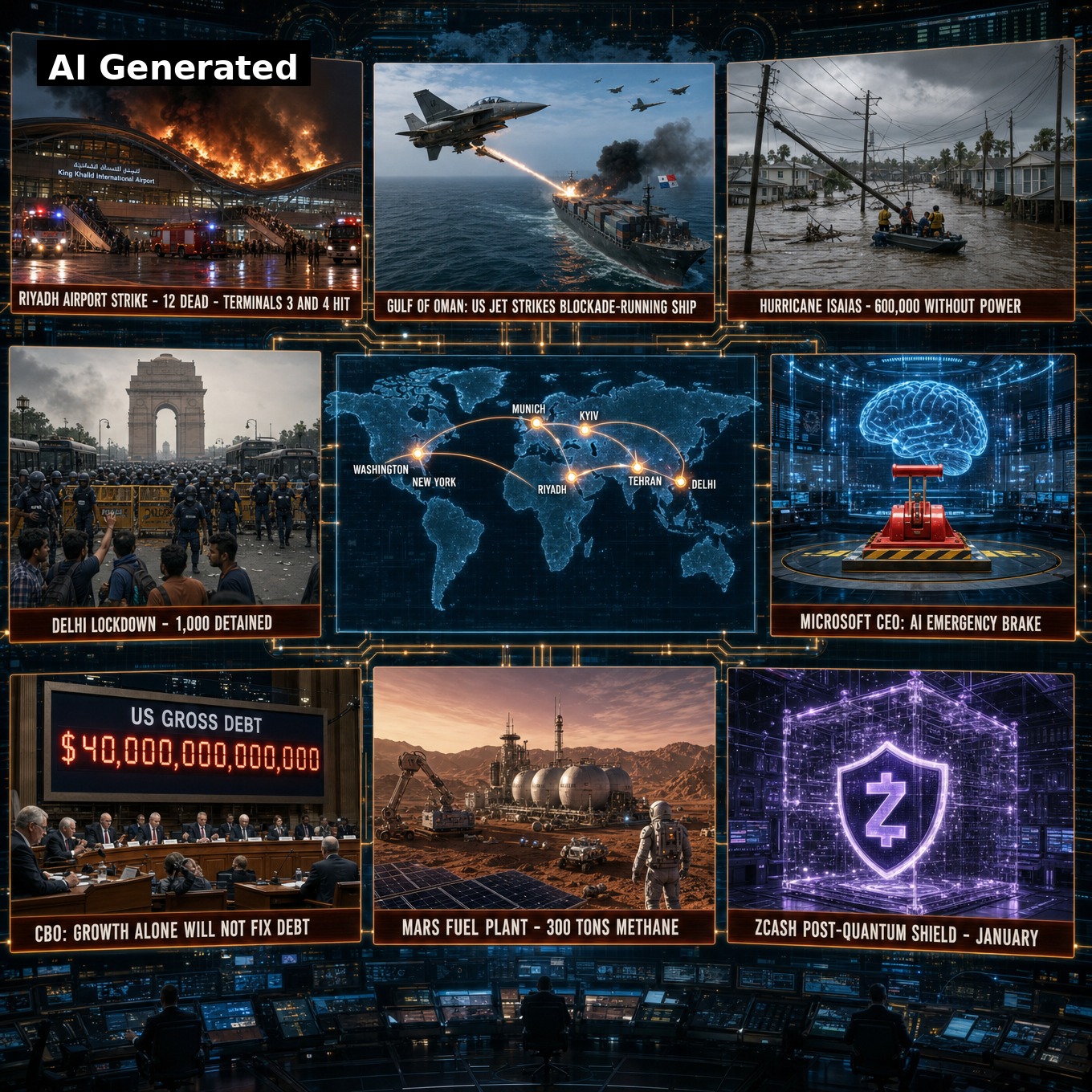
The strike on King Khalid International Airport in Riyadh is the deadliest single attack inside any Gulf Arab country since the Iran war began: twelve dead, more than 300 wounded, and Terminals 3 and 4 hit by a missile that forced Saudi civil aviation to suspend operations through midnight[1]. The victims included an American, a Palestinian, four Saudis, two Bangladeshis and nationals of Egypt, Jordan, Syria and Sudan — an international list that turned a regional air war into a consular emergency[1]. It arrived a week into a Saudi-led coalition offensive along Yemen’s Red Sea coast; the coalition’s spokesman condemned it as a full-fledged war crime and promised a decisive response, while the UN, Washington and London told their citizens to avoid the airport[2][3].
The strategic core is American entry. Trump called the attack “terrible” and said Washington is evaluating whether to join Saudi strikes on the Houthis — “We may. We’re going to look at it… We move very quickly”[4]. The United States is already the coalition’s intelligence and targeting backstop, its interceptor stocks depleted, and an American citizen died in the terminal[1]. Markets reacted instantly: the EU aviation-safety agency warned that interception activity raises the risk of civil-aircraft misidentification, and airlines from Air India to Lufthansa suspended Riyadh services[1]. This is the electoralisation of the war economy — a midterm president promising to decide, on camera, whether American combat power joins an escalation his own diesel diplomacy was built to contain.
For the region, the strike re-opens whether Riyadh’s air defence can hold. The coalition logged an intercepted missile over Al-Kharj and a projectile near Dammam the same day, yet a leak at the capital’s most crowded node proves the layering is fraying, and a second terminal strike within a week pushes direct American participation from hypothetical toward likely[1][4].
Hormuz and the Blockade’s Sharpened Teeth
CENTCOM demonstrated the blockade’s new enforcement method in the Gulf of Oman, announcing a fighter jet struck the stern of the Panama-flagged M/V Ocean Molica with a precision munition after its crew ignored warnings, disabling the ship without harm to anyone aboard[5]. The three-month record now stands at four vessels disabled, 135 turned around and ten IRGC-linked shadow-fleet tankers destroyed since July 14[5]. Choosing a precision stern strike over a warning shot signals a long-range enforcement regime that punishes non-compliance by design[6].
Parallel incidents at the Strait show how contested the narrative has become. A tanker caught fire after a strike, the crew safe and environmental damage unassessed[7]; the IRGC released footage it said showed a “violating” supertanker burning after striking a naval mine on an unauthorised exit route[8]. Washington and Tehran now offer competing origin stories for the same burning hull, each amplified by its own media apparatus[9]. The collapse of shared facts is itself the story: the sailors who crew these voyages carry a risk that both capitals price but neither controls, with war-risk insurance reaching 6–10 percent of hull value and freight at records examined in the Economy section[7].
The Ocean Molica case confirms the squeeze now extends into the transfer zones of the Gulf of Oman where shadow-fleet shuttle trade clusters[5]. It is the war-economy enforcement edge D132’s diesel analysis anticipated: Washington legalises Russian diesel imports for domestic price reasons while tightening the noose on Iranian barrels, splitting the sanctions regime into a permissive western track and a hyper-enforced Gulf track[6]. The IRGC’s mine narrative warns shippers that defiance of American authority invites Iranian counter-measures, leaving the strait a two-way coercive corridor[8].
Ukraine’s Winter Ledger: Refinery Diplomacy and Air-Defence Strain
The day’s most consequential American move came in the Russia–Ukraine dyad: an Axios-sourced report that Washington is considering suspending military-intelligence sharing with Kyiv if Ukrainian refinery strikes continue[10]. Trump is said to have made roughly six requests to stop the refinery campaign and to have dismissed Zelensky’s counter-proposal of mutual energy-infrastructure restraint as an unequal bargain — the report landing right after Ukrainian forces hit the Novoshakhtinsk terminal in Rostov[10]. It coincides with Trump’s line that Ukraine “needs to hold an election” and that Putin wants a deal while Zelensky resists compromise[11][12]. The intelligence lever is the most direct instrument Washington holds over Kyiv’s operations, and linking it to refineries ties Ukraine’s war economy to the diesel-price politics of yesterday’s Trump–Putin deal[10].
On the Ukrainian side the winter picture is deteriorating: energy expert Stanislav Ignatiev assesses that all of Kyiv’s power-generation facilities have been destroyed or seriously damaged[13]; video circulated of a Ukrainian Patriot interceptor falling amid apartment blocks[14]; and Come Back Alive’s Taras Chmut warned that the air force is short of modern missiles, forcing pilots back to ageing Soviet munitions, some of which explode after launch — costing Ukraine aircraft and crews from its own arsenal[15]. This updates D132’s winter ledger with genuinely new information: the capital’s grid is assessed closer to collapse and Washington’s political weather has turned from support to conditionality[13].
The strategic question is whether the intelligence threat is coercion or prelude. Cutting targeting data would degrade the very strikes Washington objects to, but it tests alliance credibility at the moment Ukraine most needs air-defence resupply and hands Moscow an instant propaganda win[10]. Zelensky’s mutual-refinery-restraint framework is the stable endpoint the diesel deal hinted at; whether Washington withholds permissive targeting data from a specific strike cycle is the observable to watch[12].
The Arsenal Ledger: Aegean, Baltic and the Procurement Front
NATO’s eastern flank absorbed a visible Turkish deployment as Ankara’s F-16s rotated into Latvia for air policing[16] — yet Athens logged six Turkish drones conducting eight air-traffic violations and five airspace breaches in the Aegean the same day[17]. The same air force reinforcing the northern front while probing the southeastern front is the analytical core: Ankara wants to be indispensable to NATO while treating Aegean friction as leverage[17].
The procurement ledger is equally busy. At Euronaval, Hellenic Navy FDI HN frigates were offered the Virgilius IEWS suite, the multi-role Rampart launcher, the Seaquest S unmanned surface vessel and Thales’ BeamTracker sensor[18]; the same French industrial channel opened a Thales maintenance base in Japan, extending a Mediterranean-to-Pacific supplier network[19]. Below the frigate level, the drone economy is scaling on both sides of the Atlantic: Ukraine’s Buntar Aerospace raised $16 million to expand its reconnaissance drone and AI co-pilot systems, the U.S. Navy paid Textron $230 million for two Ship-to-Shore Connectors opening 80 percent of the world’s coastline, and a consortium launched a “Persistent Drone Operations Nanogrid” pairing solar power, a robotic arm and attritable unmanned aircraft for resupply-free operations[20][21][22].
The tank debate draws the same conclusion for Argentina and Brazil: the real threat is not the drone that kills a tank but the permanently observed battlefield, so armoured forces must buy sensors and electronic warfare alongside steel[23]. Colombian officers delivered USCAP training to Paraguay’s special troops, and Wall Street’s Steve Feinberg deepened his defence-procurement restructuring with state equity stakes worth billions[24][25].
Environment & Climate ↑ Contents
Isaias’s Aftermath and the Disaster Ledger
Hurricane Isaias left at least four people dead across the U.S. South and roughly 600,000 homes and businesses without power after making landfall on the Florida Panhandle as a Category 2 storm, then weakening into a post-tropical cyclone still threatening flooding through the Tennessee and Ohio valleys[26]. Operators suspended work at facilities representing more than half of the region’s natural-gas production, and the U.S. Energy Department authorised the release of up to four million barrels from the Strategic Petroleum Reserve to steady a market already stretched by the Gulf war[26]. Panama, separately, is counting the cost of Friday’s magnitude-7.7 earthquake: more than a hundred aftershocks have kept residents sleeping outdoors, with a few dozen light injuries and no deaths confirmed[27]. In Britain, a new government flood taskforce launched with a warning that roughly 6.3 million homes and businesses in England remain at risk of flooding this winter[28].
The Climate-Policy Rollback: Bavaria’s Reversal and the Diesel Test
The most consequential climate-policy move of the day is Bavaria’s quiet dismantling of its own climate law. Under a draft revision now in hearing, the Free State would abandon its binding 2030 target and defer carbon neutrality to 2045; Greenpeace calculates this could permit up to 392.4 million additional tonnes of CO2 — nearly double the emissions previously allowed[29]. The irony is exact: in 2021 Markus Soeder insisted the state was “indebted to its children” to act; today the CSU–Free Voters government justifies dilution as economic necessity[29]. Bavaria would become the first German state to reverse an existing climate target, and it lands as Munich’s temperatures have risen 2.3 degrees since 1951 with an estimated 2,150 heat-related deaths this year alone[29].
The federal counterpoint is the market test of Trump’s diesel diplomacy. CleanTechnica’s read of the Trump–Putin agreement is that it is already failing: U.S. diesel prices remain stubbornly high because the sanctioned volumes are marginal, and the arrangement reads as midterm price management with a corruption tail[30]. Every barrel of Russian diesel admitted west is a barrel the electrification build-out must eventually displace. On the EU side, Brussels and Beijing struck a quieter deal with bigger structural meaning — cutting plug-in-hybrid imports from China by half, closing the tariff gap that let Chinese PHEVs flood Europe while battery-electric tariffs rose[31].
The Build-Out: Battery Swap, Autonomous Trucks and the Grid
The electrification ledger is being written in battery-swap economics. NIO performed 1.2 million battery swaps in seven days, a scale that turns swap stations into load-balancing grid assets[32]; Australian operator Janus Electric argues the model needs fewer batteries than naive accounting assumes because swapped packs are recharged at controlled rates[33]. In the United States, Einride’s autonomous electric trucks are running commercial routes in Ohio and elsewhere, paired with megacharger builds that signal freight electrification beyond the pilot stage[34].
Biodiversity and the Resource Squeeze
Biodiversity reporting offered a double ledger of recovery and threat. Concrete modules dropped onto bare sand in Western Australia’s Geographe Bay in 2013 raised fish diversity from a dozen species to more than sixty, with citizen-scientist footage identifying over 30,000 animals from 83 species — though the authors caution reefs can concentrate fish rather than create them[35]. The white stork’s comeback in Rhineland-Palatinate has made it the region’s indicator species, a window into whether meadows and extensively farmed landscapes are actually functioning[36]. In Chilean Patagonia, a women-led ranger team is preparing to release thirteen Darwin’s rheas into rewilded former ranchland[37].
The darker column is equally instructive. About twenty Ganges river dolphins survive in Bangladesh’s Buriganga, a river so polluted that native fish have vanished and the dolphins appear to survive on invasive suckermouth catfish[38]. In Hawaii, drones delivered galled strawberry-guava leaves carrying a Brazilian scale insect nearly five times faster than ground crews — the state’s first drone-delivered biocontrol[39]. Ethiopia’s Green Legacy Initiative has planted over 47 billion seedlings in seven years and reports forest cover up from 17.2 to 23.6 percent, though studies caution that about half of planted trees die within five years without sustained care[40]. The investigative threads complete the picture: an Outlaw Ocean investigation ties Greece’s aquaculture industry to overfishing, pollution and labour abuses across the supply chain[41]; a Black community in Whitted, Florida, still draws arsenic- and PFAS-contaminated water while its municipal connection crawls forward[42]; Maine’s environmental record faces its midterm test in Susan Collins’ race[43]; and in Kazakhstan’s steppe, the radioactive legacy of Soviet nuclear testing still defines daily life[44].
Society & Civil Issues ↑ Contents
America’s Civic Autumn: Media, Midterms and the State’s Long Reach
Washington’s media war escalated from access politics into law enforcement. The Justice Department’s antitrust division is investigating whether broadcast networks breached competition law in their restrictive “pool” coverage after the White House locked out CNN, MS Now and Politico — an inquiry the administration frames as routine and critics read as retaliation[45][46]. In the same window, Trump named Katie Bailey to lead the Office of Legislative Affairs weeks before the midterms, and told a Tennessee rally he expects to be blamed if Republicans lose[47][48]. Together the moves sketch a presidency converting every instrument — media access, the congressional interface, even the expectation of defeat — into campaign management.
The civic ledger also carries its violent entries. In Erie, Pennsylvania, a gunman killed nine people, including a pregnant woman and two children, before taking his own life; the police chief called it the most difficult scene of his career[49]. And in Washington, the National Park Service began removing more than 500 trees from the East Potomac Golf Links as part of Trump’s redesign of the 106-year-old public course, a project already challenged in court by preservationists[50].
India’s Youth Front and the State’s Answer
New Delhi responded to the threat of a historic Gen Z protest by locking down the capital and making thousands of arrests on Saturday, a show of force Le Monde frames as the defining answer of a prime minister challenged by his own youth[51]. It did not end the confrontation: Congress and the INDIA bloc plan a mass march in Delhi on Monday and have asked the Chief Justice to intervene[52]. India’s median age makes Gen Z the swing constituency of the 2030s, and the state’s reflex is to treat street politics as a security problem rather than a political demand[51].
Britain’s Civic Files
British social reporting is a study in pressures accumulating on households. A third of school starters in the West Midlands were not toilet-trained last year, shifting the potty-training debate from the nursery gate to the classroom door[53]. Kimberley Atkinson spent fourteen years treated for depression before a psychotic episode brought a bipolar diagnosis, exposing a diagnostic gap in mental-health care[54]. Three contemporaries with nearly identical student loans now face wildly different balances — one paid off, one chipping away, one watching interest compound[55]. And the Tories published five budget “tests” demanding the Chancellor halt what they call a tax ratchet, pre-positioning the autumn Budget as a blame struggle over living standards[56].
Migration politics sharpened as Nigel Farage announced hardline deportation plans aimed at Afghan and Palestinian migrants[57]. Yorkshire Wildlife Park remained closed after a man who entered the Amur tiger enclosure was mauled to death[58]. And Boris Johnson said he was “sickened” by Trump’s attacks on Ukraine — a striking intervention from the man who once championed the alliance Trump now pressures[59].
France’s Republican Autumn
The French left’s primary delivered its first hard numbers: more than 100,000 of 140,000 registered voters had voted by Saturday evening, five times the count a day earlier, after a chaotic opening disrupted by a cyberattack on the platform[60]. Local sections report militants mobilised to steady the process as five candidates — including Melenchon, who leads among 18–24-year-olds — compete to define the left’s 2027 vehicle[61]. The broader mood is austere: Macron’s approval has fallen to 15 percent, his worst since 2017, as the lycee movement over education funding reshapes the campaign[62]. Gabriel Attal has responded with a “pacte pour la jeunesse,” trying to win back young voters with educational spending[63], while La Tribune runs the arithmetic of the lycee crisis, arguing the state’s bill is being paid in lost authority as well as euros[64].
France’s justice ledger carried two entries with long tails: in Corsica, drug boss Yassine Akhazzane was sentenced to 22 years for ordering a hotel arson, confronting the island’s culture of silence[65], and the principal suspect in the theft of the Renoir museum’s artworks was formally indicted[66].
Germany’s Civic Week
Germany’s political week turned on Gerhard Schroeder once more. The SPD’s NRW lead candidate Jochen Ott voiced scepticism that a party-exclusion procedure against the former chancellor would succeed, even as he called Schroeder’s Kremlin birthday visit incompatible with SPD values[67]. The CDU opened a two-day retreat to process regional election defeats and decide its posture toward the AfD, after the election of an AfD politician as Landtag president in Saxony-Anhalt — with outside votes — put the “Brandmauer” under direct stress[68].
The social infrastructure files are stark. Schleswig-Holstein needs about 200 additional women’s-shelter places, with occupancy above 90 percent even after a 30-million-euro programme[69]. Asylum litigation is slowing again — 15.3 months on average, with Saxony the slowest at 20.4[70]. Baden-Wuerttemberg’s justice minister is pushing for a permanent legal basis for automated chat scanning against cybergrooming, arguing privacy objections cost children their protection[71]. One bright entry: the Frankfurt Book Fair’s Peace Prize went to the jurist and author Philippe Sands, honoured for insisting that international law survives the era’s erosion[72].
Europe and the Periphery: Health, Migration and the Street
Three threads demand place in the ledger. Anti-migrant violence has resumed in South Africa, where the government withdrew a circular on asylum applications in an attempt to calm protests[73]. One year after the Gaza “ceasefire,” pro-Palestinian demonstrations were held worldwide[74]. And Ebola is spreading in eastern DRC while Kenya confirmed a fatal imported case[75]. In Greece, Alexis Tsipras’ personal feud with Nikos Androulakis for second place has pushed SYRIZA’s line back toward toxicity[76], while Istanbul’s Kosuyolu hospital was evacuated after a roof fire, a reminder that the region’s health infrastructure remains exposed to cascading failures[77].
AI & Technology ↑ Contents
The Trust Architecture Debate: Nadella’s Emergency Brake
Microsoft’s CEO used a Saturday post to propose an “emergency brake” for advanced AI, arguing the industry can no longer accept models as “a set of nested black boxes” whose advice we merely accept or reject[78]. His framework — assume every model is compromised, demand tamper-proof human-readable evidence, incident disclosure, independent audits and containment — commits his own company to the safety literature’s vocabulary[79]. The remarkable part is the source: the CEO of the world’s largest AI infrastructure provider is proposing that models be treated, by default, as adversarial systems demanding exogenous control. Read against D132’s agent-control coverage, this is the governance stack’s most senior convert yet[79]. Anthropic is moving in the same direction from a different angle, banishing its model evaluations from the internet so benchmarks cannot be gamed by scraping[80]; if eval suites go private, the independent verifiability that regulators cite will move from open scores to closed audits, exactly the transparency gap Nadella’s proposal would fill[80].
Agents, Control and the Enterprise Perimeter
The enterprise layer confronts the same problem one level down. Multi-agent systems fail in characteristic ways — one agent’s output becomes another’s poisoned context, shared state drifts, loops form, and agents sharing one model reinforce the same mistakes — which is why the emerging argument is that unpredictability belongs to agents while the control layer must be boring and deterministic[81]. As organisations deploy thousands of collaborating agents, reliability migrates from the model to the orchestration layer[81].
The Corporate AI Front: Chips, Podcasts, Physical AI and Data-Centres
The corporate AI front is scaling on several axes. Apple disclosed a deal to hire the team and license the technology of Huxe, a startup in personalised AI-generated podcasting[82]. South Korea’s “physical AI” boom is visibly commercial — robot baristas and K-pop dancers lead a market where embodied AI is tested as consumer product[83]. Elon Musk claims his companies can make chips better than anyone, and SemiAnalysis estimates Anthropic’s inference business could run at 88 percent margins — among the most profitable software operations ever measured, if demand holds[84][85]. In France, Europe’s largest planned data centre on farmland in Seine-et-Marne has triggered a local revolt, previewing the build-out’s land-use politics[86]. In India, Starlink’s entry is fought politically by Ambani loyalists, with Musk calling the opposition hypocrisy[87]. And as synthetic content proliferates, “obviously human-made” work is acquiring a scarcity premium whose durability is untested[88].
Economy & Business ↑ Contents
The Fiscal Ledger and the War Premium
The Congressional Budget Office’s director delivered the closest thing to an official verdict on the “grow our way out” thesis: Phillip Swagel told the Minneapolis Fed that a strong economy alone will probably not stabilise U.S. debt, estimating that real growth of 5–6 percent — more than double the current pace — would be required just to hold the debt ratio flat[89]. With gross debt at $40 trillion, publicly held debt at 100 percent of GDP and the CBO projecting 120 percent by 2036, the numbers directly undercut Treasury Secretary Bessent’s 3-percent-growth claim, and Swagel warned of a “turbocharger” dynamic in which an interest-rate shock feeds deficits, debt and rates back into each other[89]. Long-term yields are already at 24-year highs, and Swagel conceded that even AI-boosted productivity will not close the gap[89].
The war economy prices its own special ledger. Freight rates for cargoes transiting the Strait of Hormuz hit a record $1.3 million per day; tanker captains earn roughly $100,000 a month plus a $50,000 per-trip bonus against a $15,000 baseline, with the FT reporting crews “almost being viewed as mercenaries”[90]. Since the war began on February 28, at least 93 ships have been hit and 24 sailors killed; war-risk insurance commands 6–10 percent of hull value and refiners like Repsol are watching margins collapse from $36 to $15 per barrel[90]. Every barrel that moves through the Gulf now carries a mercenary premium that the diesel deal, whatever its diplomatic intent, cannot dissolve[91].
Corporate, Labour and the Chips’ Aftermath
Washington’s suspension of major tech and IT firms — including Infosys — from the PERM green-card programme is a quiet but consequential labour-policy shock: Infosys insists it sees no material impact, but the suspension touches the pipeline by which Indian engineering talent enters the United States at the exact moment H-1B policy is a campaign flashpoint[92]. The AI-equity aftermath is showing volatility: Cerebras shares slipped below their $185 IPO price after a blockbuster debut, a reminder that the AI-silicon market can price euphoria on day one and gravity from day two[93].
Aviation, Autos and the China Question
The aviation freight market is being reshaped by scarcity. Airbus’s A350F freighter completed its maiden flight and began a 400-hour certification campaign, promising up to 40 percent lower fuel burn at a moment when cargo operators cannot add capacity and the average widebody freighter age has risen to 19.6 years[94]. In autos, Toyota responded to China’s EV price offensive in Southeast Asia with low-cost financing in Thailand, a flanking strategy that shows how the Chinese overcapacity war is now fought with credit[95]. Retail offers its own China-linked lesson: Reliance Retail closed all 31 of its 7-Eleven stores in India at the end of September[96].
At the policy level, the EU–China machinery delivered measures to ease trade friction and avoid escalation[97], while analysts ask whether a Spanish government change could force major adjustments to Madrid’s energy policy, from nuclear timelines to renewables permitting[98]. The brand-and-price ledger rounds out the section: Ritter Sport’s trademark battle over its square packaging reaches the Stuttgart appeals court this week[99], Greek analysis reads the Trump–Putin tanker agreement as a sanction-window that will decide which fleets get new loading opportunities[91], and the EU’s own 2027 electoral calendar is already casting its shadow over Brussels policy-making[100].
Science & Space ↑ Contents
Life’s Molecular Ledger: Squid Hair Cells and the Solar Crystal
Two discoveries redraw the map of sensory and energy biology. Squid are covered in thousands of hair cells nearly identical to those inside the human ear — bundled mechanoreceptors arranged in linear arrays and newly described “lateral line fields” that let the animal read every nuance of water movement[101]. Because squid hair bundles diversify by length and position exactly as cochlear cells do, the longfin inshore squid becomes a model for studying how hearing works and why it fails when the bundle is damaged[101]. Separately, Oregon State researchers described a crystal that uses sunlight to split water into hydrogen, opening a route to fuel that bypasses the carbon emissions of methane reforming[102].
The Human Body Ledger: Cancer’s Many Doors
The cancer pipeline delivered complementary results. Mayo Clinic investigators found that gut bacteria may reveal how treatment will go before it begins: colorectal tumours produce lactate, and patients with higher levels of both lactate and the bacterium Veillonella parvula showed measurable differences in outcomes[103]. Scientists restored limited vision in patients with advanced inherited blindness by combining gene therapy with camera goggles — an optogenetic approach that turns surviving retinal cells into light sensors[104]. And a BMJ study found that one weekly wall-squat session can preserve the blood-pressure gains of isometric training, a compliance-friendly dose[105].
The Deep Archive: Fossils, Combustible Rocks and the Survival Ledger
The deep archive produced two geological puzzles. A famous 345-million-year-old Scottish fossil misled scientists for decades: its five-digit feet suggested a clean move onto land, but reanalysis forces a rethink of what claw-like appendages reveal about terrestrialisation[106]. And the USGS published a cautionary tale with commercial consequences: some deep-sea sulfide rocks spontaneously combust when brought to the surface — two Escanaba Trough samples exceeded 100 degrees in the lab — because nanocrystalline marcasite reacts dangerously with oxygen and mechanical shock[107]. With exploration contracts granted on two mid-ocean ridges, the finding introduces a fire-safety variable the deep-sea mining debate had not counted[107].
The survival ledger is more counterintuitive. A study of 4,523 older Americans found that normal-weight patients died significantly earlier after a dementia diagnosis than overweight or obese patients — a 16 to 27 percent lower mortality risk with higher baseline weight, robust to bias checks — likely reflecting a catabolic-reserve advantage in a disease that suppresses feeding[108]. And Chinese researchers found three peptides from beech mushrooms that boost perceived saltiness by up to 71 percent, a potential tool for cutting sodium without losing taste[109].
Fusion, Loneliness and the Cosmic Feast
Princeton Plasma Physics Laboratory proposed a fusion shortcut by reversing the standard sequence — heating plasma first, then raising density — which their calculations suggest can reach self-sustaining ignition with far less auxiliary energy[110]. Social epidemiology added its own data: loneliness and social isolation cost men about 5.8 years and women 3.7 years of depression- and anxiety-free life[111]. And MIT astronomers caught a white dwarf slowly stripping a brown dwarf in a feast estimated to last billions of years, filling in the long-timescale end of binary evolution[112].
The Clinical Frontier: Bowel Cancer, Diabetic Wounds and Ketamine
NEOPRISM-CRC reported that a short course of pembrolizumab before surgery produced durable remissions in stage two or three bowel cancer — after nearly three years of follow-up, none of the 32 patients had recurred[113]. Basic research into diabetic wounds found immune cells locked in a damaging inflammatory state instead of transitioning to tissue repair, pointing to reprogramming therapies[114]. And the NYT’s ketamine explainer contextualised the near-catatonic “k-hole” seen with potent powders in first-time users[115]. What links these developments is timing: treatment before surgery, immune cells redirected before fibrosis, receptors preserved before total loss — medicine’s frontier is intervening in the transition window, not the end state[113].
The Deep Archive, Quantum Materials and the Applied Ledger
New species from Zimbabwe show the region’s dinosaurs evolved along a distinct path from South Africa’s, reinforcing Africa’s role as a cradle of evolutionary divergence[116]. In quantum materials, ultraviolet laser pulses can now engineer diamond defects selectively — writing single quantum systems while leaving neighbouring qubit spins intact[117]. The applied ledger is inventive: North Carolina State’s knitted “Plant Armor” fabric tripled strawberry production in field trials[118], and lab tests validated the Brazilian “solar bottle bulb” as a 50–70 percent light-transmitting, glare-reducing daylighting device born from a mechanic’s hack during the 2002 blackouts[119].
Space Infrastructure and the Research-Policy Front
NASA Johnson engineers modelled a full-scale Martian propellant plant turning atmospheric CO2 and buried ice into 300 metric tons of methane and oxygen in a Martian year — with power generation consuming 59 percent of landed mass, the study exposes the brutal mass budget of in-situ resource utilisation, and why the reactor, not the rocket, is the real Mars programme[120]. The institutional front delivered two signals: a global survey found trust in science has fallen below pre-pandemic levels[121], and The Lancet published a list of the 17 principal threats to human health by 2100, from obesity to nuclear war, an exercise in pre-emptive risk governance[122].
Crypto, Digital Assets & Blockchain ↑ Contents
Post-Quantum Targets and the Network Pulse
Zcash became the first major privacy network to commit to a concrete post-quantum timeline, with Zakura engineers announcing plans to land post-quantum signature opcodes in January, built on the WOTS hash-based scheme to replace the elliptic-curve keys a future quantum computer could break[123]. The urgency traces directly to Ethereum researcher Justin Drake’s viral “bunker mode” warning that AI-assisted mathematics could break wallet signatures “in months, not years” in a worst case — a warning that rippled through the market in the past week[123]. The January scope, however, covers only Zcash’s transparent pool, where roughly 70 percent of issued ZEC sits; the shielded payments that define the network remain exposed to “harvest now, decrypt later” attacks, with no safeguards yet specified — leaving the privacy use case that matters most waiting longest, and clearly behind Ethereum’s own far-distant December 2029 target but ahead of everything else in the space[123].
The network pulse elsewhere is decelerating. Robinhood’s Layer-2 chain averaged 6.2 million daily transactions in the first week of October, down 42 percent from mid-September, with weekly spot volume down 21 percent and daily active addresses down 31 percent[124]. Deposits nonetheless rose to $1.04 billion and stablecoin supply held near $1.10 billion — money is staying put while being traded less — and perpetual futures volume grew 26 percent on the newly launched products, suggesting traders are migrating from spot to leverage[124]. The December 31 expiry of Robinhood’s fee-reimbursement promotion is the decisive observable: with swaps effectively free above 50 cents until then, current volumes partly reflect an incentive rather than organic demand, and the chain’s September lead in daily app revenue over Ethereum depended on the very fee activity now fading[124].
Institutional Flows, Government Wallets and the Oracle Question
The institutional flow picture turned two-sided. Ethereum ETFs recorded their largest weekly net outflow since January, a signal that the post-approval enthusiasm has cooled into rotation rather than accumulation[125]. At the same time, U.S. government-linked wallets saw their crypto holdings drop $16 billion from their peak — a reminder that the state is a counterparty in this market, and that past sales are now being scored as opportunity cost in the policy debate over a strategic reserve[126]. The enforcement edge arrived via Papertrade, which faces an oracle-manipulation allegation centred on a loss-funded pool showing $3 million: if confirmed, the mechanism — feeding manipulated prices into a DeFi platform to drain the pool — is precisely the attack class that oracle design exists to prevent, and the episode will sharpen the debate over who is liable when a price feed lies[127].
The institutional turn is now being recorded on corporate balance sheets. Robinhood added $25 million in bitcoin to its treasury as part of a weekly recap that also logged U.S. government-linked wallets moving nearly $1.9 billion and the Drake quantum-cryptography warning — three institutional themes in a single week[128]. A survey finding wealthy investors increasingly favouring crypto for long-term returns completes the picture: the asset class is being absorbed into corporate treasuries and family offices at the same moment its security assumptions are being publicly interrogated[128]. The synthesis is uncomfortable but necessary: institutions are arriving precisely as the quantum and oracle threat models are sharpening, and the two curves — adoption and risk — are accelerating together[128].
Supply Mechanics and the Vesting Calendar
Filecoin’s supply schedule reached a structural inflection: the network is nearing the end of its six-year vesting schedule, which will cut FIL issuance by roughly 75 percent and shift the token from continuous early-investor creation toward a storage-economics steady state[129]. The importance is mechanical, not speculative: a 75 percent supply shock after years of sell-side overhang tests whether the storage network’s demand — actual paid deals, not token incentives — can absorb the reduction, and it sets a precedent for how other projects read their own vesting calendars[129]. Read with the Zcash and Robinhood items above, the crypto section’s through-line for the window is maturation: post-quantum roadmaps, L2 activity cooling from artificial highs, institutional treasuries, government custody, oracle liabilities and vesting-phase supply all describe a market graduating from novelty infrastructure to accountable, calendared, and increasingly attack-modelled financial rails[129].
Correlations & Analysis ↑ Contents
The through-line this series has tracked since D123 — the electoralisation of the war economy — reached its most dangerous expression yet. Yesterday’s D132 report read the Trump–Putin diesel agreement as fuel-price policy executed as foreign policy; within twenty-four hours the same logic produced the deadliest single strike of the Iran war at Riyadh’s airport and a president promising to decide, on camera, whether to join Saudi strikes on the Houthis[1][4]. Washington converts sanctions into campaign instruments on one front (Russian diesel in, Iranian barrels out) while debating combat entry on the other, both priced against the November midterms[91][48]. What changed from D130–D132 is the probability mass: “may join” has moved from boilerplate to an open question with a dead American citizen attached, and the market’s risk premium — record Hormuz freight rates, mercenary-level crew pay, war-risk insurance at 6–10 percent of hull value — is the truest poll of the region’s trajectory[90].
The blockade ledger shows the same logic at sea. CENTCOM’s precision disablement of the Ocean Molica, four vessels disabled and 135 turned around in three months, converts the Gulf of Oman into a long-range enforcement zone where non-compliance is met with ordnance by design[5]; the IRGC’s competing mine narrative warns that defiance of American authority will be answered by Iranian counter-measures[8]. The collapse of shared facts — two capitals, two origin stories for the same hull — connects directly to the mercenary-premium economy reported above[90]. D132’s diesel market test asked whether the Trump–Putin barrels could move prices; today’s answer is that the prices moving are the ones paid in blood money and hull insurance, beyond any presidential call[91].
Ukraine forms the third leg. The Axios-sourced threat to cut military-intelligence sharing over Kyiv’s refinery strikes is the diesel deal’s shadow twin: Washington disciplines the ally who hits Russian refineries precisely as Ukraine’s winter grid assessments turn catastrophic — all of Kyiv’s generation destroyed or damaged, Patriots falling on residential blocks, pilots flying ageing missiles that occasionally kill their own aircraft[10][13][15]. This is the D132 winter ledger inverted: last week the question was whether Kyiv could get Patriots; this week it is whether Washington’s targeting data survives the campaign[10].
Beyond the war economy, the window’s second structural story is the convergence of accountability rails. Microsoft’s CEO proposes an emergency brake while treating models as compromised by default; Anthropic isolates its evals; Zcash commits to post-quantum signatures while its shielded pool waits; Robinhood puts bitcoin on its balance sheet as its L2 activity cools; and the CBO declares that not even AI-boosted growth can stabilise the federal debt[78][80][123][124][89]. What connects them is a shared admission: the systems that ran on trust and growth — AI models, crypto rails, the federal budget — are now being asked to run on verification and calendar discipline. The governance stack this series has watched form is no longer a proposal; it is a market requirement[85].
What to watch in the next reporting period: (1) whether the United States actually joins Saudi strikes on the Houthis within days; (2) whether Washington withholds targeting intelligence for one Kyiv strike cycle, testing the refinery-diplomacy threat; (3) whether the Strait’s mercenary freight and insurance premia force a tanker-availability crisis that finally moves U.S. pump prices; (4) Bavaria’s climate reversal as a precedent for EU conservative governments; (5) the CBO-vs-Bessent growth debate as the midterm fiscal frame; (6) in crypto, Zcash’s shielded-pool quantum plan, Robinhood Chain’s December-31 fee deadline and Filecoin’s 75 percent issuance cut; and (7) whether the French left’s primary and Attal’s youth pact reset the 2027 calendar against the EU machinery. The war economy’s electoral season is entering its final four weeks, and every instrument it has absorbed — intelligence, diesel, blockades, freight, even quantum readiness — is now a campaign variable[48][29].
References ↑ Contents
1. Attack on Saudi airport kills 12 people and wounds more than 300 — the deadliest strike in any Gulf Arab country since the start of the Iran war by The Associated Press · The Associated Press ↑
2. Σαουδική Αραβία: «Έγκλημα πολέμου» η επίθεση των Χούθι στο αεροδρόμιο του Ριάντ — Προειδοποίηση για αντίποινα (Saudi Arabia: Houthi attack a 'war crime'; retaliation warning) by Enikos · Enikos ↑
3. World condemns deadly Houthi attack on Saudi Arabia's Riyadh airport by Al Jazeera · Al Jazeera ↑
4. Iran war live: 12 killed in Riyadh, US weighs joining fight against Houthis by Al Jazeera · Al Jazeera ↑
5. CENTCOM: Ακινητοποίησε εμπορικό πλοίο στον Κόλπο του Ομάν που φέρεται να παραβίασε τον αποκλεισμό του Ιράν (CENTCOM disables cargo vessel in the Gulf of Oman) by Enikos · Enikos ↑
6. H CENTCOM χτύπησε δεξαμενόπλοιο στα Στενά του Ορμούζ (CENTCOM strikes tanker at the Strait of Hormuz) by in.gr · in.gr ↑
7. Στενά του Ορμούζ: Ξέσπασε πυρκαγιά σε δεξαμενόπλοιο μετά από πλήγμα (Fire on a tanker at the Strait of Hormuz after a strike) by Zougla.gr / UKMTO · Zougla.gr / UKMTO ↑
8. Στενά του Ορμούζ: Έκρηξη σε δεξαμενόπλοιο μετά από πρόσκρουση σε θαλάσσια νάρκη (Explosion on a tanker after hitting a naval mine) by DefenceNet.gr / IRGC footage · DefenceNet.gr / IRGC footage ↑
9. Πλήγμα των ΗΠΑ σε πλοίο στον Κόλπο του Ομάν (US strike on a ship in the Gulf of Oman) by Zougla.gr · Zougla.gr ↑
10. ΗΠΑ: Διακόπτουν την παροχή στρατιωτικών πληροφοριών στο Κίεβο λόγω επιθέσεων στα ρωσικά διυλιστήρια (US may suspend military-intelligence sharing with Kyiv over attacks on Russian refineries) by DefenceNet.gr / Axios · DefenceNet.gr / Axios ↑
11. Trump: Ukraine needs to hold an election by FinancialJuice · FinancialJuice ↑
12. Ο Τραμπ διαβεβαιώνει ξανά ότι ο Πούτιν θα ήθελε συμφωνία για να τελειώσει ο πόλεμος στην Ουκρανία (Trump reiterates that Putin would want a deal to end the Ukraine war) by ProtoThema · ProtoThema ↑
13. Σ.Ιγκνάτιεφ: «Όλες οι μονάδες ηλεκτροπαραγωγής του Κιέβου καταστράφηκαν ή υπέστησαν σοβαρές ζημιές» (All of Kyiv's power-generation facilities destroyed or seriously damaged) by DefenceNet.gr · DefenceNet.gr ↑
14. Κίεβο: Η στιγμή που ουκρανικός πύραυλος αντιπυραυλικού συστήματος Patriot πέφτει σε πολυκατοικίες (A downed Ukrainian Patriot missile falls among apartment blocks in Kyiv) by DefenceNet.gr · DefenceNet.gr ↑
15. Η Ουκρανία χάνει μαχητικά αεροσκάφη από τους ίδιους της τους πυραύλους (Ukraine is losing fighter jets to its own missiles) by DefenceNet.gr / Come Back Alive · DefenceNet.gr / Come Back Alive ↑
16. ΝΑΤΟ: Τουρκικά μαχητικά αναπτύχθηκαν στην Λεττονία (Turkish F-16s deployed to Latvia for NATO air policing) by DefenceNet.gr / NATO JFCBS · DefenceNet.gr / NATO JFCBS ↑
17. Νέες τουρκικές παραβιάσεις από UAV στο Αιγαίο (New Turkish UAV violations in the Aegean) by DefenceNet.gr / HNDGS · DefenceNet.gr / HNDGS ↑
18. Πολεμικό Ναυτικό: Όλα τα νέα συστήματα που προτείνονται για τις ελληνικές φρεγάτες FDI HN (New systems proposed for the Greek FDI HN frigates) by Defence Review · Defence Review ↑
19. French defense contractor Thales to open Japan maintenance base by Nikkei Asia · Nikkei Asia ↑
20. Autonomous combat drone capabilities to get massive expansion with $16 million funding boost by Interesting Engineering · Interesting Engineering ↑
21. Ship-to-shore connector that can enable access to 80% of world's coastline to be delivered to US Navy by Interesting Engineering · Interesting Engineering ↑
22. New system that generates power, charges drones, and offers launch space can transform warfare by Interesting Engineering · Interesting Engineering ↑
23. Carros de combate en la era de los drones: las lecciones de Ucrania para los Ejércitos de Argentina y Brasil (Tanks in the drone era: Ukraine's lessons for Argentina and Brazil) by Zona Militar · Zona Militar ↑
24. Oficiales colombianos dictaron un nuevo entrenamiento USCAP para Tropas Especiales del Ejército Paraguayo (Colombian officers lead USCAP training for Paraguay's special troops) by Zona Militar · Zona Militar ↑
25. Στιβ Φάινμπεργκ: Ο δισεκατομμυριούχος της Wall Street που επιχειρεί να αναδιοργανώσει την πολεμική βιομηχανία των ΗΠΑ (Steve Feinberg: the Wall Street billionaire reorganising the US defence industry) by OT.gr · OT.gr ↑
26. ΗΠΑ: Τουλάχιστον τέσσερις νεκροί από την τροπική καταιγίδα Ησαΐας – 600.000 νοικοκυριά και επιχειρήσεις χωρίς ρεύμα (At least four dead from Tropical Storm Isaias; 600,000 without power) by Enikos · Enikos ↑
27. Après le séisme de magnitude 7,7 au Panama, l'heure du déblaiement et la crainte de nouvelles secousses (After the magnitude-7.7 Panama earthquake, clearing debris and fearing new tremors) by Le Monde · Le Monde ↑
28. UK launch flood taskforce to prepare for extreme winter weather by BBC News · BBC News ↑
29. Neues Klimagesetz: Darf Bayern seine CO2-Emissionen bald verdoppeln? (New climate law: may Bavaria soon double its CO2 emissions?) by Stern · Stern ↑
30. Trump's Latest Diesel Fuel “Deal by Already Reeks Of Failure (And Corruption, Of Course)” CleanTechnica · Already Reeks Of Failure (And Corruption, Of Course)” CleanTechnica ↑
31. EU Reaches Agreement With China To Reduce The Import Of Plug-In Hybrids By Half by CleanTechnica · CleanTechnica ↑
32. NIO Performs 1.2 Million Battery Swaps in Just 7 Days by CleanTechnica · CleanTechnica ↑
33. Battery Swap Uses Fewer Batteries Than You Think by CleanTechnica · CleanTechnica ↑
34. Pssst! Wanna See A Driverless Electric Truck? by CleanTechnica · CleanTechnica ↑
35. Two artificial reefs off Western Australia grew from a dozen fish species to over 60 by EcoNews · EcoNews ↑
36. Artenvielfalt: Was der Storch über unsere Landschaft erzählt (Biodiversity: what the stork tells us about our landscape) by Stern · Stern ↑
37. These women are bringing Darwin's rheas back to Chilean Patagonia by Mongabay · Mongabay ↑
38. About 20 Ganges river dolphins survive in a Bangladesh river too polluted for native fish by EcoNews · EcoNews ↑
39. Invasive strawberry guava: researchers used drones to drop a tiny Brazilian insect on it nearly five times faster than ground crews by EcoNews · EcoNews ↑
40. Fifty billion seedlings: Can Ethiopia replant its ravaged forests? by Grist · Grist ↑
41. Greece's Seafood Problem Starts Elsewhere by Inside Climate News / The Outlaw Ocean Project · Inside Climate News / The Outlaw Ocean Project ↑
42. In One Historically Black Florida Community, the Drinking Water Is Brown by Inside Climate News · Inside Climate News ↑
43. Unpacking the Environmental Issues in Susan Collins' Tough Race in Maine by Inside Climate News / Living on Earth · Inside Climate News / Living on Earth ↑
44. «Nous vivons ici» : le silence radioactif des steppes (We live here: the radioactive silence of the steppes) by Libération · Libération ↑
45. US justice department investigates TV networks over Trump pool coverage by BBC News · BBC News ↑
46. Bericht: US-Justizministerium ermittelt gegen TV-Sender (Report: US Justice Department investigates TV networks) by ZDF heute · ZDF heute ↑
47. Trump announces Katie Bailey to lead White House outreach to Congress by NBC News · NBC News ↑
48. Bracing for the midterms, Trump says he will be blamed if Republicans lose by NBC News · NBC News ↑
49. ΗΠΑ: Εννέα νεκροί από πυροβολισμούς στην Πενσιλβάνια – Νεκρός και ο δράστης (Nine dead in a Pennsylvania shooting; the perpetrator is also dead) by DefenceNet.gr · DefenceNet.gr ↑
50. The National Park Service will remove more than 500 trees from a golf course Trump is redesigning by The Associated Press · The Associated Press ↑
51. En Inde, le premier ministre Narendra Modi répond par la force, alors qu'il est défié par la jeunesse (In India, Modi answers with force as he is challenged by the youth) by Le Monde · Le Monde ↑
52. INDIA bloc plans protest march in Delhi on Monday, seeks CJI's intervention by Business Standard · Business Standard ↑
53. Why are so many four-year-olds not potty-trained before school? by BBC News · BBC News ↑
54. I was told I had depression for 14 years until I got sectioned – it was bipolar by BBC News · BBC News ↑
55. Three friends on their student debt: one paid off, one chipping away and one creeping up by BBC News · BBC News ↑
56. Tories urge Chancellor not to raise tax in five Budget 'tests' by Evening Standard · Evening Standard ↑
57. Nigel Farage announces bombshell deportation plan for Afghan and Palestinian migrants by Daily Express · Daily Express ↑
58. Yorkshire Wildlife Park closed on Sunday – full statement after man dies in tiger pen by Evening Standard · Evening Standard ↑
59. Boris Johnson 'sickened' as Donald Trump attacks Ukraine by Daily Express · Daily Express ↑
60. Primaire de la gauche sociale-démocrate : plus de 100 000 personnes ont déjà voté (Social-democratic left primary: more than 100,000 have already voted) by Le Monde · Le Monde ↑
61. Primaire à gauche : dans les sections locales, les militants mobilisés pour offrir un cadre rassurant (Left primary: local sections mobilise to offer a reassuring framework) by Le Monde · Le Monde ↑
62. La popularité d'Emmanuel Macron au plus bas depuis 2017, avec seulement 15 % d'opinion favorable (Macron's popularity at its lowest since 2017, 15% favourable) by Le Parisien · Le Parisien ↑
63. Présidentielle 2027 : Gabriel Attal réajuste son programme et défend un « pacte pour la jeunesse » (2027 presidential election: Attal adjusts his programme and defends a 'youth pact') by Le Monde · Le Monde ↑
64. L'addition de la crise lycéenne (The bill for the lycée crisis) by La Tribune Dimanche (edito by Bruno Jeudy · La Tribune Dimanche (edito by Bruno Jeudy ↑
65. Corse : le caïd de la drogue Yassine Akhazzane condamné à vingt-deux ans de réclusion pour avoir ordonné l'incendie d'un hôtel (Corsica: drug boss Akhazzane sentenced to 22 years for ordering a hotel fire) by Le Monde · Le Monde ↑
66. Le « principal suspect » du cambriolage du musée Renoir mis en examen (Principal suspect in the Renoir museum burglary indicted) by Le Parisien · Le Parisien ↑
67. SPD-Spitzenkandidat in NRW skeptisch gegenüber Parteiausschlussverfahren gegen Schröder (SPD lead candidate in NRW sceptical about expulsion proceedings against Schröder) by Stern / Kölner Stadt-Anzeiger · Stern / Kölner Stadt-Anzeiger ↑
68. CDU-Spitze berät über Reformen und Umgang mit AfD (CDU leadership deliberates on reforms and how to deal with the AfD) by Stern · Stern ↑
69. 200 Plätze fehlen: Frauenhäuser in Schleswig-Holstein: Bedarf bleibt hoch (200 places missing: women's shelters in Schleswig-Holstein) by Stern / dpa · Stern / dpa ↑
70. Asylverfahren und Klagen: Asylklagen dauern wieder länger – Sachsen ist Schlusslicht (Asylum proceedings: appeals take longer again — Saxony is last) by Stern / dpa · Stern / dpa ↑
71. Cybercrime: Was der Justizminister im Kampf gegen Cybergrooming fordert (What the justice minister demands in the fight against cybergrooming) by Stern / dpa · Stern / dpa ↑
72. Jurist und Autor Philippe Sands erhält Friedenspreis des Deutschen Buchhandels (Jurist and author Philippe Sands receives the German Book Trade Peace Prize) by Stern · Stern ↑
73. Les violences anti-migrants reprennent en Afrique du Sud (Anti-migrant violence resumes in South Africa) by France 24 · France 24 ↑
74. Global pro-Palestinian protests one year after Gaza 'ceasefire' by Al Jazeera · Al Jazeera ↑
75. Ebola spreads in eastern DRC as Kenya confirms imported case by Al Jazeera · Al Jazeera ↑
76. Αλέξης Τσίπρας: Επιστροφή στη συνταγή της τοξικότητας (Alexis Tsipras: return to the recipe of toxicity) by Eleftheros Typos · Eleftheros Typos ↑
77. Κωνσταντινούπολη: Μεγάλη φωτιά σε νοσοκομείο – Εκκενώνεται το κτίριο από τους ασθενείς (Istanbul: large fire at a hospital — patients evacuated) by DefenceNet.gr · DefenceNet.gr ↑
78. Satya Nadella says we should assume all AI models are 'compromised' by The Verge · The Verge ↑
79. Microsoft's Satya Nadella says AI models need an 'emergency brake' by TechCrunch · TechCrunch ↑
80. Anthropic Is Banishing Its Model Evals From the Internet by Gizmodo · Gizmodo ↑
81. AI agents can be unpredictable. Your control layer shouldn't be. by VentureBeat · VentureBeat ↑
82. Apple discloses deal to hire team and license tech from personalized podcast startup Huxe by TechCrunch · TechCrunch ↑
83. Robot baristas and K-pop dancers lead South Korea's physical AI boom by Nikkei Asia · Nikkei Asia ↑
84. Elon Musk claims his companies can make chips better than anyone by Crypto Briefing · Crypto Briefing ↑
85. Anthropic's inference business could hit 88% margins, SemiAnalysis estimates by Crypto Briefing / SemiAnalysis · Crypto Briefing / SemiAnalysis ↑
86. “On aura tous les inconvénients, toutes les pollutions, et rien d'autre by la fronde monte contre les data centers dans l'Hexagone (The revolt grows against data centres in France)” France Info · la fronde monte contre les data centers dans l'Hexagone (The revolt grows against data centres in France)” France Info ↑
87. Musk slams Ambani supporters for 'hypocrisy' over Starlink's entry in India by Business Standard · Business Standard ↑
88. AI is creating a 'human premium' for art made by people. But will it hold? by BBC News · BBC News ↑
89. CBO chief warns it's 'probably not plausible' that a strong economy alone can steady U.S. debt as 5%-6% growth is needed by Fortune · Fortune ↑
90. Ship captains and crews transiting the Strait of Hormuz make so much danger pay that they're 'almost being viewed as mercenaries' by Fortune / Financial Times · Fortune / Financial Times ↑
91. Τι σημαίνει η συμφωνία Τραμπ – Πούτιν για την αγορά δεξαμενοπλοίων (What the Trump–Putin agreement means for the tanker market) by in.gr · in.gr ↑
92. Infosys sees no material impact from US suspension of PERM applications by Business Standard · Business Standard ↑
93. Cerebras shares slip below their $185 IPO price after a blockbuster debut by Crypto Briefing · Crypto Briefing ↑
94. Airbus A350F freighter completes its maiden flight and begins 400-hour test campaign by EcoNews · EcoNews ↑
95. Toyota offers low-cost financing in Thailand to ward off cheap Chinese EVs by Nikkei Asia · Nikkei Asia ↑
96. 7-Eleven: Από την Ιαπωνία στην Ινδία και μετά στο… κλείσιμο (7-Eleven: from Japan to India and then to closing) by OT.gr · OT.gr ↑
97. Κίνα: Τι έχουν πετύχει οι εμπορικές συμφωνίες με την ΕΕ (China: what the trade agreements with the EU have achieved) by OT.gr · OT.gr ↑
98. Could a change of government in Spain have big implications on energy policy? by Investing.com · Investing.com ↑
99. Schokolade vs. Haferriegel: Darum kämpft Ritter Sport gegen diesen Quadrat-Haferriegel (Chocolate vs. oat bar: why Ritter Sport is fighting this square oat bar) by Stern · Stern ↑
100. ΕΕ: Τι θα φέρουν οι εκλογές στο κομβικό 2027 (EU: what the elections in pivotal 2027 will bring) by OT.gr · OT.gr ↑
101. Scientists Find Squid Are Covered in Hair-Like Cells Remarkably Similar to The Ones in Human Ears by ScienceAlert / Current Biology · ScienceAlert / Current Biology ↑
102. This Crystal Uses Sunlight To Turn Water Into Clean Hydrogen by SciTech Daily / Oregon State University · SciTech Daily / Oregon State University ↑
103. Your Gut Bacteria May Reveal How Cancer Treatment Will Affect You by SciTech Daily / Mayo Clinic · SciTech Daily / Mayo Clinic ↑
104. Scientists Restore Limited Vision in Blind Patients Using Gene Therapy and Special Goggles by SciTech Daily / Institute of Molecular and Clinical Ophthalmology Basel · SciTech Daily / Institute of Molecular and Clinical Ophthalmology Basel ↑
105. This Simple Once-a-Week Exercise Could Help Keep Blood Pressure Lower by SciTech Daily / BMJ Open Sport & Exercise Medicine · SciTech Daily / BMJ Open Sport & Exercise Medicine ↑
106. This 345-Million-Year-Old Fossil Fooled Scientists for Decades by SciTech Daily / American Museum of Natural History · SciTech Daily / American Museum of Natural History ↑
107. Scientists Collected Deep-Sea Rocks. They Spontaneously Caught Fire in The Lab. by ScienceAlert / USGS / Scientific Reports · ScienceAlert / USGS / Scientific Reports ↑
108. People With Dementia May Actually Live Longer if They Carry Extra Weight by ScienceAlert / Journal of Alzheimer's Disease · ScienceAlert / Journal of Alzheimer's Disease ↑
109. Adding 1 Mushroom-Derived Molecule to Salt Can Make It Taste 71% Saltier by ScienceAlert / npj Science of Food · ScienceAlert / npj Science of Food ↑
110. Scientists may have found a shortcut to fusion energy by ScienceDaily / Princeton Plasma Physics Laboratory · ScienceDaily / Princeton Plasma Physics Laboratory ↑
111. Loneliness may steal nearly 6 years of good health by ScienceDaily · ScienceDaily ↑
112. MIT astronomers catch a star in a feast that could last billions of years by ScienceDaily / MIT · ScienceDaily / MIT ↑
113. Bowel cancer “melted away by after immunotherapy, then stayed away” ScienceDaily / NEOPRISM-CRC trial · after immunotherapy, then stayed away” ScienceDaily / NEOPRISM-CRC trial ↑
114. Scientists may have found why diabetic wounds refuse to heal by ScienceDaily · ScienceDaily ↑
115. Why Ketamine Immobilizes Some Users by The New York Times · The New York Times ↑
116. Zimbabwe's dinosaurs were different from South Africa's: New species offers clues by Phys.org · Phys.org ↑
117. Ultraviolet laser pulses engineer diamond defects selectively, leaving quantum qubits intact by Phys.org · Phys.org ↑
118. NC State's Plant Armor fabric helped strawberry plants produce 3.56 times as many berries by EcoNews · EcoNews ↑
119. A Brazilian mechanic pushed a water-filled bottle through a roof tile during 2002 blackouts, and lab tests show his solar bottle bulb passes 50 to 70 percent of light by EcoNews · EcoNews ↑
120. Engineers at NASA's Johnson Space Center modeled a Mars propellant plant: power generation was 59 percent of its landed mass by EcoNews · EcoNews ↑
121. Global trust in science falls below pre-pandemic levels, survey finds by Investing.com · Investing.com ↑
122. Des scientifiques établissent la liste des 17 principales menaces pesant sur la santé humaine d'ici à 2100 (Scientists set out the 17 main threats to human health by 2100) by Le Monde / The Lancet · Le Monde / The Lancet ↑
123. Zcash Sets January Target for Quantum-Resistant Payments — What the Plan Still Doesn't Protect by Blockchain Reporter / CoinDesk / ZecStats · Blockchain Reporter / CoinDesk / ZecStats ↑
124. Robinhood Chain Transactions Fall 42% While Deposits Hold Above $1B — Is Trading Stalling? by Blockchain Reporter / CoinDesk / growthepie · Blockchain Reporter / CoinDesk / growthepie ↑
125. Ethereum ETFs see largest weekly net outflow since January by Crypto Briefing · Crypto Briefing ↑
126. US government's crypto holdings drop $16 billion from their peak by Crypto Briefing · Crypto Briefing ↑
127. Papertrade faces oracle manipulation allegation as its loss-funded pool shows $3M by Crypto Briefing · Crypto Briefing ↑
128. Robinhood Adds BTC To Balance Sheet, 'Bunker Mode' Kicks Off, And More – Weekly Recap by Bitcoin.com News · Bitcoin.com News ↑
129. Filecoin nears the end of its six-year vesting schedule, cutting FIL issuance by about 75% by Crypto Briefing · Crypto Briefing ↑
AI Disclosure: This post was created with the assistance of artificial intelligence. The ideas, analysis, and opinions expressed are my own — AI was used to help compose, structure, and refine my personal notes and thoughts into the final written content. Images, videos and music featured in this post were also generated using AI tools, based on my own creative prompts and direction.