



The boy and the abyss
I grew up in the 1980s, and I was a science-fiction kid. The full diet — television, books, comics — and I was an Asimov fan. Not even the gadgets or the space. What I loved was the way those stories imagined people thinking together with machines.
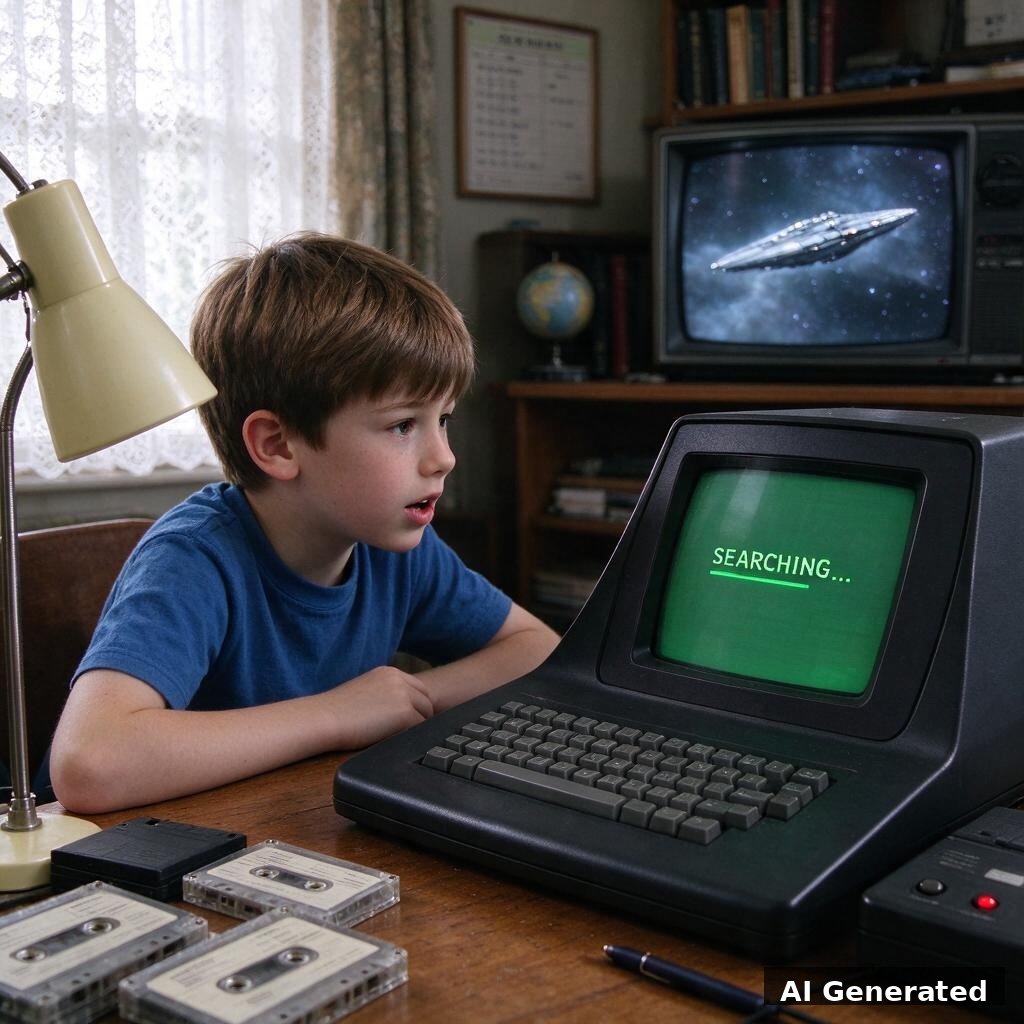
One evening I watched a Star Trek film. There is a scene in it I have carried ever since, and I remember exactly which part of it struck me. An engineer from the future is stuck in 1986, needing materials he has no money to buy. He walks up to the most advanced computer of the time, a small Apple Macintosh, and he simply starts talking to it.
“Computer!” he calls. Nothing. “Computer?” Nothing. They hand him a mouse, and he speaks into it, like the communicator from his century — which, of course, it is. “Hello, computer.” Nothing [3]. The 1980s engineer at his side finally says the most devastating line in the film: “Just use the keyboard.” And the man from the future looks at it and answers: “Keyboard. How quaint.” [3]
The plot needed him to conjure, then and there, the formula for a wonder material he could trade for what he really needed [2][4]. I barely registered the material. What knocked me sideways was the interaction itself. In the 23rd century, people don’t type at their machines. They talk to them. The computer hears, understands, and does things — it answers questions, it remembers, it solves. Remove the whales, remove the time travel, and that scene is the whole dream in miniature: a human and a computer, in conversation, building something neither could build alone.
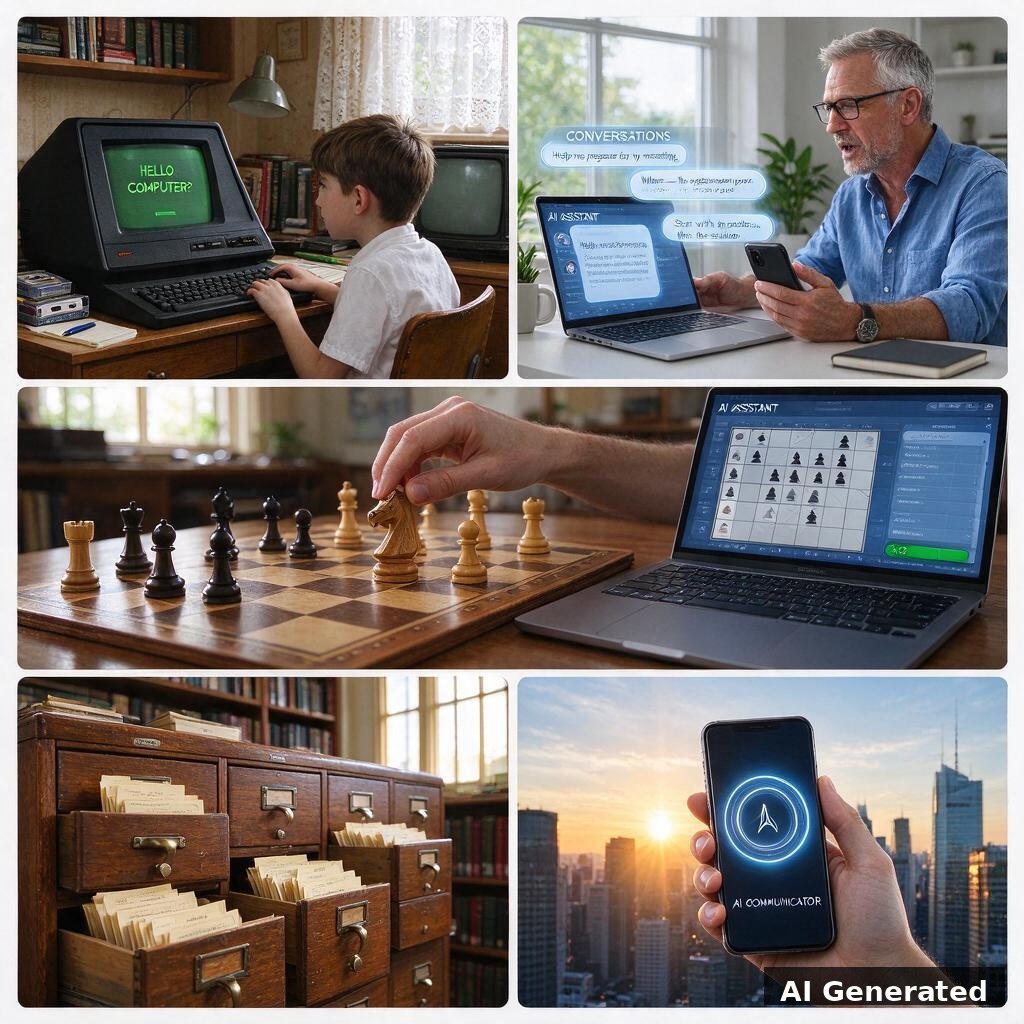
And here is where my young mind hit the abyss. My computer at the time was a Sinclair QL [1]. The initials stood for “Quantum Leap” [1] — a beautifully optimistic name for the little machine meant to be Sinclair’s leap forward. Launched in January 1984 at £399, with 128 kilobytes of memory and a multitasking operating system, it was genuinely advanced for its day [1]. (It shipped late and buggy and sold only about 150,000 units — but that is another story [1].) My Quantum Leap could display text. It could run a spreadsheet. It could not hear me. It could not understand a single word I said. And I could not imagine a world where it ever would.
We will never get there, I thought. Whatever “there” was — the conversation — was so far away that my child’s mind could not even see the bridge, let alone cross it.
The abyss was crossed in one lifetime
Here is the thing that fills me with gratitude every time I think about it: the abyss was not crossed in centuries. It was crossed inside one human lifetime. Mine.
The road was paved in patient increments. In 1952, Bell Laboratories built “Audrey,” which could recognize the spoken digits zero to nine — if the right person spoke them [5]. In 1962, IBM’s Shoebox understood sixteen English words at the World’s Fair [5]. In the 1970s, a DARPA-funded program at Carnegie Mellon produced Harpy, with a vocabulary of over a thousand words and the ability to recognize whole sentences [5]. The early 1990s brought the first consumer dictation product, Dragon Dictate; 1997 brought Dragon NaturallySpeaking, the first continuous-speech system, transcribing natural speech at around a hundred words a minute [5].
Then the pace changed. Siri arrived in smartphones in 2011, Alexa in 2014, Google’s assistant in 2016 [5]. And on November 30, 2022, OpenAI released ChatGPT to the public: one million users in five days, roughly a hundred million monthly users within two months [6].
Read that again from my seat: the exact thing I watched a man from the future fail to do in 1986 — speak to a computer and be understood — became something hundreds of millions of people now do every day, mostly without thinking about it. The scene that defined my idea of “impossible” is no longer an ending. It is a beginning. We are not at the end of this era. We are at the very start of it.
But does it really understand us?
Now the honest part, because I refuse to write a praise letter. There is a genuine, unresolved debate about whether these machines understand anything at all, or whether they are marvellous mimics. In 2021, a landmark paper by Emily Bender and colleagues called large language models “stochastic parrots”: systems that stitch together sequences of linguistic forms observed in their training data, “without any reference to meaning” [7].
I confess the name made me smile twice. First, because stochastic comes from the Greek στοχαστικός — “based on guesswork” [7]. The Greeks gave us πληροφορία — information — the root of the flood we now swim in, and now the newest word in the debate is Greek too. Second, because there are days it truly does feel like guesswork. The machines hallucinate; they invent confident nonsense; they fumble ambiguity [7]. Even the inventors joke about it — Sam Altman himself once tweeted “i am a stochastic parrot, and so r u” [7].
But the other side is equally serious. Geoffrey Hinton, a pioneer of neural networks, answers the parrot objection directly: to predict the next word accurately, you have to understand the sentence [7]. And researchers studying “emergent abilities” — capabilities that simply do not exist in smaller models but appear in larger ones — argue that scaling keeps producing results nobody could have extrapolated in advance [8].
I don’t need to settle that debate to live well in this era. But there is a second fear, not philosophical at all, that deserves real respect: that using these tools quietly outsources our thinking. In 2025, researchers at Microsoft Research surveyed 319 knowledge workers about a wide range of real AI use cases, presented at the CHI conference [9]. The pattern that emerged: the more people trusted the AI, the less they questioned it [9]. On routine, low-stakes tasks, they reported thinking less, not more [9].
That is the real danger of this era — not that the computer is a fake, but that we become passengers in our own minds.
The centaur — what actually works
Here is what the evidence says about how to thrive in this era: don’t let the machine replace the mind. Let it extend the mind. Chess proved this spectacularly.
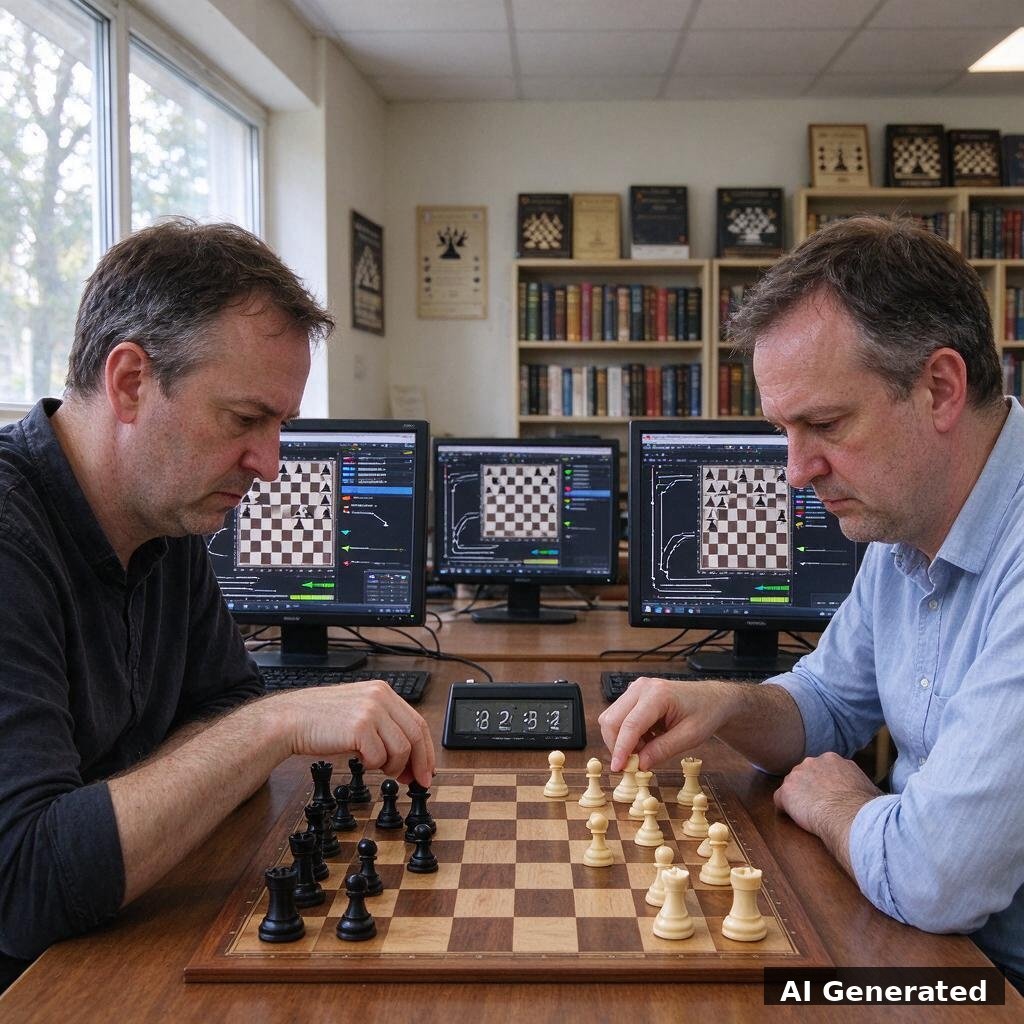
In 1997, IBM’s Deep Blue defeated world champion Garry Kasparov, and the headlines declared the end of human chess [12]. Kasparov refused that conclusion and did something braver: he invented a form of play where humans and computers are on the same team — “advanced chess,” later called freestyle [12]. The result amazed everyone. In the 2005 freestyle tournament, teams of grandmasters with powerful computers competed… and the winners were two amateurs from New Hampshire — Steven Cramton, rated 1685, and Zackary Stephen, rated 1398 — using three ordinary desktop computers and off-the-shelf chess software [10]. No grandmasters. No supercomputers [10]. They even left the mighty Hydra chess machine behind them [10][12].
How? They had spent four or five years building their own database of strategies [11], and they had a disciplined method for deciding when to trust the computer and when to trust their human judgement. In Stephen’s own words: “We had really good methodology for when to use the computer and when to use our human judgement, that elevated our advantage” [11]. Kasparov’s verdict on the whole experiment: “Human strategic guidance combined with the tactical acuity of a computer was overwhelming” [12].
The chess world learned to rank the combinations: a grandmaster is good. A grandmaster with a laptop is better. But a pair of determined amateurs who truly understand how to work with the machine beat them all — because the amateurs, not the machine, set the direction, questioned the answers, and owned the result [12]. As Kasparov concluded: it’s the two together, working side by side [12].
Now reread that Microsoft study, and you will see the two findings are not in conflict. The workers whose thinking suffered were the ones who trusted without checking. But the same study found that on high-stakes work, people thought harder — and that the very nature of their critical thinking had shifted toward something specific: verification [9]. When asked what critical thinking meant in the age of AI, the workers described verifying the machine’s output against external sources and against their own expertise [9]. Microsoft’s own recommendation flows from that: treat AI as a thought partner — one that can even provoke you — not as a machine that dispenses finished answers [9].
That is this essay in one sentence: use it the way Star Trek used the computer — as a companion for discovery and expansion, never as an easy way out.
What I discovered, at my age
I tell you all this not as a researcher, but as someone who came to it late and unfit. I don’t know everything about coding — and I don’t need to. I learned to give the machine guidance: architecture, scope, what “done” looks like. Then it builds, and I check. I run its work through the discipline an engineer applies to any tool: verify the process, verify the results, and watch the mistakes — because it makes them, especially the cheaper models, and that is exactly when I learn the most. I keep a second monitor open to verify and to learn while the work happens. I ask it questions not to get answers, but to understand.
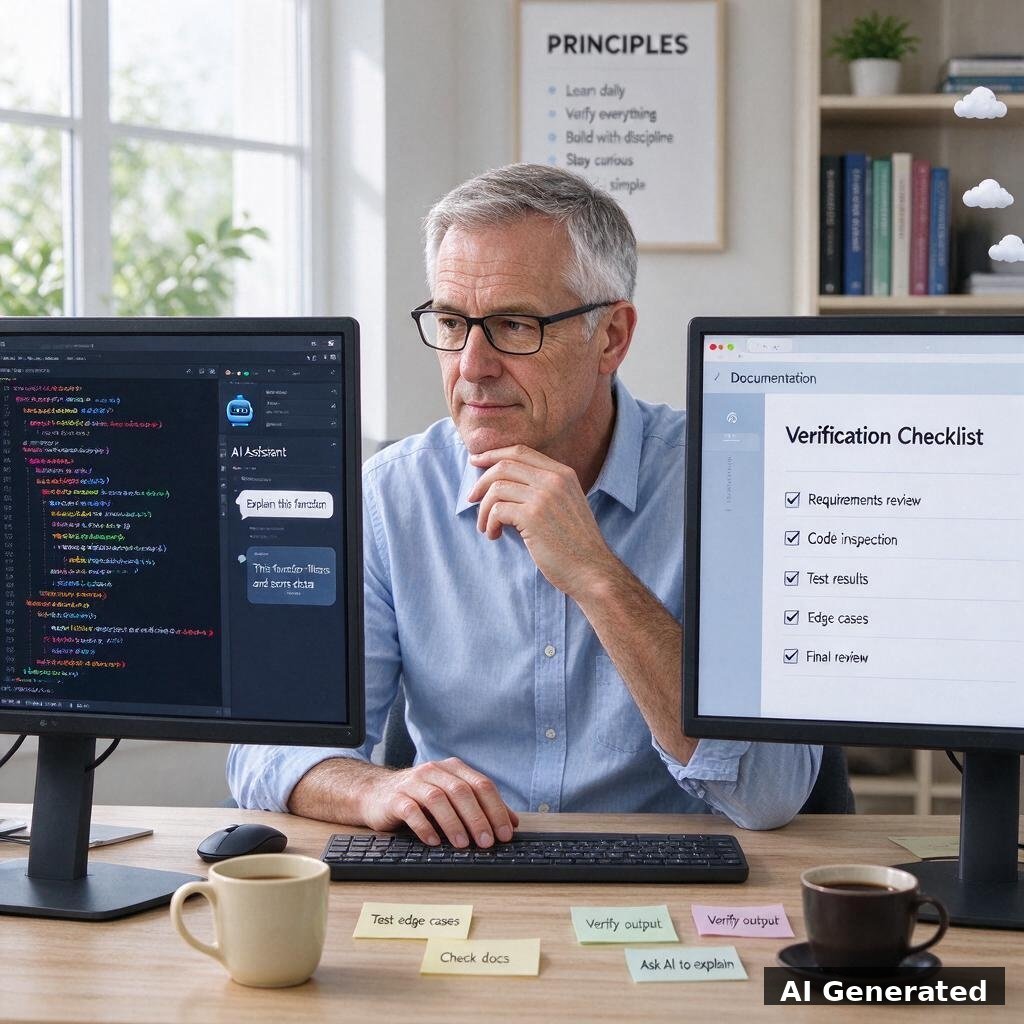
And I follow one rule that has nothing to do with technology: do not blindly trust any intelligent entity — not a human, not a machine. It is naive. Our survival instincts are beeping against it for a reason, and that reason is written into every species that ever survived: blind trust is a recipe for damage. The machine earns your trust exactly the way a colleague does — through work you check, again and again.
Then and now, for the young
Let me give the younger readers the contrast, because you cannot see it from inside. When I was a student, knowledge was physical. You went to a library. You consulted the card catalog — wooden drawers full of index cards, where every book had several cards so you could hunt it by author, by title, or by subject [13]. Then you walked the stacks and hoped the book was where the card said it was. If your library didn’t have it, you asked the librarian to request an interlibrary loan — and you waited. Non-available books took two weeks to two months; rare, recent, or in-demand items took longer still [14]. If the book didn’t exist anywhere, you waited in vain. I borrowed from cousins, begged, bought what I could, and read what I had.
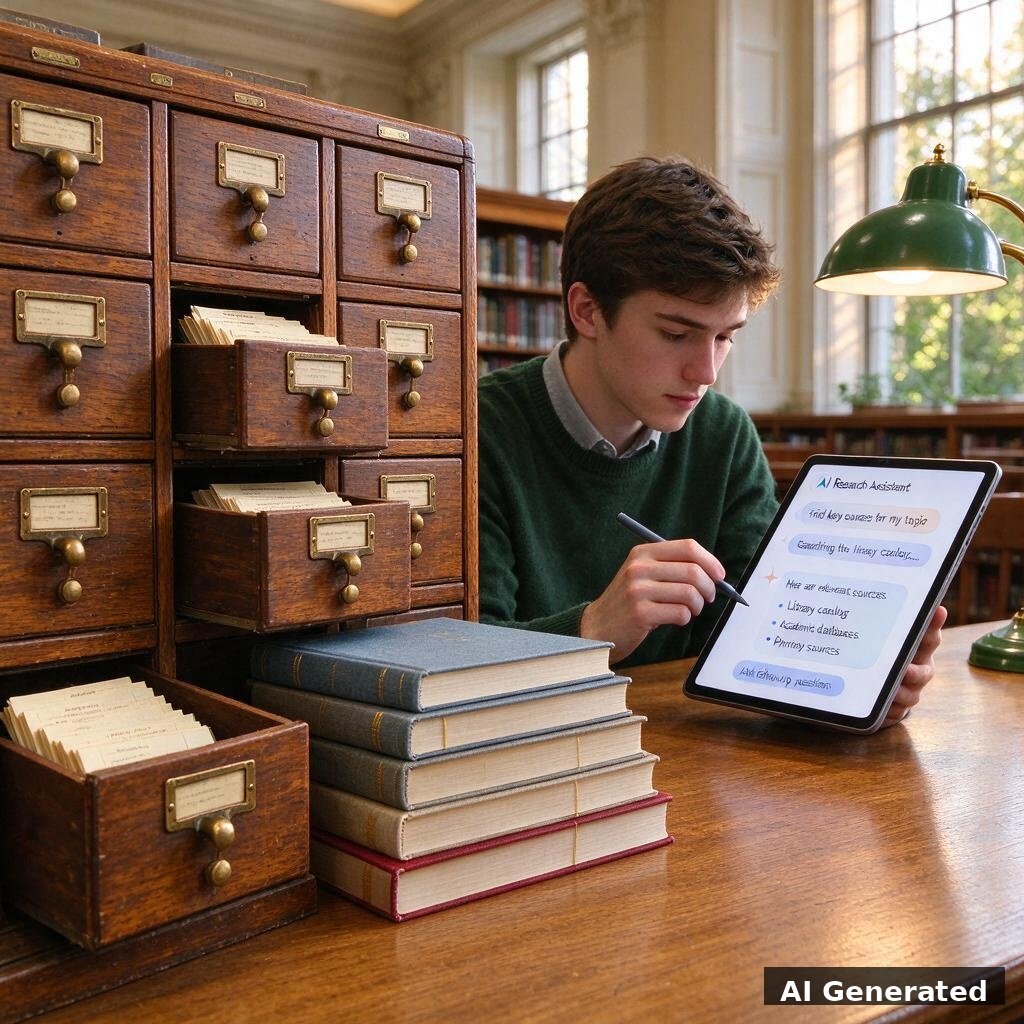
The internet came, and it poured information into every home: the flood of πληροφορία — widely available, but hard to sail. Search engines helped; they did not converse. And then came the machines that finally do what that engineer from the future expected: you ask, they understand, they find, they explain. My own library is now digital, searchable, and mine; my model reads it, brings back more current references, and helps me find, verify, and learn. Research that once took weeks takes minutes. Understanding, which once demanded years of apprenticeship, now asks only for curiosity and the honesty to check.
The era has begun
Star Trek’s record of prediction is genuinely good: the communicators became the phones in our pockets; the PADD became the tablet on every kitchen table; the universal translator became the real-time translation on every screen [15]. Some of its inventions are still ahead of us — and that is precisely the point. This is not the golden age. It is the first age. We stand where the first users of radio stood: at the very beginning of something big.
The boy who sat at his Quantum Leap and stared across the abyss now talks to a computer every day — and it talks back. And the wonderful part is that I still treat it the way that film taught me: as the tool that helps a curious mind become more. We need to keep this tool freely available to everyone, because an era like this only works if it is shared. It’s the beginning. And for me, that is the most exciting part of all.
References
[1] Wikipedia. (n.d.). Sinclair QL. Wikipedia. <a href=”https://en.wikipedia.org/wiki/Sinclair_QL”>https://en.wikipedia.org/wiki/Sinclair_QL</a>
[2] Ragan, S. M.. (2015). The wonders of transparent aluminum. Make:. <a href=”https://makezine.com/article/science/transparent-aluminum/”>https://makezine.com/article/science/transparent-aluminum/</a>
[3] Clip.Cafe. (2022). Just use the keyboard… — Star Trek IV: The Voyage Home scene. Clip.Cafe. <a href=”https://clip.cafe/star-trek-iv-the-voyage-home-1986/just-use-the-keyboard/”>https://clip.cafe/star-trek-iv-the-voyage-home-1986/just-use-the-keyboard/</a>
[4] Reed, M.. (2015). Top 25 films with unrealistic computer scenes. Den of Geek. <a href=”https://www.denofgeek.com/movies/top-25-films-with-unrealistic-computer-scenes/”>https://www.denofgeek.com/movies/top-25-films-with-unrealistic-computer-scenes/</a>
[5] Transcribe. (2024). The history of speech recognition. Transcribe. <a href=”https://transcribe.com/blog/the-history-of-speech-recognition”>https://transcribe.com/blog/the-history-of-speech-recognition</a>
[6] DeVon, C.. (2023). On ChatGPT’s one-year anniversary, it has more than 1.7 billion users—here’s what it may do next. CNBC Make It. <a href=”https://www.cnbc.com/2023/11/30/chatgpts-one-year-anniversary-how-the-viral-ai-chatbot-has-changed.html”>https://www.cnbc.com/2023/11/30/chatgpts-one-year-anniversary-how-the-viral-ai-chatbot-has-changed.html</a>
[7] Wikipedia. (n.d.). Stochastic parrot. Wikipedia. <a href=”https://en.wikipedia.org/wiki/Stochastic_parrot”>https://en.wikipedia.org/wiki/Stochastic_parrot</a>
[8] Wei, J., Tay, Y., Bommasani, R., Raffel, C., Zoph, B., Borgeaud, S., Yogatama, D., Bosma, M., Zhou, D., Metzler, D., Chi, E. H., Hashimoto, T., Vinyals, O., Liang, P., Dean, J., & Fedus, W.. (2022). Emergent abilities of large language models. arXiv. <a href=”https://arxiv.org/abs/2206.07682″>https://arxiv.org/abs/2206.07682</a>
[9] Rintel, S., Reicherts, L., Tankelevitch, L., Sarkar, A., Ghosh, P., & Banks, R.. (2025). The future of AI in knowledge work: Tools for thought at CHI 2025. Microsoft Research. <a href=”https://www.microsoft.com/en-us/research/blog/the-future-of-ai-in-knowledge-work-tools-for-thought-at-chi-2025/”>https://www.microsoft.com/en-us/research/blog/the-future-of-ai-in-knowledge-work-tools-for-thought-at-chi-2025/</a>
[10] ChessBase. (2005). Dark horse ZackS wins freestyle chess tournament. ChessBase. <a href=”https://en.chessbase.com/post/dark-horse-zacks-wins-freestyle-che-tournament”>https://en.chessbase.com/post/dark-horse-zacks-wins-freestyle-che-tournament</a>
[11] Baraniuk, C.. (2015). The cyborg chess players that can’t be beaten. BBC Future. <a href=”https://www.bbc.com/future/article/20151201-the-cyborg-chess-players-that-cant-be-beaten”>https://www.bbc.com/future/article/20151201-the-cyborg-chess-players-that-cant-be-beaten</a>
[12] Thompson, C.. (2013). Clive Thompson: Destroying the grandmasters. National Post. <a href=”https://nationalpost.com/opinion/clive-thompson-destroying-the-grandmasters”>https://nationalpost.com/opinion/clive-thompson-destroying-the-grandmasters</a>
[13] Wheeles, L., & Marvin, H.. (2025). Information before the Internet. Research and the Information Landscape, UMSL Libraries. <a href=”https://umsystem.pressbooks.pub/information/chapter/242/”>https://umsystem.pressbooks.pub/information/chapter/242/</a>
[14] University of Minnesota Law Library. (n.d.). Interlibrary loan services FAQ. University of Minnesota Law Library. <a href=”https://law.umn.edu/library/law-students/borrow-copy-retrieve/interlibrary-loan-services-faq”>https://law.umn.edu/library/law-students/borrow-copy-retrieve/interlibrary-loan-services-faq</a>
[15] Jones, P. A.. (2026). 6 pieces of ‘Star Trek’ technology that eventually became real. Mental Floss. <a href=”https://www.mentalfloss.com/entertainment/tv/star-trek-technology-became-real”>https://www.mentalfloss.com/entertainment/tv/star-trek-technology-became-real</a>
AI Disclosure: This post was created with the assistance of artificial intelligence. The ideas, analysis, and opinions expressed are my own — AI was used to help compose, structure, and refine my personal notes and thoughts into the final written content. Images and video featured in this post were also generated using AI tools, based on my own creative prompts and direction.
