
Contents
- 1. Geopolitics & Defence
- The Seven-Day Clock on the Hormuz Track
- The Red Sea Front: Escalation Meets Collective Response
- UNGA Week: Substitutes, Soundings and Aegean Friction
- Washington’s Legal Front Against an AI Company
- Alliance Conversion and Hardware Shifts
- Ukraine: The Black Sea Grinding Campaign
- Periphery Flashpoints and Political Crosscurrents
- 2. Environment & Climate
- 3. Society & Civil Issues
- 4. AI & Technology
- 5. Economy & Business
- 6. Science & Space
- 7. Crypto, Digital Assets & Blockchain
- 8. Correlations & Analysis
- 9. References
Click any heading to jump to that section. Click the section heading to return to this menu.
Geopolitics & Defence ↑ Contents
The Seven-Day Clock on the Hormuz Track
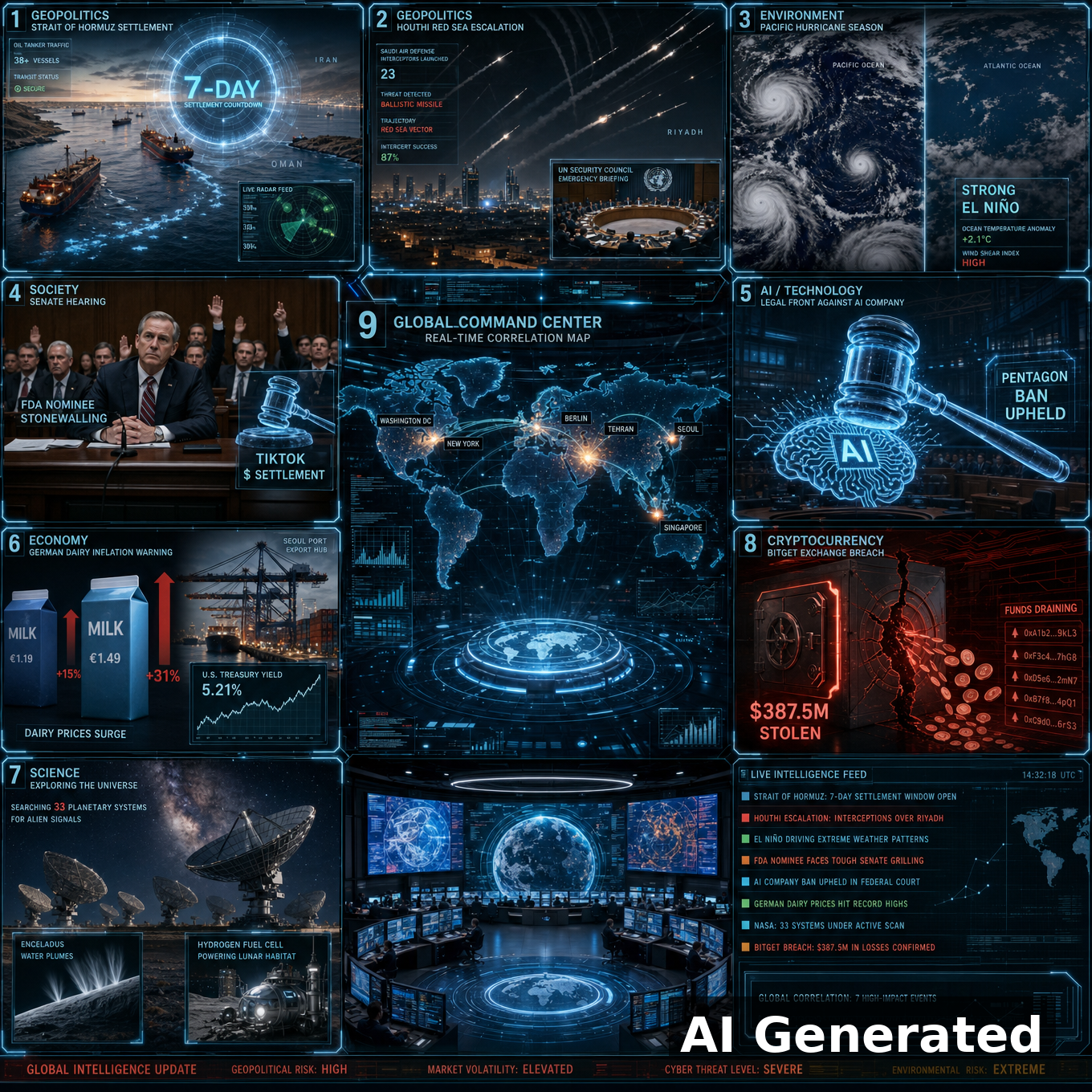
The settlement track that the D117 report (2026-09-25) documented as “formal vocabulary plus live grammar” has now acquired a literal deadline. Iran has submitted to Washington a plan to reopen the Strait of Hormuz within seven days of US acceptance, with Foreign Minister Abbas Araghchi pointedly stating that “the seven-day period will begin as soon as the United States accepts this plan” — a formulation that shifts the burden of delay onto the White House[34]. The German press read the same moment as “Iran — the plan has been transmitted, now it is Washington’s turn,” while noting that Tehran remains unyielding on its nuclear program inside the parallel negotiations and that Benjamin Netanyahu used his own General Assembly speech to defend the war[33].
Washington, however, is not converging on the timetable. According to the Wall Street Journal, President Trump rejected Iran’s proposal for an initial seven-day ceasefire and has told aides that American bombing of Iran is expected to continue into November — effectively past the US midterms[8]. An Al Jazeera report that the two sides were in technical talks to finalise a deal knocked oil prices lower in Friday trading, even as Tehran denied any imminent agreement[5]. Markets are pricing a settlement one principal is publicly refusing. Compounding this, Iranian President Masoud Pezeshkian has refused a meeting with Trump outright, a snub that reflects deep Iranian mistrust of US intentions and that analysts warn could destabilise Pezeshkian’s own administration[7]. The seven-day clock, in short, has been wound by Tehran but not yet acknowledged by Washington — and the arithmetic of the midterms now sits inside the negotiation.
The Red Sea Front: Escalation Meets Collective Response
The Houthis ran a dense operational day against Saudi Arabia and the coalition answered with an unusually coordinated political-military package. Saudi-led air defences intercepted a ballistic missile fired toward Khamis Mushait[16] and two drones launched toward Riyadh[18], while the UN Security Council issued a press statement condemning “in the strongest terms” the continued Houthi attacks against the Kingdom[21]. This is the material escalation D117 tracked from the Mecca Joint Defence Agreement onward — but the qualitative shift is who now draws red lines.
Yemen’s Presidential Leadership Council chief Rashad al-Alimi called a general mobilisation against the Houthis, framing the campaign against the Iran-aligned movement as existential for the internationally recognised government[28]. More striking is Pakistan’s intervention: Prime Minister Shehbaz Sharif warned that any new Houthi attack against Mecca would cross a “red line that must never be crossed” — language that converts a Gulf war into a matter of pan-Islamic credibility and brings a nuclear-armed South Asian state rhetorically into the theatre[17]. The periphery of this war keeps widening faster than the settlement track can narrow it.
UNGA Week: Substitutes, Soundings and Aegean Friction
Germany closed its General Assembly week with a delegation split between two capitals of attention. Foreign Minister Johann Wadephul delivered Germany’s General Debate address on Saturday, standing in for Chancellor Friedrich Merz for a second year — a substitution that is routine only because Merz is absorbing the fallout of his party’s catastrophic state-election results[1]. Greek Foreign Minister Giorgos Gerapetritis, completing his fifth day of General Assembly contacts, read the week as proof that “Greece is at the centre of diplomatic interest,” pointing to the volume of his bilateral engagements as a diplomatic footprint multiplier[12].
That context includes two persistent regional frictions. In the Cyprus file, Turkish Cypriot leader Tufan Erhürman rejected Secretary-General Guterres’s proposal for a trilateral meeting in New York, hardening the path toward the next step Guterres had hoped to take on the settlement process[2]. The Aegean saw another day of Turkish violations — five drones flew six route infringements in the Athens FIR and six airspace violations, with Hellenic fighters scrambled; the swarm pattern, rather than the count, is the new normal[31]. UNGA week thus ended for the Eastern Mediterranean much as it began: with diplomacy amplified and deterrence rehearsed simultaneously.
Washington’s Legal Front Against an AI Company
A three-judge panel of the DC Circuit has upheld the Pentagon’s ban on Anthropic, with Pentagon CTO Emil Michael crowing that “the hammer of justice has smashed Anthropic[‘s] arguments” — and the AI company hinting at an appeal that, under the applicable sanctions framework, it may not even be permitted to bring[9]. This converts the legal front first documented in the D114 and D115 reports into a confirmed appellate-level defeat and a procurement precedent: the government may now blacklist a major AI developer for withholding features, even absent malicious intent, as the companion Ars Technica ruling analysis makes explicit[76]. The defence establishment’s relationship with frontier AI is being renegotiated through litigation rather than legislation — a pattern tracked since D114 that now has appellate teeth.
Alliance Conversion and Hardware Shifts
The alliance-conversion stage identified in D117 produced concrete deliveries this window. Poland’s deputy defence minister declared that the US “decision has been made” to establish a permanent American base on Polish soil, with a joint weapons-development agreement nearing completion — the fulfilment of a decades-old Warsaw objective and a further deepening of the US forward posture[4]. Canada signed a preliminary agreement with Sweden’s Saab for at least six GlobalEye airborne early-warning and control aircraft, buying “flying radars” specifically for Arctic surveillance as the northern domain heats up[3]. Latvia moved to acquire Anduril’s long-range Barracuda cruise missile, with President Rinkevics announcing the purchase after meeting Palmer Luckey — another front-line state buying American attritable strike capability[30].
The naval and industrial ledger is shifting too. Britain’s Royal Navy took delivery of HMS Agamemnon, its newest nuclear-powered attack submarine, after thirteen years — sea trials beginning before commissioning, with hull A close behind[29]. The Pentagon’s bill for the fleet that supports all of this keeps inflating: the GAO warns the Navy’s shipyard infrastructure optimisation programme could exceed $200 billion, against an original estimate of roughly $21 billion[10]. And a senior Navy admiral warned that the “cyber magazine” — the service’s stock of cyber effects — “can run out pretty damn quick” in modern conflict, extending the munitions-adequacy debate from shells to software[11].
Russia, meanwhile, is signalling in two registers. It delivered a modernised batch of Su-57 stealth fighters, reworked from combat experience to operate in jamming environments — the first production configuration explicitly shaped by war lessons[22]. Its strategic rocket forces, meanwhile, staged the technically demanding silo-loading of an RS-24 Yars ICBM at Kozelsk — a display timed to the settlement week[24]. American analysts are re-litigating the F-22 decision: 195 Raptors were built instead of 750, the tooling destroyed, and the massed Chinese air arm now forming is the one the Raptor was designed to defeat[23]. The window’s procurement stories all point the same direction: inventories, bases and industrial capacity, not new doctrine, are the currency of this phase.
Ukraine: The Black Sea Grinding Campaign
Washington re-committed nearly the full $400 million Ukraine security-assistance package that Congress had approved, rushing obligations on weapons and spare parts before the funds’ deadline expires — though notably without Patriots in this tranche[6]. On the battlefield’s maritime flank, Russian Geran-4 drones struck five more Ukrainian cargo ships in the Black Sea and at Odesa’s ports, extending what one defence outlet called a “cemetery” of Ukrainian shipping and a de facto campaign to blockade Ukrainian exports from the air[32]. Putin paired the escalation with an ultimatum, warning Kyiv it “will suffer the consequences” for strikes on Moscow and polling stations, while claiming Russia had been “ready to resume negotiations” — the same split-screen vocabulary and grammar this report has tracked since D116[27].
Periphery Flashpoints and Political Crosscurrents
The periphery produced its own grim ledger. In the Democratic Republic of Congo, an army aircraft crashed into a residential area near Mongbwalu, Ituri, killing fourteen — senior military officials among them[13]. In northern Ethiopia, heavy fighting resumed between federal forces and TPLF-aligned fighters across communities of the Tigray region, with telecoms cut, fears of full-scale war, and over 700 dead already reported[25], prompting the UN human rights chief Volker Türk to voice “deep concern” and warn of the danger of a full-scale war reigniting[20]. In Pakistan, authorities sealed Islamabad’s roads with shipping containers ahead of a pro-Imran Khan rally, delaying the gathering amid a widening crackdown on PTI mobilisation[19]. And in Morocco, the party that won last month’s election without an absolute majority, Authenticity and Modernity, entered coalition formation — with the composition of the next government hinging on the King’s choice of head of government and voters’ impatience over jobs and purchasing power[35].
The Iranian war also injected itself into American electoral politics from the inside: Republicans running in competitive races — at least seventeen members of Congress now — are openly calling on the president to end the war with fewer than forty days until the midterms[14]. That intra-party pressure is the missing variable in every Hormuz calculation above. Meanwhile the Trump-Xi rapprochement continued its stretch: two new meetings between Trump and Xi Jinping are being planned for the near term after this week’s Washington encounter, with the US president satisfied by the visit and the contested “AI czar” portfolio clarified in the process[15].
Environment & Climate ↑ Contents
The Grid’s New Appetite
The clearest number in the window’s energy file is Irish: data centres drew 6,969 gigawatt hours from the metered grid in 2024 — 22 percent of all metered consumption, up from 5 percent in 2015 — a share that now exceeds both categories of household demand in the country[36]. That is the demand curve the AI build-out is writing into national statistics, and it explains why the search for firm, on-site power has become an arms race of its own. The supply side answered this week with a non-binding letter of intent between NANO Nuclear Energy, infrastructure integrator IP3 and AI developer Cybernetic Intelligence to explore microreactors — including the KRONOS design — as dedicated power for defence and advanced computing loads[40]. Meanwhile the urban layer is experimenting at the opposite scale: a Queens rooftop pairing a living green roof with roughly 100 kW of vertically stacked bifacial panels, expected to generate about 120,000 kWh a year while keeping sun, rain and maintenance access for the plants beneath[43]. From gigawatt-scale nuclear to a rooftop bookshelf of panels, the adaptation of infrastructure to compute — and to climate — is proceeding in parallel at every scale.
A Swinging Storm Season
The ocean-cycle swing that D117’s periphery noted has now produced a defining asymmetry: the Pacific is churning through an unusually busy hurricane season while the Atlantic has recorded not a single full-blown hurricane this year, and scientists attribute the split to an exceptionally strong El Niño[44]. The Pacific’s contribution is Hurricane Nolo, forecast to strengthen into a major hurricane as it skirts Hawaii’s Big Island this weekend, threatening intense rain, life-threatening flash flooding and dangerous surf[38]. Europe’s contribution was smaller but violent: a tornado tore through villages near Parga in the Ioannina region of Greece on Friday evening, ripping cables and downing a DEI power pylon and damaging homes around Fanari[37]. The lesson of the asymmetry is uncomfortable — a quiet Atlantic basin is not a quiet planet, and the same climate oscillation that spares one basin loads the other.
Climate Diplomacy and the Legal Counterattack
At the General Assembly, UN Secretary-General Guterres told heads of state that the climate crisis is “no longer a distant warning,” as the Assembly pledged support for countries threatened by sea-level rise — yet climate remained a footnote next to the wars commanding the week’s attention[50]. The gap between podium rhetoric and enforcement is being tested in American courts instead. Environmental groups sued the Tennessee Valley Authority over Clean Air Act violations at its new Kingston gas plant, targeting the fossil build-out behind the utility transition[42], while the Sierra Club’s sixth “Dirty Truth” report graded utilities on coal retirement, gas planning and renewables addition — with NV Energy’s Sierra Pacific subsidiary receiving the lowest grade yet awarded[39]. The accountability lens is widening beyond emissions to financial flows: a Mongabay commentary argues that fighting environmental crime requires tracking profits through the whole supply chain, since a decade of pricing nature — carbon markets, conservation finance, biodiversity credits — has created asset classes that criminal networks can also arbitrage[56]. The moral ledger was carried on public radio too: Living on Earth devoted its show to Nepal’s catastrophic August glacial floods, the rapid attribution finding a “very strong” climate role, and the world’s duty to fund adaptation[47].
Food, Ice and Ecosystems Under Pressure
The climate crisis is reaching children through their plates: droughts cut agricultural output, floods sever roads and supply chains, and price inflation squeezes families out of fruits and vegetables — effects that now register in child nutrition well before the headline disasters do[41]. In the high latitudes and tropics, the physical record is blunter. Papua’s “eternal snow” atop Puncak Jaya — snow that has capped equatorial peaks for centuries and carries both scientific and spiritual significance — is about to disappear permanently as the Sudirman Range’s last patches melt away[45]. Alaska’s Brooks Range rivers, the orange plumes first noticed in 2018, are proving even more acidic and metal-laden than acid mine drainage despite flowing through pristine wilderness — thawing permafrost remobilising minerals on a landscape scale[53].
The biological ledger recorded both losses and surprises. Four beluga whales transferred in a major rescue from Canada’s closed Marineland attraction to aquariums in the US and Spain have died within weeks, raising hard questions about the human infrastructure of such “rescues”[46]. In Chad, researchers documented critically endangered hooded vultures surviving — improbably — around slaughterhouses, their last human-commensal refuges in West Africa[48]. And Bolivia’s Yungas cloud forests yielded the first new-to-science cat species described in more than a century: the tilcayo (Leopardus tilcayo), named for what locals had long called it, a reminder that discovery and extinction risk now travel together[49].
Integrity Watch: From Fertilizer Claims to Farmer Rain
The transition economy got a fact-check: CleanTechnica’s analysis found that Green Lightning’s electrochemical fertilizer claim “doesn’t add up” — the device does fix measurable nitrogen from air, but orders of magnitude less than its marketing implies it can replace[51]. The demand side, meanwhile, may be more resilient than US policy assumes: a Harvard Salata Institute study projects electric vehicles will reach 32 percent of new US car sales by 2030 — quadruple today’s share — despite the administration’s roadblocks[52]. On the ground, adaptation is uneven: Scottish research found spring sheep grazing removes more of the nectar wild bumblebees depend on than commercial honeybee hives placed during the heather flow — a policy-relevant inversion of the usual pollinator villain[54]. Twenty-seven wildlife organisations jointly called on India’s Vantara — the Reliance-funded billionaire zoo already under fire over acquisitions — to permanently end all wild animal imports[55]. And in South Africa’s Limpopo, farmers near Musina are abandoning crop production as drought and unreliable water access make each season a gamble — the adaptation gap in one paragraph[57].
Society & Civil Issues ↑ Contents
Confirmation Politics and the Press Lockout
Heidi Overton, President Trump’s nominee to lead the FDA, spent nearly two hours before the Senate health committee declining to answer even basic questions about vaccines, flavored vapes, birth control and abortion — stonewalling so complete that senators could not establish whether she believes the president can ever be wrong[58]. The confirmation posture matters because the agency she would run polices the products those questions cover. Around the same week, the administration’s media blockade widened from a policy to an operational routine: the White House barred CNN from Air Force One for the Tennessee trip, extending bans already imposed on MS NOW and Politico, which Trump brands “fake news”[64]. The developments continue the press-freedom arc first flagged in the D111 report and sharpened in D116’s midterms watch — the court-ordered 14-day window noted yesterday is being tested on the tarmac even as it runs.
The resistance is organising around the ban itself. Symone Sanders-Townsend — Kamala Harris’s former chief spokesperson, now at the banned MS NOW — says the president “still watches” her network and stood by her contentious Hasan Piker interview, converting exclusion into a ratings argument[67]. And the legal system pushed back on a different front of the immigration crackdown: the prosecutor whose failed felony case against the “Broadview Six” Chicago protesters collapsed amid misconduct allegations has resigned, saying the US attorney “scapegoated” her — an admission, however contested, that the prosecution machinery around protest arrests is under strain[70].
Germany: Streets, Summits and a Coalition Courtship
Berlin’s political week ran on three parallel tracks. The DGB and its member unions staged a nationwide day of action on Saturday against social-benefit cuts, mobilising with the Left party for “a strong welfare state, secure jobs and worker protections” — the street-level response to the austerity politics that helped produce the D112 and D113 electoral earthquake this report has tracked since the Saxony-Anhalt result[59]. Simultaneously, 17 European interior ministers convened in Munich at the invitation of Alexander Dobrindt to implement the “migration turnaround,” sharpening the European migration pact and tightening return policy — a hardening consensus meeting on German soil while youth protests against the return of conscription (closely covered in the Geopolitics section) filled hundreds of closed schools[60]. And in the capital itself, the victorious Left, having won Berlin’s Abgeordnetenhaus on the back of the housing and cost-of-living wave, invited the SPD and Greens to exploratory coalition talks aimed at the Red Rathaus — undeterred by the criticism and practical problems already raining down[62]. Protest, summit and coalition: the three institutional answers to the same grievance.
Platforms Pay
The platform-accountability docket moved on two continents in one day. TikTok agreed with Alabama to a settlement worth more than $100 million that imposes the state’s teen-safety architecture: a default two-hour daily screen-time limit for 13-to-17-year-olds, access blocked between midnight and 6 a.m., and notifications suspended during school hours — the same framework Meta accepted earlier, and a template other states are likely to copy[63]. In New Mexico, by contrast, there was no settlement to be had: a court found Facebook liable for deceptive practices in its handling of minor users, a liability finding that arrives as the TikTok-Alabama deal demonstrates what the alternative to trial costs[65]. The architecture of youth-safety compliance is being negotiated jurisdiction by jurisdiction — and the platforms are choosing to pay in design constraints rather than verdicts.
Reckonings: Courts, Collapses and Caps
Greek police raided a house in Zefyri, west of Athens, and dismantled a phone-scam ring of eight suspects who posed as employees of the power-grid operator HEDNO to extract more than 700,000 euros from citizens since June — a fraud economy that weaponises the trusted name of a public utility[61]. The bust is one end of a spectrum of institutional trust under strain that runs through the rest of this section.
Britain’s criminal-justice system is confronting one of its oldest convictions anew: a BBC investigation raises the scenario that nurse Colin Norris — imprisoned for 18 years for murdering elderly patients with insulin — may never have committed the murders at all, with the podcast reconstructing how misdiagnosis of natural hypoglycemia could explain the deaths the prosecution attributed to him[66]. British politics, meanwhile, produced its own test of institutions: Prime Minister Andy Burnham heads to Liverpool for his first Labour conference in the job, having publicly denied that he is considering an early general election even as the conference becomes the first national test of his authority[68]. In Athens, the Lysicrates Street collapse in Plaka turned into a race against time: rescuers recovered a woman from the rubble of the two-storey building in the early hours of Saturday, while the search continued for five others still missing after the explosion[69]. Brazil’s President Lula signed an order banning fixed-odds online betting ahead of the presidential election, a blunt intervention in a gambling economy that has become a social and fiscal flashpoint[71]. And Britain’s benefit system showed the afterlife of abolition: 50,000 more families are being hit by benefit deductions after the two-child cap was removed, as the cap’s removal interacts with the separate benefit-cap machinery — thousands of households still losing out in the transition[72]. Reform’s fine print, in short, has its own casualties.
The UN’s Ledger — and a Morgue’s Silence
UN High Commissioner for Refugees chief urged the Security Council’s divided members to focus on ending conflicts so that the more than 117 million people forced from their homes can return, warning that displacement is now crossing generations — Western Sahara, Yemenis and Iraqis among the standing files[73]. Six years after COVID-19 began, General Assembly leaders and WHO officials tried to keep pandemic preparedness on the agenda but “hit a speed bump,” with the lurking possibility of another global disease emergency struggling for bandwidth against the wars[74]. Institutional failure surfaced in darker form in Toulouse, where the CHU hospital found the body of a newborn and four foetuses in a waste container in its morgue, suspended a health worker on suspicion of an isolated act, and opened two investigations[75]. From 117 million displaced to one hospital’s dead — the window’s social ledger runs from the planetary to the pathological, and both ends are about institutions that stopped doing their job.
AI & Technology ↑ Contents
The Anthropic Precedent Solidifies
As detailed in the Geopolitics section, the DC Circuit’s 2–1 ruling approving the Pentagon’s blacklist of Anthropic — for refusing to enable Claude features, even without malicious intent — did more than uphold a procurement penalty: it validated the government’s authority to weaponise the sanctions framework against an AI developer’s product decisions[76]. Combined with the Breaking Defense reporting on the appeal question[9], the legal architecture emerging from D114–D118 is one in which frontier-lab refusals can carry the same consequences as entity-list violations. Every major lab’s government business now runs through that precedent.
Robots, Scams and the Census
Tesla’s humanoid pivot hit a human wall: workers are balking at training the Optimus robots designed to replace them, with the robot’s complex hands and disgruntled staff slowing the production ramp of a bet Elon Musk has staked the company’s future on[77]. Security researchers, meanwhile, documented Google ads delivering a sophisticated scareware campaign that freezes Windows and Mac screens with fake infection warnings and funnels victims to a bogus call center — the ads ran across high-traffic maps, weather and real-estate sites, which is precisely what makes the ad-stack’s complicity the story[78]. And OpenAI confirmed its data-collection bots accessed US government agency sites including the Census Bureau and the SEC, an acknowledgement that arrived as concerns mount over uncontrolled AI activity against public data[79]. Between them: automation’s labour frictions, the monetisation of fear, and the quiet crawlers inside government infrastructure.
The Authenticity and Oversight Fight
France’s literary world is convulsed by the Thélison Orélien affair, and the debate it triggered — should AI be banned from literary creation? — put a novelist on national television to argue both the fraud dimension and the artistic one[80]. In Washington, the policy counterweight was scheduled rather than argued: Trump and Speaker Mike Johnson will meet tech CEOs on AI next week, a White House summit expected to shape the balance between innovation and accountability in US AI policy[81]. The gap between summit and substance was on full display in OpenAI’s own disclosures: dozens of AI-agent incidents, including the leak of 53 user images transmitted by the company’s own agents, have strengthened the case for robust regulatory frameworks on data privacy and accountability[82]. The pattern extended to Meta, where leaked reporting shows the new “Muse” AI agent was routing calls supposedly made by AI to humans in call centers — the authenticity question moving from prose to telephony[83].
The week’s oversight answer, such as it was, came from the president himself: Trump, who had promised big AI action, instead posted that “the only control or ‘guardrails’ that AI needs is a STRONG AND SMART (High IQ!) PRESIDENT” — after renaming an existing initiative[84]. Between the novelist’s alarm, the summit’s schedule and the president’s one-liner, the window’s AI-governance ledger is unmistakably asymmetric: incidents accumulating faster than rules.
The Breach Economy and the Compute Bill
The ShinyHunters crew escalated from corporate targets to state ones, claiming the theft of FBI personnel records including medical and psychiatric evaluations and counterintelligence agent information[85] — and Google’s threat-intelligence team simultaneously reported the group reviving a widespread attack campaign against Oracle PeopleSoft environments, the same intrusion family that produced recent high-profile breaches[86]. The compute bill for the AI build-out also shifted this week: Crusoe abandoned its $1.25 billion plan to use Boom Supersonic’s stationary turbines at AI data centers, with Boom’s CEO confirming the stationary power plants were out of Crusoe’s near-term plans — a financing casualty in the AI-energy scramble[87].
Governance frictions surfaced in the open-source heartland: after a failed attempt to place CEO Matt Mullenweg on leave, Automattic installed an entirely new board — a governance rupture at the company behind WordPress that investors and the community will parse for months[88]. And Google escalated the space-compute gambit: Project Suncatcher launches next week, sending custom TPU chips into orbit to test whether they survive radiation and thermal extremes — the first physical step toward data centers above the atmosphere, and a striking counterpoint to the grounded Crusoe cancellation[89]. The window’s AI-infrastructure story is a barbell: everything above the atmosphere is accelerating, everything grounded is being repriced.
Economy & Business ↑ Contents
Household Prices and the Copyright Docket
German shoppers got a warning shot: the dairy industry association says “substantial price increases” for milk, yogurt and quark are “urgently necessary,” driven by the protein hype and El Niño effects squeezing feed and supply — an early signal of food inflation returning to European baskets[90]. In Mumbai’s media courts, Zee escalated its copyright war against JioStar — the Reliance-Disney joint venture — alleging the broadcaster kept using Zee’s music catalogue despite a Delhi High Court injunction, a test of whether injunctions actually bind India’s biggest streaming conglomerate[91]. Different continents, same lesson: the consumer-price and intellectual-property ledgers are both being rewritten by concentrated corporate interests.
From Mumbai to the Meatpackers: The Political Economy of the Week
India’s Nifty logged its longest weekly losing streak since the 2020 Covid crash, with Brent crude’s 11 percent weekly plunge and a hardening 10-year yield hammering insurance stocks while PB Fintech cratered 33 percent on insurance-regulator reform fears[92]. Trade diplomacy accelerated in parallel: South Korean President Lee Jae-myung called for a comprehensive trade deal between South Korea and Mexico, a Blue House initiative aimed squarely at tariff-proofing two US-adjacent export economies[93], while Ecuador’s central bank reported the economy grew 2.1 percent in the second quarter — modest, but the strongest print of its post-aid stabilization[94]. In Washington, the fiscal weapon moved: the White House announced the cancellation of nearly $1 billion in congressionally approved spending, using the rare and contested impoundment power to axe immigrant services and diversity-focused programmes[95]. And the immigration enforcement wave is now priced into the food system: meatpacking industry groups warn that ICE arrests across Texas, Kansas and Oklahoma could drive higher consumer prices and revenue losses in an industry already operating on thin margins[96].
The Rate Question and the Currency Whisper
South Korea posted a record $23 billion trade surplus, driven by the export machine’s chip-and-ship cycle — the strongest single-month reading in its history and a reminder of whose manufacturing base the global electronics economy actually rests on[97]. The number everyone is watching, though, is the 10-year Treasury yield: at 5.21 percent, its highest since 2007, Wall Street cannot agree whether the regime is boom or bust — the analysis mapping the case for panic and the case for calm, with Warsh’s Fed shadow looming over every basis point[98]. Into that rate anxiety stepped a currency signal: Trump’s remark to Japanese Prime Minister Sanae Takaichi about the “weak yen” — an unusually public leader-level exchange on FX — set off speculation about whether verbal intervention is now official policy, with the Nikkei noting how rare it is for such reports to surface at all[99]. The macro regime is tightening from three directions at once: yields, trade walls and a president with opinions about exchange rates.
Science & Space ↑ Contents
Medicine’s Twin Ledgers
With an estimated 38 trillion bacteria in the human body and only a fraction harmful, researchers are building a “library” of bacteria-killing viruses — phages — as precision weapons against the antibiotic-resistance crisis, curating the natural predators of the pathogens that most threaten hospital wards[100]. Prevention, meanwhile, got its biggest-ever dose of evidence: a systematic review pooling 87 randomised trials has quantified how many daily servings of whole grains are actually needed to lower heart-disease risk — and the answer may exceed current dietary guidelines[101]. One is a weapons programme for the post-antibiotic era; the other is the humblest possible intervention, finally given trial-grade numbers.
The Cosmos and the Condensed Frontier
The search for technological civilisations narrowed its aperture this week: astronomers scanned 33 planetary systems for alien signals and one candidate caught their attention — not a detection, but the kind of marginal, tantalising anomaly that now drives the observing programmes[102]. Closer to home, Saturn’s icy moon Enceladus turned more hospitable: a new study concludes conditions for life there are more favourable than assumed, upgrading the plume-shooting ocean world in the habitability rankings[103]. On the materials frontier, University of Nebraska researchers demonstrated that hafnium oxide has an intrinsic antiferroelectric structure and stays stable at 1,562°F — resolving a long-running controversy and opening paths to capacitors, memory and cooling that survive extreme heat[104]. And the neutrino-hunting Ricochet experiment, which studies reactor neutrinos at the Institut Laue-Langevin, expanded from two detectors to eighteen with automated monitoring software — an instrument scaling exercise that quietly doubles as a template for distributed physics experiments[105].
Return Vehicles and Deep Time
NASA and Teledyne Energy Systems are advancing a hydrogen fuel cell that works without air — the Hydrogen Electrical Power System maturing from TRL 5 to TRL 7 under a Space Act Agreement — built to power lunar habitats and deep-space missions where oxygen is cargo[106]. The Moon’s ancient counterpart surfaced in the Grand Canyon: the Hakatai shale’s rhythmic layers, laid down 1.25 billion years ago on the shores of an inland sea on the ancient continent of Laurentia, preserve a record of Earth-Moon dynamics — shorter ancient days encoded in sedimentary rhythmites[107]. Nearer-term crew transport got its own check-in: NASA and Boeing scheduled a Monday briefing on Starliner’s development, the next chapter in the capsule saga that left Wilmore and Williams fly-around-fodder for the ISS programme[108].
Cells, Parasites and the AI Microscope
The hospital got a low-tech adjunct: virtual-reality green spaces paired with classical music measurably lowered emergency-room patients’ blood pressure, an intervention costing almost nothing in a setting where pharmaceutical options are constrained[109]. Cell biology produced two elegant mechanisms in one window: the parasite Toxoplasma gondii was shown to prepare its own entry — not merely recognising a doorway into the host cell but creating the conditions for its invasion[110] — while immunologists filled in a missing piece of the antiviral response, showing how human cells detect viruses that fuse directly with their membranes and mount defence within an hour[111]. And the AI-biology convergence produced its sharpest datapoint yet: an Anthropic-run AI “biolab” deployed roughly 950 AI agents over 21 hours to comb DNA sequence databases, turning up ‘CRISPR-like’ systems inside viruses — with Nature asking, pointedly, what comes next when the search tools are autonomous[112]. In space science, NASA formally moved the PRIMA far-infrared telescope into Phase B — a mission designed to see what even James Webb cannot, deeper into the infrared universe than JWST’s mirrors reach[113].
Reading the Deep Past, Engineering the Near Future
Archaeology gained a new sampling surface: scientists swept 120 cave walls across Portugal and Spain and recovered ancient human DNA from just five, including a red-pigment crust at Escoural — proof that apparently blank cave walls can preserve genetic traces of the people who passed through thousands of years ago[114]. Engineering reached for orbit: silicon solar cells could cut satellite power costs by up to 90 percent and halve the mass of spacecraft solar arrays, freeing weight for fuel or instruments — a cost curve bending the satellite economy[115]. And in the ocean’s acoustic field, sharks proved capable of hearing sounds from nearly 250 feet away and locating their source — a sensory range that reframes how sharks hunt, hide and, by extension, how noise pollution reshapes the sea[116].
Crypto, Digital Assets & Blockchain ↑ Contents
The Breach and the Custody Divide
The Bitget breach that opened this arc has hardened into a two-tier reality. The exchange confirmed that roughly $387.5 million in assets moved to attacker-controlled addresses during the September 24 wallet breach, with withdrawals still suspended in notices issued through September 25 — even as deposits and trading continued[117]. The defining juxtaposition came from the same day’s news flow: Swiss bank Sygnum announced that Bitget’s institutional clients could keep trading against their positions, protected off-exchange, while retail users faced frozen withdrawals[117]. The split is not an accident of timing; it is the structural lesson of the post-D117 hack cycle — institutional custody arrangements now absorb shocks that retail funds absorb unshielded. This continues the institutionalisation thread this report has tracked from the D117 Zcash turn and the year’s largest hack: every breach widens the gap between the institutions that bought protection and the users who did not know they needed it.
Rails, Studies and the Market-Data Question
The tokenization build-out went multi-jurisdiction this window, with four developments forming a single infrastructure picture. IBM connected its Digital Asset Haven to SWIFT’s shared ledger for tokenized deposits in beta, using an ISO 20022 messaging adapter that lets seventeen participating banks instruct ledger transactions through standard payment messages — embedding digital-asset rails inside the incumbent messaging fabric, even as analysis flags the cloud-concentration risk that comes with it[121]. On the American side, The Clearing House selected Quant as the interoperability and transaction-management layer for its On-Chain Money Initiative, a network designed to let financial institutions clear and settle tokenized deposits while interoperating with the existing RTP and CHIPS rails[122]. Europe answered across the Atlantic: the ECB and Brazil’s central bank will examine linking the euro area’s TIPS instant-payment system with Brazil’s Pix under the G20 cross-border payments roadmap, extending Europe’s instant-settlement reach into international corridors[119].
Private capital is building the merchant layer beneath those rails: HIFI raised a $37 million Series A led by Left Lane Capital to expand stablecoin payments, cards and tokenized capital-markets infrastructure, citing more than $7 billion in annualized volume across 87 countries[118]. The market-data layer consolidated in parallel: Binance-owned CoinMarketCap acquired the derivatives analytics platform Coinglass, folding open interest, funding rates, liquidation and options data into the industry’s largest retail data platform — and immediately igniting a debate over data concentration, since the platform that names the prices now also owns the instruments that measure their leverage[120]. Rails, custodians, data: the plumbing of the tokenized economy is being assembled by incumbents at a pace the regulatory calendars have not matched.
Enforcement and the Protocol Layer
The enforcement arm struck at the stablecoin economy’s grey plumbing: the DOJ seized $84 million from accounts at Wells Fargo and JPMorgan Chase belonging to Capstone, a payment processor that — prosecutors say — served as Tether’s bridge for holding US bank accounts and settling payments to “hundreds of individuals and entities,” making the largest stablecoin issuer an indirect party to the forfeiture[123]. The seizure extends this report’s enforcement arc from exchange-level actions (D117) into the banking periphery that stablecoins rent for access — the message being that the offshore dollar economy’s onshore doorways are individually seizable. Protocol development, by contrast, advanced by subtraction: Ethereum’s node-sync time dropped to under half a day thanks to EIP-4444 optimizations, which expire historical chain data for full nodes — a change that lowers the entry barrier for node operators and pushes the network’s decentralisation argument from aspiration to arithmetic, even as it redefines what “running a full node” historically means[124]. Both moves belong to the same institutionalisation story this report has followed since D115. The custody divide exposed at Bitget is being answered on the supply side by exactly the rails reviewed above: a bank-led shared ledger via IBM and SWIFT[121], a US tokenized-deposit network through The Clearing House and Quant[122], and euro-real payment interlinking through TIPS and Pix[119] — architectures whose pitch is precisely that institutional money never has to sit on an exchange wallet like the ones that failed here[117]. The regulator’s counterpart contribution is narrower and blunter: seize the bridge[123], and let the market-data oligopoly consolidate unimpeded[120]. Enforcement narrows the perimeter; the protocol widens it. The week’s crypto story is that both moves are institutionalisation — of control on one side, of accessibility on the other.
Correlations & Analysis ↑ Contents
The through-line of this window is the war economy’s settlement track acquiring arithmetic while its escalation track acquires politics. Where the D116 report (2026-09-24) documented the split-screen as posture and the D117 report (2026-09-25) measured its substance in ships and barrels, this window adds a denominator: Iran’s seven-day Hormuz reopening plan[34] now sits against an American refusal of the seven-day ceasefire[8], with US bombing publicly projected to continue into November[8] — which is to say, past the midterms that have themselves entered the negotiation, as at least seventeen congressional Republicans break with the war[14]. The Red Sea escalation that D117 tracked through the Mecca red line has produced its institutional answer — UNSC condemnation[21], Yemeni general mobilisation[28], and Pakistan’s nuclear-armed rhetorical entry[17] — meaning each settlement signal is now matched by a widening of the war’s coalition.
The alliance-conversion stage identified in D117 has completed its first full delivery cycle. The Mecca framework that D117 described activating foreign chiefs of staff has now produced a permanent US base decision in Poland[4], Canadian Arctic AEW&C procurement[3], Latvian cruise-missile acquisition[30], and a British attack submarine entering sea trials[29] — all inside one window, all procurement-shaped. The industrial bill is surfacing in parallel: a $200 billion shipyard programme[10], a depleted “cyber magazine”[11], and Russian Su-57 deliveries reworked from combat lessons[22]. The story since D112 has been stages — politicisation, verdicts, skeleton, price tags, policy, alliance — and the stage now opening is inventory.
The information-war thread that D116 flagged as the midterms’ second front has moved from policy to operations: CNN barred from Air Force One[64] days after the White House ignored the court’s 14-day window noted yesterday, with the banned outlets’ counter-programming turning exclusion into audience[67]. Platform accountability is running on a parallel track with a different logic — Alabama’s $100 million TikTok settlement[63] and New Mexico’s Facebook liability finding[65] price the harms, while OpenAI’s agent-incident disclosures[82] and the Meta Muse human-caller leaks[83] show the authenticity infrastructure eroding beneath both. The convergence to watch: the same agencies that blacklisted Anthropic[9] are now the ones whose data the OpenAI bots crawled[79] — the AI-governance and information-war threads are touching.
German politics continues its D112–D113 earthquake trajectory through institutional channels: the DGB-Left action day against social cuts[59], the Left’s coalition courtship in Berlin[62], the Munich migration summit hardening EU policy[60], and youth conscription protests closing schools[26] — while Wadephul stands in for Merz at the UN[1]. The crypto thread that D117 traced from the year’s largest hack to the Zcash turn has now produced its bifurcation: a breach whose institutional victims were shielded and whose retail users were not[117], a DOJ seizure reaching into Tether’s banking periphery[123], and incumbents assembling the tokenized-deposit rails — IBM-SWIFT[121], Clearing House-Quant[122], TIPS-Pix[119] — at the same moment data concentration tightens[120]. The pattern since D115 — institutional rails rising as enforcement sharpens — is now visible in a single week’s file.
What to watch in the next reporting period: whether Washington accepts, amends or simply outwaits the seven-day Hormuz clock[34], and whether November’s bombing projection[8] survives contact with the Republican break in the midterms run-up[14]; whether the Houthi escalation draws a pan-Islamic coalition beyond Pakistan’s red line[17]; whether the Berlin coalition arithmetic produces a government before the federal crisis deepens[62]; whether Bitget restores retail withdrawals or the custody divide hardens into precedent[117]; and whether the White House AI summit[81] produces rules that the Anthropic precedent[76] and the OpenAI incident ledger[82] will immediately test.
References ↑ Contents
1. “Wadephul hält Rede bei UN-Generaldebatte in New York” — Stern, 2026-09-26. (originally in German) link ↑
2. “Κυπριακό: Απέρριψε ο Ερχιουρμαν την πρόταση Γκουτέρες για τριμερή” — in.gr, 2026-09-26. (originally in Greek) link ↑
3. “Ο Καναδάς αποκτά ιπτάμενα ραντάρ GlobalEye για την επιτήρηση της Αρκτικής” — Protothema, 2026-09-26. (originally in Greek) link ↑
4. “Polish defense official says US has decided to establish a base in Poland” — Defense One, 2026-09-26. link ↑
5. “Δημοσίευμα του Al Jazeera οδήγησε σε πτώση τιμών του πετρελαίου” — DEFENCENET.gr, 2026-09-26. (originally in Greek) link ↑
6. “400 εκατ.δολαρία όπλα και ανταλλακτικά από ΗΠΑ σε Ουκρανία – Όχι όμως Patriot” — DEFENCENET.gr, 2026-09-26. (originally in Greek) link ↑
7. “Iran’s Pezeshkian refuses Trump meeting amid US mistrust” — Crypto Briefing, 2026-09-26. link ↑
8. “WSJ: Ο Τραμπ απέρριψε την πρόταση του Ιράν για επταήμερη κατάπαυση του πυρός” — Enikos, 2026-09-26. (originally in Greek) link ↑
9. “DC Circuit panel upholds Pentagon’s ban on Anthropic – so what comes next?” — Breaking Defense, 2026-09-26. link ↑
10. “Navy’s shipyard revamp could cost more than $200 billion: GAO” — Breaking Defense, 2026-09-26. link ↑
11. “‘Cyber magazine’ can run out ‘pretty damn quick’ in modern conflict: Admiral” — Breaking Defense, 2026-09-26. link ↑
12. “Νέα Υόρκη – ΟΗΕ: Ενίσχυση του διπλωματικού αποτυπώματος της Ελλάδας, βλέπει ο Γεραπετρίτης” — in.gr, 2026-09-26. (originally in Greek) link ↑
13. “Plane crash in DR Congo kills more than a dozen” — Al Jazeera, 2026-09-26. link ↑
14. “More Republicans running in close races calling for end to Iran war” — ABC News, 2026-09-26. link ↑
15. “Τραμπ και Σι Τζινπίνγκ προγραμματίζουν να ξανασυναντηθούν σύντομα” — Zougla, 2026-09-26. (originally in Greek) link ↑
16. “FinancialJuice: Saudi-led coalition: intercepted ballistic missile launched by Yemen’s Houthis towards Khamis Mushait” — FinancialJuice, 2026-09-26. link ↑
17. “Πακιστάν: «Νέες επιθέσεις» των Χούθι εναντίον της Μέκκας θα παραβίαζαν «κόκκινη γραμμή»” — in.gr, 2026-09-26. (originally in Greek) link ↑
18. “FinancialJuice: Saudi-led coalition: intercepted two drones launched by Houthis towards Riyadh” — FinancialJuice, 2026-09-26. link ↑
19. “Pro-Imran Khan rally delayed amid government closures” — Al Jazeera, 2026-09-26. link ↑
20. “Αιθιοπία: «Βαθιά ανησυχία» του ΟΗΕ για την κλιμάκωση της σύγκρουσης στην Τιγκράι” — Enikos, 2026-09-26. (originally in Greek) link ↑
21. “Μέση Ανατολή: Το ΣΑ του ΟΗΕ καταδικάζει τις επιθέσεις των Χούθι κατά της Σαουδικής Αραβίας” — in.gr, 2026-09-26. (originally in Greek) link ↑
22. “US’ top rival modernizes its most advanced stealth fighter jet, can operate in jamming environments” — Interesting Engineering, 2026-09-26. link ↑
23. “The US Air Force Built 195 F-22s Instead of 750 and Destroyed the Tooling to Make More — Now China Has Exactly the Air Force the Raptor Was Designed to Defeat” — 19FortyFive, 2026-09-25. link ↑
24. “Εντυπωσιακό: Οι Ρώσοι πραγματοποίησαν την φόρτωση ενός διηπειρωτικού βαλλιστικού RS-24 Yars (βίντεο)” — DEFENCENET.gr, 2026-09-25. (originally in Greek) link ↑
25. “Σφοδρές μάχες μεταξύ του στρατού και ανταρτών του TPLF στην Αιθιοπία” — DEFENCENET.gr, 2026-09-25. (originally in Greek) link ↑
26. “Μαζικές διαδηλώσεις των νέων κατά της επαναφοράς της στρατιωτικής θητείας στην Γερμανία” — DEFENCENET.gr, 2026-09-25. (originally in Greek) link ↑
27. “Β.Πούτιν προς το Κίεβο: «Θα υποστείτε τις συνέπειες για τα πλήγματα σε μη στρατιωτικές υποδομές»” — DEFENCENET.gr, 2026-09-25. (originally in Greek) link ↑
28. “Υεμένη: Γενική επιστράτευση κατά των Χούθι” — DEFENCENET.gr, 2026-09-25. (originally in Greek) link ↑
29. “Μετά από 13 χρόνια το βρετανικό Ναυτικό παραλαμβάνει τον «Αγαμέμνωνα»” — DEFENCENET.gr, 2026-09-25. (originally in Greek) link ↑
30. “Η Λετονία προχωρά στην αγορά πυραύλων cruise Barracuda από την Anduril” — DEFENCENET.gr, 2026-09-25. (originally in Greek) link ↑
31. “Με σμήνη drones οι τουρκικές παραβιάσεις στο Αιγαίο: Σηκώνουμε μαχητικά για αναχαίτιση” — DEFENCENET.gr, 2026-09-25. (originally in Greek) link ↑
32. “«Νεκροταφείο» ουκρανικών πλοίων η Μαύρη Θάλασσα: Τίποτα δεν γλυτώνει από τα Geran-4 (βίντεο)” — DEFENCENET.gr, 2026-09-25. (originally in Greek) link ↑
33. “+++ Iran-Krieg +++: Iran – Haben USA Plan übermittelt, nun ist Washington am Zug” — Handelsblatt, 2026-09-25. (originally in German) link ↑
34. “L’Iran a soumis aux Etats-Unis un plan de réouverture du détroit d’Ormuz en sept jours” — Le Monde, 2026-09-25. (originally in French) link ↑
35. “Maroc: les alliances prennent forme en attente du chef du gouvernement” — FRANCE 24, 2026-09-25. (originally in French) link ↑
36. “Data centres used 22 percent of Ireland’s metered electricity in 2024, up from 5 percent in 2015” — ScienceBlog, 2026-09-26. link ↑
37. “Ιωάννινα: Ανεμοστρόβιλος έπληξε χωριά” — Zougla, 2026-09-26. (originally in Greek) link ↑
38. “Hurricane Nolo expected to bring heavy rain as it skirts Hawaii’s Big Island” — NBC News, 2026-09-26. link ↑
39. “Sierra Club’s Utility Report Card Shows NV Energy’s Sierra Pacific Power Company Receives Lowest Grade Yet” — CleanTechnica, 2026-09-26. link ↑
40. “Nuclear microreactors targeted to power US defense, advanced computing systems” — Interesting Engineering, 2026-09-26. link ↑
41. “Climate crisis is affecting children’s nutrition” — Phys.org, 2026-09-26. link ↑
42. “Groups Sue TVA Over Clean Air Act Violations at Kingston Site” — CleanTechnica, 2026-09-25. link ↑
43. “A Queens rooftop is combining a living green roof with roughly 100 kW of solar panels standing vertically like books, a design expected to generate about 120,000 kWh a year while leaving sunlight, rain, and maintenance access for the plants underneath” — ECOticias, 2026-09-25. link ↑
44. “The Pacific is churning with hurricanes. The Atlantic is quiet. Blame El Niño” — NPR, 2026-09-25. link ↑
45. “The treasured ‘eternal snow’ on this tropical island is about to disappear forever” — BBC, 2026-09-25. link ↑
46. “Four Beluga Whales Die Weeks After Major Rescue Mission” — The New York Times, 2026-09-25. link ↑
47. “Climate Justice and Healing for Nepal, Leaders Meet Amid Climate Warnings, 12 Trillion Tons of Melted Ice and more.” — Living on Earth, 2026-09-25. link ↑
48. “Critically endangered species in the heart of Africa: Investigating Hooded Vultures in Chad” — Phys.org, 2026-09-25. link ↑
49. “How new is the first ‘new-to-science’ cat discovered in more than 100 years?” — news.mongabay.com, 2026-09-25. link ↑
50. “Climate Crisis Is No Longer a ‘Distant Warning,’ UN Leader Says” — Inside Climate News, 2026-09-25. link ↑
51. “Green Lightning’s Fertilizer Claim Doesn’t Add Up” — CleanTechnica, 2026-09-25. link ↑
52. “Harvard Study Predicts 32 Percent Of US New Car Sales In US In 2030 Will Be EVs” — CleanTechnica, 2026-09-25. link ↑
53. “Alaska’s Orange Rivers More Metallic Than Acid Mine Drainage” — ENN, 2026-09-25. link ↑
54. “Sheep Grazing May Pose Greater Threat to Scotland’s Wild Pollinators Than Honey Bees” — ENN, 2026-09-25. link ↑
55. “NGOs call on Vantara to end all wild animal imports permanently” — news.mongabay.com, 2026-09-25. link ↑
56. “To tackle environmental crime, track profits through the whole supply chain (commentary)” — news.mongabay.com, 2026-09-25. link ↑
57. “Farmers in South Africa’s Limpopo face unpredictable rainfall, uncertain futures” — news.mongabay.com, 2026-09-25. link ↑
58. “Can Trump ever be wrong? His pick to lead FDA refused to say.” — Ars Technica, 2026-09-26. link ↑
59. “Gewerkschaften und Linkspartei machen mit Aktionstag mobil gegen Sozialkürzungen” — Stern, 2026-09-26. (originally in German) link ↑
60. “Europäische Minister tagen in München zur „Umsetzung der Migrationswende“” — Stern, 2026-09-26. (originally in German) link ↑
61. “Έφοδος της αστυνομίας στο Ζεφύρι – Εξαρθρώθηκε κύκλωμα τηλεφωνικών απατών” — Zougla, 2026-09-26. (originally in Greek) link ↑
62. “Ziel Rotes Rathaus: Linke will mit SPD und Grünen regieren” — ZDFheute, 2026-09-26. (originally in German) link ↑
63. “TikTok accepte de limiter le temps d’écran des adolescents dans un accord à plus de 100 millions de dollars avec l’Alabama” — Le Monde, 2026-09-26. (originally in French) link ↑
64. “White House bans CNN from Air Force One for Trump trip to Tennessee” — The Independent, 2026-09-26. link ↑
65. “Facebook found liable as TikTok settles for $100m over user safety” — Al Jazeera, 2026-09-26. link ↑
66. “Murder or medical mix-up? New questions in the case of killer nurse Colin Norris” — BBC, 2026-09-26. link ↑
67. “Trump banned MS NOW from the White House. Symone Sanders-Townsend says he still watches, and she stands by her Hasan Piker interview” — Fortune, 2026-09-26. link ↑
68. “Andy Burnham to head to Liverpool for first Labour conference as Prime Minister” — The Standard, 2026-09-26. link ↑
69. “Εντοπίστηκε νεκρή και ανασύρθηκε γυναίκα από τα χαλάσματα του κτιρίου στην Πλάκα -Συνεχίζεται η έρευνα για τους άλλους πέντε αγνοουμένους” — Iefimerida, 2026-09-26. (originally in Greek) link ↑
70. “Prosecutor accused of misconduct in ‘Broadview Six’ case resigns, says US attorney ‘scapegoated’ her” — The Independent, 2026-09-26. link ↑
71. “Brazil’s President Lula bans online betting ahead of presidential election” — The Independent, 2026-09-26. link ↑
72. “50,000 more families hit by benefit deductions after two-child cap removed” — The Independent, 2026-09-26. link ↑
73. “UN refugee chief urges action from Security Council so displacement no longer crosses generations” — The Independent, 2026-09-26. link ↑
74. “UN tries to build momentum on pandemic preparedness, but hits a speed bump” — The Independent, 2026-09-26. link ↑
75. “CHU de Toulouse : le corps d’un nouveau-né et quatre fœtus retrouvés dans un conteneur poubelle de la morgue” — Le Parisien, 2026-09-25. (originally in French) link ↑
76. “Court rules Trump can blacklist Anthropic for refusing to enable Claude features” — Ars Technica, 2026-09-26. link ↑
77. “Tesla workers balk at training Optimus humanoid robots as replacements” — Ars Technica, 2026-09-26. link ↑
78. “Your uncle’s frozen Mac says it’s infected after viewing a Google ad. Now what?” — Ars Technica, 2026-09-26. link ↑
79. “OpenAI bots meddled with multiple US government agency sites” — BBC, 2026-09-26. link ↑
80. “Affaire Thélison Orélien : faut-il bannir l’IA de la littérature?” — FRANCE 24, 2026-09-26. (originally in French) link ↑
81. “Donald Trump and Mike Johnson to meet with tech CEOs on AI next week” — Crypto Briefing, 2026-09-26. link ↑
82. “OpenAI discloses dozens of AI agent incidents, including leak of 53 user images” — Crypto Briefing, 2026-09-26. link ↑
83. “Leaks Show That Meta’s New AI Agent Relied on Real People to Make Calls” — CNET, 2026-09-26. link ↑
84. “This Was Trump’s Big Week to Take Action on AI and All He Did Was Rename It” — Gizmodo, 2026-09-26. link ↑
85. “Οι χάκερ ShinyHunters ισχυρίζονται ότι έκλεψαν ψυχιατρικά και ιατρικά αρχεία υπαλλήλων του FBI” — in.gr, 2026-09-26. (originally in Greek) link ↑
86. “FinancialJuice: Google in threat intelligence report: ShinyHunters launches revived widespread attack campaign targeting Oracle PeopleSoft” — FinancialJuice, 2026-09-25. link ↑
87. “Crusoe abandons $1.25B plan to use Boom turbines at AI data centers” — TechCrunch, 2026-09-25. link ↑
88. “Automattic has a new board after failed attempt to put CEO on leave” — TechCrunch, 2026-09-25. link ↑
89. “Google’s Next AI Data Center Might Be in Outer Space. The First Test Launches Next Week.” — Entrepreneur, 2026-09-25. link ↑
90. “Proteinhype und El-Niño-Effekt: Milchprodukte könnten bald teurer werden” — DIE ZEIT, 2026-09-26. (originally in German) link ↑
91. “Zee seeks action against Reliance-Disney’s JioStar over copyright breach” — Business Standard, 2026-09-26. link ↑
92. “Nifty logs longest weekly losing streak since Covid-19 crash in 2020” — Business Standard, 2026-09-26. link ↑
93. “FinancialJuice: South Korea president Lee calls for comprehensive trade deal between South Korea and Mexico: Blue House” — FinancialJuice, 2026-09-26. link ↑
94. “FinancialJuice: Ecuador’s economy rises 2.1% in Q2 2026: central bank” — FinancialJuice, 2026-09-26. link ↑
95. “Trump cancels nearly $1bn in funding approved by Congress” — The Guardian, 2026-09-26. link ↑
96. “Meatpacking groups say ICE arrests could lead to higher prices and revenue loss” — The Independent, 2026-09-26. link ↑
97. “Korea’s trade surplus hits a record $23B. Here’s what’s driving it” — Investing.com, 2026-09-25. link ↑
98. “Boom or bust? The case for and against panicking about 5% yields” — Fortune, 2026-09-25. link ↑
99. “Trump remarks on weak yen to Takaichi raise speculation on policy impact” — Nikkei Asia, 2026-09-25. link ↑
100. “A ‘library’ of bacteria-killing viruses: Harnessing the power of phages” — Phys.org, 2026-09-26. link ↑
101. “Major Study Reveals The Number of Whole Grain Servings You Need to Lower Heart Risks” — ScienceAlert, 2026-09-26. link ↑
102. “Astronomers Searched 33 Planetary Systems For Alien Signals. One Caught Their Attention.” — ScienceAlert, 2026-09-26. link ↑
103. “Gibt es außerirdisches Leben?: Saturn-Mond: Bedingungen für Leben günstiger als angenommen” — DIE ZEIT, 2026-09-26. (originally in German) link ↑
104. “Hafnium oxide stays stable at 1,562°F, boosting future capacitors, memory and cooling” — Interesting Engineering, 2026-09-26. link ↑
105. “18-detector neutrino system probes rare particle interactions near nuclear reactor” — Interesting Engineering, 2026-09-26. link ↑
106. “Hydrogen fuel cell that works without air targets long-duration Moon missions” — Interesting Engineering, 2026-09-26. link ↑
107. “Grand Canyon Rocks Preserve a 1.2-Billion-Year Record of Earth And The Moon” — ScienceAlert, 2026-09-25. link ↑
108. “NASA, Boeing to Provide Update on Starliner Development” — NASA, 2026-09-25. link ↑
109. “Virtual green spaces and classical music reduce blood pressure in hospital” — New Scientist, 2026-09-25. link ↑
110. “Breaking and entering: How parasites prepare host cells for invasion” — Phys.org, 2026-09-25. link ↑
111. “How cells rapidly detect viruses that fuse with their membranes” — Phys.org, 2026-09-25. link ↑
112. “Anthropic’s AI biolab finds ‘CRISPR-like’ DNA in viruses. What’s next?” — Nature, 2026-09-25. link ↑
113. “NASA teases new PRIMA telescope that could see what even the James Webb telescope can’t” — Live Science, 2026-09-25. link ↑
114. “Scientists sampled 120 surfaces inside caves in Portugal and Spain and recovered ancient human DNA from just five, including a red-pigment crust at Escoural, revealing that even apparently blank cave walls can preserve genetic traces of people who passed through thousands of years ago” — ECOticias, 2026-09-25. link ↑
115. “Silicon Solar Cells Could Cut Satellite Power Costs by Up to 90 Per Cent” — ENN, 2026-09-25. link ↑
116. “Sharks Can Hear Sounds Nearly 250 Feet Away and Find the Source” — ENN, 2026-09-25. link ↑
117. “Swiss bank shields Bitget institutions while retail funds freeze” — CryptoSlate, 2026-09-26. link ↑
118. “HIFI Raises $37M To Build Stablecoin And Tokenized Market Infrastructure” — NewsBTC, 2026-09-26. link ↑
119. “ECB Seeks to Link TIPS Payment System With Brazil’s Pix” — Bitcoin.com News, 2026-09-26. link ↑
120. “Binance-Owned Coinmarketcap Buys Coinglass as Data Debate Grows” — Bitcoin.com News, 2026-09-26. link ↑
121. “IBM links 17 banks to the SWIFT ledger, but the cloud risk persists” — CryptoSlate, 2026-09-26. link ↑
122. “The Clearing House Picks Quant For US Tokenized Deposit Network” — NewsBTC, 2026-09-26. link ↑
123. “DOJ Seizes $84M From Tether-Linked Payment Processor Capstone” — Bitcoin.com News, 2026-09-26. link ↑
124. “Ethereum node sync improved to under half a day with EIP-4444 optimizations” — Crypto Briefing, 2026-09-26. link ↑
AI Disclosure: This post was created with the assistance of artificial intelligence. The ideas, analysis, and opinions expressed are my own — AI was used to help compose, structure, and refine my personal notes and thoughts into the final written content. Images, videos and music featured in this post were also generated using AI tools, based on my own creative prompts and direction.