

Daily Intelligence Briefing — 2026-09-03 (D95)
Contents
- 1. Geopolitics & Defence
- Kuwait Suffers Third Wave of Iranian Strikes; Airport and Residential Complex Hit
- Trump Suggests Renaming Strait of Hormuz “Trump Strait,” Claims U.S. Control
- U.S. Adopts “Tanker-for-Tanker” Targeting Policy Against Iran’s Oil Fleet
- Russia Secretly Helping Iran Develop Supersonic Cruise Missiles, FT Reports
- Germany Formally Accuses Russia of Attempted Drone Strike at Leipzig Airport
- Turkey Deploys Research Vessel and Naval Assets Near Greek Waters Around Kastellorizo
- Germany-France-Poland Weimar Triangle Meeting Addresses Russian Hybrid Threats
- Russia Captures Strategic Town of Svyatogorsk in Donetsk
- Ukraine’s F-16 Force Faces Critical Missile Shortage
- ICAO Warns Nations to Protect Civil Aviation from Conflict Zone Risks
- Germany’s IRIS-T Proposal Exposes Greek Defense Procurement Controversy
- 2. Environment & Climate
- Three Simultaneous Hurricanes Spin Across the Pacific, Fueled by Historic El Niño
- China’s Carbon Emissions Decline as Oil Consumption Drops Amid Hormuz Disruption
- Australia’s New Environmental Protection Agency Approves Coal Mine Extension
- European Data Center Expansion Meets Growing Resistance Over Energy and Water Use
- 3. Society & Civil Issues
- Minneapolis Mass Shooting Kills Two, Wounds Three Police Officers
- German Hospitals Lack Cooling for Nearly 60% of Patient Rooms
- Spain Riven by Massive Protests Over Ceuta Migrant Crisis
- UK Compensates More Than 1,800 LGBT Former Military Personnel
- UK Pensioners Face Highest Income Tax Rates as Threshold Freeze Persists
- Iran Sentences Two Women to Death for Anti-Government Protests
- 4. AI & Technology
- Google Launches Gemini 3.8 Flash and Flash Cyber
- Microsoft Restructures Into “Agents and Infra” and “Devices and Consumer”
- Palo Alto Networks Acquires Console for $500M
- Uber and Wayve Launch London’s First Public Robotaxi Service
- Budget Deal Blocks Political Control of Science Grants
- Adobe Integrates 70+ Creative Tools Into Slack
- 5. Economy & Business
- Brent Crude Surges Above $95 Amid Escalating Conflict
- Venezuela Signs Landmark Energy Deals
- ByteDance Secures $30 Billion Loan
- Dollar/Yen Dips Below 158 on BOJ Hawkish Signals
- German Metal and Electronics Industry Reports Job Losses
- IMF Warns Rising Bond Yields Threaten Developing Country Debt
- Berkshire Eyes Bigger Stakes in Japan Trading Houses
- China Services PMI Beats Forecasts
- 6. Science & Space
- 7. Crypto, Digital Assets & Blockchain
- Stablecoins Quietly Becoming the Fed’s Debt Buyer of Last Resort
- Silicon Network Shuts Down With Nearly $10M Still On-Chain
- Fidelity Warns Bitcoin’s Private Keys Face Future Quantum Risk
- Nakamoto Shares Fall 99% From Peak as Bitcoin Treasury Model Unravels
- Strategy Urges MSCI to Withdraw Proposed Index Exclusion
- CFTC Files Bid to Dismiss CME Suit Over Kalshi Bitcoin Perps
- Securitize and Socios.com Plan Tokenized Equity for Sports Teams
- BitGo Opens Singapore Office as APAC Client Base Triples
- 8. Correlations & Analysis
- 9. References
Click any heading to jump to that section. Click the section heading to return to this menu.
1. Geopolitics & Defence
↑ ContentsKuwait Suffers Third Wave of Iranian Strikes; Airport and Residential Complex Hit
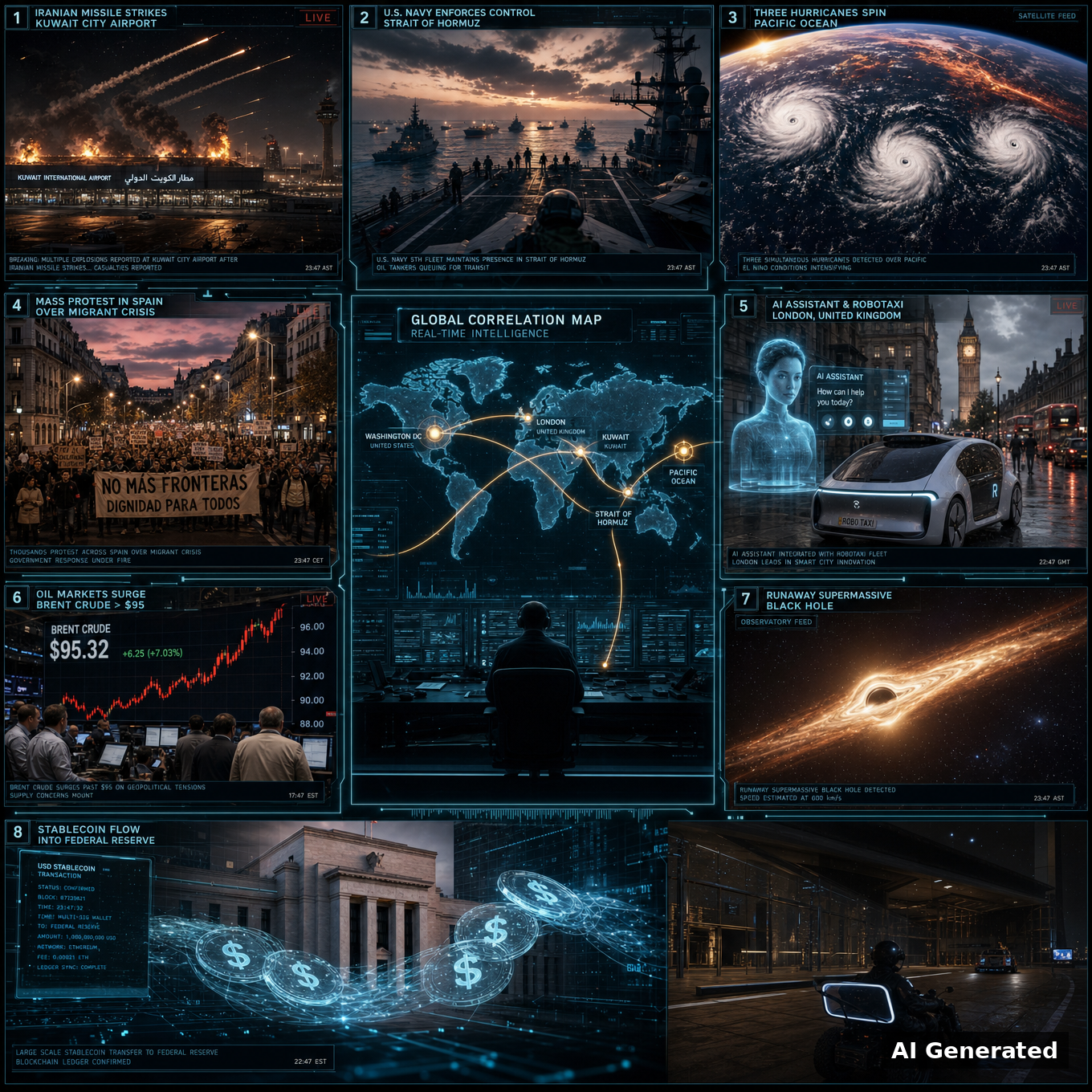
Iran launched a new wave of missile and drone attacks against Kuwait in the early hours of Thursday morning, targeting both military installations and civilian infrastructure including the country’s main international airport, marking a significant escalation in the conflict’s geographic reach and operational tempo[1]. Kuwait’s General Staff confirmed on X that air defense systems were engaging “hostile enemy missile and drone attacks,” with explosions reported from interception operations. A separate attack struck a residential complex in Kuwait, triggering a fire that the country’s Fire Force brought under control, with no injuries reported from that particular incident[2]. Iran’s state news agency IRNA described the attacks as a direct response to “America’s crimes,” targeting U.S. military bases in Kuwait including the Ali Al Salem airbase, where the IRGC claimed to have struck the commander’s headquarters and drone facilities. The attacks came just hours after Iran’s retaliatory barrage had hit targets in Jordan, Bahrain, and Iraq, creating a pattern of reciprocal strikes that has now persisted for several consecutive days. For the Gulf states hosting U.S. forces — which had sought to maintain a degree of neutrality in the conflict — the direct Iranian targeting of their territory represents a significant deterioration in their strategic position, forcing a reevaluation of the cost-benefit calculus of hosting American military assets. The pattern of Iranian escalation, moving from primarily military targets to mixed military-civilian infrastructure, suggests that Tehran is broadening its targeting calculus to maximize political and psychological pressure on Washington’s allies. Kuwait’s experience — where the airport attack directly disrupts civilian air travel and the residential complex strike demonstrates vulnerability to collateral effects — serves as a template for what the other Gulf states may face if the conflict continues to intensify.
Trump Suggests Renaming Strait of Hormuz “Trump Strait,” Claims U.S. Control
President Donald Trump proposed renaming the Strait of Hormuz the “Trump Strait” in a Truth Social post, asserting that the waterway was now “under U.S.A. control” and suggesting the new name would be “hotter than ever before”[3]. The proposal, which immediately drew international condemnation and ridicule, came just 24 hours after a U.S. strike killed at least four people at a wedding party in Sirik, Iran, and amid claims by Trump that American forces had destroyed 28 Iranian vessels in the latest round of strikes. The president’s rhetoric about controlling the strait was not supported by the operational reality described by maritime security firms, which continued to report contested and high-risk transits through the waterway. Senator Bernie Sanders responded sharply, writing on X that “The American people don’t want you to rename the Strait of Hormuz after yourself. They want you to end your illegal war in Iran that has raised diesel prices to $5.69 a gallon and gas prices to $4.12 a gallon”[4]. The episode encapsulated the dual nature of the conflict’s political dimension — Trump’s rhetorical escalation occurring simultaneously with the very real military consequences of the ongoing exchanges, including the Sirik wedding casualties that Iran characterized as a war crime and the unprecedented threat to commercial shipping through one of the world’s most critical maritime chokepoints.
U.S. Adopts “Tanker-for-Tanker” Targeting Policy Against Iran’s Oil Fleet
The United States adopted a new retaliatory targeting policy striking Iranian oil tankers in direct response to Iranian attacks on commercial shipping in the Strait of Hormuz, marking a significant expansion of the conflict’s economic dimension[5]. Axios reported that the policy, approved by President Trump, represented a shift from previous incidents where ships were only attacked for running the ongoing U.S. naval blockade on Iranian ports. CENTCOM released video showing strikes on two separate Iranian vessels anchored off Iran’s coast, and a U.S. official described the objective as “mowing the lawn” — reducing Iran’s ability to threaten commercial shipping. One U.S. official told Axios that the new strikes “bought at least a month” of lowered threat levels for commercial ships. The policy came as Brent crude surged above $95 per barrel, reflecting the growing market anxiety over extended disruption to the strait through which roughly 20% of global oil transit flows. The tanker-for-tanker approach introduces a new dimension to the economic warfare accompanying the military conflict, directly targeting Iran’s revenue-generating capacity while simultaneously signaling to global energy markets that the U.S. intends to maintain its blockade posture. However, the escalation also risks triggering further Iranian retaliation against commercial shipping, potentially creating a self-reinforcing cycle of disruption that could push oil prices significantly higher.
Russia Secretly Helping Iran Develop Supersonic Cruise Missiles, FT Reports
The Financial Times revealed a covert Russian program, codenamed C430L, to help Iran develop advanced supersonic cruise missiles capable of threatening U.S. aircraft carriers and other warships in the Middle East[6]. The investigation uncovered that the multiyear program began in 2023 and continued into the U.S.-Israeli military operations against Iran, enlisting some of Russia’s most experienced missile specialists to help Tehran develop ramjet propulsion technology for anti-ship and land-attack cruise missiles. The weapon system, or at least the impetus for it, is possibly connected to Russia’s P-800 Oniks (SS-N-26), which Russia has been using against Ukraine since the early days of the all-out war and has exported in various configurations. Fabian Hinz, a senior analyst with Conflict Armament Research, described it as “the transfer of a highly strategically sensitive military technology from Russia that the Iranians have wanted to acquire for decades,” noting that “a program like this would require political clearance from the very top in Russia.” The revelation deepens the complexity of the geopolitical alignment between Moscow and Tehran, coming at a time when Russia is simultaneously waging its own war in Ukraine and seeking to maintain diplomatic relationships with both Western and non-Western powers. The transfer represents a significant escalation in Moscow’s material support for Tehran, providing capabilities that could fundamentally alter the naval balance in the Persian Gulf.
Germany Formally Accuses Russia of Attempted Drone Strike at Leipzig Airport
Germany formally accused Russia of orchestrating an explosive-drone attack against a Ukrainian An-124 heavy cargo aircraft at Leipzig/Halle Airport, marking the first time a NATO member has publicly attributed a kinetic hybrid attack on its territory to Moscow[7]. The drone, discovered inside the airport’s secured perimeter on August 5, carried approximately 1.3 pounds of explosives and was found near the Ukrainian-operated cargo plane — a critically symbolic target given that the An-124 is a global icon of Ukrainian resilience. German Interior Minister Dobrindt and Foreign Minister Wadephul stated that Russian state actors supplied the equipment while locally recruited “low-level agents” carried out the operation — a pattern consistent with suspected Russian covert activity identified across multiple European countries including Bulgaria, Italy, Poland, Romania, and the United Kingdom. Russia’s Foreign Minister Lavrov responded by announcing the closure of Goethe-Institut cultural branches in Russia, a retaliatory gesture that further strained already fracted diplomatic relations. The attribution came alongside a separate incident in Brandenburg, where sophisticated incendiary devices were launched at a critical power-grid substation near the Jänschwalde coal-fired plant, causing a generating unit shutdown. Together, the two events illustrate the breadth of hybrid threats Germany is attempting to address.
Turkey Deploys Research Vessel and Naval Assets Near Greek Waters Around Kastellorizo
Turkish naval forces escalated tensions in the Aegean by deploying the research vessel R/V TÜBITAK Marmara to waters south of the Greek island of Kastellorizo, escorted by frigates, in a move Greece’s Defence Ministry described as an encroachment into sovereign territory[8]. The deployment occurred within an area delineated by Turkey’s August 2026 presidential decree establishing a “marine national park” extending from Fethiye to Kaş — a zone Greece considers entirely within its continental shelf. MarineTraffic updated the maritime region name to the Turkish designation, prompting accusations from Greek officials that the platform was facilitating Turkey’s territorial claims. Greece responded by issuing an Anti-NAVTEX, asserting that only the hydrographic station in Iraklio, Crete has authority to issue navigational warnings in the area. Cyprus also issued a parallel Anti-NAVTEX. Turkish President Erdogan, speaking from his presidential aircraft on return from Bishkek, appeared to reference the deployment: “If we made a sound from our side, let’s say from Kaş towards Greece, they wouldn’t hear us?” The incidents suggest Ankara is leveraging the broader regional instability created by the U.S.-Iran conflict to advance its Aegean claims, emboldened by the Pentagon’s continued disengagement from traditional European security guarantees.
Germany-France-Poland Weimar Triangle Meeting Addresses Russian Hybrid Threats
German Foreign Minister Johann Wadephul, French Foreign Minister Jean-Noël Barrot, and Polish Foreign Minister Radoslaw Sikorski convened in Weimar for their regular trilateral meeting, with the primary agenda item being Russia’s escalating hybrid warfare activities targeting European infrastructure and security[9]. The meeting came in the wake of Germany’s formal accusations regarding the Leipzig airport drone attack and the separate sabotage incident at a Brandenburg power substation. Macron had separately called for new European sanctions against Russia, declaring that “hybrid attacks are multiplying in Europe” and “cannot go unanswered.” The Weimar Triangle, established 35 years ago, has emerged as a key coordination mechanism for European security policy as the continent confronts simultaneous threats from Russian aggression and the spillover effects of the U.S.-Iran conflict. The three ministers discussed the need for a coordinated European response to what they characterized as an increasingly aggressive Russian posture below the threshold of conventional military conflict.
Russia Captures Strategic Town of Svyatogorsk in Donetsk
Russia’s Ministry of Defense announced the capture of the strategically significant town of Svyatogorsk in the Donetsk region, completing the operation by forces of the “Zapad” (West) Group[10]. Svyatogorsk, situated along the Severky Donets River and known for its historic Orthodox Lavra monastery, represents a critical logistical and geographic node whose loss creates a significant breach in Ukrainian defensive lines in northern Donetsk. The capture opens an axis of pressure toward the fortified city of Sloviansk and complicates Ukrainian supply routes in the broader Liman area. Simultaneously, Russia’s “Sever” (North) Group captured the border settlement of Kazachya Lopan in the Kharkiv region, further stretching Ukrainian defensive capacity. The advances came amid a broader intensification of Russian operations across multiple axes, with Ukrainian losses reported exceeding 200 soldiers in the Kharkiv-Sumy sector alone and over 140 near Slavyansk-Kramatorsk.
Ukraine’s F-16 Force Faces Critical Missile Shortage
Ukraine’s F-16 pilots are facing such a severe shortage of air-to-air missiles that some daytime sorties have seen them rely solely on the fighters’ internal 20mm cannon to engage Russian aerial threats[11]. A senior Ukrainian Air Force commander identified by the callsign “Phantom” confirmed the weapons shortage, stating bluntly: “Any aircraft without weapons is… useless.” The pilot described how Ukrainian forces monitor missile shipments as they cross the border, counting “not just the hours but the minutes until those weapons reach the aircraft.” The crisis extends beyond the F-16 fleet — Patriot interceptors have been heavily consumed against Russian ballistic missiles, with relatively few replacements arriving. PAC-3 MSE lead times stand at 31 months, THAAD at 34 months, Tomahawk at 40 months. The combined demand from Ukraine’s air defense needs and ongoing conflicts in the Middle East has created a global bottleneck in advanced weapons production, leaving Ukraine facing a critical vulnerability as Russia traditionally intensifies attacks against energy infrastructure during winter months.
ICAO Warns Nations to Protect Civil Aviation from Conflict Zone Risks
The International Civil Aviation Organization issued an urgent call for member states to protect civilian aircraft from threats emanating from conflict zones, prompted by Ukrainian warnings that Russian airspace has become “extremely dangerous” due to drone activity[12]. The warning came as both Russia and Ukraine intensified aerial operations, with Russian strikes hitting a five-star hotel near Kyiv reportedly housing military personnel, and attacks on residential buildings in Odessa injuring at least eight people. The ICAO’s intervention reflects growing concern within the aviation community about the risk of civilian aircraft being caught in the crossfire, a danger that has been a persistent concern since the 2014 downing of Malaysia Airlines Flight MH17 over eastern Ukraine.
Germany’s IRIS-T Proposal Exposes Greek Defense Procurement Controversy
Revelations emerged that Germany’s Diehl Defence had proposed selling Greece 10 complete IRIS-T SLM air defense batteries for approximately EUR 1.9 billion — roughly one-third the cost of the multi-system Israeli package Athens is pursuing at EUR 3.1 billion[13]. The German proposal, linked to the European Sky Shield Initiative (ESSI), included a 35% volume discount and guaranteed industrial participation for Greek defense companies that have been involved in the IRIS-T program for over two decades. Greek Defense Minister Nikos Dendias had previously claimed no alternatives to the Israeli systems existed. The revelation raises questions about the strategic and economic rationality of Greece’s procurement decisions, particularly at a time when German industry faces its own workforce crisis — Bayern’s metal and electronics sector has lost 35,000 jobs since early 2024 despite the defense boom.
2. Environment & Climate
↑ ContentsThree Simultaneous Hurricanes Spin Across the Pacific, Fueled by Historic El Niño
A rare meteorological convergence unfolded in the Pacific Ocean as three tropical cyclones — Hurricanes Karina and Lowell, along with Tropical Storm Marie — spun simultaneously across the basin, driven by one of the strongest El Niño events on record[14]. Hurricane Karina intensified rapidly to Category 4 strength with sustained winds of 140 mph, while Hurricane Lowell followed in its wake, and Tropical Storm Marie formed further east near Baja California with expectations of strengthening into a hurricane. The occurrence of three named systems in the Eastern Pacific coincided with the formation of Tropical Storm Edouard in the Atlantic, producing a four-storm configuration across two basins that was virtually unprecedented. Meteorologist Ben Noll described the situation as “an El Niño-fueled hurricane train in the Pacific,” noting that the 10th tropical storm of 2026 occurred roughly ten days earlier than normal in the eastern Pacific basin. NOAA had predicted 15 to 22 named storms for the season, and the Philippines weather service PAGASA noted that a moderate to strong El Niño “may breach a very strong category or Super El Niño before the end of 2026.” The simultaneous storms raised concerns about potential impacts on Pacific Island communities, coastal infrastructure, and global shipping routes, while underscoring the compounding effects of ocean temperature anomalies on extreme weather events.
China’s Carbon Emissions Decline as Oil Consumption Drops Amid Hormuz Disruption
China’s carbon pollution fell modestly in recent months as the world’s second-largest oil consumer sharply reduced its oil consumption, driven in part by disruption to global energy supplies from the conflict in the Strait of Hormuz[15]. The analysis showed that China’s oil use declined by approximately 9 percent as market disruptions curtailed supply and prices surged, creating conditions that could translate into a full-year reduction in China’s carbon dioxide emissions. However, the emissions reduction was driven less by deliberate climate policy than by the practical constraints of energy supply disruption, raising questions about sustainability once the geopolitical situation stabilizes. The finding illustrates the paradoxical relationship between geopolitical conflict and climate outcomes — where the disruption that harms economies can simultaneously reduce emissions, creating an unintentional experiment in demand destruction that climate researchers will study for years.
Australia’s New Environmental Protection Agency Approves Coal Mine Extension
Australia’s newly established national environmental protection agency approved its first coal project, granting the Saraji mine in Queensland permission to continue open-cut mining operations until 2055 while clearing threatened woodland and koala habitat[16]. The decision drew immediate criticism from environmental groups, who noted the contradiction between Australia’s stated climate commitments and the approval of a multi-decade fossil fuel extraction project. The case highlights the structural challenge facing resource-rich nations attempting to balance economic dependence on commodity exports with international climate commitments, particularly as Pacific Island nations press industrialized nations to accelerate their transition away from fossil fuels.
European Data Center Expansion Meets Growing Resistance Over Energy and Water Use
Across Europe, hyperscale data center expansion is generating increasing pushback from environmental groups and local communities concerned about energy consumption, water usage, and land use conflicts[17]. In Austria, activists have mobilized against a massive Google data center project. In France, Digital Economy Minister Roland Lescure warned that U.S.-style opposition “could also arrive in France” as the continent accelerates digital infrastructure buildout. A parallel case in Nevada saw a federal panel halt a data center over water consumption in the Colorado River Basin. The tension between AI-driven infrastructure and environmental sustainability represents one of the most significant emerging policy challenges, as the energy demands of training and running large AI models increasingly compete with climate adaptation and conservation priorities.
3. Society & Civil Issues
↑ ContentsMinneapolis Mass Shooting Kills Two, Wounds Three Police Officers
A mass shooting in downtown Minneapolis left two people dead and three police officers wounded when a gunman opened fire in an apartment building in the Loring Park neighborhood[18]. The suspected shooter was also killed. Governor Tim Walz deployed state officials to support local police. One resident, Julius Bailey, described seeing the shooter — whom he recognized as a building resident — holding a gun and hearing eight shots fired. The attack came amid heightened public anxiety about mass violence, underscoring the persistent challenge of gun violence in American cities even as national attention remains focused on international conflicts.
German Hospitals Lack Cooling for Nearly 60% of Patient Rooms
A survey revealed nearly sixty percent of all German hospitals cannot cool a single patient room, contributing to an estimated 15,800 excess deaths between June and mid-August during the country’s record-breaking summer[19]. The Baden-Württemberg Krankenhausgesellschaft estimated an additional EUR 4 billion in investment is needed in that state alone. Heat-related deaths now routinely exceed influenza deaths during summer months, representing a critical infrastructure failure at the intersection of healthcare, climate adaptation, and energy policy.
Spain Riven by Massive Protests Over Ceuta Migrant Crisis
Tens of thousands rallied across Spain against the government’s handling of the migrant crisis at Ceuta, with opposition figures calling the situation an “invasion” by migrants from Morocco[20]. The protests reflected growing public frustration with what critics characterized as the government’s inability to manage migration flows, and underscored the political vulnerability of governing parties across Europe as migration remains a dominant public concern.
UK Compensates More Than 1,800 LGBT Former Military Personnel
The United Kingdom announced compensation payments to more than 1,800 former military personnel forced to serve in silence or discharged because of their sexual orientation[21]. The scheme represented a significant acknowledgment of institutional discrimination and the long-term consequences of discriminatory policies that persisted for decades within one of Europe’s largest armed forces.
UK Pensioners Face Highest Income Tax Rates as Threshold Freeze Persists
One million British pensioners now face the highest marginal rate of income tax as the threshold freeze continues to drag retirees into higher tax bands through fiscal drag[22]. The interaction between the freeze and the triple-lock guarantee creates a structural trap where pensioners’ nominal incomes rise faster than their real purchasing power.
Iran Sentences Two Women to Death for Anti-Government Protests
Iran’s judiciary sentenced two women to death for participation in anti-government protests, drawing international condemnation[23]. The timing coincides with escalating military conflict and economic pressure from the Hormuz blockade — conditions historically associated with increased domestic repression.
4. AI & Technology
↑ ContentsGoogle Launches Gemini 3.8 Flash and Flash Cyber
Google announced Gemini 3.8 Flash and 3.8 Flash Cyber — the company’s third Flash release in six weeks, priced at $0.75 per million input tokens[24]. The standard variant outperforms larger frontier models on coding benchmarks including DeepSWE, while Flash Cyber achieved 86.2% on CyberGym and 47.2% on CWE-Bench for automated vulnerability patching. Google reports the model discovered a 13-year-old Chromium vulnerability in under two hours. Flash Cyber is being deployed through the Fairwind Program to government and critical-infrastructure operators.
Microsoft Restructures Into “Agents and Infra” and “Devices and Consumer”
Microsoft restructured its operations into two primary divisions — “Agents and Infra” and “Devices and Consumer” — signaling AI and cloud infrastructure as primary strategic priorities[25]. The “Agents” designation reflects Microsoft’s commitment to deploying AI agents across its product suite.
Palo Alto Networks Acquires Console for $500M
Palo Alto Networks acquired Thrive-backed Console for approximately $500 million, positioning itself in the AI-powered IT services automation market and illustrating the accelerating convergence between cybersecurity and AI[26].
Uber and Wayve Launch London’s First Public Robotaxi Service
Uber and Wayve launched London’s first public robotaxi service using Ford Mustang Mach-E vehicles, initially with safety operators in the driver’s seat, beating Waymo to the milestone[27].
Budget Deal Blocks Political Control of Science Grants
A stopgap funding measure blocked OMB from implementing rules giving political appointees control over federal science funding, a significant victory for the scientific community[28].
Adobe Integrates 70+ Creative Tools Into Slack
Adobe integrated more than 70 tools from Photoshop, Illustrator, and Premiere Pro into Slack, enabling AI-powered creative content production through conversational interfaces[29].
5. Economy & Business
↑ ContentsBrent Crude Surges Above $95 Amid Escalating Conflict
Brent crude surged above $95 per barrel, its highest level since the conflict began, as escalating U.S.-Iran exchanges disrupted Hormuz shipping[30]. The price increase compounds inflationary pressures facing central banks worldwide, creating a particularly challenging monetary policy environment as energy costs flow through to consumer prices.
Venezuela Signs Landmark Energy Deals
U.S. Energy Secretary Wright presided over agreements expected to more than double Venezuela’s oil production within five years. Chevron announced $7 billion in investment to reach 600,000 barrels per day; Eni secured rights to develop a 35-billion-barrel field; GE Vernova signed to modernize Venezuela’s electric grid[31]. However, analysts noted the heavy crude involved would require years of infrastructure development.
ByteDance Secures $30 Billion Loan
ByteDance secured a $30 billion loan — the second-largest in Asia in 2026 — reflecting continued lender appetite for the world’s most valuable private technology company[32].
Dollar/Yen Dips Below 158 on BOJ Hawkish Signals
Dollar/yen briefly dipped below 158 as BOJ hawkish signals continued to weigh on the currency, with implications for carry trade unwinding across Asian markets[33].
German Metal and Electronics Industry Reports Job Losses
Bayern’s M+E industry reported 11,000 job losses in H1 2026, continuing a trend of 35,000 positions eliminated since early 2024[34].
IMF Warns Rising Bond Yields Threaten Developing Country Debt
IMF Managing Director Georgieva warned that rising bond yields threaten debt restructuring progress for developing countries[35].
Berkshire Eyes Bigger Stakes in Japan Trading Houses
Berkshire Hathaway CEO Greg Abel indicated the conglomerate is seeking to increase its holdings in major Japanese trading houses, signaling continued confidence in the Japanese economic transformation despite the recent Nikkei crash and BOJ tightening[36]. The investment strategy, which has become one of the most closely watched barometers of Western sentiment toward Japanese assets, reflects a contrarian bet that the BOJ’s monetary normalization will ultimately strengthen corporate governance and shareholder returns across the trading house sector. The announcement came as the dollar/yen exchange rate remained volatile, creating both risk and opportunity for Berkshire’s significant currency-exposed position in Japanese equities.
China Services PMI Beats Forecasts
China’s general services PMI rose to 51.4 in August, up from 50.4 in July and exceeding the forecast of 50.6, signaling strengthening domestic demand despite global economic headwinds from the Middle East conflict and trade tensions[37]. The improvement in the services sector, which accounts for more than half of China’s GDP, provided a counterpoint to concerns about the impact of oil price disruptions on the broader economy.
6. Science & Space
↑ ContentsPancreatic Cancer Drug Shows Promise Against Lung Cancer
Daraxonrasib demonstrated efficacy against lung cancer beyond its pancreatic indication, bolstering hopes for cross-application of targeted therapies across malignancy types[38].
Human Family Tree May Need Major Rewrite
Growing evidence of blurred boundaries between early human relatives prompted Monash University researchers to propose expanding the genus Homo[39].
Genetic Study Links 1,200+ Variants to Personality Traits
A massive study identified over 1,200 genetic variants linked to Big Five personality traits, with effects largely independent of family background[40].
Physicists Determine Cause of Runaway Supermassive Black Hole
UCSB and UT Austin researchers determined a galactic merger ejected a supermassive black hole into intergalactic space[41].
Ancient Treasure Stolen in Spain, Leaving Behind Meteoritic Iron Artifact
Thieves stole most of the 3,000-year-old Treasure of Villena from a Spanish museum, leaving behind a meteoritic iron bracelet — one of only two such artifacts from the Iberian Peninsula[42].
7. Crypto, Digital Assets & Blockchain
↑ ContentsStablecoins Quietly Becoming the Fed’s Debt Buyer of Last Resort
Circle President Heath Tarbert testified before Congress that stablecoin legislation could strengthen the dollar’s global role, framing digital-dollar infrastructure as a tool of dollar statecraft[43]. The testimony came as the Federal Reserve estimated stablecoin market capitalization at $317 billion in April 2026, more than 50% above early 2025 levels. While stablecoin issuers hold less than 1% of total Treasuries outstanding, their demand for short-term bills has increased by $70 billion since 2022, creating a growing role in financing government debt. The Bank for International Settlements estimated that roughly 98% of stablecoin value is denominated in dollars, demonstrating the technology’s reinforcing effect on dollar dominance in private token markets. However, BIS researchers warned that broad adoption of dollar stablecoins could accelerate private currency substitution, weaken domestic monetary-policy traction and capital controls, and redirect emerging markets’ savings toward U.S. Treasury bills. A run on a major issuer could transmit stress into local financial systems and short-term dollar markets, creating a systemic risk that sits at the intersection of technology, finance, and geopolitics. The Fed analysis found USDC had high-quality reserves equal to its liabilities, while Tether reported total reserves at about 1.04 times liabilities but higher-quality reserves at roughly 0.74 times — a discrepancy that regulation could narrow under the GENIUS Act framework, whose main requirements were expected to take effect in 2027.
Silicon Network Shuts Down With Nearly $10M Still On-Chain
Silicon Network, a Polygon CDK-based Ethereum layer-2 network integrated with South Korean exchange Korbit, announced its shutdown with approximately $9.75 million in assets still on-chain, giving users until December 31 to withdraw[44]. The closure included $2.66 million of USDC, $2.54 million of WBTC, $2.08 million of ETH, and $1.85 million of USDT. Tokens originally bridged from Ethereum can return to mainnet, but tokens issued directly on Silicon face a much harder exit path. The shutdown illustrates the increasing concentration of Ethereum’s scaling market, with Base and Arbitrum now securing approximately $24.7 billion — more than 80% of the roughly $30.5 billion held across all tracked L2 networks. For smaller L2s, the closure demonstrates what market consolidation means at the bottom: users must unwind bridges and find liquidity before the chain itself disappears.
Fidelity Warns Bitcoin’s Private Keys Face Future Quantum Risk
Fidelity Digital Assets published research warning that future quantum computers could derive Bitcoin private keys from exposed public keys, threatening funds held in addresses whose public keys have been revealed through transactions[45]. The analysis proposed a hash-based signature system as mitigation, though larger signatures would reduce transaction throughput and complicate wallet recovery. The warning from a major institutional custodian adds urgency to discussions within the Bitcoin development community about upgrading cryptographic primitives to quantum-resistant algorithms.
Nakamoto Shares Fall 99% From Peak as Bitcoin Treasury Model Unravels
Nakamoto, a company that adopted the Bitcoin treasury strategy pioneered by Strategy, saw its shares crash 99% from peak while posting a $372 million H1 2026 loss driven by Bitcoin exposure[46]. The company completed a reverse stock split to meet Nasdaq listing requirements and has turned to acquisitions and buybacks. The collapse represents a cautionary tale for the Bitcoin treasury model, demonstrating its dependence on continued equity market confidence.
Strategy Urges MSCI to Withdraw Proposed Index Exclusion
Strategy Inc. urged MSCI to withdraw a proposal that could remove Bitcoin-treasury companies from global equity indexes, arguing the screening methodology misclassifies its operations[47]. If implemented, the change could affect index weightings of multiple crypto-exposed companies and reduce passive-investment flows supporting their valuations.
CFTC Files Bid to Dismiss CME Suit Over Kalshi Bitcoin Perps
The CFTC filed to dismiss CME’s lawsuit against Kalshi’s Bitcoin perpetual futures product, potentially reshaping competitive dynamics in the U.S. crypto derivatives market[48].
Securitize and Socios.com Plan Tokenized Equity for Sports Teams
Partnership announced to develop regulated tokenized equity offerings tied to professional sports team minority interests under the EU DLT Pilot Regime[49].
BitGo Opens Singapore Office as APAC Client Base Triples
BitGo opened a Singapore office to capitalize on the tripling of its Asia-Pacific client base, reflecting growing institutional demand for regulated crypto custody services in the region and the broader trend of institutional crypto infrastructure expansion into Asian markets[50].
8. Correlations & Analysis
↑ ContentsThe D95 report captures a moment of compounding escalation across multiple crisis domains that were already straining the international system. The U.S.-Iran conflict has now entered its most dangerous phase: Kuwait, previously shielded from direct Iranian retaliation, has been struck for a third consecutive day with attacks targeting both military installations and civilian infrastructure including the airport and a residential complex. The adoption of a “tanker-for-tanker” targeting policy against Iranian oil vessels represents a qualitative shift in economic warfare, while Trump’s proposal to rename the Strait of Hormuz after himself — a geopolitical victory lap while the conflict intensifies — reveals the dangerous disconnect between political rhetoric and military reality. The civilian casualty event at Sirik continues to reverberate, with Iran calling it a war crime and mounting diplomatic pressure from nations across Latin America, Asia, and Europe. The FT’s C430L revelation deepens the picture: Russia is not merely diplomatically supporting Iran but actively transferring strategic military technology that could fundamentally alter the naval balance in the Persian Gulf.
The Russia-Europe dimension has deepened in parallel with the Iran escalation. Germany’s formal attribution of the Leipzig drone attack to Russian state actors, combined with the sabotage of Brandenburg’s power infrastructure and the FT’s revelation of a covert missile technology transfer program, paints a picture of Russian hybrid operations expanding in both scope and ambition. The Weimar Triangle meeting represents Europe’s attempt to coordinate a response, but Washington’s simultaneous engagement with Russian Finance Minister Siluanov at the G20 fractures Western sanctions unity, while the diversion of U.S. military attention to the Gulf reduces American capacity to reinforce European security commitments. For Ukraine, the crisis manifests most acutely in the F-16 missile shortage — sophisticated aircraft rendered “useless” by weapons scarcity — and the loss of Svyatogorsk, which opens a strategic axis toward Sloviansk. The capture of Kazachya Lopan in Kharkiv region further stretches Ukrainian defensive capacity across a front that has now been active for four and a half years.
The Turkey-Greece maritime situation around Kastellorizo continues to represent one of the most volatile flashpoints in the Eastern Mediterranean. The deployment of a Turkish research vessel under frigate escort in waters Greece considers sovereign, combined with MarineTraffic’s adoption of Turkish geographic nomenclature and Erdogan’s provocative rhetoric, suggests Ankara is systematically testing Greece’s red lines during a period of broader geopolitical disruption. The defense procurement revelation — that Germany offered IRIS-T SLM batteries at roughly one-third the cost of the Israeli systems Greece is purchasing — raises serious questions about the strategic and economic rationality of Athens’ procurement decisions, questions that become more pressing as Turkish military pressure in the Aegean intensifies.
In the environment and climate domain, the convergence of three simultaneous Pacific hurricanes driven by a historic El Niño, China’s emissions decline caused by oil supply disruption rather than policy, Australia’s approval of coal mining through 2055, and the intensifying European resistance to data center expansion all point to a world where climate objectives are being reshaped by forces that have nothing to do with deliberate decarbonization strategy. The 5-metal 2D catalyst converting CO&sub2; without external electrical input represents a genuine scientific advance, but it exists in a policy landscape where environmental regulation is being rolled back even as the physical evidence of climate change accelerates. The paradox is stark: the technology to address climate change is advancing rapidly while the political will to deploy it at scale remains constrained.
What to watch in the next reporting period: The Kuwait attacks will determine whether Iran’s strategy of targeting U.S. allied bases in the Gulf can be sustained, or whether the cumulative political cost forces a recalibration. The FT’s C430L revelation will prompt intelligence assessments of whether Russia’s missile technology transfer has already reached operational deployment stages. In Europe, the Weimar Triangle’s response to German hybrid warfare allegations will indicate whether the continent can develop a coordinated security posture independent of Washington’s conflicting priorities. And in financial markets, the interaction between $95 oil, rising bond yields, and central bank tightening across the BOJ, RBNZ, and Fed will test whether the global economy can absorb simultaneous energy shocks and monetary contraction without triggering the recessionary scenario that has been projected since the D80 reporting cycle.
References
↑ Contents1. Kuwait suffers third wave of Iranian strikes; airport and residential complex hit · Kuwait suffers third wave of Iranian strikes; airport and residential complex hit” — Al Jazeera ↑
2. Drone strike hits Kuwait residential complex as authorities contain fire · Drone strike hits Kuwait residential complex as authorities contain fire” — Gulf Business ↑
3. Trump suggests renaming Strait of Hormuz as ‘Trump Strait’ · Trump suggests renaming Strait of Hormuz as ‘Trump Strait'” — Al Jazeera ↑
4. Sanders blasts Trump over Strait of Hormuz rename proposal · Sanders blasts Trump over Strait of Hormuz rename proposal” — Enikos.gr ↑
5. Iranian Oil Tankers In The Cross Hairs Of New U.S. Campaign · Iranian Oil Tankers In The Cross Hairs Of New U.S. Campaign” — The War Zone ↑
6. Russia secretly helping Iran develop supersonic cruise missiles · Russia secretly helping Iran develop supersonic cruise missiles” — Financial Times ↑
7. Germany formally accuses Russia of attempted drone strike on Ukrainian An-124 at Leipzig airport · Germany formally accuses Russia of attempted drone strike on Ukrainian An-124 at Leipzig airport” — The War Zone ↑
8. Turkey deploys research vessel and frigates south of Kastellorizo · Turkey deploys research vessel and frigates south of Kastellorizo” — Defencenet.gr ↑
9. Weimar Triangle foreign ministers meet · Weimar Triangle foreign ministers meet” — Stern.de, September 2, 2026 ↑
10. Russia captures strategic town of Svyatogorsk in Donetsk · Russia captures strategic town of Svyatogorsk in Donetsk” — Defencenet.gr ↑
11. Missile Shortage Has Now Hit Ukrainian F-16 Force · Missile Shortage Has Now Hit Ukrainian F-16 Force” — The War Zone ↑
12. ICAO calls nations to protect civil aviation from conflict zone risks · ICAO calls nations to protect civil aviation from conflict zone risks” — Skai.gr, Protothema.gr, September 3, 2026 ↑
13. Germany’s IRIS-T proposal exposes Greek defense procurement controversy · Germany’s IRIS-T proposal exposes Greek defense procurement controversy” — Defencenet.gr ↑
14. Three simultaneous hurricanes spin across the Pacific · Three simultaneous hurricanes spin across the Pacific” — Newsweek ↑
15. China’s Carbon Pollution Fell in Recent Months as Oil Demand Plummeted · China’s Carbon Pollution Fell in Recent Months as Oil Demand Plummeted” — Inside Climate News ↑
16. Australia’s new environmental protection agency approves coal project · Australia’s new environmental protection agency approves coal project” — The Guardian ↑
17. European data center expansion meets growing resistance · European data center expansion meets growing resistance” — Zougla.gr ↑
18. Minneapolis mass shooting kills two, wounds three police officers · Minneapolis mass shooting kills two ↑
19. German hospitals lack cooling for nearly 60% of patient rooms · German hospitals lack cooling for nearly 60% of patient rooms” — Stern.de ↑
20. Massive protests erupt across Spain over Ceuta migrant crisis · Massive protests erupt across Spain over Ceuta migrant crisis” — ZDF ↑
21. UK compensates more than 1,800 LGBT former military personnel · UK compensates more than 1,800 LGBT former military personnel” — Le Parisien, September 3, 2026 ↑
22. UK pensioners face highest income tax rates as threshold freeze continues · UK pensioners face highest income tax rates as threshold freeze continues” — Express.co.uk ↑
23. Iran sentences two women to death for anti-government protests · Iran sentences two women to death for anti-government protests” — Defencenet.gr ↑
24. Google’s Gemini 3.8 Flash is built for agents · Google’s Gemini 3.8 Flash is built for agents” — VentureBeat ↑
25. Microsoft restructures organization · Microsoft restructures organization” — Gizmodo ↑
26. Palo Alto Networks paid $500M for Thrive-backed Console · Palo Alto Networks paid $500M for Thrive-backed Console” — TechCrunch ↑
27. Uber and Wayve Launch London’s First Public Robotaxi Service · Uber and Wayve Launch London’s First Public Robotaxi Service” — CNET ↑
28. Spending deal blocks political control of grants · Spending deal blocks political control of grants” — Ars Technica ↑
29. Adobe brings 70+ tools from Photoshop, Illustrator and more to Slack · Adobe brings 70+ tools from Photoshop ↑
30. Brent crude prices surge above $95 amid Middle East tensions · Brent crude prices surge above $95 amid Middle East tensions” — Crypto Briefing ↑
31. Private companies set to strike new deals to expand Venezuelan oil production · Private companies set to strike new deals to expand Venezuelan oil production” — Scripps News ↑
32. ByteDance secures $30 billion loan · ByteDance secures $30 billion loan” — FinancialJuice, September 3, 2026 ↑
33. Yen in the spotlight after sudden jump · Yen in the spotlight after sudden jump” — Reuters/Investing.com ↑
34. Stellenabbau in der Metall- und Elektroindustrie · Stellenabbau in der Metall- und Elektroindustrie” — Stern.de, September 3, 2026 ↑
35. IMF’s Georgieva says rising bond yields threaten developing country debt · IMF’s Georgieva says rising bond yields threaten developing country debt” — Reuters/Investing.com ↑
36. Berkshire eyes bigger stakes in Japan trading houses: CEO Abel · Nikkei Asia ↑
37. China services PMI beats forecasts, signaling stronger domestic demand ↑
38. Landmark pancreatic cancer drug shows potential against lung cancer too · Landmark pancreatic cancer drug shows potential against lung cancer too” — Nature ↑
39. The Human Family Tree May Need a Major Rewrite · The Human Family Tree May Need a Major Rewrite” — SciTechDaily/Monash University ↑
40. Huge study links ‘Big Five’ personality traits to genetic variants · Huge study links ‘Big Five’ personality traits to genetic variants” — Nature ↑
41. Physicists Determine Cause of Runaway Supermassive Black Hole · Physicists Determine Cause of Runaway Supermassive Black Hole” — Universe Today ↑
42. Rare Ancient Treasure Trove Stolen · Rare Ancient Treasure Trove Stolen” — ScienceAlert ↑
43. How stablecoins are quietly becoming the Fed’s debt buyer of last resort · How stablecoins are quietly becoming the Fed’s debt buyer of last resort” — CryptoSlate ↑
44. Nearly $10 million must escape a dying Ethereum L2 network · Nearly $10 million must escape a dying Ethereum L2 network” — CryptoSlate ↑
45. Fidelity Warns Bitcoin’s Private Keys Face Future Quantum Risk · Fidelity Warns Bitcoin’s Private Keys Face Future Quantum Risk” — Bitcoin.com ↑
46. Nakamoto shares fall 99% from peak as Bitcoin treasury model unravels · Nakamoto shares fall 99% from peak as Bitcoin treasury model unravels” — CoinTurk ↑
47. Strategy slams MSCI’s proposed index exclusion methodology · Strategy slams MSCI’s proposed index exclusion methodology” — Bitcoin.com ↑
48. CFTC files bid to dismiss CME suit over Kalshi’s Bitcoin perps · CFTC files bid to dismiss CME suit over Kalshi’s Bitcoin perps” — Crypto Briefing ↑
49. Securitize and Socios.com Plan Tokenized Equity for Sports Teams · Securitize and Socios.com Plan Tokenized Equity for Sports Teams” — Blockchain Reporter ↑
50. BitGo opens Singapore office as APAC client base triples ↑
AI Disclosure: This post was created with the assistance of artificial intelligence. The ideas, analysis, and opinions expressed are my own — AI was used to help compose, structure, and refine my personal notes and thoughts into the final written content. Images, videos and music featured in this post were also generated using AI tools, based on my own creative prompts and direction.