





Contents
- 1. Geopolitics & Defence
- 2. Environment & Climate
- 3. Society & Civil Issues
- 4. AI & Technology
- 5. Economy & Business
- 6. Science & Space
- 7. Crypto, Digital Assets & Blockchain
- 8. Correlations & Analysis
- 9. References
Click any heading to jump to that section. Click the section heading to return to this menu.
Daily News Intelligence Report
D29 — Monday, 29 June 2026
Articles analysed: 120 · Articles kept: 37 · References: 37
Geopolitics & Defence
↑ ContentsMiddle East: From Open War to Quiet Recalibration
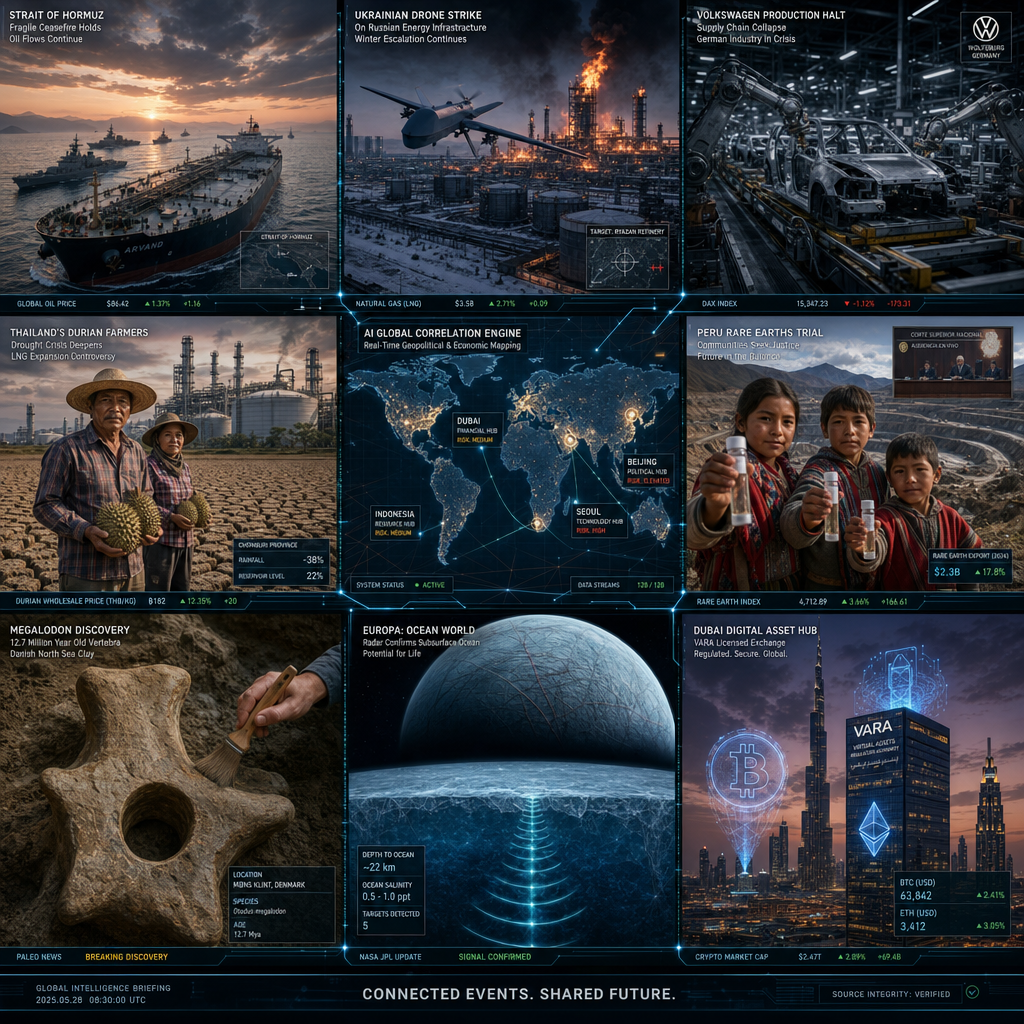
The signal from the Strait of Hormuz this morning is the first since the February escalation that resembles an off-ramp rather than a breakdown. After the weekend’s exchange of strikes — the third rupture event in nine days tracked in the D28 report [1] — both the United States and Iran have agreed to halt attacks, with Iranian and American delegations expected in Qatar to resume the peace track that the D26 reporting flagged as fraying. The halt comes not from a sudden diplomatic breakthrough but from the accumulating cost of the conflict itself: Nikkei’s regional infrastructure survey captures the scale of physical damage across Gulf energy, desalination, and port assets, with reconstruction timelines now measured in years rather than months [2]. What the two sides are buying with the halt is not peace but breathing room — a window in which the Hormuz traffic that dropped from 27 to 13 ships per day during the active phase can recover before either side’s domestic politics forecloses another round.
The deeper story in the Gulf this week is not Washington’s posture but its absence. The 19FortyFive analysis makes explicit what the D28 correlations paper had already been circling: the Gulf states no longer treat American protection as a reliable backdrop for their own security [3]. Saudi Arabia is positioning itself as the convening power for a regional order that includes direct Iran engagement, operationalised through the Muscat memorandum that brought Iranian Majlis Speaker Ghalibaf and Foreign Minister Araghchi to Omani talks on 23 June. The Saudi-Emirati rivalry for influence across the Red Sea, Sudan, and Libya does not disappear in this reordering, but it is now nested inside an Iran-GCC-Iraq diplomatic architecture that did not exist three months ago. For Washington, the operational consequence is that the Strait of Hormuz is being managed bilaterally rather than through the framework the D26 report identified as the central organising principle of the post-deal order.
Ukraine: Putin Admits What the Refineries Already Showed
Vladimir Putin’s public acknowledgement that Russia faces fuel supply problems is the first time the Kremlin has used the word “problems” to describe the domestic energy situation, and it validates the strategic logic of Ukraine’s four-week refinery strike campaign [4]. The D28 report documented strikes on Krasnodar and Yaroslavl; today’s admission confirms those strikes have produced effects that propagate through civilian fuel distribution, not just battlefield logistics. The admission matters less for its tactical content than for what it reveals about the information environment inside Russia — when the president names a shortage on the record, it has crossed the threshold from deniable military friction into visible economic stress.
The European dimension of the Ukraine war has shifted from weapons deliveries to manpower arithmetic. The European Commission has proposed denying temporary asylum to military-age Ukrainian men who left without authorisation, at Kyiv’s formal request [5]. The framing is humanitarian-turned-strategic: Sweden’s Migration Minister Johan Forssell stated the quiet part out loud, that the war must be fought and won and that more men need to stay in Ukraine and fight. The numbers behind this shift are stark. Ukraine is hunting two million evaders; two hundred thousand soldiers have already gone absent without leave, a figure that exceeds the entire active-duty strength of the British military. With four million Ukrainians under temporary protection across the EU, Brussels is now treating refugee policy as a variable in Kyiv’s mobilisation arithmetic rather than a purely humanitarian file.
Naval Power Recalibrates: Distributed Fleets and New Warheads
The U.S. Navy’s surface fleet in Japan is operating at tempo. The Ship Repair Facility and Japan Regional Maintenance Center returned both USS Shoup and USS George Washington to the 7th Fleet on schedule, an outcome the command explicitly framed as critical to sustaining forward-deployed combat power in the Indo-Pacific [6]. The on-time return matters because carrier and destroyer availability has become the binding constraint on U.S. response options across the Taiwan Strait and the Korean Peninsula, and any slippage in the maintenance cycle translates directly into weeks of reduced presence. The facility’s motto — “Nan Demo Dekimasu!” or “We Can Do Anything!” — captures an industrial reality that the Indo-Pacific force structure now depends on absolutely.
Britain is making a different bet on the future of naval power. The Ministry of Defence has formally dropped the Type 83 air-defence destroyer in favour of at least six Common Combat Vessels designed to act as command hubs for drone swarms across air, surface, and subsurface domains [7]. The shift is structural, not budgetary: it acknowledges that the mass and individual capability of a next-generation destroyer can be replaced by a leaner crewed hull orchestrating large numbers of autonomous platforms. The Conservative opposition argues the move leaves both crewed combatants and drone investment underfunded, but the Strategic Defence Review’s Hybrid Navy direction is now being implemented in steel. For NATO writ large, the British decision creates a precedent that the United States, France, and Italy will be pressured to follow or explain.
Underpinning the surface-fleet recalibration is the slow but irreversible modernisation of the sea-based nuclear deterrent. The Navy has formally advanced the D5LE2 Trident II missile and the W93/Mk7 warhead — the first new U.S. nuclear warhead design in nearly forty years [8]. Initial fleet introduction is planned for fiscal year 2039, with the system bridging the Ohio-class to the Columbia-class ballistic-missile submarine transition. The D5LE2 service period will be more than double the historical service life of any previous submarine-launched ballistic missile, meaning the deterrent architecture being built now will define U.S. nuclear posture through the 2070s. PAE SSP is also developing a nuclear-armed sea-launched cruise missile and the non-nuclear Conventional Prompt Strike hypersonic system, an indication that the strategic weapons portfolio is expanding rather than contracting.
South Asia: The Pakistan-Afghanistan Border War Widens
Pakistan’s overnight airstrikes into eastern Afghanistan mark an escalation in a conflict that has been building since the Karachi attack earlier this month [9]. JF-17 Thunder fighters struck Paktia, Paktika, and Kunar provinces, with Islamabad claiming twenty-five Tehrik-i-Taliban Pakistan militants killed. The Afghan Taliban government disputes the casualty figures, reporting dozens of civilian deaths including women and children and characterising the strikes as a war crime. The operation reflects a wider pattern of cross-border violence that has accelerated over the past quarter, with both sides treating each other’s territory as a legitimate target despite nominal ceasefire efforts, and with neither side’s strategic logic yet driving them back to the table.
Americas: U.S. Military Footprint Expands into Post-Quake Venezuela
The deployment of approximately one hundred U.S. Air Force personnel and one hundred thirty Marines to reopen Caracas airport and La Guaira port is the most visible American military presence in Venezuela since the January operation that removed Nicolás Maduro from power [10]. The 24 June double earthquake — magnitudes 7.2 and 7.5 — has produced a confirmed death toll of 1,450 with more than fifty thousand still missing, creating a humanitarian opening that the transitional government in Caracas cannot manage alone. C-130 and V-22 Osprey aircraft are now operating from Venezuelan airfields, with U.S. Southern Command framing the mission as civilian infrastructure restoration rather than a combat deployment. For the region, this is the first sustained U.S. logistical footprint in Venezuela since the post-Maduro transition, and it sets the template for how Washington intends to backstop the Delcy Rodríguez government without committing to a formal reconstruction compact.
Environment & Climate
↑ ContentsWater and Power: Thailand’s Drought-Era Energy Test
The most consequential climate-economy story in Southeast Asia this week is not a heat record but a permitting battle. In Chachoengsao province, farmers who have already cut durian irrigation to fifteen minutes a day now face the prospect of a 600-megawatt liquefied natural gas plant drawing twelve thousand cubic metres of water per day — the daily equivalent of forty-nine thousand residents — in a district the World Resources Institute’s Aqueduct atlas classifies as medium-to-high drought risk [11]. The Burapa power station’s 2021 environmental impact assessment was generous about water demand and quiet about the irrigation system that already keeps the orchards alive during the dry months. The D28 report’s confirmation that European heat records are now scientifically attributable to climate change sets the analytical frame for cases like Chachoengsao: what looks like a local siting dispute is increasingly a question of whether industrial water demand will be planned against a climate baseline that no longer matches the historical record.
Tourism, Housing, and the Cost of Arriving by Air
The housing crisis across Southern Europe and Ireland now has a quantified air-tourism signature. Transport & Environment’s modelling suggests unchecked growth in air traffic, enabled by airport expansion and gaps in aviation taxation, could lift rents by up to €250 per year in the most exposed destinations [12]. The mechanism is familiar but the cost arithmetic is freshly specific: cheap flights inflate the short-let market, which removes long-let housing stock and shifts the cost onto permanent residents who cannot arbitrage their own city. The implication for climate policy is uncomfortable, because the same aviation growth that drives the housing squeeze is also one of the harder sectors to decarbonise, meaning the political constituencies pressing hardest for climate action are simultaneously the ones being priced out by air-tourism-driven displacement.
Mining Justice: Bougainville and Peru Set the Precedent
The 2026 Goldman Environmental Prize went this year to Theonila Roka Matbob, a Nasioi woman from Bougainville who has spent her political career insisting that the toxic legacy of the Panguna mine must be cleaned before any reopening [13]. The Panguna copper and gold mine, operated by Bougainville Copper Limited and majority-owned Rio Tinto from 1972 to 1989, left behind an estimated 1.1 billion tonnes of mine waste and a downstream environment in which communities report polluted water, flooding, and chronic health concerns. A 2020 complaint through the Australian National Contact Point forced Rio Tinto, the Autonomous Bougainville Government, and BCL into a Roundtable process that has now produced a shared Legacy Impact Assessment recognising unstable landforms, contaminated water, and waste-rock pollution. The immediate test is whether November 2025’s non-binding cooperation agreement with India’s Lloyds Metals becomes a binding redevelopment deal without resolving who pays for the cleanup.
The same week, fourteen thousand feet above sea level in the Peruvian Andes, the municipality of Cerro de Pasco filed an amparo action against Volcan Compañía Minera and three subsidiaries over a century of heavy-metal contamination [14]. Hair-sample testing of seventy-eight children in Paragsha, a quarter-mile from the open pit, found significantly elevated concentrations of aluminium, arsenic, cadmium, chromium, iron, lead, tin, and thallium, with measurable associations to nosebleeds, chronic colic, skin conditions, mood changes, and visual-field reduction. Peru’s Ministry of Health had already logged 8,848 medical visits for heavy-metal exposure in Pasco as recently as 2018, and the Defensoría del Pueblo flagged the children-specific risk four years ago. The legal theory is straightforward — plaintiffs are asking for recognition of rights violations, a population health diagnosis, contaminated-site remediation, and a guarantee against recurrence. The defense argues sustainability is “at our core.” The case is now in a Lima court, but the international signal is what matters: mining communities across Latin America and the Pacific are watching whether the Cerro de Pasco plaintiffs obtain relief or join the long list of environmental cases the formal system has acknowledged without acting on.
Society & Civil Issues
↑ ContentsNorthern Ireland’s NHS Enters a Fresh Round of Industrial Action
The British Medical Association has launched a new round of resident doctor strike action in Northern Ireland over pay, with the union warning that the walkout will “undoubtedly” lead to cancellation of operations, outpatient appointments, and elective care while insisting that patient safety remains the priority [15]. The action — the latest chapter in a three-year pay dispute that has become a structural feature of NHS workforce relations rather than a discrete negotiating cycle — follows an even more unprecedented walkout by consultants and specialist doctors in Northern Ireland last week. The D28 running context flagged the UK political transition under Burnham as a period in which domestic fiscal trade-offs are being contested openly, and the doctors’ strike is the most visible expression of that contest. With waiting lists still at record levels and emergency departments reporting summer pressures, the political cost of the strike compounds rather than substitutes for the operational cost of an already-strained system.
France’s Regulatory State Pushes into Fashion and Finance
France’s anti-ultra-fast-fashion law is now in enforcement mode, with Shein and Temu in the first line of regulatory exposure but French domestic fashion brands also required to demonstrate compliance [16]. The legal architecture penalises the volume-and-disposability business model that powered the two Asian platforms’ European expansion, and the French brands’ vigilance reflects a calculation that the law will reshape supplier relationships and minimum-order economics across the entire sector. The broader European pattern — visible in the D27 report’s coverage of Italy’s record summer heatwave and Germany’s industrial contraction in the D25 coverage — is that national regulators are increasingly willing to impose structural costs on global commerce to defend domestic social and environmental baselines.
The same week, an investigation by The Fuller Project published through Le Monde revealed that PayPal is knowingly processing payments for the French far-right identitarian group Némésis, in direct contradiction of the platform’s own stated standards [17]. The group’s online shop continues to operate through PayPal infrastructure despite the company’s public commitments against funding extremist movements. The leak exposes the gap between financial-sector compliance rhetoric and the operational reality of payment-processor onboarding, and it raises questions that extend beyond one French group. PayPal’s European banking partners, payment-card networks, and downstream acquirers now have visibility into a specific failure mode that they have previously insisted is not occurring at scale. Whether Némésis is an isolated example or a representative case will determine whether this becomes a single enforcement action or the opening of a broader review of payment-processor exposure to extremist financing across the European Union.
AI & Technology
↑ ContentsThe Compute Map Expands: Nvidia Anchors Indonesia
Australia’s Firmus has announced a Nvidia-backed AI compute facility in Indonesia, extending the Asia-Pacific compute footprint into Southeast Asia at a moment when the global race for AI infrastructure capacity is being contested in dollar and watt terms [18]. The geography matters: Indonesia brings both a young workforce and proximity to the supply chains that have made the broader region a centre for electronics manufacturing. For Nvidia, the partnership is another node in a customer base that now spans Australian capital, Indonesian power, and U.S. silicon, and the D28 report’s note that compute is becoming the binding constraint on AI deployment applies in full here. The bet is that hyperscale training will increasingly happen outside the United States and Europe, in jurisdictions where the combination of power availability, regulatory permissiveness, and industrial policy alignment favours new entrants.
The Space Race Is Also an AI Race: China’s BeiDou Lead
An Information Technology and Innovation Foundation report finds that China now leads the United States in positioning, navigation, and timing services, in remote sensing, and in counterspace capabilities, driven by the global expansion of the BeiDou Navigation Satellite System and the Jilin-1 commercial imaging constellation [19]. The U.S. retains its lead only in low-Earth-orbit broadband, where SpaceX’s Starlink and Amazon’s Project Kuiper still outpace China’s Qianfan and Guowang networks. The strategic reading is that space has become an AI-adjacent domain in which data quality, refresh rate, and constellation density are decisive, and China’s commercial-military fusion has produced an integrated ecosystem that the U.S. can match in some segments but not in others. With the global space economy projected to surpass one trillion dollars over the next decade, the report argues the U.S. risks losing its leadership position without swift and decisive action.
Z.ai Closes the Cybersecurity Gap
Zhipu AI’s open-weight GLM-5.2 has been claimed by some researchers to match Anthropic’s Mythos in specific bug-finding and cybersecurity scenarios, even while lagging in more general tasks [20]. The claim is technically narrower than the headline suggests — Mythos remains the frontier model in the United States, and GLM-5.2 does not match it across the capability spectrum — but the cybersecurity narrowness is what matters for the U.S. government, which has worked to restrict China’s access to powerful models and the hardware needed to train and run them. If Chinese open-weight models can credibly match U.S. frontier systems in the vertical that matters most for offensive cyber operations, then the export-control regime’s effectiveness is reduced at exactly the point it was designed to protect.
Australia Doubles Down on Child Safety
Australia will double potential fines for social media platforms that fail to prevent Australian children from holding accounts, escalating the regulatory pressure that has been in force since the December 2025 ban on under-16 social media users [21]. The fine structure is the enforcement mechanism, but the deeper signal is that the Australian government is not retreating from a controversial age-verification regime that has faced legal and technical challenges from the platforms themselves. The D28 report’s identification of social-media age bans reaching a “global tipping point” is reinforced today, with Australia’s move joining similar regulatory pressure points in the United Kingdom and the European Union.
Economy & Business
↑ ContentsVolkswagen and the End of the German Manufacturing Myth
Volkswagen is reportedly considering cutting up to one hundred thousand jobs over the coming years while closing factories, reducing investment, and restructuring parts of the business — a development framed by industry analysts as the most visible confirmation yet that Germany’s industrial base has been structurally hollowed out [22]. Operating profit collapsed fifty-three per cent in 2025, falling from €19.1 billion to €8.9 billion on essentially flat revenue. The first quarter of 2026 brought another four per cent decline in global deliveries, with China down fifteen per cent and North America down twenty per cent. The arithmetic cannot be explained away as cyclical: high energy costs, regulatory burden, premature electric-vehicle mandates, and Chinese EV competition have combined to produce a structural decline that retrenchment cannot reverse. China has even bid to buy the shuttered VW factories within Germany, the most concrete symbol yet that the country that built the European industrial model is now scrambling to contain the damage.
China’s Stimulus Machine and the Asian Industrial Counter-Response
The People’s Bank of China launched overnight reverse repos at a borrowing cost of 1.25 per cent, below market forecasts, signalling that Beijing is committed to liquidity support as factory activity returns to only meagre growth [23]. The PBOC move is the latest in a sequence of incremental easing steps that has not produced the demand recovery Chinese policymakers are seeking. Meanwhile, the industrial-policy response from China’s competitors is intensifying. South Korea’s Samsung Group and SK Group are poised to announce a combined two thousand trillion won — roughly $1.3 trillion — in investment over the next decade as part of President Lee Jae Myung’s “Three Mega Project for the Great Leap Forward” initiative [24]. Samsung Electronics and SK Hynix are each expected to build four to five semiconductor fabs in the Gwangju area, with Samsung also building chip packaging plants in South Chungcheong and SK Hynix expanding NAND plants in North Chungcheong. The investment package dwarfs anything previously announced by either conglomerate and represents a coordinated response to China’s industrial ambition.
Japan is making its own structural bet. The government’s new economic blueprint targets more than doubling real growth to over one per cent, signalling that Tokyo is willing to back an ambitious structural-reform agenda at a time when conventional monetary policy has reached its limits [25]. The combined picture is that the major Asian economies are converging on industrial-policy intervention as the primary tool of economic statecraft, even as the United States and Europe struggle to articulate coherent responses to China’s state-led model.
Trade Tensions and the New Export-Control Geometry
China has imposed export restrictions on units of Mitsubishi, Hitachi, and Komatsu, escalating trade tensions with Japan in a move that targets the industrial heart of the Japanese conglomerate model [26]. The restrictions are calibrated to inflict maximum supply-chain disruption while remaining technically defensible under Chinese export-control law. The signal is geopolitical: Beijing is signalling that Japanese participation in any broader US-Japan-Korea technology-coordination framework carries material commercial risk. The D28 report’s note on China’s strategic export-control architecture is now being operationalised against specific Japanese corporate targets, with implications for the semiconductor-equipment and heavy-machinery segments in particular.
Energy Normalises, the Dollar Firms
Oil prices have fallen back to pre-Iran-war levels as the Strait of Hormuz reopens and global demand weakens, signalling that the energy-market disruption driven by the conflict is now reversing [27]. The normalisation is the supply-side counterpart to the demand-side weakness visible in China’s factory PMI hovering near the expansion line, and the combined effect is keeping headline inflation contained across most major economies. The US dollar is on track for its strongest monthly performance in nearly a year, driven by safe-haven flows tied to Gulf tensions and the upcoming jobs data [28]. A stronger dollar compresses emerging-market import capacity and tightens global financial conditions, which in turn reinforces the safe-haven flows that are driving the dollar’s rally — a reflexive loop that the D26 correlations paper identified as a structural feature of the post-conflict environment.
The Long View: Infrastructure and the End of the Car Economy
Two record-breaking bridges in China’s Zhejiang province are nearing completion simultaneously. The Qinglongmen Grand Bridge is the world’s longest three-tower cable-stayed bridge at 2,212 metres, and the Hangzhou Bay Cross-Sea Railway Bridge will become the world’s longest sea-railway bridge at 29.2 kilometres, designed for 350 km/h high-speed rail [29]. Together they represent the physical infrastructure of a Chinese industrial economy that has decided to keep building at scale even as property and consumer demand soften. The contrast with the European auto sector is stark: a new analysis projects the global car market must contract significantly by 2040 as electrification, shared mobility, and urban-density trends compound [30]. The structural shift implied by that contraction — fewer cars, more infrastructure, more data flows, less individual vehicle ownership — is the same trajectory the Chinese bridge programme anticipates, except that China is positioning itself to build the infrastructure of the next economy while Europe is still reckoning with the collapse of the previous one.
Science & Space
↑ ContentsMedicine: A Safer Opioid Path and the Pathway to Limb Regrowth
A research team at the Hefei University of Technology and the Chinese Academy of Sciences has developed a modified version of an existing FDA-approved opioid that shows promise for treating chronic pain and pruritus with significantly lower risk of addiction and respiratory depression [31]. The development matters because the opioid crisis continues to constrain prescribing practice even as chronic-pain prevalence rises, and a therapy that decouples analgesic effect from dependence liability would be a structural change in pain medicine. The compound is already on the market in modified form, which compresses the regulatory timeline compared with a de novo molecule and raises the prospect of clinical adoption within a few years rather than a decade.
In a separate line of research, Texas A&M University investigators have identified regenerative pathways in mammalian tissue that may be reactivatable, challenging the long-standing assumption that humans cannot regrow lost limbs [33]. The work is at an early stage and the practical distance from a human therapeutic is significant, but the conceptual barrier — that mammals have irreversibly lost the regenerative capacity of amphibians and fish — is now cracked open. The two findings together sketch a near-future medical landscape in which chronic pain is treated without addiction risk and trauma-induced tissue loss is reversible, neither of which was on the horizon a decade ago.
Palaeontology: The Megalodon Size Question Is Settled
Vertebrae from a single megalodon specimen unearthed in 1978 from the Gram Clay Pits in Denmark — and then lost in a 1989 storage transfer — have been rediscovered in a jumbled box of fragments and reanalysed, confirming the maximum-size estimate of 24.3 metres for the extinct giant shark [32]. The critical measurement is a single centrum 23 centimetres in diameter, which anchors the size estimate that has underpinned public and scientific understanding of the species since the original 1980s analysis. The reproducibility check is itself important: the most up-to-date size estimates until today had relied on photographs rather than the fossil itself. The rediscovery also yielded an unexpected biological finding — fossil basking-shark scales in the sediment surrounding the vertebrae, which the researchers interpret as evidence that megalodon preyed on large sharks, not just marine mammals.
Ecology: The Order of Loss Matters as Much as the Loss Itself
New research published this week shows that the order in which species disappear from grasslands — which cover roughly forty per cent of terrestrial ecosystems and underpin global food security — fundamentally alters how stable the remaining ecosystem remains [34]. The finding matters because conservation and climate-adaptation planning have historically focused on which species to save, not on the sequence of losses if saving fails. Grasslands are carbon sinks, pollinator habitat, and forage for livestock, and the implication of the new finding is that two regions losing the same set of species in different orders may end up with very different ecological outcomes. The D28 report’s coverage of the European heatwave and its ecological consequences gives the work immediate policy relevance: as climate-driven species losses accelerate, the sequence of those losses becomes a planning variable.
Space: Europa’s Ice Shell Comes Into Focus
A ground-based radar study has produced new structural data on the ice shell of Jupiter’s moon Europa, which harbours a subsurface ocean containing roughly twice the water of all of Earth’s oceans combined [35]. The findings sharpen the scientific case for the Europa Clipper mission and its successors by characterising the interface between the ice shell and the underlying ocean, a critical boundary for assessing whether the chemical energy sources required for life as we know it are accessible to the ocean. The convergence of better remote-sensing data and imminent in-situ exploration puts Europa in the same category Mars occupied a generation ago: the next place humans will plausibly discover extant life beyond Earth.
Crypto, Digital Assets & Blockchain
↑ ContentsDubai’s Regulatory Architecture Reaches Scale
Dubai’s Virtual Assets Regulatory Authority has licensed its fiftieth crypto firm, an inflection point that marks Dubai’s emergence as one of the most regulatorily mature crypto markets outside the European Union’s MiCA framework [36]. The headline number — fifty licensed entities — conceals a more telling operational figure: only thirty-nine of those firms were fully operational as virtual asset service providers at the end of 2025. The gap between licensed and operational reflects the supervisory rigour VARA has imposed, including capital requirements, anti-money-laundering controls, and technology-risk assessments that have weeded out applicants unable or unwilling to meet the threshold. The cumulative effect is that Dubai has built a regulatory market that institutional participants can enter without the counterparty risk that has historically made Middle Eastern crypto exposure unattractive. The broader implication is that the global map of credible crypto jurisdictions now extends well beyond the traditional financial centres, with Gulf-state regulators competing with Singapore, Switzerland, and the EU for the same institutional flow.
The Dubai milestone is structurally important because the crypto market’s institutional maturation depends on regulatory clarity of exactly the kind VARA has provided. The D28 report noted that stablecoin demand is cooling even as the underlying infrastructure is being built out — a pattern consistent with capital rotating from speculative positions into regulated vehicles that offer yield, custody, and counterparty transparency. The VARA framework enables that rotation by giving institutional desks a clear legal pathway to enter, operate, and exit Dubai-licensed venues. The same dynamic is visible in the regulatory competition between Dubai and Abu Dhabi, with the two emirates pursuing subtly different models: VARA’s product-neutral licensing versus the ADGM’s framework that explicitly accommodates tokenised real-world assets. For global institutions, the practical implication is that Gulf-domiciled regulated crypto exposure is now a deployable allocation rather than a frontier-market bet.
South Korea’s Institutional Wave Crests Over the Exchange Sector
Kiwoom Securities, one of South Korea’s largest retail brokerage firms, is set to acquire a stake in Bithumb, the country’s second-largest cryptocurrency exchange, as part of a broader wave of South Korean institutional purchases of domestic exchanges [37]. The pattern mirrors what has already played out in the traditional finance sector with Upbit’s investor base and is a function of regulatory conditions that have clarified sufficiently for institutional capital to deploy. The strategic logic is straightforward: exchanges are the on-ramps and off-ramps for the entire Korean crypto market, and equity exposure to that infrastructure is now a permissible investment for securities firms operating under the Financial Services Commission’s evolving framework. For Kiwoom specifically, the move diversifies revenue away from a brokerage business that has suffered from the multi-year Korean retail-trading slump and provides participation in a higher-margin segment of the financial-services market.
The Korean institutional wave is the most consequential Asian crypto development of the cycle because it combines two structural conditions that have rarely aligned: a sophisticated retail-trading culture and a regulator willing to permit institutional entry. Japan has the first condition but has restricted the second through years of restrictive exchange licensing. Singapore has the second but lacks the retail depth. Hong Kong’s regulatory framework is being rebuilt after the 2023 crackdowns and remains structurally conservative. South Korea now stands alone in Asia as a market where domestic institutional capital is actively taking equity positions in domestic exchange infrastructure, and the D27 report’s coverage of MiCA implementation across Europe suggests the same pattern is playing out globally — exchanges are shifting from founder-controlled start-ups to institutionally-owned utilities. The implication for the broader market is that exchange governance, fee structures, and listing standards are all likely to drift toward institutional norms as the ownership base professionalises.
The combined picture across Dubai and Seoul is that the crypto market’s institutional plumbing is being installed precisely during the bear-market phase that the D25 report identified as a stress test for treasury-accumulation strategies. The timing is not coincidental: institutional investors enter when prices are low, when regulatory frameworks have clarified, and when speculative froth has cleared enough to permit disciplined valuation work. The 2026 setup — Dubai at fifty licensed firms, Korean securities firms taking exchange stakes, MiCA fully in force across Europe — is the most institutionally friendly crypto market structure ever assembled. Whether that structure can absorb the next speculative surge without re-creating the failures of previous cycles is the open question for the second half of 2026, but the infrastructure for that answer is now in place.
Correlations & Analysis
↑ ContentsThe most consequential structural development in today’s report is the convergence of the Iran-US de-escalation with the Gulf states’ diplomatic pivot away from Washington. The D28 report identified the framework agreement’s unraveling as the dominant open thread; today’s halt-to-attacks and Qatar talks resumption [1] represents the first concrete reversal of that trajectory. But the D26 correlations paper’s warning that the post-deal architecture was cracking is now compounded by the 19FortyFive analysis showing that Saudi Arabia is building a parallel Iran-GCC-Iraq diplomatic track [3] that does not depend on American mediation. The D19 report, which covered the opening of Switzerland peace talks, framed the US-Iran relationship as the central organising variable of Gulf security. Today’s evidence suggests that variable is being replaced by a multilateral Gulf-led process in which Washington is one stakeholder among several — a shift with implications for energy markets, basing agreements, and the NATO Ankara summit on 7-8 July that the D26 running context flagged as a critical juncture.
The second correlation links Putin’s fuel-shortage admission [4] to the Volkswagen collapse [22] through the common lens of energy-cost-driven industrial stress. The D28 report documented Ukraine’s systematic degradation of Crimean logistics; today’s Kremlin acknowledgement that fuel shortages have reached civilian distribution validates the D26 thesis that Ukraine’s deep-strike campaign is producing strategic effects beyond the battlefield. Meanwhile, Volkswagen’s 53% profit collapse and potential 100,000 job cuts [22] represent the civilian-economic counterpart: Germany’s manufacturing base, already weakened by the energy-cost shock that the D25 report identified as structural, is now losing the automotive sector that was its last competitive anchor. The D27 report’s note on European auto industrial policy splitting between China-model production and Porsche repatriation is now resolved — Volkswagen is choosing retrenchment, and China is bidding for the shuttered factories. The correlation is that energy policy decisions made in Berlin and Brussels over the past five years are now producing simultaneously visible effects in Russian military logistics and German industrial employment.
The third pattern connects the Zhipu GLM-5.2 cybersecurity capability [20] to China’s BeiDou space lead [19] and the Firmus-Nvidia AI factory in Indonesia [18] as three facets of a single strategic architecture. The D28 report’s coverage of BIS warnings on AI-driven systemic financial risk focused on the demand side of AI compute; today’s data adds the supply side. China is simultaneously leading in space-based positioning data (BeiDou), closing the AI model gap in the specific vertical that matters for offensive cyber operations (GLM-5.2), and watching its competitors (South Korea, Japan, Australia-Indonesia) build counter-investment packages [24][25][18] that are unprecedented in scale but may be too late to close the ecosystem gap. The D24 report’s coverage of the Trump administration weighing government equity stakes in AI companies and the D27 report’s note on OpenAI’s GPT-5.6 launch under government preview both reflect the same structural anxiety: the US is attempting to manage AI competition through export controls and domestic investment, while China is building an integrated commercial-military ecosystem that export controls cannot fully constrain.
The fourth correlation is institutional and cuts across the crypto, defence, and economic sections. Dubai’s VARA reaching fifty licensed firms [36], South Korea’s Kiwoom acquiring a Bithumb stake [37], the UK dropping destroyers for drone-command warships [7], and Samsung-SK’s $1.3 trillion investment commitment [24] all represent the same underlying phenomenon: institutional capital and state industrial policy are converging on infrastructure assets that were previously left to entrepreneurial or speculative markets. The D25 report identified the crypto bear market as a stress test for treasury-accumulation strategies; today’s evidence suggests the stress test is being passed not by individual firms but by the institutional plumbing being built around them. The D27 report’s note on exchanges shifting toward MiCA-compliant institutional utilities is the European expression of the same trend visible in Dubai and Seoul. The common thread is that the 2026 mid-cycle period is producing the most institutionally friendly market structure for crypto, defence procurement, and semiconductor investment simultaneously — a convergence that the D26 correlations paper anticipated but did not fully specify.
The fifth pattern is environmental and connects the Thailand LNG water conflict [11], the Bougainville and Peru mining-justice cases [13][14], and the European air-tourism rent study [12] through the lens of climate-driven resource competition entering legal and regulatory channels. The D28 report scientifically linked the European heatwave to climate change; today’s stories show that linkage producing concrete legal and economic consequences — farmers litigating water access in Thailand, municipalities suing mining companies in Peru, and European regulators quantifying the housing cost of aviation growth. The D26 report’s coverage of climate adaptation tested in real time is now being operationalised in courtrooms and regulatory bodies across three continents, suggesting that the transition from climate science to climate law is accelerating faster than the policy frameworks designed to manage it.
References
[1] The Independent — “Iran-US war latest: Trump and Tehran agree to halt attacks after exchanging strikes over Strait of Hormuz”
https://www.independent.co.uk/news/world/middle-east/iran-us-war-live-trump-tehran-attacks-strait-of-hormuz-b3004699.html
[2] Nikkei Asia — “How US-Iran conflict devastated infrastructure in the Middle East”
https://asia.nikkei.com/spotlight/iran-tensions/iran-war/how-us-iran-conflict-devastated-infrastructure-in-the-middle-east
[3] 19FortyFive — “The Gulf No Longer Trusts America to Protect It, So It’s Cutting Its Own Deal With Iran”
https://www.19fortyfive.com/2026/06/the-gulf-no-longer-trusts-america-to-protect-it-so-its-cutting-its-own-deal-with-iran/
[4] The Independent — “Ukraine-Russia war latest: Putin admits to having ‘problems’ in invasion and warns of fuel shortage from Kyiv’s strikes”
https://www.independent.co.uk/news/world/europe/ukraine-russia-war-live-putin-trump-zelensky-offensive-b3004432.html
[5] Armstrong Economics — “Europe to Assist Zelensky’s Conscription Effort”
https://www.armstrongeconomics.com/world-news/war/europe-to-assist-zelenskys-draft-effort/
[6] Defence Industry EU — “U.S. Navy repair facility in Japan returns USS Shoup and USS George Washington to fleet after on-time maintenance periods”
https://defence-industry.eu/u-s-navy-repair-facility-in-japan-returns-uss-shoup-and-uss-george-washington-to-fleet-after-on-time-maintenance-periods/
[7] UK Defence Journal — “UK to buy drone command warships instead of new destroyers”
https://ukdefencejournal.org.uk/uk-to-buy-drone-command-warships-instead-of-new-destroyers/
[8] Defence Industry EU — “U.S. Navy advances Trident II missile and new warhead modernization to sustain sea-based nuclear deterrence”
https://defence-industry.eu/u-s-navy-advances-trident-ii-missile-and-new-warhead-modernization-to-sustain-sea-based-nuclear-deterrence/
[9] Euronews — “Pakistan strikes eastern Afghanistan killing dozens following Karachi attack”
http://www.euronews.com/2026/06/29/pakistan-strikes-eastern-afghanistan-killing-dozens-following-karachi-attack
[10] Stern — “US-Soldaten bei der Öffnung von Hafen und Flughafen in Venezuela im Einsatz”
https://www.stern.de/news/us-soldaten-bei-der-oeffnung-von-hafen-und-flughafen-in-venezuela-im-einsatz-37617962.html
[11] Mongabay — “Thai farmers fear water woes from planned LNG plant”
https://news.mongabay.com/2026/06/thai-farmers-fear-water-woes-from-planned-lng-plant/
[12] CleanTechnica / Transport & Environment — “Booming Air Tourism Could Fuel European Rent Hikes of up to €250 a Year”
https://cleantechnica.com/2026/06/28/booming-air-tourism-could-fuel-european-rent-hikes-of-up-to-e250-a-year/
[13] Ecoticias / Mongabay — “Bougainville locals want justice for a toxic mine scar”
https://www.ecoticias.com/en/bougainville-locals-want-justice-for-a-toxic-mine-scar-proving-ghost-pollution-never-sleeps/33837/
[14] Ecoticias / EarthRights — “Peru’s Cerro de Pasco villagers haul a mining giant into court”
https://www.ecoticias.com/en/perus-cerro-de-pasco-villagers-haul-a-mining-giant-into-court-demanding-someone-clean-up-a-century-old-mess/33832/
[15] BBC — “Resident doctors take strike action over pay”
https://www.bbc.co.uk/news/articles/cpv31erm387o
[16] Le Parisien — “Loi contre l’ultra fast-fashion: les enseignes françaises vigilantes, même si Shein et Temu sont en première ligne”
https://www.leparisien.fr/economie/consommation/loi-contre-lultra-fast-fashion-les-enseignes-francaises-vigilantes-meme-si-shein-et-temu-sont-en-premiere-ligne-29-06-2026-TDJUYMY2G5D37PJXXHJIEJ4M7Q.php
[17] Le Monde / The Fuller Project — “Le groupe identitaire Némésis se finance grâce à Paypal, qui ferme les yeux”
https://www.lemonde.fr/les-decodeurs/article/2026/06/29/le-groupe-identitaire-nemesis-se-finance-grace-a-paypal-qui-ferme-les-yeux_6716796_4355770.html
[18] Nikkei Asia — “Australia’s Firmus announces Nvidia-backed ‘AI factory’ in Indonesia”
https://asia.nikkei.com/business/technology/artificial-intelligence/australia-s-firmus-announces-nvidia-backed-ai-factory-in-indonesia
[19] Interesting Engineering — “China surpasses US in satellite navigation, orbital warfare, strategic military sectors”
https://interestingengineering.com/space/china-surpasses-us-in-satellite-navigation
[20] The Verge — “China’s Z.ai claims it can match Mythos on cybersecurity”
https://www.theverge.com/ai-artificial-intelligence/958804/chinas-z-ai-glm-52-mythos-cybersecurity
[21] The Independent — “Australia to double potential fines for Facebook and Instagram over child social media accounts”
https://www.independent.co.uk/news/australia-instagram-melbourne-facebook-big-tech-b3004692.html
[22] Armstrong Economics — “Volkswagen Is Germany’s Warning”
https://www.armstrongeconomics.com/international-news/europes-current-economy/volkswagen-is-germanys-warning/
[23] FinancialJuice — “China’s central bank launches overnight reverse repos with borrowing cost at 1.25%, below market forecasts”
https://www.financialjuice.com/News/9655780/Chinas-central-bank-launches-overnight-reverse-repos-with-borrowing-cost-at-125-below-market-forecasts-sources.aspx
[24] Fortune / Bloomberg — “Samsung, SK reportedly to invest $1.3 trillion over 10 years”
https://fortune.com/2026/06/28/samsung-sk-hynix-chip-fabs-investment-fabs-1-3-trillion-10-years-nand/
[25] Reuters / Investing.com — “Japan targets more than doubling real growth to over 1% in economic blueprint”
https://www.investing.com/news/economy-news/japan-targets-more-than-doubling-real-growth-to-over-1-in-economic-blueprint-4764200
[26] Nikkei Asia — “China restricts exports to Mitsubishi, Hitachi, Komatsu units”
https://asia.nikkei.com/politics/international-relations/japan-china-tensions/china-restricts-exports-to-mitsubishi-hitachi-komatsu-units
[27] Crypto Briefing — “Global oil prices fall to pre-Iran war levels as demand weakens and Strait of Hormuz reopens”
https://cryptobriefing.com/oil-prices-fall-pre-iran-war-levels/
[28] Reuters / Investing.com — “Dollar poised for best month in nearly a year; eyes on jobs data, Gulf tension”
https://www.investing.com/news/economy-news/dollar-poised-for-best-month-in-nearly-a-year-eyes-on-jobs-data-gulf-tension-4764198
[29] Interesting Engineering — “World’s longest three-tower cable bridge and sea railway bridge near completion in China”
https://interestingengineering.com/transportation/zhengjiang-record-bridges-qinglongmen-hangzhou-bay-railway
[30] Gizmodo — “New Report Says Car Market Will Have to Shrink Significantly by 2040”
https://gizmodo.com/new-report-says-car-market-will-have-to-shrink-significantly-by-2040-2000778724
[31] Refractor — “Modified FDA-approved opioid treats chronic pain without the risks”
https://refractor.io/chronic-pain/modified-existing-drug-chronic-pain-candidate/
[32] ScienceAlert — “Megalodon Fossil Lost For Decades Confirms The Monster’s Terrifying Size”
https://www.sciencealert.com/megalodon-fossil-lost-for-decades-confirms-the-monsters-terrifying-size
[33] New Atlas — “Our bodies may be able to regrow lost limbs after all”
https://newatlas.com/biology/our-bodies-regrow-lost-limb/
[34] Phys.org — “The order of species loss alters how grasslands maintain stability, study finds”
https://phys.org/news/2026-06-species-loss-grasslands-stability.html
[35] Universe Today — “Europa’s Ice Shell Secrets Unlocked by Ground Radar Study”
https://www.universetoday.com/articles/europas-ice-shell-secrets-unlocked-by-ground-radar-study
[36] Crypto Briefing — “Dubai’s VARA licenses 50th crypto firm as market expands”
https://cryptobriefing.com/dubai-vara-licenses-50th-crypto-firm/
[37] The Block — “South Korea’s Kiwoom Securities to acquire stake in Bithumb crypto exchange: report”
https://www.theblock.co/post/406470/kiwoom-securities-bithumb
Compliance: 14 rules acknowledged · D29 · 2026-06-29 · 37 articles cited · 37 references · English-only body · Sequential reference numbering (1-37) · 7 sections in fixed taxonomy order · Correlations reference D19, D25, D26, D27, D28 by name.
AI Disclosure: This post was created with the assistance of artificial intelligence. The ideas, analysis, and opinions expressed are my own — AI was used to help compose, structure, and refine my personal notes and thoughts into the final written content. Images, videos and music featured in this post were also generated using AI tools, based on my own creative prompts and direction.
