




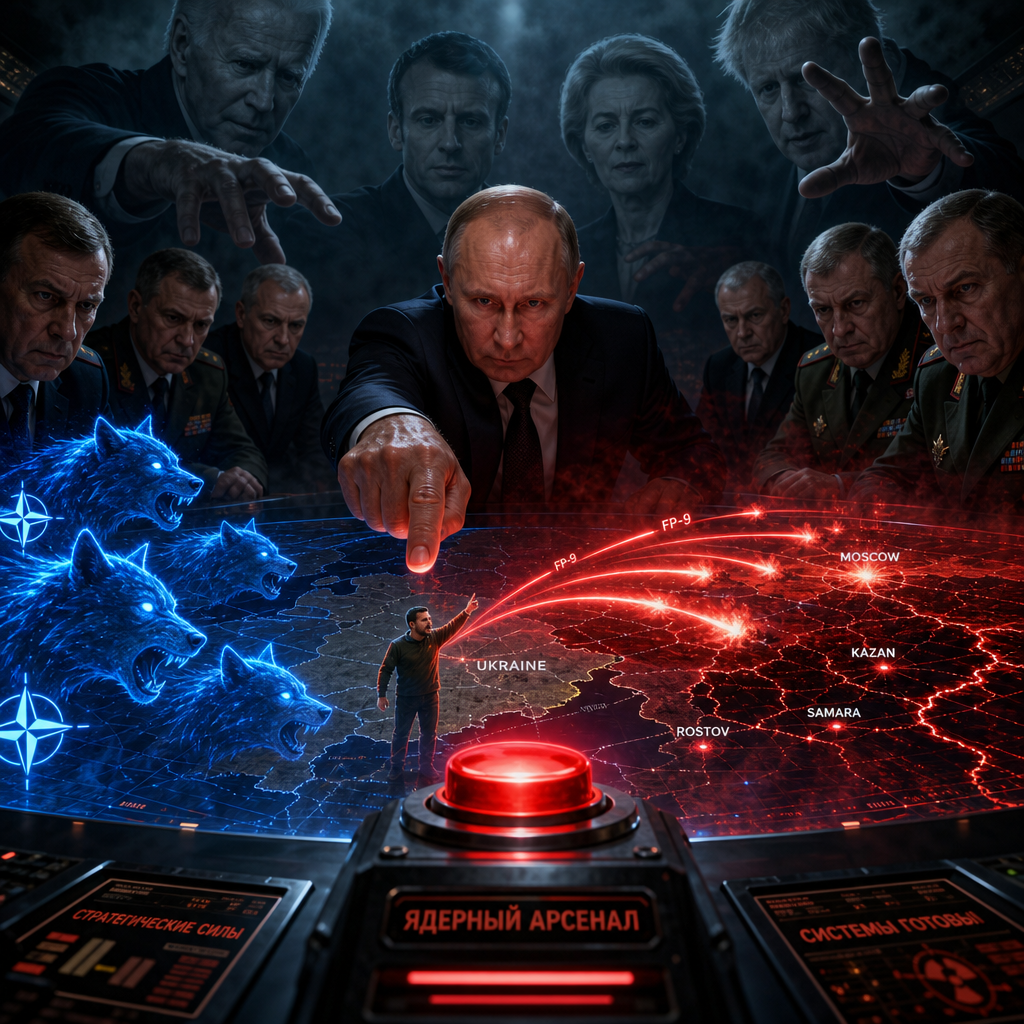


In recent months, something has changed in the war between Ukraine and Russia — and most people haven’t noticed. When explosions ripped through a defense electronics plant in Cheboksary, 1,500 kilometers inside Russia, or when fires erupted at the Titan-Barrikady factory in Volgograd — a facility that builds the launchers for Russia’s Iskander and Yars nuclear-capable ballistic missiles — the world assumed these were drone strikes. Cheap, improvised, the kind of asymmetric warfare Ukraine has become famous for.
They were not. These strikes were carried out by FP-5 Flamingo cruise missiles — Ukrainian-built, ground-launched weapons carrying warheads of over one ton, flying at near the speed of sound, 30 to 40 meters above the ground, across distances that cover 90 percent of Russia’s defense industry. And behind the Flamingo sits something far more consequential: Ukraine is developing ballistic missiles — the FP-7 and FP-9 — capable of reaching Moscow itself, with flight speeds exceeding Mach 6.5 and warheads heavy enough to destroy hardened military infrastructure [1][2][3].
This is not a footnote in a distant war. It is a development that, combined with the trajectory of Russian strategic doctrine, brings the world closer to nuclear conflict than at any point since the Cuban Missile Crisis.
What These Weapons Actually Are
The FP-5 Flamingo, revealed in August 2025, is a cruise missile with a range of 3,000 kilometers and a warhead of 1,150 kilograms — more than double the payload of an American Tomahawk, at roughly one-quarter the cost [1]. It uses a repurposed Soviet-era AI-25 turbofan engine, a carbon-fiber fuselage, and satellite navigation with anti-jamming antennas. Its accuracy is approximately 14 meters — not precision by Western standards, but more than sufficient for a warhead that large [1].
Behind it are two ballistic missiles: the FP-7 (200 km range, 150 kg warhead, already in testing) and the FP-9 — a system that, based on mock-ups displayed in Poland in April 2026, is larger than Russia’s own Iskander. The FP-9 has a claimed range of 855 kilometers, a speed of 2,200 meters per second, and an 800-kilogram warhead. It can reach Moscow [2][3]. Ukraine’s co-founder of Fire Point, Denys Shtilerman, stated in June 2026: “I expect that this summer, or at the latest in early autumn, we will begin test flights toward Moscow” [3]. Ukraine’s Defense Minister Mykhailo Fedorov described the significance plainly: “Ukrainian ballistic missiles will change everything in this war. They will fundamentally change Ukraine’s status in the world. This is in a whole different league” [4].
Germany’s Diehl Defence has expressed interest in manufacturing the Flamingo with upgraded guidance [1]. Europe is not merely supplying Ukraine with weapons — it is helping Ukraine build a strategic strike capability that reaches deep into Russia’s heartland.
A Doctrine Rewritten — And a Warning Ignored
On November 19, 2024, Russia revised its nuclear doctrine. The change was not subtle. Under the previous doctrine, nuclear weapons could be used only in response to an existential threat to the Russian state. The new doctrine lowered that threshold to a “critical threat to sovereignty or territorial integrity” — and, crucially, authorized nuclear use in response to conventional attacks by a non-nuclear state supported by a nuclear power [5][6]. That description fits Ukraine exactly.
The very next day, November 21, 2024, Russia launched an Oreshnik intermediate-range ballistic missile at the city of Dnipro — the first-ever combat use of a MIRV-capable system, a delivery vehicle normally armed with nuclear warheads [6]. The message was not ambiguous. It was the clearest possible signal: the next one might not be conventional.
Most Western commentators treated this as posturing. They should not have.
The Warnings Go Back 30 Years
Vladimir Putin did not wake up one morning in 2022 and decide to invade Ukraine. The warnings began long before his presidency.
On May 31, 1997 — five years before Putin became President — then-Security Council Secretary Ivan Rybkin stated that NATO expansion would constitute a direct threat to Russian security, and that Russia would take all necessary measures to prevent it [7].
In February 1993, Boris Yeltsin wrote to President Clinton that the “genuine sovereignty” of post-Soviet states and the “maintenance of their borders” were matters of “geopolitical reality” in the national interests of both Russia and the United States [8]. He was asking — not demanding, asking — for a partnership. He was ignored.
The expansion came anyway. 1999: Poland, Hungary, Czech Republic. 2004: the Baltic states, Romania, Bulgaria — bringing NATO to within 200 kilometers of St. Petersburg and completely encircling Kaliningrad. Russia protested each time. Each time, it was ignored. And each time, the implicit understanding — this is as far as it goes — was broken [7].
2007: Putin stood at the Munich Security Conference and abandoned the pretense of cooperation entirely: “The unipolar model is not only unacceptable but also impossible in today’s world” [9].
2008: NATO’s Bucharest Summit declared that Ukraine and Georgia “will become” members. Five months later, Russia invaded Georgia. The pattern — expansion, warning, accommodation, further expansion, crisis — had become a cycle. Ukraine’s 2014 Maidan revolution, Russia’s annexation of Crimea, and the support for Donbas separatists were not random acts of aggression. They were responses in a strategic sequence that Russia’s leadership had been telegraphing for two decades [7].
The argument is not that Russia’s actions are justified. The argument is that they were predictable — and that continuing to ignore the pattern does not make it disappear.
The Pressure Behind Putin
Here is what most analysis misses: Putin is not acting alone, and he is not the most hawkish voice in Moscow.
Sergey Karaganov, a former Kremlin adviser and one of Russia’s most influential strategic thinkers, has publicly called for Russia to consider a “demonstrative nuclear strike” — not against Ukraine, but against a Western European target — to shock the world into respecting Russia’s red lines. In June 2024, at the St. Petersburg Economic Forum, Karaganov moderated a discussion on nuclear doctrine with Putin in the audience, delivering the message: “It is only the assessment of our own interests that determines [nuclear use]” [10].
On June 26, 2026, Reuters reported that Russian hardliners are urging Putin to “abandon diplomacy and escalate” — with some voices calling openly for “tactical nuclear weapons” [11].
Putin has, until now, resisted these voices. Analysis has identified restraining factors including fear of NATO military response, fear of losing China’s support, and belief that his goals remain achievable without escalation. But these are Putin’s personal calculations, not institutional checks. If someone with the worldview of Dmitry Medvedev — who has publicly stated that Russia should use nuclear weapons if its territorial integrity is threatened [12] — held power, the probability of nuclear use would rise dramatically.
The chilling reality is this: Putin himself is the restraint mechanism. Not the Security Council. Not the Duma. Not any institution. One man’s calculation stands between a devastating but manageable war and civilizational catastrophe.
What Happens If the Line Is Crossed
NATO’s stated position is that “any use of nuclear weapons by Russia would fundamentally change the nature of the war” and that Russia would face “severe consequences” [13]. The German Council on Foreign Relations assessed that NATO would “probably respond to Russian military aggression with conventional means for as long as possible, destroying major military capabilities on Russian soil” [14].
Here is the paradox that nobody in Brussels wants to articulate: Under Russia’s revised doctrine, conventional NATO strikes on Russian soil — by British aircraft, French weapons, or any system from a nuclear-armed alliance — constitute the very trigger for nuclear escalation that the conventional response was designed to prevent [5][6].
The United States understands this. Vice President JD Vance has stated that direct confrontation with Russia could lead to unintended escalation [15]. Senator Marco Rubio argued that direct NATO involvement could quickly “slip into World War III” [15]. Even the Biden administration acknowledged that direct confrontation with Russia could lead to war that “escalat[es] to a nuclear level” [15].
If tactical nuclear weapons are used in Ukraine and NATO responds by striking targets inside Russia — Moscow, St. Petersburg, military installations — there is no mechanism to prevent that exchange from becoming strategic nuclear war. The escalation ladder has no reliable off-ramp once nuclear weapons enter the equation.
The Cycles Must End
The pattern of the past 300 years is clear: Western expansion toward Russia’s borders, Russian warnings, Western dismissal, Russian military response. It happened with Sweden, with Napoleon, with Germany — twice. It is happening again.
Russia compromised on the Baltic states — accepting that NATO would sit within artillery range of St. Petersburg and fully encircle Kaliningrad — in the expectation that the West would compromise on Ukraine. When the West did not — when NATO declared at Bucharest that Ukraine “will become” a member, when Western-backed political movements transformed Ukraine’s orientation — Russia concluded that further compromise meant further retreat, and further retreat meant strategic destruction. So it stopped retreating [7].
The development of Ukraine’s ballistic missile capability, with European financial and technical support, does not break this cycle. It tightens it. Every Flamingo that strikes a Russian defense plant strengthens the hand of those in Moscow who argue that compromise is weakness and that only escalation brings security. Every FP-9 test flight that pushes toward Moscow compresses the decision-making window in which Russian commanders must determine whether an incoming missile carries a conventional or nuclear warhead.
What Ordinary People Should Understand
For the vast majority of Europeans — for the vast majority of human beings on this planet — there are no strategic interests in Ukraine or Russia worth a nuclear exchange. We lived in peace and prosperity as neighbors for decades. We can do so again — not because we agree on everything, but because the alternative is unthinkable.
The development of long-range ballistic missiles by Ukraine, with the active support of its European allies, is not a path to peace. It is a path that moves us incrementally, measurably, and provably closer to a nuclear confrontation that no one can win.
The table — not the battlefield — is where this war must end. Diplomacy is not weakness. It is the only rational response to the reality that the weapons now being built can trigger consequences that cannot be undone.
Weapons Specifications: FP-5 Flamingo, FP-7, and FP-9
| Parameter | FP-5 Flamingo | FP-7 (Strike) | FP-9 |
|---|---|---|---|
| Type | Cruise missile | Ballistic missile | Ballistic missile |
| Range | 3,000 km | 200 km | 855 km |
| Warhead | 1,150 kg | 150 kg | 800 kg |
| Speed | 850–900 km/h cruise | 1,500 m/s (Mach 4.4) | 2,200 m/s (Mach 6.5) |
| Accuracy (CEP) | 14 m | Not disclosed | ~20 m |
| Engine | AI-25TL turbofan | Solid rocket motor | Solid rocket motor |
| Guidance | GPS/GNSS + INS (anti-jam CRP antenna) | Not disclosed | Not disclosed |
| Status | Operational since Aug 2025 | Testing | Mock-up displayed Apr 2026; flight tests expected summer 2026 |
| Cost | ~$520,000 per unit | Not disclosed | Not disclosed |
| Key feature | Longest range; heaviest warhead in class | S-400 48N6 missile body | Larger than Russian Iskander; can reach Moscow |
Source: [1][2][3]
Reference List
[1] Wikipedia contributors. (2025). “FP-5 Flamingo.” Wikipedia. Retrieved from https://en.wikipedia.org/wiki/FP-5_Flamingo
[2] Kyiv Independent. (2025, September 4). “Ukrainian firm behind ‘Flamingo’ unveils new FP-7, FP-9 ballistic missiles, air defense systems.” Kyiv Independent. Retrieved from https://kyivindependent.com/ukrainian-firm-unveils-new-fp-7-fp-9-ballistic-missiles-air-defense-systems/
[3] Swoyer, A. (2026, June 8). “Ukraine will soon test domestic ballistic missiles capable of striking targets within Moscow.” The Washington Times. Retrieved from https://www.washingtontimes.com/news/2026/jun/8/ukraine-soon-test-domestic-ballistic-missiles-capable-striking/
[4] UNN. (2026, June 17). “Ukrainian ballistics will strike Russia and change everything in this war – Fedorov.” Ukrainian National News. Retrieved from https://unn.ua/en/news/ukrainian-ballistics-will-strike-russia-and-change-everything-in-this-war-fedorov
[5] Reuters. (2024, November 19). “Putin issues warning to United States with new nuclear doctrine.” Reuters. Retrieved from https://www.reuters.com/world/europe/putin-issues-warning-us-with-new-nuclear-doctrine-2024-11-19/
[6] Wikipedia contributors. (2024). “Oreshnik (missile).” Wikipedia. Retrieved from https://en.wikipedia.org/wiki/Oreshnik_(missile)
[7] National Security Archive. (2017, December 12). “NATO Expansion: What Gorbachev Heard.” George Washington University. Retrieved from https://nsarchive.gwu.edu/briefing-book/russia-programs/2017-12-12/nato-expansion-what-gorbachev-heard-western-leaders-early
[8] National Security Archive. (2018, March 16). “Retranslation of Yeltsin letter on NATO expansion.” George Washington University. Retrieved from https://nsarchive.gwu.edu/document/16376-document-04-retranslation-yeltsin-letter
[9] Putin, V. (2007, February 10). “Speech at the Munich Conference on Security Policy.” President of Russia. Retrieved from http://en.kremlin.ru/events/president/transcripts/24034
[10] Karaganov, S. (2024). “From Restraining to Deterring: Nuclear Weapons, Geopolitics, Coalition Strategy.” Russia in Global Affairs. Retrieved from https://eng.globalaffairs.ru/articles/nuclear-strike-karaganov/
[11] Reuters. (2026, June 26). “Russian hawks urge Putin to escalate war, drop US talks as Ukraine strikes deep.” Reuters. Retrieved from https://www.reuters.com/world/europe/russian-hawks-urge-putin-escalate-war-drop-us-talks-ukraine-strikes-deep-2026-06-26/
[12] Kyiv Independent. (2026, February 24). “Medvedev threatens UK, France with nuclear strikes after Russia’s claims about nuclear technology transfer.” Kyiv Independent. Retrieved from https://kyivindependent.com/medvedev-threatens-nuclear-strikes-against-ukraine-uk-france
[13] NATO. (2026). “NATO’s support for Ukraine.” North Atlantic Treaty Organization. Retrieved from https://www.nato.int/cps/en/natohq/topics_192648.htm
[14] Kamp, K. (2025, November). “Basics of a New Nuclear Strategy for NATO.” DGAP Policy Brief No. 21. German Council on Foreign Relations. Retrieved from https://dgap.org/en/research/publications/basics-new-nuclear-strategy-nato
[15] Davis Center for Russian and Eurasian Studies. (2026). “Marco Rubio on Russia and Ukraine.” Harvard University. Retrieved from https://daviscenter.fas.harvard.edu/insights/marco-rubio-russia-and-ukraine
AI Disclosure: This post was created with the assistance of artificial intelligence. The ideas, analysis, and opinions expressed are my own — AI was used to help compose, structure, and refine my personal notes and thoughts into the final written content. Images, videos and music featured in this post were also generated using AI tools, based on my own creative prompts and direction.
