




Have We Really Evolved? Health Aid, Mineral Extraction, and the Unbroken Chain of Exploitation.

The Question That Won’t Go Away
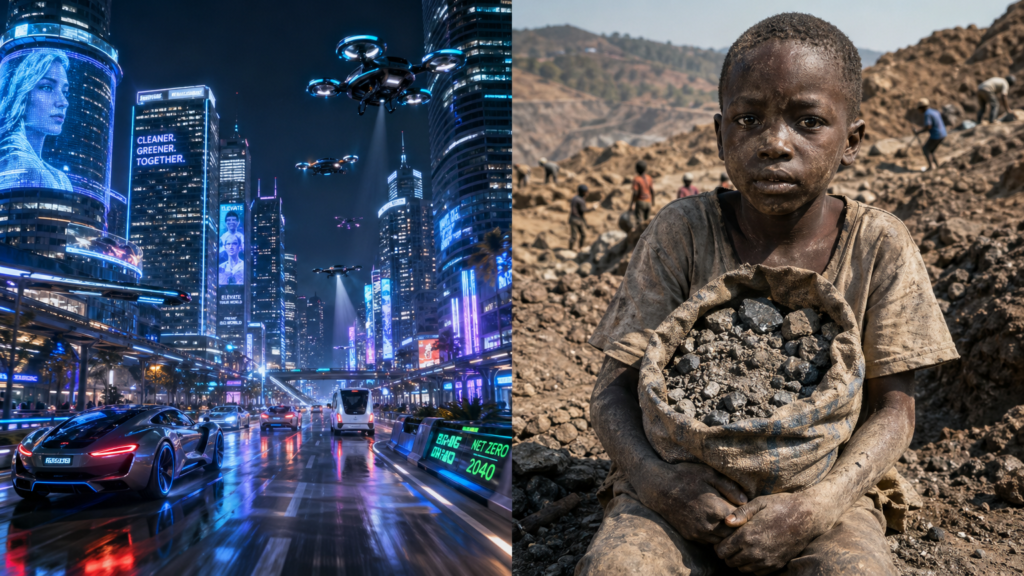
We fly in jets powered by artificial intelligence. We carry supercomputers in our pockets that contain cobalt mined by children in the Democratic Republic of Congo [1]. We celebrate the green energy revolution while the cobalt, copper, and lithium that make it possible are extracted under conditions that would be familiar to a 19th-century colonial administrator [1][2].
So the question is simple and uncomfortable: has humanity evolved — or have we simply found more sophisticated ways to do the same things to each other?
In 1965, Ghana’s first president Kwame Nkrumah coined a term that remains disturbingly current. “The essence of neo-colonialism is that the State which is subject to it is, in theory, independent and has all the outward trappings of international sovereignty. In reality its economic system and thus its political policy is directed from outside” [3].
He described a system where foreign capital is used for exploitation rather than development, giving external powers “power without responsibility” and subjecting the formerly colonised to “exploitation without redress” [3].
Sixty years later, every piece of data we have confirms that Nkrumah was not describing a passing phase. He was describing the operating system — one that still runs beneath the surface of every trade agreement, health deal, and mineral contract signed between Africa and the world’s powerful nations.
HIV Treatment as a Bargaining Chip
In Zambia, over one million people live with HIV. For more than two decades, the United States’ PEPFAR programme provided life-saving antiretroviral treatment, helping cut AIDS-related deaths by over 70% in 15 years [4]. New infections dropped from 63,000 to 30,000 between 2010 and 2025 [4].
Then came the reckoning. After dismantling USAID in 2025, the Trump administration replaced decades of grant-based health aid with bilateral Memorandums of Understanding (MOUs) under its “America First Global Health Strategy” [5]. The State Department said it sought to “transition from a foreign assistance paradigm to an investment and growth paradigm” [4].
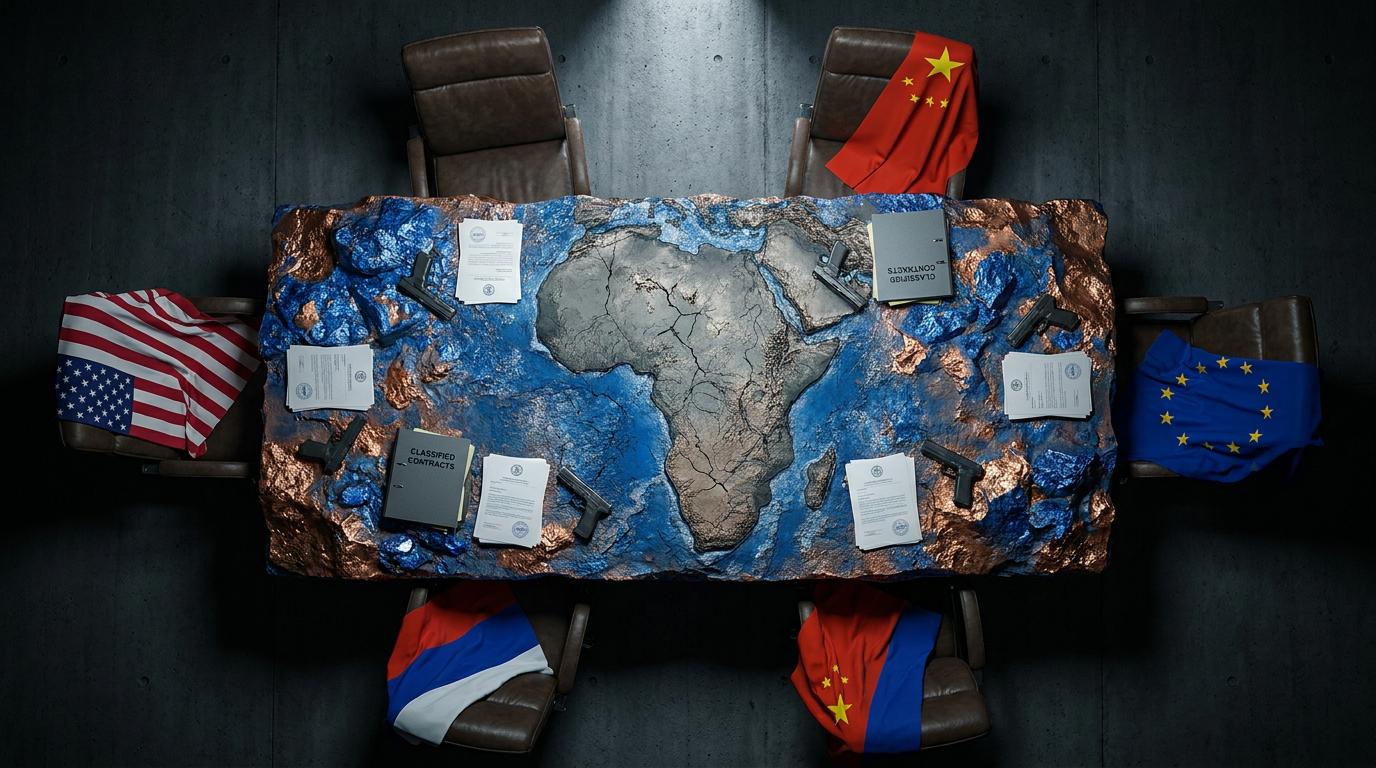
The reality is starker. The US offered Zambia roughly $1 billion over five years — less than half of what it previously received — on the condition that Lusaka commit $340 million in new domestic health spending, grant access to health data and biological specimens for 25 years, and, critically, entertain linked agreements granting Washington better access to its copper, cobalt, and nickel [4][6]. If Zambia did not sign by a May 2026 deadline, funding would be discontinued [6].
The New York Times obtained a memo prepared for Secretary of State Marco Rubio outlining how the US could withdraw health support “on a massive scale” to force Zambia and others to accept terms [4][5]. For 1.3 million Zambians dependent on PEPFAR — which funds over 80% of the country’s HIV response — that threat meant losing daily life-saving treatment [6].
Zimbabwe walked away from similar negotiations, calling US demands on data and biological samples “lopsided” and an “intolerable infringement on sovereignty” [4]. Kenya signed, but activists took the deal to court over data privacy concerns [4][5]. A Kenyan high court suspended implementation while evaluating concerns about pathogen sample transfers and health data access [5]. Cameroon’s health department heads were unaware negotiations were even happening until a deal was already signed [5].
An analysis by Partners in Health found that under the new agreements, health funding would drop by 69% to Rwanda, 61% to Madagascar, 42% to Liberia, and 34% to Eswatini, where a quarter of adults live with HIV [5]. The Center for Global Development calculated an average 49% decrease in annual US financial support across all signed compacts [7]. Uganda’s MOU stipulates the US will reduce funding at a 2:1 ratio for every dollar the government fails to commit in domestic health spending increases [7].
When life-saving drugs are explicitly or implicitly tied to mineral concessions, the ethical question is stark: is this partnership, or is it extortion dressed in the language of development?
Europe’s Colonial Trade, Rewritten
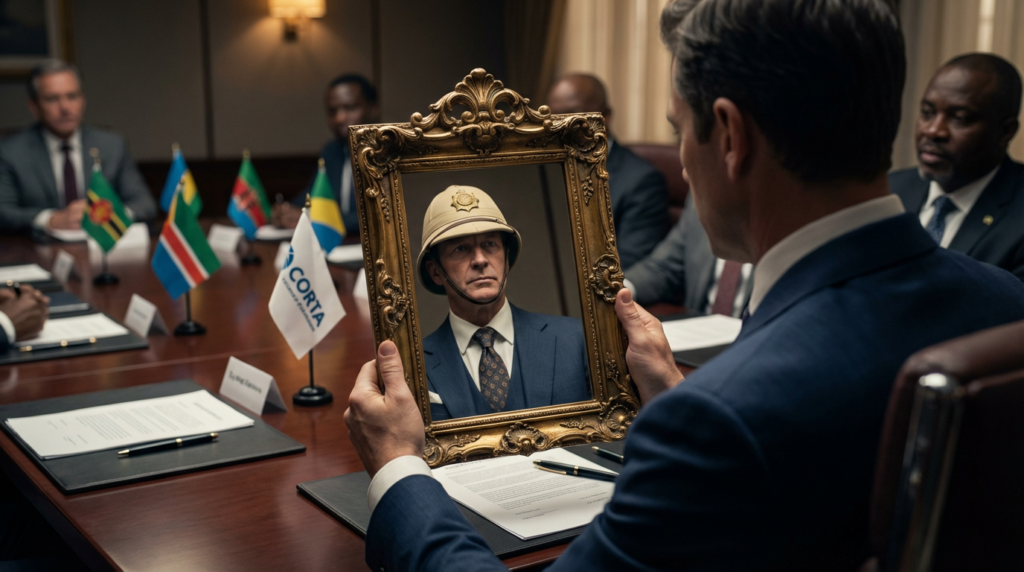
Many in Europe point at the US or China and feel morally superior. But the EU’s economic policies toward Africa reproduce colonial patterns in more technocratic language.
Between 2022 and 2024, minerals and fuels made up 53% of Africa’s exports to the EU — worth €194 billion — while vehicles, electrical machinery, cocoa products, and apparel together accounted for only about 7% [8]. Sixty years after formal decolonisation, the pattern of raw materials out and finished goods in looks remarkably unchanged [8].
Economic Partnership Agreements (EPAs) between the EU and African regions were marketed as tools for development and industrialisation. Critics argue they lock African countries into opening their markets to heavily subsidised European agricultural and manufactured goods [9]. The East African Community committed to liberalise 80% of its market to EU imports over 15 years, exposing local farmers and industries to competition from subsidised European producers [9].
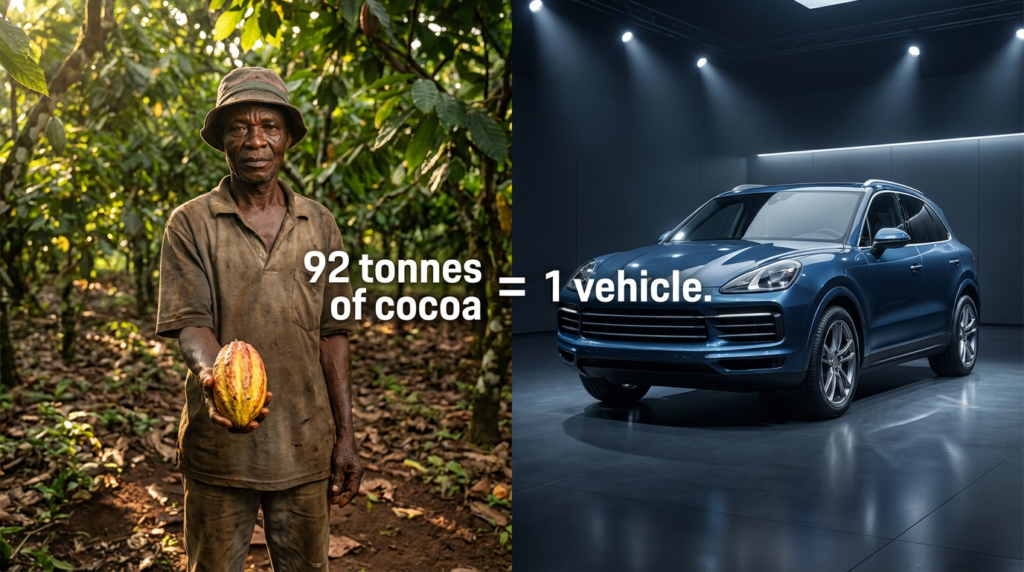
A Ghanaian human rights lawyer put the terms of trade in devastating perspective: “A tonne of cocoa is roughly US $1,300, while one 4×4 vehicle is now about US $120,000. You need about 92 tonnes of cocoa to exchange for one 4×4. The average cocoa farmer in Ghana has only around 2-3 acres, meaning it would take him or her well over 500 years to produce enough cocoa to buy a 4×4” [9].
EU “Aid for Trade” mostly finances trade-related infrastructure — customs reform, ports, corridors — rather than targeted value-chain development [8]. The EU’s Global Gateway initiative has been criticised as a geostrategic response aimed at securing access to African raw materials, not building African industrial capacities [8].
The EU likes to brand itself as the ethical alternative. Its trade numbers tell a different story.
Not Displacement — Proliferation
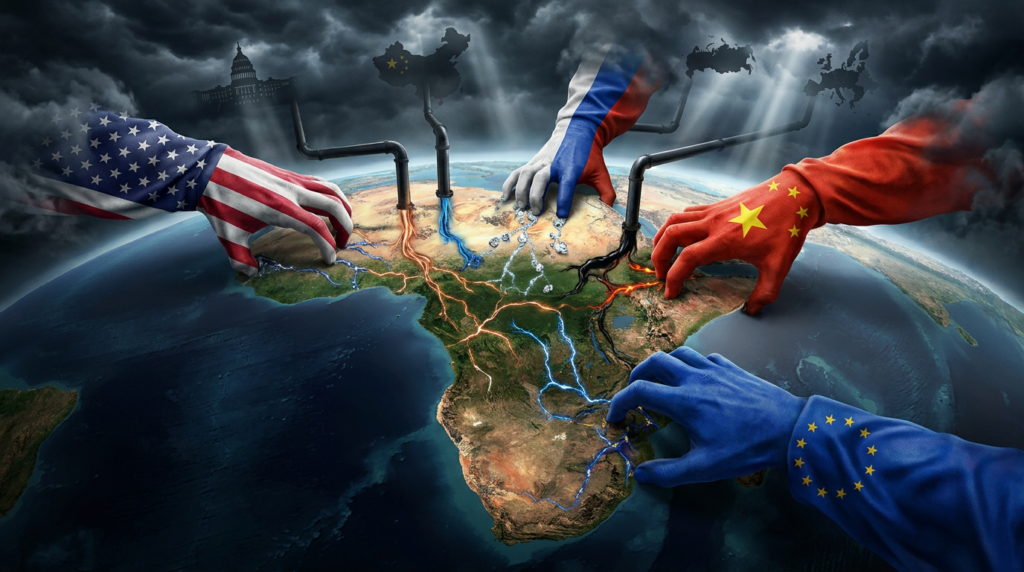
The result is not one colonial master replaced by another, but multiple powers competing for the same African ore — each claiming to be different from the others.
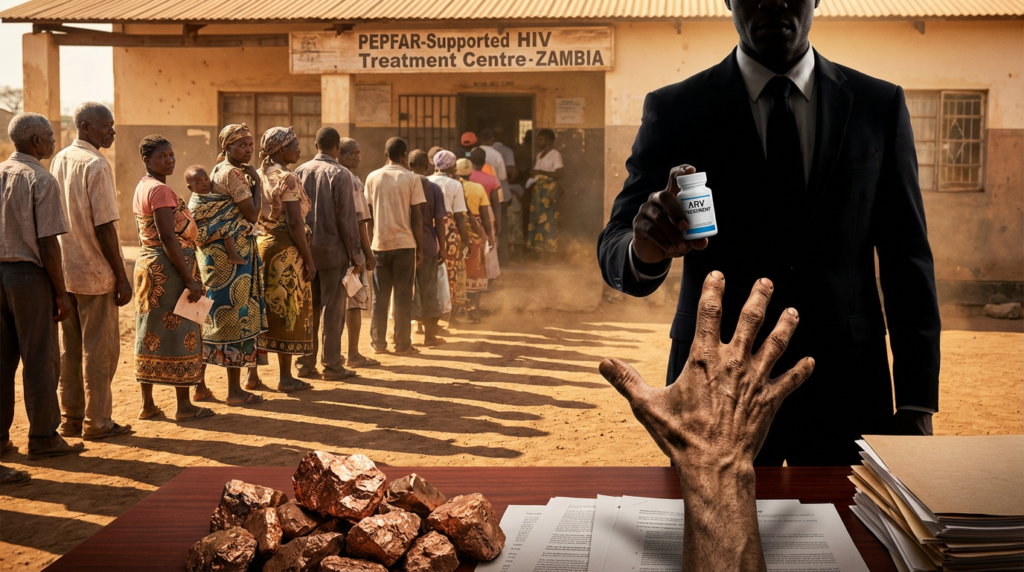
China now refines 73% of the world’s cobalt, 68% of its nickel, 59% of lithium, and controls 61% of global rare earth production and 92% of processing capacity [10]. Chinese policy banks issued nearly $57 billion in mining loans between 2000 and 2021, with three-fourths going to Chinese-owned ventures [10]. In the DRC, Chinese firms have stakes in 15 of 17 industrial cobalt operations [10].
Russia’s influence in Africa centres on arms sales, Wagner Group deployments, and regime-security-for-resources swaps in countries like Mali, the Central African Republic, and Sudan [11]. Moscow has been described as pursuing “neo-colonial and neo-imperialist state capture,” propping up embattled leaders in exchange for mining rights and political alignment [11]. The RAND Corporation documented how Russia is “riding an anti-colonial wave across Africa” by leveraging Soviet-era liberation credentials [12].
Nkrumah anticipated exactly this scenario: “It is possible that neo-colonial control may be exercised by a consortium of financial interests which are not specifically identifiable with any particular State” [3].
Is the current situation a shift of colonial power from Europe to new actors? No. It is something worse: a proliferation. Europe did not leave. The US entered with a new weapon. China arrived with infrastructure-for-resources. Russia brought security-for-mining.
The Policies Backfire
Here is the part that Western policymakers refuse to confront: these policies are not just morally questionable. They are strategically self-defeating.
Influence is eroding. Gallup’s World Poll found that the US has lost its place as the most influential global power in Africa, with China gaining ground [13]. After military coups in Mali, Burkina Faso, and Niger, US influence collapsed and Russian forces filled the vacuum [12][14]. African elites are pivoting toward China, Russia, Turkey, and Gulf states — powers that demand fewer concessions around governance, human rights, and data sovereignty [4].
Disease does not respect borders. US aid cuts contributed to an estimated 518,428 child deaths and 263,915 adult deaths from manageable diseases, plus nearly 10 million new malaria cases [6]. Drug-resistant strains of HIV and TB developing in under-treated populations pose a direct global health threat, including to Americans [15].
Mineral access is being undermined. The US imports more than 95% of its demand for rare earth elements, mostly from China [10]. Alienating African mineral producers pushes them further toward Beijing — worsening the very dependence Washington claims to be addressing [10].
The credibility gap widens. As one expert warned about the Zambia deal: “We’re doing essentially what the US government has accused the Chinese of doing for the past two decades in Africa” [4].
The result is a policy architecture that achieves the opposite of every stated goal: it counters China’s mineral dominance by pushing producers toward China; it promotes democracy by fuelling authoritarianism; it protects taxpayers by eliminating markets for American companies; and it maintains global leadership by losing influence to rivals.
Slavery Did Not End — It Adapted
Many people in the global North treat slavery as a closed chapter. The data says otherwise.
The Global Slavery Index estimates that 50 million people worldwide live under conditions of modern slavery — forced labour, forced marriage, debt bondage — an increase of 10 million since 2016 [16]. The International Labour Organisation reports 27.6 million in forced labour, generating $236 billion in illegal profits annually [17]. Seven million of those trapped are in Africa [16].
These are not abstractions. Children and adults work in dangerous mines, farms, and domestic settings under conditions that amount to slavery. Migrants take desperate routes to escape poverty and end up exploited by employers, traffickers, and corrupt officials — precisely because their legal status is precarious [16]. Rich states outsource their border enforcement to African transit countries, creating markets for smugglers and pushing migration into ever more dangerous channels [8].
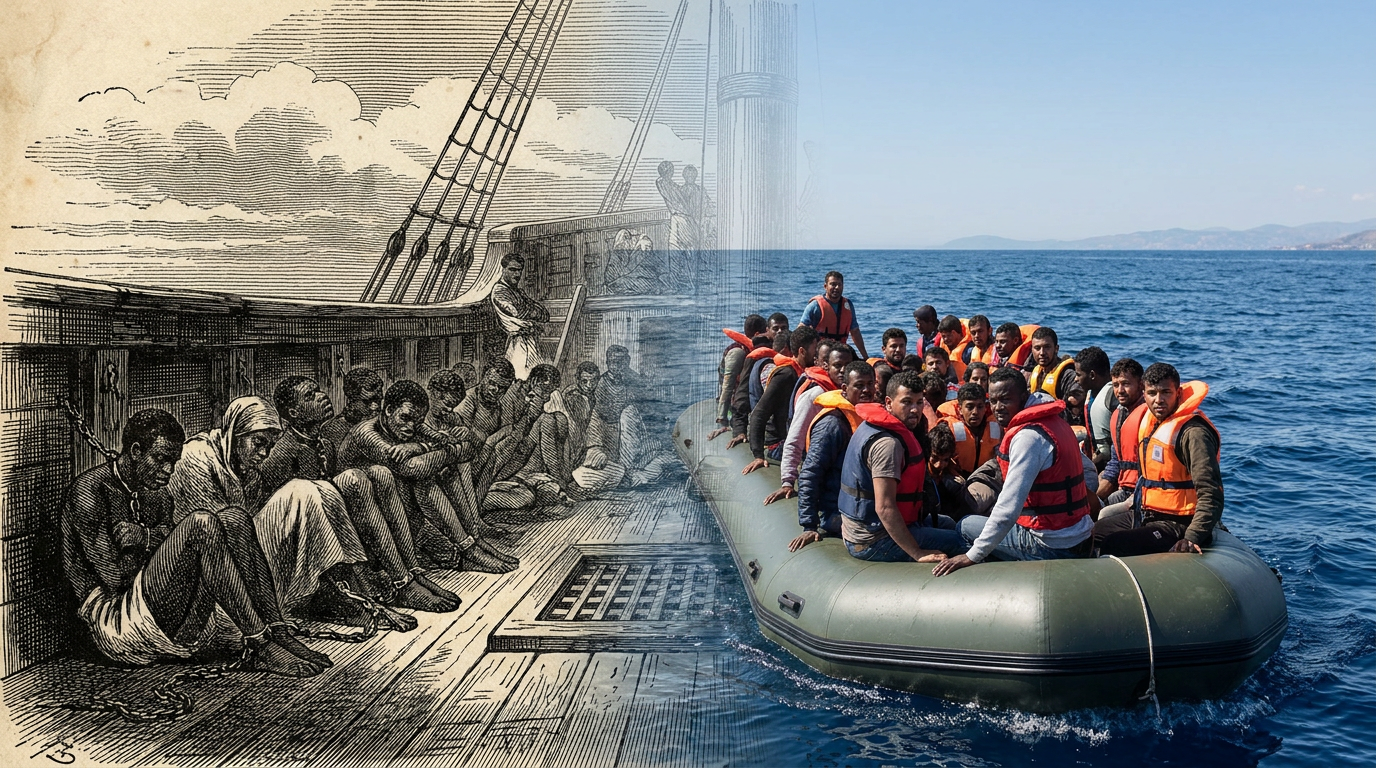
Replace the wooden ships with rubber boats. Replace slave codes with visa regimes. Replace auction blocks with informal labour markets where undocumented workers have almost no rights. The tools changed. The underlying logic — whose freedom and safety can be traded for others’ comfort and profit — did not.
The Hardest Truth
So what does all of this tell us about us — as a species, as civilisations, as moral beings?
Technologically, we are in a different universe from the 19th century. Ethically, looking at Africa’s position in global health, minerals, trade, and migration, the picture is one of colonialism rewritten in denser contracts and softer language [3][4][5].
We can draft human rights declarations and Sustainable Development Goals. But the operating system beneath those texts still rewards extraction over justice, power over solidarity, and short-term gain over human survival.
Nkrumah warned that “neo-colonialism is a mill-stone around the necks of the developed countries who practise it. Unless they can rid themselves of it, it will drown them” [3].

Sixty years on, the mill-stone is heavier — and the developed world has not freed itself of it. It has simply found more complex, bureaucratic, and deniable ways to maintain it.
That does not mean nothing has changed. There is more awareness, more organised resistance, more legal and moral language to contest injustice than ever before. African scholars, activists, and communities are naming and challenging these patterns and sometimes winning real concessions. The fact that we can link PEPFAR MOUs, cobalt supply chains, EU trade policy, and modern slavery in one ethical conversation is itself a small sign of moral evolution.
But evolution is not linear or guaranteed. The question is not just “have we evolved?” It is “will we choose to?” Right now, the global system still rewards those who treat ethics as PR and extraction as business as usual.
We are more comfortable than our ancestors, surrounded by better technology and nicer language. But in our treatment of the most vulnerable — in Africa and beyond — we have not yet proved that we are morally different people.
References:
[1] Carleton University Institute of Interdisciplinary Studies. (2025). “Colonialism Reimagined: The Neo-Colonial Scramble for Africa and the DRC.” Carleton University.
[2] Akpobi, M. (2025). “The enduring colonialism and neoliberalism in Africa — A close look at Nigeria’s political-economic entanglements with imperial structures.” Review of African Political Economy (ROAPE), April 30, 2025.
[3] Nkrumah, K. (1965). Neo-Colonialism, the Last Stage of Imperialism. Introduction. Marxists Internet Archive.
[4] Stockdale, A. (2026). “Zambia: Is the US trading HIV treatment for resources?” Deutsche Welle, April 10, 2026.
[5] Nolen, S. (2026). “U.S. Cuts Health Aid and Ties It to Funding Pledges by African Governments.” The New York Times, January 15, 2026.
[6] Lawal, S. (2026). “Minerals for aid: Are new US health deals ‘exploiting’ African countries?” Al Jazeera, April 1, 2026.
[7] Estes, J. and Keller, J.M. (2025). “What We Know — and Don’t Know — About the Trump Administration’s Global Health Agreements.” Center for Global Development, December 18, 2025.
[8] Chowdhury, S. (2025). “Time for Europe and Africa to move beyond colonial-era trade.” African Business, November 24, 2025.
[9] GRAIN. (2017). “Colonialism’s new clothes: The EU’s Economic Partnership Agreements with Africa.” CADTM, August 22, 2017.
[10] Lisinski, K.V. (2025). “The Silent Cartel: How Chinese Companies Came to Dominate Critical Mineral Markets.” New Lines Institute, August 13, 2025.
[11] Various academic sources. Russia’s neo-colonial and neo-imperialist state capture in Africa. Cited across peer-reviewed analyses including Africa Policy Research Institute publications.
[12] RAND Corporation. (2024). “Russia Is Riding an Anti-Colonial Wave Across Africa.”
[13] Gallup. (2023). World Poll: US Lost Place as Most Influential Power in Africa.
[14] Gallup. (2025). Global States of Mind Report: American Perceptions of US Influence.
[15] CIDRAP. (2025). “US cuts to HIV programs in sub-Saharan Africa pose global risk, experts say.” Center for Infectious Disease Research and Policy.
[16] Walk Free Foundation. (2023). Global Slavery Index 2023.
[17] International Labour Organisation. (2022/2024). 2022 Global Estimates of Forced Labour and Profits and Poverty: The Economics of Forced Labour.
AI Disclosure: This post was created with the assistance of artificial intelligence. The ideas, analysis, and opinions expressed are my own — AI was used to help compose, structure, and refine my personal notes and thoughts into the final written content. Images, videos and music featured in this post were also generated using AI tools, based on my own creative prompts and direction.
