





You think Bitcoin’s price is set by code, halvings, and institutional adoption. So why did its odds of hitting $80,000 jump because of a shipping lane? You were told crypto was an independent system. Yet here we are, watching its short-term fate hinge on U.S.-Iran tensions over the Strait of Hormuz, a reality reflected in a reported wave of roughly $415 million in liquidations. This isn’t a glitch in the matrix; it is the matrix, fully revealed.
The Liquidation Engine
Let’s be precise about the mechanism. The prediction market odds you see are not a sentiment poll; they are the output of a financial engine under stress. A move in the odds for an $80,000 Bitcoin target in April can occur in a live but still structurally limited market where pricing reacts quickly to flows and headlines. This is where technology meets brutal finance. When geopolitical risk spikes, oil prices rise. Rising oil prices increase operational costs for Bitcoin miners, who may liquidate BTC reserves to cover expenses, creating selling pressure. This miner capitulation can trigger long-position liquidations on derivatives exchanges, a technical cascade where forced selling begets more forced selling. The blockchain’s immutability doesn’t insulate it from this; it merely records the panic with perfect fidelity.
The technology works. The question is whether we’ve built a system whose price is now algorithmically tethered to the very geopolitical risks it was meant to transcend.
The Correlation Trap.
The strongest argument for Bitcoin as “digital gold” is its fixed supply and decentralized issuance—a hedge against fiat debasement. And yet, that thesis cannot explain the last 72 hours. The data shows Bitcoin’s correlation with broader macro stress can become a dominant short-term driver. This isn’t a betrayal of the vision; it’s a revelation of the market’s current plumbing. Liquidity is global and fungible. When risk-off sentiment hits, capital flees to the dollar, and assets from tech stocks to crypto are sold to cover margin calls elsewhere. The liquidations in long positions weren’t just numbers; they were leveraged bets by traders who misjudged how tightly this new system is wired to the old one.
We wanted a new financial paradigm. We got one that is exquisitely sensitive to the old world’s conflicts. The market priced in institutional adoption; it failed to price in institutional correlation.
Theaters of Power.
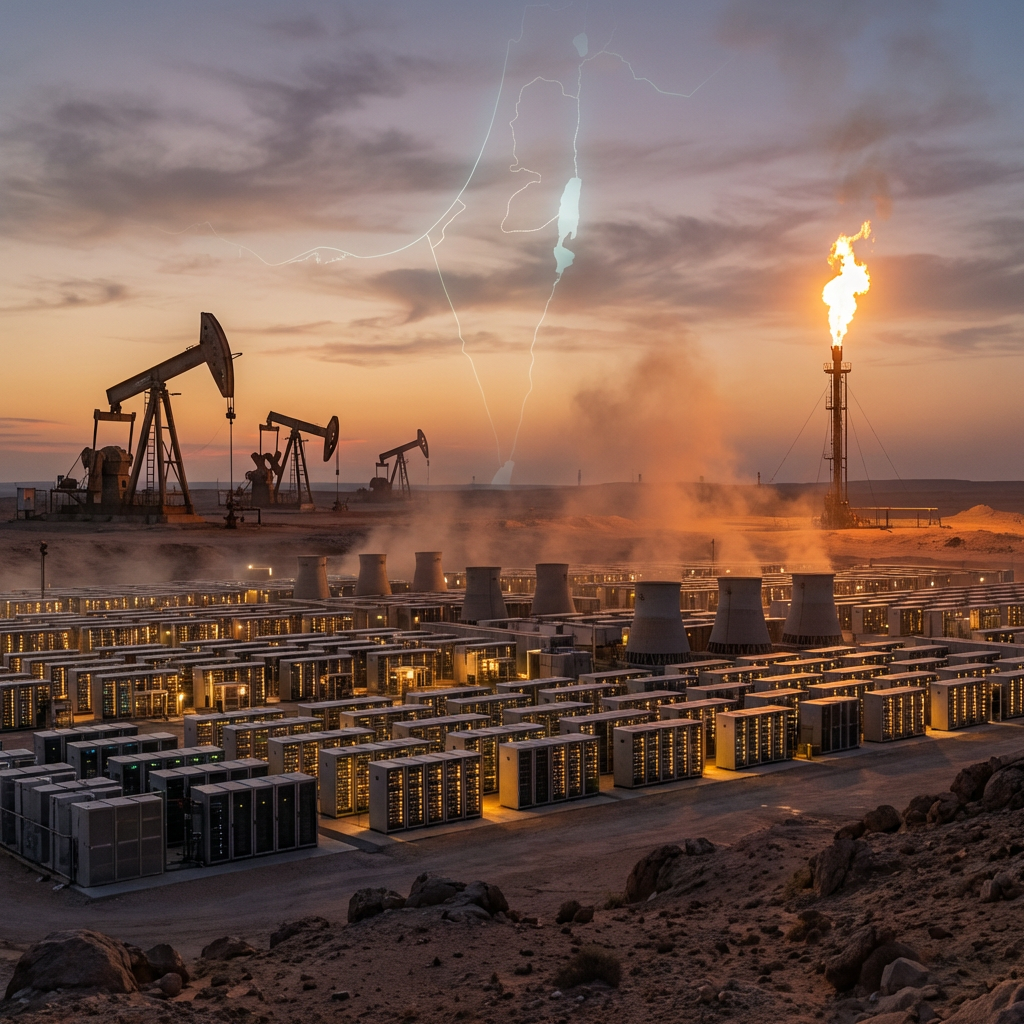
Now, follow the power. The U.S.-Iran tension is not a random event; it’s a calculated geopolitical move. The Strait of Hormuz handles almost 20% of globally traded oil, making it a leverage point in global politics. For the U.S., positioning itself as a crypto superpower—as recent political rhetoric suggests—is partly theater, but it’s theater with real effects on market structure. Meanwhile, the EU’s MiCA regulation, which we rightly see as a thoughtful framework, operates on the assumption that crypto markets can be made more resilient through transparency, disclosure, authorization, and supervision. This week’s action tests that assumption. Regulation can manage exchange behavior and counterparty risk; it cannot decouple Bitcoin from the global cost of energy or the flight path of missiles.
Are we watching the maturation of crypto, or its capture by the same geopolitical playbook that governs oil and sovereign bonds? The line is blurrier than you think.
The Miner and The Retail Trader.
This is where it gets personal. If you hold Bitcoin, you are now indirectly exposed to oil volatility. A miner in Kazakhstan or Texas, facing a spike in electricity costs, doesn’t care about your store-of-value thesis. He sells to stay operational, and that sale hits the order book you’re watching. Your savings, your hedge, becomes a source of liquidity for a geopolitical crisis thousands of miles away. The prediction market’s YES share for an $80,000 April outcome is not just a crypto bet; it is also a bet on macro calm and de-escalation.
The revolution promised you sovereignty. The system gives you correlation. The stakes for your portfolio have never been more global, or less within your control.
What Comes Next?
Crypto’s success has always depended on institutional depth, but depth brings entanglement. The path to $80,000 is no longer a chart pattern; it’s a geopolitical risk calculation. Watch the Strait of Hormuz. Watch miner reserves and exchange flows. Watch futures positioning and leverage for signs of stress. The winners in this next phase will not be the ideologues, but the pragmatists who understand that a global, digital asset is hostage to global, analog politics.
Is this the independent financial system we coded for? Or have we simply built the world’s most efficient mirror, reflecting every tremor from the old world with terrifying clarity? And when the next crisis hits, will you see your hedge, or will you see the chain?
Reference list
Binance Square, “Bitcoin’s Volatility Triggers $415 Million in Liquidations Amid U.S.-Iran Tensions”, 2026.
Polymarket, “What price will Bitcoin hit in April?”, market page, accessed April 2026.
Coin Metrics, “Q1 2025 Bitcoin Data Special”, State of the Network, March 24, 2025.
IMF, Global Financial Stability Report, October 2024: Steadying the Course, 2024.
U.S. Energy Information Administration, “Strait of Hormuz is chokepoint for 20% of world’s oil”, March 25, 2026.
Atlantic Council, “The 2025 crypto policy landscape: Looming EU and US divergences?”, January 27, 2025.
European Securities and Markets Authority, “Markets in Crypto-Assets Regulation (MiCA)”, 2025.
AI Disclosure: This post was created with the assistance of artificial intelligence. The ideas, analysis, and opinions expressed are my own — AI was used to help compose, structure, and refine my personal notes and thoughts into the final written content. Images, videos and music featured in this post were also generated using AI tools, based on my own creative prompts and direction.
