






As major fossil fuel companies quietly retreat from their climate commitments under the political cover of the current U.S. administration’s pro-drilling agenda, a growing number of oil and gas professionals are confronting a deeply personal question: can they continue working in an industry whose trajectory increasingly contradicts the science on climate change?
A new initiative called Life After Oil, launched during International Energy Week in London earlier this year, is offering a support community for workers wrestling with this exact dilemma — and the movement signals a widening rift inside the fossil fuel workforce that could reshape the industry’s talent pipeline for years to come.
The Industry’s Climate Reversal
The backdrop to this emerging workforce crisis is a striking corporate retreat on climate. Over the past two years, several of the world’s largest oil companies have softened or delayed emissions reduction targets announced earlier in the decade. BP and Shell, both of which made high-profile pledges to diversify into renewables and cut carbon output, have since scaled back transition plans, slowed investment in clean energy, and doubled down on expanding oil and gas production.
These reversals have accelerated under what industry observers describe as the political oxygen provided by the Trump administration’s “drill, baby, drill” energy policy. The combination of regulatory rollbacks, fossil-fuel-friendly rhetoric, and weakened climate oversight has created an environment in which oil majors face fewer external pressures to honour earlier commitments.
For employees who joined these companies believing they were part of a genuine energy transition, the shift has felt like a bait-and-switch. And for those who remained during the years of green pledges hoping internal advocacy could move the needle, the retreat has pushed many to a breaking point.
“The Cognitive Dissonance Became Too Painful”
The voices emerging from inside the industry paint a picture of deepening moral unease. Arjan Keizer, a former senior manager at Shell, described the tension in stark terms. “Prestige and salary matter far less than whether you can look your children in the eye in twenty years,” he said. “The majority of employees want their companies to lead the transition.”
Guy Mansfield, a former financial director at a major oil and gas company, went further. He said the mental strain of reconciling the industry’s role in accelerating climate change with corporate narratives about sustainability eventually became unbearable. “The level of cognitive dissonance made it impossible for me to remain within the company,” Mansfield said. “Staying in, the level of denial simply became too painful.”
Jo Alexander, a former senior manager at BP, framed her departure in similarly direct terms. “I had to decide if this was really a career I wanted to dedicate my life to,” she said. “The obvious and unavoidable answer was no.”
These are not marginal voices or early-career idealists. They are senior professionals with decades of institutional knowledge — precisely the kind of talent the oil industry cannot easily replace.
Life After Oil: A Community Takes Shape
The Life After Oil initiative emerged from this growing disquiet. Launched at a media briefing in Westminster during International Energy Week, the network positions itself as a peer support community for current and former oil and gas employees who believe the sector is moving in the wrong direction on climate — and who are considering what comes next.
Nick Smith, whose family has worked in coal and oil supply for four generations, helped inspire the initiative. His own businesses have gradually shifted toward renewable energy, though he continues to supply fuels where alternatives are not yet commercially viable. Smith is careful not to demonise individuals working in the sector, but he is unsparing in his criticism of the corporate leadership driving strategy.
“What binds our community together is a recognition that the major oil companies are failing to provide a sensible contribution to the conversation about how to respond to the fossil fuel dilemma,” Smith said. “Clearly we need oil now for essential purposes, but we need to reduce consumption urgently.”
Smith takes particular aim at the industry’s favourite deflection: rising global energy demand. “By blithely pointing to increased consumer demand, they sidestep their own role in shaping markets, investment priorities and narratives,” he said.
The community offers peer support, shares stories of career transitions, and explores how skills honed in the oil patch — engineering, project management, subsurface geology, logistics — can be redeployed in the low-carbon economy.
The Numbers Behind the Talent Drain
The anecdotal evidence is backed by workforce data that should alarm fossil fuel executives. Research suggests more than a quarter of oil and gas workers are actively considering leaving the sector. Meanwhile, the pipeline of new talent is narrowing: around 12 percent of higher education institutions now refuse to advertise fossil fuel industry roles to their students, according to recent surveys.
This creates a compounding problem. As experienced professionals depart and fewer graduates enter the industry, the remaining workforce faces heavier workloads, reduced institutional knowledge, and growing difficulty attracting the calibre of talent needed to manage complex operations safely and efficiently.
Some climate advocates see this talent drain not as a crisis but as an opportunity. Jeremy Leggett, a former oil industry geologist who left the sector decades ago, went on to found Solar Century, which became a major player in the UK solar market. He now leads Highlands Rewilding, a nature restoration venture.
“Talent is the lifeblood of the oil and gas industry, and it is now imperative that we drain it into the transition away from fossil fuels,” Leggett said. “My experience shows there is nothing to fear, and indeed much to do that allows an oilman or oilwoman to look their children in the eyes without shame.”
What This Means for the Energy Transition — and for Workers
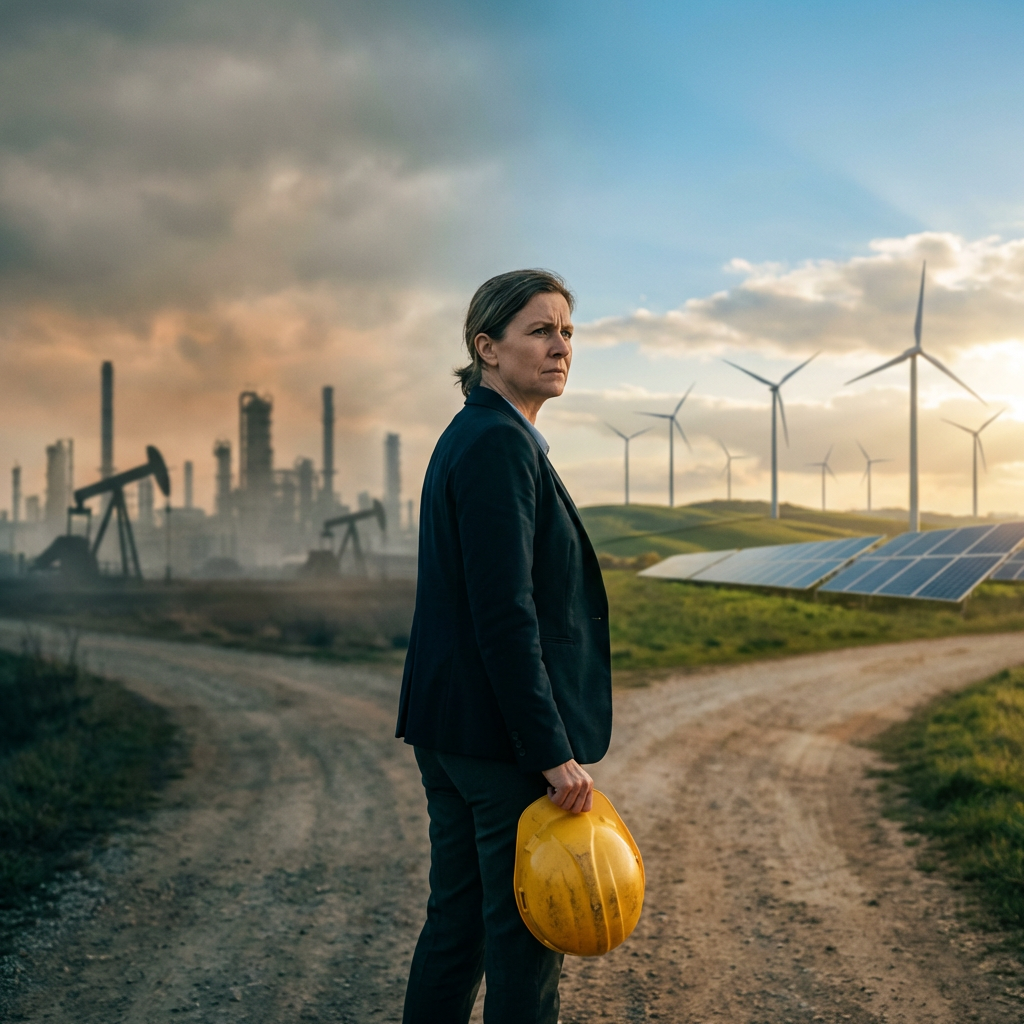
The emergence of communities like Life After Oil sits at the intersection of two powerful forces reshaping the global energy landscape: the corporate retreat from climate commitments and the accelerating movement of human capital toward clean energy.
For the oil industry, the implications are significant. Companies that have spent years positioning themselves as leaders of the energy transition now face a credibility gap — not just with investors and regulators, but with their own employees. The talent exodus, if it accelerates, could undermine operational capacity at precisely the moment when oil majors are trying to maintain production levels to fund their diversification strategies.
For the clean energy sector, the influx of experienced engineers, geologists, project managers, and financial professionals represents a substantial transfer of capability. The technical skills required to drill wells, manage complex supply chains, and operate large-scale infrastructure translate directly to the challenges of building out renewable energy, carbon capture, and grid-scale storage.
For individual workers, the calculus is intensely personal. Not everyone can afford to walk away from a well-paying job. Not everyone believes leaving is the most effective way to drive change — some argue that staying and pushing for reform from within remains a viable strategy. The founders of Life After Oil acknowledge this complexity. Their goal is not to issue ultimatums but to create space for honest conversations about direction, values, and the long-term viability of careers built on a fuel source the world must ultimately leave behind.
The bottom line for anyone watching this story: the energy transition is not just a matter of technology and policy — it is a human resources story. Where the most skilled, experienced workers in the global energy sector choose to invest their careers will shape how fast, how equitably, and how effectively the world moves away from fossil fuels. That choice is no longer abstract. For a growing number of oil and gas professionals, it is the most consequential career decision they will ever make.
