






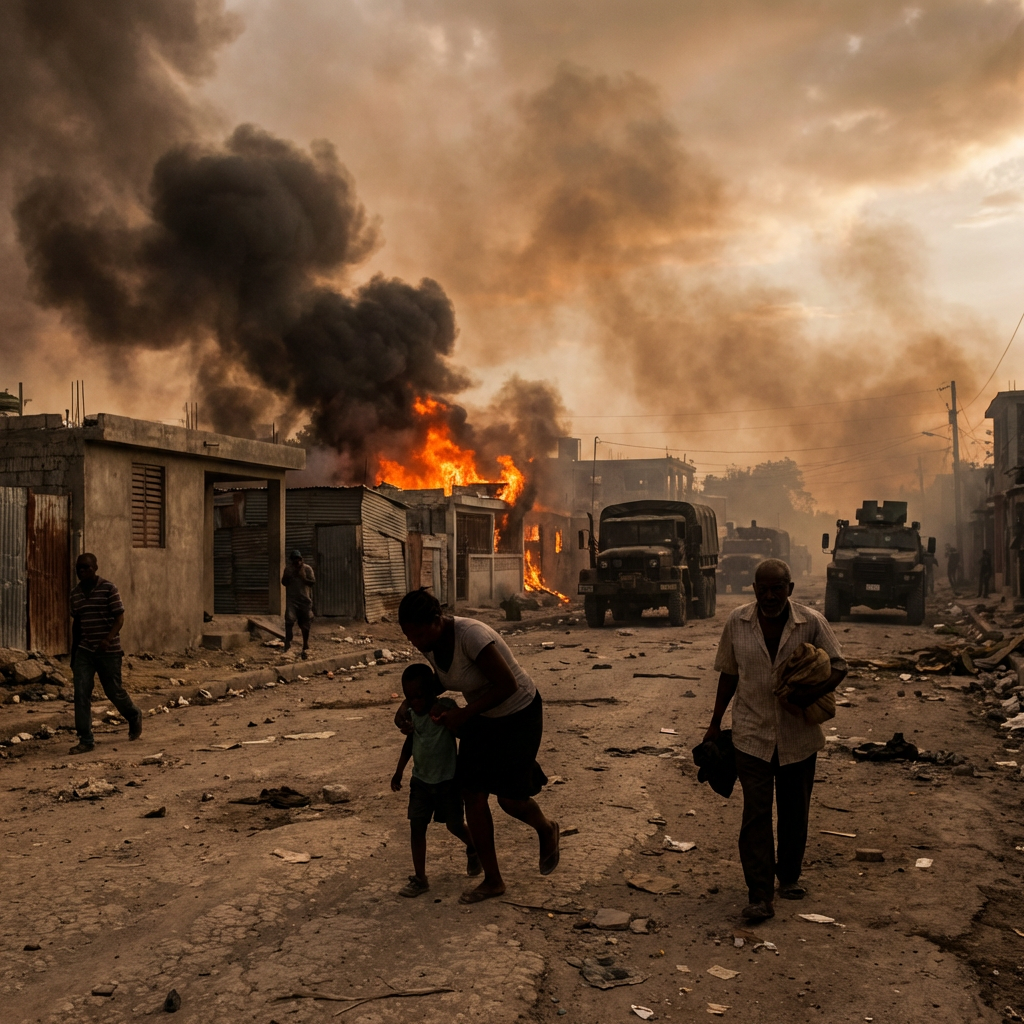
Violence erupted in the central Haitian town of Petite-Rivière de l’Artibonite early Sunday morning as a powerful gang clashed with a vigilante group, leaving residents trapped in a nightmare of gunfire, burning homes, and streets choked with smoke. The confrontation marks the latest escalation in Haiti’s deepening security crisis, which has claimed thousands of lives and displaced hundreds of thousands across the Caribbean nation.
Witnesses reported hearing heavy gunfire beginning before dawn, with exchanges intensifying through the morning hours. Thick plumes of black smoke rose above the town as structures were set ablaze during the fighting. Residents described scenes of chaos as families fled their homes with whatever belongings they could carry, seeking shelter in churches, schools, and the homes of relatives in safer areas.
Background: Haiti’s Unraveling Security
Haiti has experienced a dramatic collapse of state authority over the past several years. Armed gangs now control an estimated 80 percent of the capital, Port-au-Prince, according to the United Nations, and their influence has steadily expanded into rural and semi-urban areas like Petite-Rivière de l’Artibonite.
The Artibonite department, Haiti’s agricultural heartland, has become a flashpoint for gang activity. Criminal organizations have exploited the region’s strategic location along key transit routes, engaging in kidnapping for ransom, extortion of farmers and merchants, and territorial warfare that has crippled local economies.
As police forces have become overwhelmed and under-resourced, civilian self-defense groups — known locally as “bwa kale” movements — have emerged across the country. These vigilante organizations, born out of desperation, have taken up arms to protect their communities, but their confrontations with entrenched gangs have produced cycles of retaliatory violence.
What Happened in Petite-Rivière
The Sunday morning assault involved a well-known gang operating in the lower Artibonite Valley that has terrorized the region for years. The group reportedly launched an attack against a local vigilante faction that had been resisting the gang’s control over the town and surrounding agricultural lands.
Multiple sources on the ground confirmed the following key details:
- The fighting began around 4:00 a.m. local time on Sunday
- Both sides used automatic weapons and improvised incendiary devices
- At least several residential structures were set on fire during the clashes
- Residents reported being unable to leave their homes for hours due to active gunfire in the streets
- Local markets and commercial areas were shuttered as businesses closed in fear
- Communication networks were disrupted, making it difficult to obtain casualty figures
Haitian National Police units were reportedly deployed to the area, but their response was hampered by limited personnel and the scale of the violence. Haiti’s police force numbers roughly 9,000 officers for a population of more than 11 million — a ratio among the lowest in the Western Hemisphere.
Expert Perspectives and Data
The United Nations Integrated Office in Haiti (BINUH) documented more than 5,600 violent deaths in Haiti in 2024, a figure that represents a staggering increase from previous years. The UN Human Rights Office has repeatedly warned that gang violence has reached “unprecedented levels,” with sexual violence, kidnapping, and forced displacement becoming systematic tools of control.
“What we are witnessing is the complete breakdown of the social contract in Haiti,” said Marlon Aristilde, a Haitian security analyst based in Port-au-Prince. “When the state cannot protect its citizens, people will protect themselves — and that creates exactly the kind of armed confrontations we saw in Petite-Rivière.”
The Multinational Security Support (MSS) mission, led by Kenya and authorized by the UN Security Council in October 2023, has deployed approximately 400 personnel to Haiti. However, analysts and humanitarian organizations have criticized the mission as woefully underfunded and understaffed relative to the scale of the crisis.
The International Organization for Migration (IOM) reported that more than 700,000 Haitians have been internally displaced by gang violence as of early 2025, with many fleeing rural areas like Artibonite for overcrowded displacement camps in less affected regions.
Implications
The violence in Petite-Rivière de l’Artibonite carries significant implications both for Haiti’s internal dynamics and the broader region.
At the national level, the expansion of gang warfare into central Haiti signals that the crisis is no longer confined to Port-au-Prince. Artibonite is the country’s primary rice-producing region, and continued instability there threatens Haiti’s already fragile food supply chain. Agricultural production has plummeted as farmers abandon fields, markets close, and transportation routes become too dangerous to use.
Regionally, the violence adds to the pressure driving Haitian migration. The Dominican Republic, which shares the island of Hispaniola with Haiti, has intensified deportations and border security measures. The United States continues to intercept Haitian migrants at sea, while countries across Latin America — including Chile, Brazil, and Mexico — grapple with growing Haitian diaspora populations fleeing the chaos.
For ordinary Haitians, the implications are immediate and devastating. Families in Petite-Rivière and surrounding communities face the loss of homes, livelihoods, and basic security. Schools that might offer children a path out of poverty remain closed. Healthcare facilities, already scarce, become inaccessible when fighting breaks out. The psychological toll on communities caught between armed groups — whether criminal gangs or self-defense militias — is immense and largely undocumented.
Haiti’s security crisis is no longer a distant headline — it is a daily reality for millions who live under the threat of armed violence with almost no state protection. The fighting in Petite-Rivière is not an isolated incident; it is a symptom of a nation where government institutions have effectively ceased to function in large swaths of the country. Until a credible, adequately funded international security presence is deployed alongside genuine efforts to rebuild Haitian state capacity, cycles of gang warfare and vigilante retaliation will continue to claim lives and destroy communities.
The question now is whether the international community will match its rhetoric with the resources and political will needed to stabilize Haiti before the crisis deepens further — or whether towns like Petite-Rivière will continue to burn while the world watches.
