






World Trade Organization officials convened an emergency session this week as the global trading system faces what many analysts now describe as its most severe crisis since the body’s founding in 1995. The meeting, held amid escalating tariff wars and the breakdown of long-standing dispute resolution mechanisms, signals a pivotal moment for international commerce.
With major economies imposing retaliatory measures and the WTO’s appellate body still paralyzed, delegates from 164 member nations gathered to confront a reality that few diplomats publicly acknowledge: the rules-based multilateral order that governed global trade for decades is fracturing in real time.
Background .
The system began buckling under political pressure years before this meeting. The United States effectively crippled the WTO’s Appellate Body in December 2019 by blocking the appointment of new judges, leaving the organization’s highest dispute resolution tribunal without a quorum. Since then, trade disputes have piled up with no authoritative mechanism to settle them.
The crisis accelerated dramatically in 2025 and early 2026 as major economies — led by Washington, Brussels, and Beijing — imposed sweeping tariffs on everything from electric vehicles and semiconductors to agricultural commodities. The cumulative effect has eroded trust among trading partners and pushed bilateral and regional deals to replace the multilateral framework.
Detailed Coverage
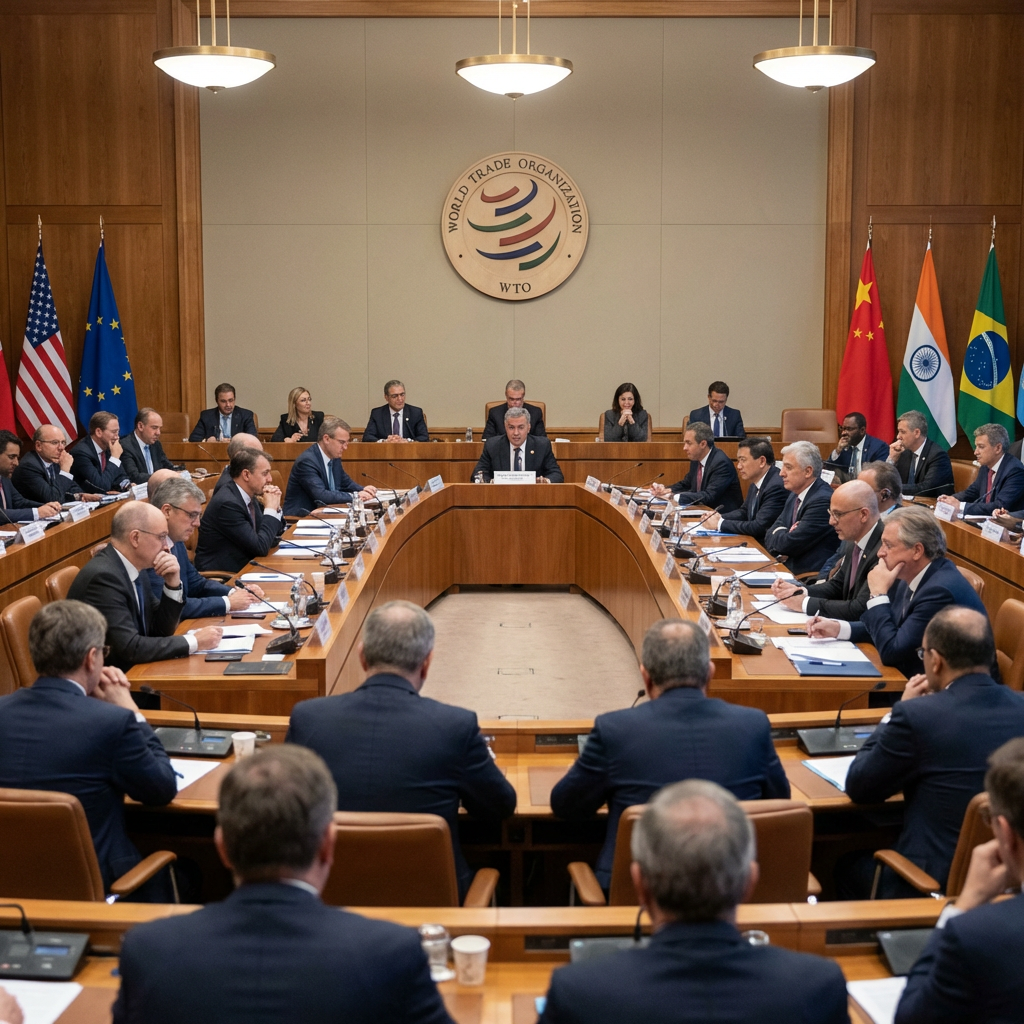
This session brought together trade ministers and senior negotiators from the WTO’s key blocs — the United States, the European Union, China, India, Brazil, and Japan — alongside representatives from dozens of smaller economies that depend most heavily on predictable trade rules.
WTO Director-General Ngozi Okonjo-Iweala opened the meeting with a stark warning. “We are at a crossroads,” she told delegates, according to officials present. “Either we find a way to restore confidence in this system, or we accept a future where trade is governed by power rather than rules.”
The central agenda items included three urgent priorities: restoring a functional dispute settlement mechanism, addressing the proliferation of unilateral tariffs, and negotiating updated rules for digital trade and subsidies.
- Dispute settlement reform — delegates discussed proposals to replace the defunct Appellate Body with a new arbitration framework, but the U.S. and EU remained far apart on enforcement powers.
- Tariff de-escalation — several nations called for a moratorium on new tariffs, though no major economy committed to rolling back existing measures.
- Digital trade rules — negotiations continued on cross-border data flows, e-commerce taxation, and artificial intelligence governance, with developing nations pushing for technology transfer provisions.
- Agricultural subsidies — India and several African nations demanded reforms to farm subsidies in wealthy nations that distort global markets.
The U.S. delegation, led by Trade Representative Katherine Tai’s successor, pushed back against restoring the old appellate mechanism, arguing it overreached into domestic policy. Washington instead proposed a system where disputes would be resolved through mediation, with binding arbitration only by mutual consent — a position that critics say effectively allows powerful nations to opt out of enforcement.
The EU countered with a proposal for a standing tribunal with enforceable rulings, backed by trade sanctions for non-compliance. China expressed conditional support for reform but demanded that any new system address what Beijing calls “discriminatory measures” targeting Chinese exports, a reference to U.S. and European restrictions on Chinese technology and EVs.
Expert Perspectives & Data
The stakes extend well beyond diplomatic protocol. According to the World Bank’s January 2026 Global Economic Prospects report, the fragmentation of the global trading system could reduce worldwide GDP by up to 5 percent in the long term — a loss equivalent to roughly $5 trillion annually. The report specifically cited “policy uncertainty driven by trade conflicts” as a primary drag on investment and growth.
“What we’re witnessing is not a temporary disruption — it’s a structural shift,” said Anabel González, a former WTO deputy director-general and current senior fellow at the Peterson Institute for International Economics, speaking in February 2026. “Countries are building parallel trade architectures outside the WTO, and once those systems mature, bringing them back under multilateral discipline becomes exponentially harder.”
Data from the WTO’s own monitoring reports paints a grim picture. In 2025 alone, G20 nations implemented 74 new trade-restrictive measures — the highest annual total since the organization began tracking in 2009. Meanwhile, the value of global merchandise trade covered by WTO dispute rulings dropped to its lowest level in two decades, reflecting the appellate paralysis.
Simon Evenett, professor of international trade at the University of St. Gallen and coordinator of the Global Trade Alert database, noted in March 2026 that industrial subsidies worldwide have tripled since 2019. “Governments are spending trillions to reshore manufacturing and secure supply chains,” Evenett said. “That spending is often WTO-inconsistent, and nobody is enforcing the rules.”
Implications
The collapse of multilateral trade governance carries profound consequences at both the macro and everyday levels. For the global economy, the immediate risk is a spiral of retaliatory tariffs that raises costs across supply chains, fuels inflation, and discourages cross-border investment. The World Bank’s projection of a 5 percent long-term GDP loss translates directly into slower wage growth, reduced job creation, and diminished economic dynamism — particularly in developing nations that rely on export-led growth strategies.
For ordinary consumers, the effects are already visible. Tariffs on Chinese EVs have pushed electric vehicle prices higher in the U.S. and Europe. Agricultural tariffs and counter-tariffs have raised food costs in multiple markets. Small businesses that import components or sell across borders face unpredictable costs and regulatory complexity that larger competitors can absorb more easily.
Farmers in developing countries face a particularly acute squeeze. Without functioning WTO rules, agricultural exporters in nations like Brazil, Thailand, and Kenya lose the legal leverage to challenge subsidies in wealthy nations that undercut their products — subsidies that the WTO was specifically designed to regulate.
The bottom line: when the rules-based trade system weakens, everyday people pay more for goods, businesses face higher uncertainty, and the global economy grows slower. The WTO crunch meeting matters because the outcome will shape whether trade remains a driver of prosperity or becomes a weapon in a geopolitical contest.
When the rules‑based trading system weakens, consumers pay more, businesses face greater uncertainty, and global growth slows. With MC14 in Yaoundé ending in deadlock and the e‑commerce moratorium lapsing, the WTO’s credibility has taken a visible hit. The key question now is whether the U.S. and EU can still bridge their differences on dispute settlement reform and basic institutional fixes in the aftermath. If they fail, the system will drift further toward fragmentation, with bilateral and minilateral deals – not the WTO – increasingly setting the rules of global trade.

[…] WTO Holds Crunch Meeting as Multilateral Trade System Teeters on the Edge. […]