





This analysis draws on reporting by Katarzyna Kubacka for Euronews, published today: “Experts warn of rapid loss of water in the Baltic Sea: ‘A vibrant reef is turning into an underwater wasteland'”
The Baltic Is in Trouble. Real Trouble.
At the start of February, something extraordinary happened in one of Europe’s most important bodies of water — and almost nobody noticed.
The Baltic Sea lost 275 billion tones of water in a matter of weeks. Sea levels dropped 67 centimeters below the long-term average — a record that stretches back 140 years. To put that in perspective: you would have to go back to 1886 to find anything comparable. And scientists are emphatic that this is not some peculiar meteorological quirk. This is climate change doing what climate change does — reshaping the planet, quietly, relentlessly, and now with increasing speed.
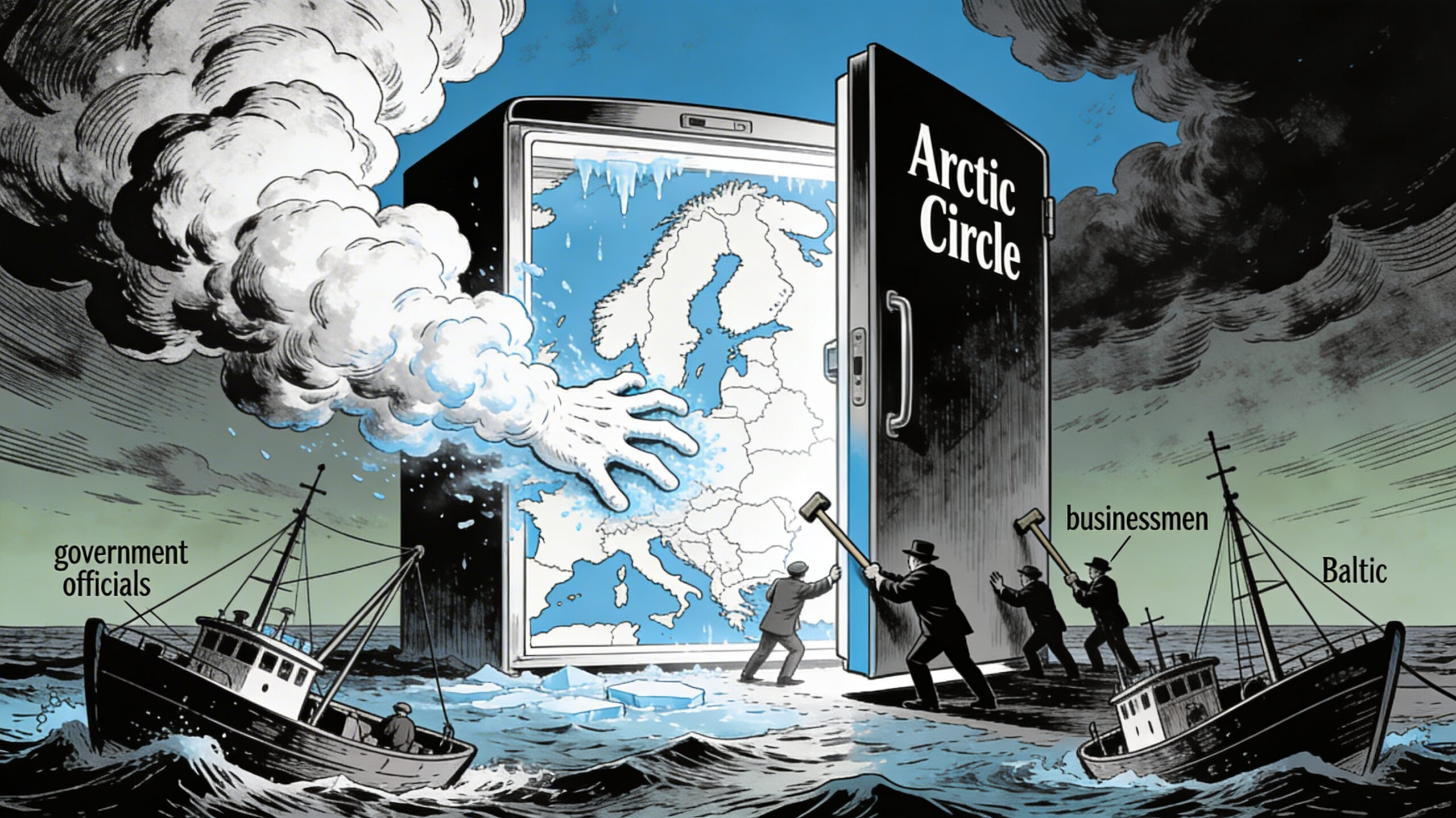
The mechanism, according to Dr. Tomasz Kijewski of the Polish Academy of Sciences’ Institute of Oceanology, is the fracturing of the polar vortex — the atmospheric circulation that has kept Arctic cold locked in place for millennia. As the Arctic warms, that seal breaks. Cold air spills south, easterly winds intensify, and the Baltic’s water gets pushed through the Danish Straits into the North Sea. Kijewski has a darkly comic name for it: “the open fridge effect”. You open the fridge, the cold air rushes out. Except in this case, the fridge is the Arctic, and the consequences are anything but trivial.
The falling water levels are dramatic, yes. But they are only the headline. The Baltic is simultaneously becoming warmer and fresher — the precise conditions under which toxic blue-green algae thrive. These algal blooms suck oxygen from the water and turn thriving marine ecosystems into dead zones. Cod, already struggling, depend on cold, salty bottom water to spawn. That habitat is vanishing. The Arctic itself is warming at four times the global average rate, and species from warmer latitudes are now encroaching northward in a process called “borealisation,” pushing out endemic cold-water species that have no higher latitude to retreat to.
And then there are the corals. The numbers are stark and they should stop you in your tracks: a sustained warming of just 1.5°C will destroy between 70 and 90 percent of all coral reefs on Earth. An ocean heatwave of just 2°C above normal, sustained for a matter of weeks, is sufficient to trigger mass bleaching events. The symbiotic algae that give coral both colour and nutrition abandon the polyps. The coral starves. What Kijewski describes as “a vibrant reef” becomes, in his words, “an underwater wasteland”. Coral reefs support at least 25 percent of all marine species. When they go, they take a quarter of ocean biodiversity with them.
We have already crossed 1.5°C. Not as a projected milestone — as a lived reality. The three-year average for 2023–2025 has breached the Paris Agreement threshold, according to the Copernicus Climate Change Service. The line that was never supposed to be crossed has been crossed.
Many Have Written About This. Repeatedly.
Here is the uncomfortable truth: none of this is news to anyone who has been paying attention.
Last October, in our piece “Our Planet’s Final Warning: Understanding the Climate Crisis Through CO₂ Emissions,” we set out clearly how 2024 had become the hottest year on record, and how the climate system’s distress signals had shifted from quiet to deafening. We wrote that the warnings could no longer be treated as something on the horizon. They were here.
Then, just two weeks ago, we published “Climate — When Economic Models Become Fiction” — an analysis of research from the University of Exeter and Carbon Tracker showing that the economic frameworks driving global climate policy are not merely inadequate; they are structurally blind to the very risks that matter most. They cannot model cascading failures. They cannot account for tipping points. They treat climate breakdown as a manageable footnote to an otherwise functioning global economy. They are, as researcher Dr. Jesse Abrams put it, unable to “capture what matters most.”
The Baltic Sea, today, is what it looks like when those models fail in the real world.
This Is Not a Warning Anymore
There is a particular kind of frustration that comes from watching something you predicted unfold exactly as you said it would, and discovering that the prediction made no difference.
Global temperatures are not creeping toward the 1.5°C threshold — they have already blown past it. The Arctic is not at risk of accelerated warming — it is already warming at four times the global average. Coral reefs are not facing an existential future threat — they are dying now, in real time, during ocean heatwaves that are becoming more frequent and more intense with every passing year. The Baltic is not a future case study in climate disruption — 275 billion tonnes of missing water make it a present-tense emergency.
And yet, the political response remains calibrated to a world that no longer exists. The economic models informing carbon policy still treat climate damage as a gentle, linear inconvenience rather than the non-linear, compounding catastrophe that the science describes. The investment frameworks governing energy infrastructure still discount future harm at rates that make inaction look rational on paper and suicidal in reality.

Dr. Kijewski, for his part, offers the simplest possible prescription: stop interfering with the oceans. We have, he argues, done enough damage. The sea needs space and time to recover whatever resilience it has left. The rare-earth mining operations now extending into ocean floors — spreading excavated material across vast areas, eliminating light and oxygen for deep-sea organisms — represent a further assault that compounds the thermal damage already underway.
But “stop interfering” demands political courage of a kind that is in chronically short supply. It demands that governments and corporations absorb short-term economic costs in exchange for long-term survival. It demands that electorates vote for restraint rather than growth. And it demands that all of us — investors, policymakers, citizens — genuinely reckon with a level of systemic risk that human psychology is remarkably poorly equipped to process.
The Baltic Sea is not somewhere far away. For readers across northern Europe, it is visible from the coastline. The water that has disappeared is not a statistic — it is the same water where millions swim in summer, where fishing fleets have operated for centuries, where ecosystems evolved over millennia. It is vanishing at a rate and in a manner that has no modern precedent.
Science cannot stop it rising back. What it can do is slow the rate at which we make everything worse. That requires listening — to researchers, to data, and to the plain evidence accumulating all around us.
Many have been saying this for some time now. The ecosystem of our planet is endangered . NOW !! The Baltic Sea is saying it louder.
It is time the world started listening.
Read the full Euronews report by Katarzyna Kubacka: “Experts warn of rapid loss of water in the Baltic Sea: ‘A vibrant reef is turning into an underwater wasteland'” (Euronews, 22 February 2026)
Previous BrainSharing coverage:
- “Our Planet’s Final Warning: Understanding the Climate Crisis Through CO₂ Emissions” — October 2025
- “Climate — When Economic Models Become Fiction” — February 8, 2026
