


After more than half a century, the United States is mounting its most ambitious lunar campaign since Apollo. NASA’s Artemis programme aims to land astronauts on the Moon’s surface by 2026, establish a sustained human presence, and use the lunar surface as a proving ground for an eventual crewed mission to Mars.
The effort is driven by converging forces: a renewed geopolitical competition with China, transformative scientific discoveries about water ice at the lunar south pole, and a booming commercial space economy worth over $600 billion globally. The stakes extend far beyond planting flags — they reach into national security, technology leadership, and humanity’s long-term future in space.
The Road Back: From Apollo to Artemis
The last humans to walk on the Moon were Apollo 17 astronauts Eugene Cernan and Harrison Schmitt in December 1972. For five decades, no nation has returned. Budget pressures, shifting priorities, and the absence of a compelling strategic rival allowed lunar exploration to fall off the agenda.
That changed in 2017 when President Donald Trump signed Space Policy Directive 1, formally directing NASA to return American astronauts to the Moon. Congress subsequently appropriated funding through the Artemis programme, named after Apollo’s twin sister in Greek mythology. The programme received bipartisan support — a rarity in Washington — because it touches on science, national security, and economic competitiveness simultaneously.
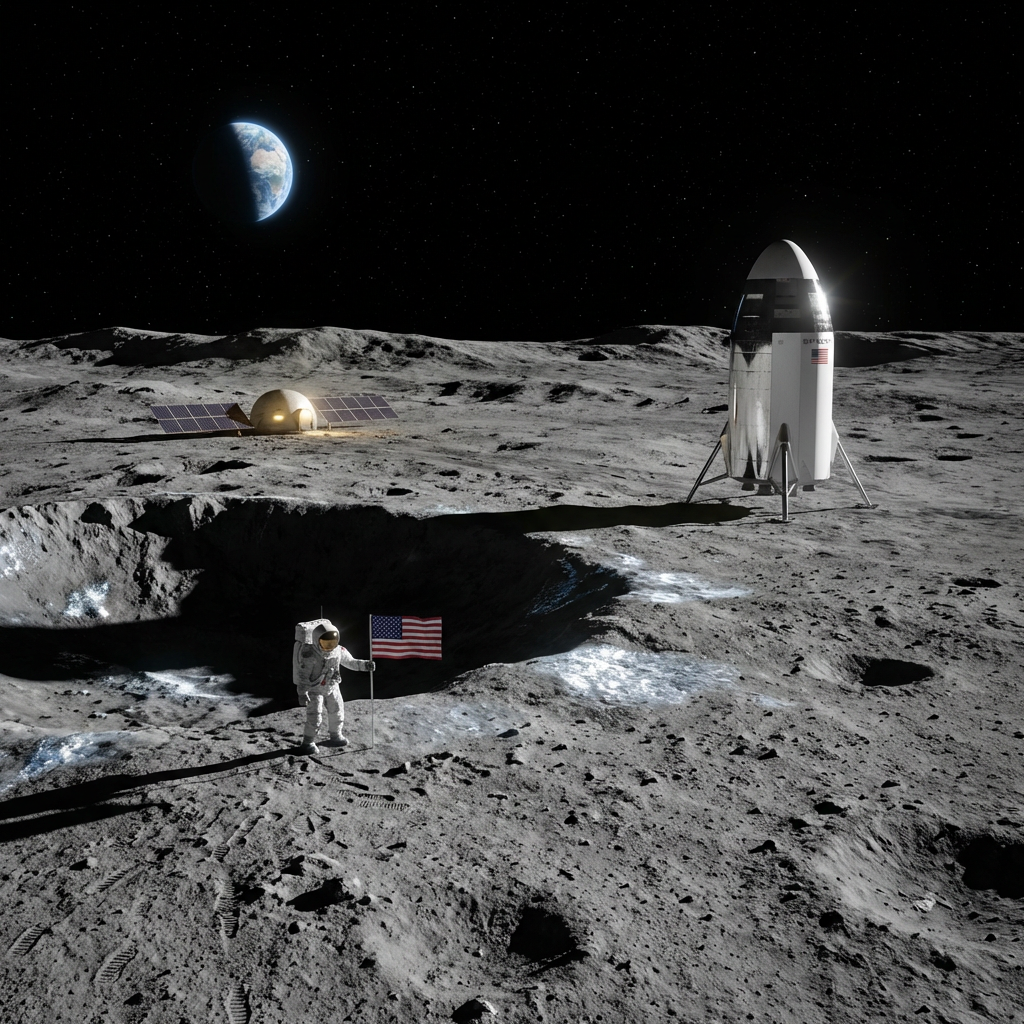
NASA’s architecture for Artemis differs fundamentally from Apollo. Rather than brief flag-and-footprint visits, the agency plans to build infrastructure: the Lunar Gateway space station in lunar orbit, human landing systems provided by commercial partners SpaceX and Blue Origin, and eventually a permanent base camp near the Moon’s south pole.
The China Factor
Perhaps the single most powerful catalyst for America’s lunar return is China’s accelerating space programme. Beijing has made no secret of its ambitions. The China National Space Administration (CNSA) successfully landed the Chang’e 4 probe on the Moon’s far side in 2019 — a world first — and returned lunar samples with Chang’e 5 in 2020 and Chang’e 6 from the far side in 2024.
China remains firmly committed to landing its own astronauts on the Moon by 2030, a target its space agency has repeatedly reaffirmed. Alongside that crewed mission goal, Beijing and Moscow are co-leading the International Lunar Research Station (ILRS), a rival to the U.S. Artemis programme targeting the lunar south pole. The ILRS construction phase begins in 2026 and is set to run through 2035, with a nuclear-powered, permanently crewed base planned for operational status around 2036 — backed by 17 partner nations including Egypt, Pakistan, and South Africa. Western intelligence assessments treat both timelines as credible and a direct driver of urgency in NASA’s own programme
“We are in a second space race,” NASA Administrator Bill Nelson told reporters in January 2024. “And it is a fact: we better watch out that they don’t get to a place on the Moon under the guise of scientific research.” Nelson has repeatedly warned that China could establish a presence at the strategically significant lunar south pole before the United States does.
- China landed Chang’e 6 on the Moon’s far side in June 2024, returning 1,935 grams of samples
- China’s crewed lunar mission target: 2030
- China has signed ILRS cooperation agreements with over a dozen countries
- NASA’s Artemis III crewed landing target: 2028
Water Ice: The Game Changer
Scientific discoveries over the past two decades have transformed our understanding of the Moon and made it far more valuable as a destination. The most consequential finding: substantial deposits of water ice exist in permanently shadowed craters near the lunar south pole.
NASA’s Lunar Crater Observation and Sensing Satellite (LCROSS) confirmed water ice in 2009. Subsequent missions, including India’s Chandrayaan-1 orbiter and NASA’s Lunar Reconnaissance Orbiter, have mapped these deposits with increasing precision. A 2023 study published in the Planetary Science Journal estimated that some permanently shadowed regions contain water ice concentrations of up to 12 percent by weight in the top 20 centimetres of regolith.
This matters enormously. Water ice can be harvested and split into hydrogen and oxygen — breathable air and rocket propellant. A lunar base capable of producing its own fuel and life support would dramatically reduce the cost of deep-space missions. Instead of launching everything from Earth’s deep gravity well, spacecraft could refuel at the Moon.
“Water is the oil of the solar system,” said Clive Neal, a lunar geologist at the University of Notre Dame. “Whoever controls access to lunar water ice will have a strategic advantage in space for decades to come.”
The Artemis Missions: Where Things Stand
NASA has already flown the first Artemis mission. Artemis I launched in November 2022, sending an uncrewed Orion capsule on a 25.5-day journey around the Moon and back. The mission validated the Space Launch System (SLS) rocket and Orion spacecraft, though it also revealed issues with the heat shield that required engineering fixes.
Artemis II successfully launched on April 1, 2026, from Kennedy Space Center — the first crewed mission beyond low-Earth orbit since Apollo 17 in 1972. After multiple delays caused by a liquid hydrogen leak, a helium flow issue, and a January winter storm, the Space Launch System lifted off at 6:24 p.m. EDT. Ground teams briefly lost communication with the crew shortly after liftoff but quickly restored contact. Commander Reid Wiseman, Pilot Victor Glover, Mission Specialist Christina Koch, and Canadian astronaut Jeremy Hansen are now en route on a ten-day free-return trajectory around the Moon, paving the way for Artemis III’s planned crewed lunar landing in mid-2027
Artemis III — once slated to be the historic first crewed lunar landing since 1972 — will no longer attempt a Moon landing at all. In a February 2026 announcement, NASA redesigned the mission as a 2027 low-Earth orbit rehearsal, focused on rendezvous and docking with SpaceX’s Starship HLS and Blue Origin’s Blue Moon landers, testing life support, communications, and the new xEVA spacesuits — broadly comparable to Apollo 9’s role in the Apollo programme. The actual crewed lunar south pole landing has been pushed to Artemis IV, now targeting 2028. SpaceX’s timeline adds further uncertainty: the company is internally targeting its Starship orbital refuelling demonstration for June 2026, an uncrewed Starship lunar landing in June 2027, and a crewed lunar surface mission no earlier than September 2028
Expert Perspectives and Data
The geopolitical dimensions of the lunar race have drawn sharp analysis from defence and space policy experts. A 2024 report by the Center for Strategic and International Studies (CSIS) warned that “the Moon represents a new domain of strategic competition” and urged the United States to accelerate its timeline or risk ceding the high ground — literally — to Beijing.
The commercial dimension is equally significant. The global space economy reached $630 billion in 2023, according to the Space Foundation, and is projected to exceed $1 trillion by 2040. Lunar activities — including resource prospecting, communications relay stations, and scientific research — represent a growing share of that market.
“The Moon is no longer just a science destination,” said Bhavya Lal, former NASA associate administrator for technology, policy, and strategy. “It is becoming economic infrastructure. The nations and companies that build the first lunar supply chains will shape the next century of space commerce.”
Cost remains a persistent concern. NASA’s Office of Inspector General reported in November 2023 that the Artemis programme will cost approximately $93 billion through 2025, with SLS launches running roughly $4.1 billion each — far exceeding initial projections. Critics argue that commercial launch providers like SpaceX could deliver equivalent capability at a fraction of the cost.
What This Means Going Forward
For the space industry and geopolitical landscape, NASA’s lunar return signals a fundamental shift. The Moon is no longer a symbolic destination but a strategic waypoint. Control of lunar resources, particularly water ice, could determine which nations and companies dominate the next era of space exploration. The Artemis Accords — signed by 43 nations as of mid-2025 — establish norms for lunar activity, but China and Russia remain outside this framework, creating a potential for competing governance regimes on the lunar surface.
For ordinary people, the implications are less immediate but no less real. NASA’s investment in Artemis has already generated thousands of high-skilled jobs across the United States, from manufacturing facilities in Alabama and Louisiana to mission control in Houston and launch operations in Florida. Technologies developed for lunar missions — including advanced life support, autonomous robotics, and in-situ resource utilisation — will eventually filter into everyday applications on Earth, much as Apollo-era innovations gave rise to modern computing, materials science, and telecommunications.
Taxpayers should also watch the cost trajectory closely. At $93 billion and counting, Artemis represents one of the largest single-programme investments in NASA’s history. Whether that investment yields transformative returns — scientific, strategic, and economic — depends on execution over the next five years.
The bottom line: the Moon is no longer a relic of Cold War nostalgia. It is becoming the most strategically contested real estate beyond Earth. Whether the United States or China establishes a sustained presence first will shape space governance, resource access, and technological leadership for the rest of this century. For everyday Americans, this race will drive job creation, technology spinoffs, and — eventually — lower costs for satellite services like GPS, weather forecasting, and broadband that billions of people already depend on.
The critical question to watch: will SpaceX’s Starship successfully demonstrate orbital refuelling in time for Artemis III’s 2026 target, or will technical delays hand China a window to stake its claim at the lunar south pole first?
