
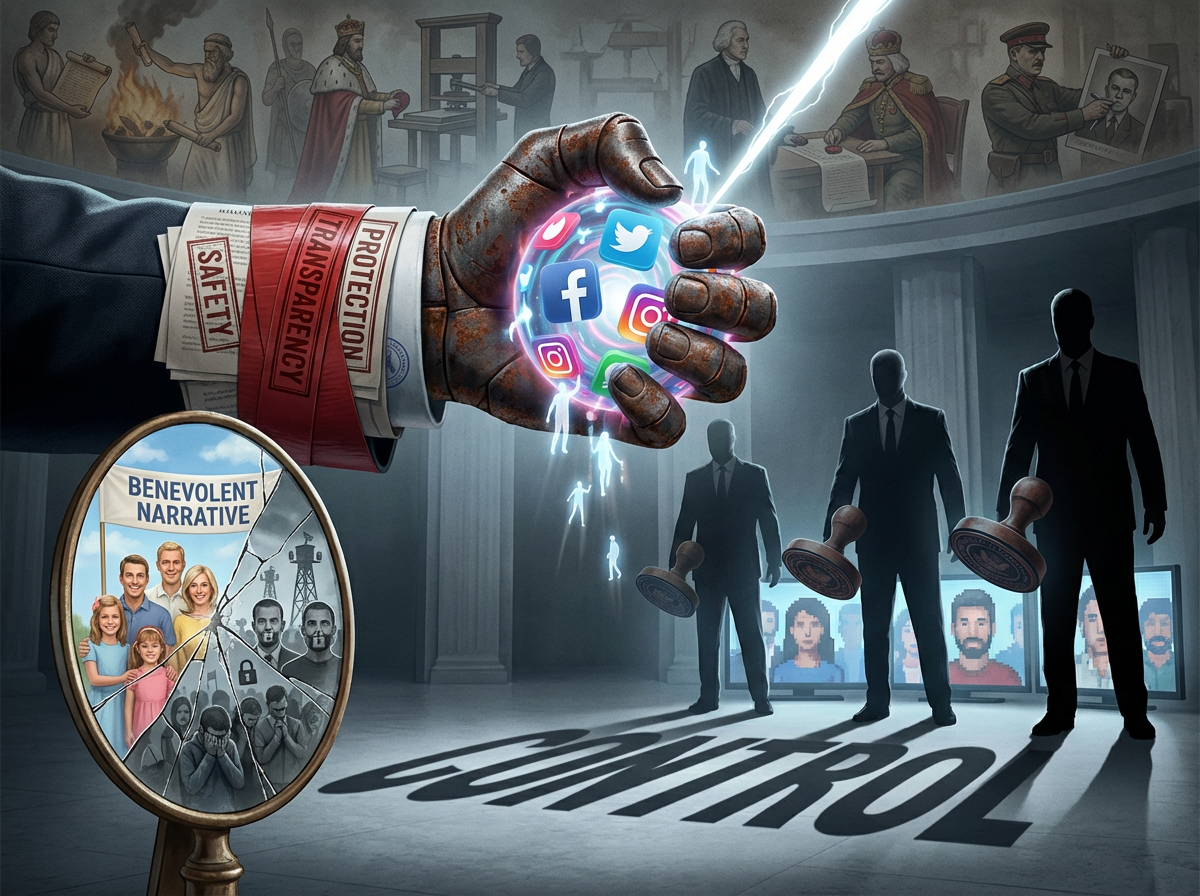

There is a battle underway — quiet in its legal language, but thunderous in its consequences. Governments, regulators, and the establishment interests that orbit them are systematically tightening their grip on social media, and the official justifications being offered — protecting children, combating misinformation, ensuring platform transparency — are, at best, incomplete. At worst, they are a smokescreen for something altogether more ancient and familiar: the determination of powerful people to control what other people are allowed to say, read, and believe.
To understand where we are, we must understand where we came from.
The Old Order and Its Perfect Machinery
For most of the twentieth century, the architecture of public discourse was brutally simple. A small number of television networks, newspaper chains, and radio conglomerates held a virtual monopoly over the information that billions of people consumed. This was not accidental.
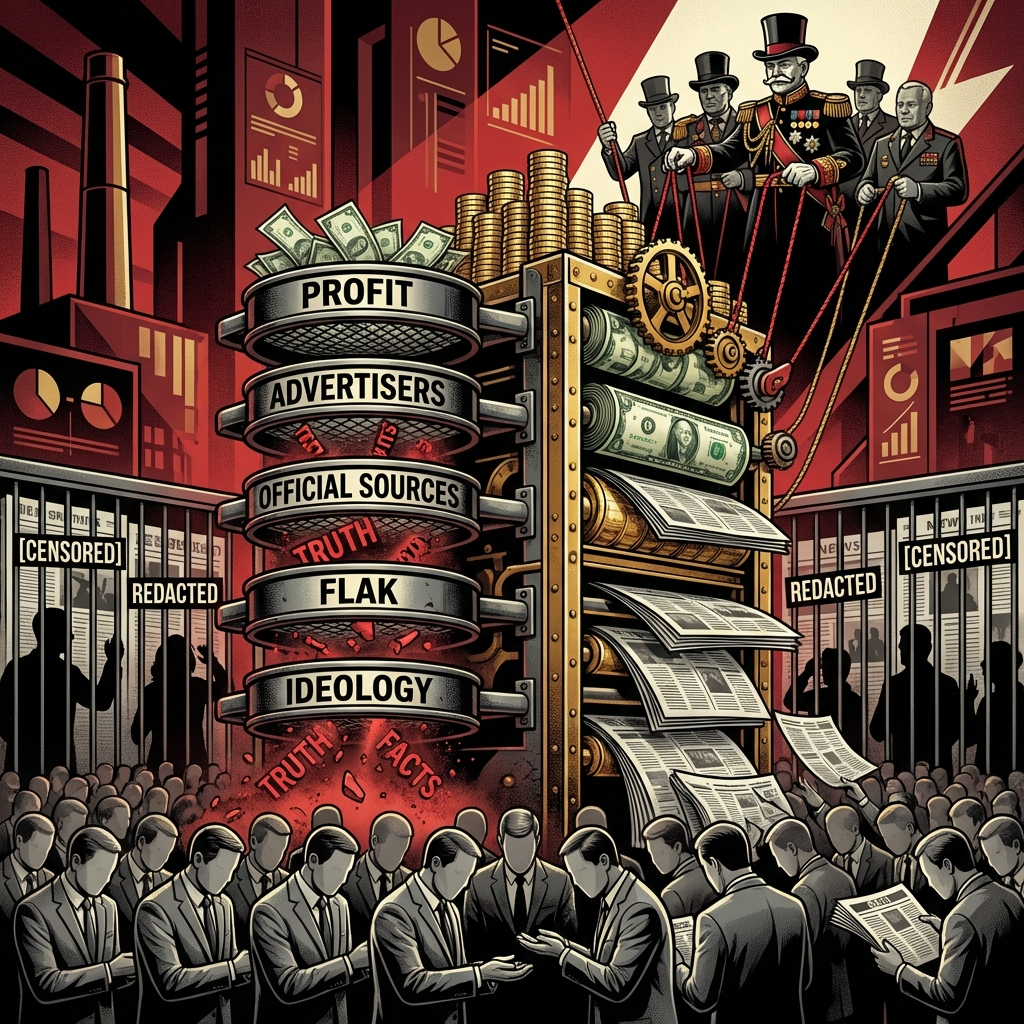
In their landmark 1988 work Manufacturing Consent: The Political Economy of the Mass Media, Noam Chomsky and Edward Herman described precisely how this system operated. Their “propaganda model” identified five filters through which news must pass before it reaches the public: profit motive, advertiser influence, dependence on government and institutional sources, vulnerability to coordinated criticism, and ideological conformity. The result was a media landscape that, while projecting the appearance of pluralism and independence, was structurally oriented toward protecting elite power and suppressing dissent.
By the time the Reagan administration dismantled media ownership regulations in the 1980s, the consolidation became extreme. Today, as Chomsky’s analysis predicted, just six corporations control approximately 90% of all American mainstream media sources. The pattern is not American alone. A January 2026 Oxfam report confirmed that more than half of the world’s largest media companies are now owned or controlled by billionaires. In the United Kingdom, four super-rich families control three-quarters of the national newspaper circulation. In France, billionaire Vincent Bolloré effectively transformed CNews into a vehicle for his political worldview through editorial control. This is media ownership as political infrastructure — not press freedom, but press possession.
Al Gore, in his prescient 2007 work The Assault on Reason, diagnosed the specific pathology that television introduced into democratic life. The medium’s one-way, passive nature, he argued, destroyed the “marketplace of ideas” that the founders of American democracy had imagined — a marketplace modelled on the reciprocal, argumentative nature of the printed word and the town hall. Television made citizens into spectators, dependent on whoever could afford expensive broadcast time, which made politicians dependent on wealthy donors who could fund campaigns, which made governance dependent on the interests of those donors. It was a self-reinforcing loop of captured democracy. Gore’s remedy was a genuinely open internet — a two-way medium that could restore civic participation and break the broadcast monopoly. He was right about the diagnosis. What he could not fully anticipate was how ferociously the old order would resist the cure.
Social Media Breaks the Model — and Terrifies the Establishment
When social media matured in the late 2000s and accelerated through the 2010s, it did something the gatekeepers had never encountered: it gave ordinary people a genuine megaphone. A citizen journalist in Cairo could reach a global audience. A political candidate without donor backing could build millions of followers. An investigative claim could go viral before a newspaper editorial board had finished its first breakfast meeting. The research is unambiguous: as one peer-reviewed study on social media and democratic participation concluded, “the legacy of traditional media as gatekeepers or campaign mediators is declining in terms of influence and power”. Suddenly, the model that Chomsky described — the one in which non-routine sources “must struggle for access and may be ignored by the arbitrary decision of the gatekeepers” — was crumbling.
This was politically destabilising in ways that cut across left and right. Brexit, the Arab Spring, the Yellow Vest movement, the rise of independent political commentators with audiences dwarfing legacy TV shows — all of these demonstrated that social media could catalyse genuine political force outside of established channels. Shoshana Zuboff, in her monumental The Age of Surveillance Capitalism (2019), framed what came next as a confrontation between two visions of the digital age: one of individual empowerment and democratisation, and one of behaviour modification and social engineering at an industrial scale. The establishment chose the latter path — and regulation became its primary tool.
The Regulatory Assault — Evidence, Not Conspiracy Theory
The fines and legal actions against social media companies have become a drumbeat so constant that each new headline barely registers. But when placed side by side, they reveal a pattern of escalating institutional pressure that goes well beyond consumer protection.
Meta alone has accumulated approximately €2.29 billion in EU fines in recent years, including a €1.2 billion GDPR penalty, a €797.72 million competition fine, and a €91 million penalty for password storage failures. In December 2025, the European Commission issued the first-ever fine under the Digital Services Act, hitting X with €120 million over alleged transparency violations — with a broader ongoing investigation into the platform’s content practices still proceeding. More than 100 free-speech experts and legal scholars issued a coordinated warning in late 2025 that the DSA risks “creating a global online censorship regime,” pointing specifically to vague categories such as “systemic risks,” “disinformation,” and “illegal content” that give Brussels sweeping power to pressure platforms into removing lawful speech. The Commission dismissed those concerns entirely.
In the United States, the legal assault shifted to civil courts in early 2026, with juries in both New Mexico and California finding social media companies liable for harm to minors, with analysts explicitly comparing the moment to the “big tobacco” litigation era. The EU’s Digital Services Act Article 35 guidelines on electoral integrity, issued in April 2024, instructed very large platforms to adapt their algorithms, content moderation systems, and advertising tools during election periods specifically to “mitigate risks to civic discourse” — language that critics note is indistinguishable from government-directed preemptive political censorship. Globally, according to a March 2026 Statista analysis, internet censorship cases rebounded to 81 new restrictions in 2025 — a sharp increase from 63 in 2024 — with political events as the trigger in more than half of all instances.
Platforms Caving — The Evidence Is Specific
Even X, ostensibly the platform most resistant to political pressure under Elon Musk’s ownership, demonstrated in 2025 that no platform operating in a jurisdiction with coercive tools at its disposal is immune. In May 2025, Human Rights Watch documented that X complied with Turkish court orders to block the account of Istanbul Mayor İmamoğlu — a man with 9.7 million followers — during nationwide anti-government protests. Meta and X both admitted to complying with Turkish government content-blocking requests ahead of the 2023 presidential elections after facing bandwidth throttling threats. Venezuela blocked Telegram during Maduro’s 2025 inauguration. Indonesia temporarily shut Instagram over content disputes. The mechanism is always the same: threaten a platform’s access to the market, its bandwidth, its App Store presence, or its ability to operate legally, and extract compliance.
This is the infrastructure chokepoint, and it is more powerful than any fine. When Parler, Gab, and similar alternative platforms grew in the early 2020s, the response was swift and surgical: Apple and Google removed them from their App Stores, and Amazon Web Services deplatformed Parler entirely, rendering it inoperative overnight. The message to any platform contemplating genuine independence was explicit: you do not own your distribution, and you do not own your server space. The apparent plurality of online voices rests on a foundation of perhaps five or six infrastructure companies — and those companies are firmly within the jurisdictional and regulatory reach of Western governments.
Why Control Matters More Than Harm
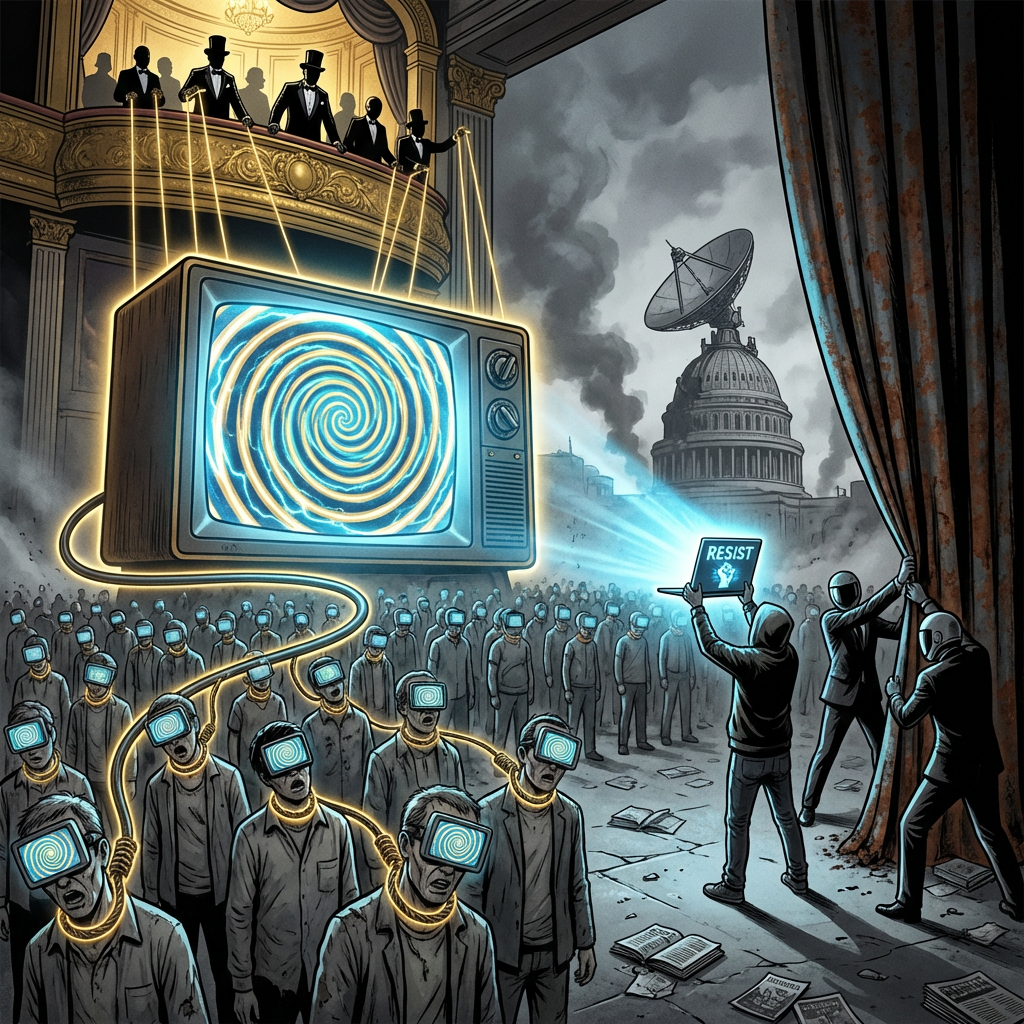
It would be dishonest to deny that social media carries genuine risks. The documented effects on adolescent mental health, the algorithmic amplification of outrage and addiction mechanics — these are real, and they deserve serious policy attention. But they are not new. Neil Postman warned in Amusing Ourselves to Death (1985) that television was restructuring cognition, attention, and democratic capacity in children and adults alike. Al Gore’s Assault on Reason made identical arguments about TV addiction and passive consumption as threats to civic life. Video games, 24-hour news cycles, and tabloid newspapers have all generated comparable moral panics. None of them triggered the systematic, coordinated global regulatory architecture now being constructed around social media.
The distinguishing factor is not harm — it is power. As the University of Pennsylvania’s DevLab research on media ownership and political investment concluded, the ultra-rich use media ownership not primarily for profit, but as a political instrument. Social media disrupts that instrument because it cannot be easily purchased, editorially directed, or selectively withheld in the way a newspaper chain or television network can be. A billionaire can buy the Washington Post and instruct its editorial line. No single billionaire — not even Musk — can fully control what one billion Instagram users post every day. That uncontrollability is precisely what is being targeted. The regulation is not about protecting democracy. In many cases, it is about restoring the elite’s capacity to manage it.
The Path Forward — Distributed, Decentralised, Ungovernable
The solution, historically, has always been the same: when power concentrates control, those who value freedom disperse. And the technical infrastructure to do exactly that already exists and is growing rapidly.
The Fediverse — a constellation of independently hosted, interoperable platforms built on the open ActivityPub protocol — is the most architecturally significant development in this space. Mastodon, PeerTube, Pixelfed, Lemmy, and dozens of other services operate without any central authority. Each is hosted independently, often by individuals or small organisations, meaning that shutting down one instance leaves thousands of others entirely intact. No single government can serve a takedown notice to the Fediverse because there is no single legal entity to serve it to. The decentralised social media market was valued at $18.5 billion in 2025 and is projected to reach $141.6 billion by 2035. Ethereum co-founder Vitalik Buterin’s public return to decentralised platforms in early 2026 was widely interpreted as a signal that serious technical and financial credibility is following this movement.
A 2025 TechPolicy Press investigation identified independent media’s core vulnerability as infrastructural dependency — the fatal decision, made by Vice, BuzzFeed, and countless smaller outlets, to build their entire audience on rented land — Facebook reach, Google traffic, YouTube monetisation — rather than on owned platforms. The French Union of Independent Online Press (SPIIL) has formally mandated that member outlets maintain independent websites specifically because relying solely on social media is too existentially risky. The lesson is transferable and urgent: if you don’t own your infrastructure, you don’t own your voice.
The practical stack for genuine digital resilience is available today. Self-hosted WordPress or BBPress forums for publishing and community. PeerTube for video, with YouTube used only as an additional distribution channel. Mastodon or a self-hosted ActivityPub instance for social reach. Email lists and RSS feeds as the non-algorithmic, non-censorable connective tissue between audience and creator. European-based hosting providers — Hetzner in Germany is a prime example — operating outside US corporate jurisdiction but within GDPR compliance frameworks.
The logic is not ideological. It is the same logic applied to any resilient system: the more nodes in the network, the more difficult the network becomes to disrupt. One thousand independent platforms are not merely ten times harder to control than one hundred — they are categorically, architecturally different in kind. They require a qualitatively different level of legal, political, and technical effort to suppress, and that friction is, ultimately, what freedom depends on.
The gatekeepers are not going away. The regulatory machinery being assembled around social media is real, well-funded, and backed by interests that have been managing public discourse for a century. But the tools to route around that machinery have never been more accessible, more mature, or more widely understood. The question is not whether a more open information ecosystem is technically possible. The question is whether enough people understand what is at stake — and choose to build it.
AI Disclosure: This post was created with the assistance of artificial intelligence. The ideas, analysis, and opinions expressed are my own — AI was used to help compose, structure, and refine my personal notes and thoughts into the final written content. Images, videos and music featured in this post were also generated using AI tools, based on my own creative prompts and direction.
References
Herman, E.S. & Chomsky, N. (1988). Manufacturing Consent: The Political Economy of the Mass Media. Pantheon Books, New York.
Aeon/Al Jazeera. (2022). “Is mass media still ‘manufacturing consent’ in the internet age?” https://aeon.co/videos/is-mass-media-still-manufacturing-consent-in-the-internet-age
Oxfam International / Kenyan Wall Street. (2026, January 21). “Billionaires Have Tightened Grip on Global Media.” https://kenyanwallstreet.com/billionaires-tighten-grip-on-global-media-oxfam
DCReport. (2025, October 8). “When Billionaires Own the News: The Death of Public Truth.” https://www.dcreport.org/2025/10/08/private-media-ownership-threat-democracy/
Gore, A. (2007). The Assault on Reason. Penguin Press, New York. https://en.wikipedia.org/wiki/The_Assault_on_Reason
Boulianne, S. (2020). “Social Media Effects: Hijacking Democracy and Civility in Civic Engagement.” Preprints. https://pmc.ncbi.nlm.nih.gov/articles/PMC7343248/
Morozov, E. (2011). The Net Delusion: The Dark Side of Internet Freedom. PublicAffairs, New York.
Zuboff, S. (2019). The Age of Surveillance Capitalism: The Fight for a Human Future at the New Frontier of Power. PublicAffairs, New York. https://www.bias-ame.com/ar/library/browse/title/details/1df8c3cd
EU Perspectives. (2026, January 12). “€3.77bn in fines: Last year’s Big Tech bill in Europe.” https://euperspectives.eu/2026/01/last-years-big-tech-bill-in-europe/
EU Criminal Justice / EuCrim. (2025). “EU Fines X €120 Million in First DSA Non-Compliance Decision.” https://eucrim.eu/news/eu-fines-x-120-million-in-first-dsa-non-compliance-decision/
NTD / ADF International. (2025, December 5). “EU Faces Backlash Over Digital Services Act Due to Free Speech Concerns.” https://www.youtube.com/watch?v=8nsdTThiBmY
YouTube / NPR. (2026, March 26). “Two Verdicts Find Fault With Social Media Giants.” https://www.youtube.com/watch?v=EG1w8Sa-rLU
European Parliament. (2025, March). “Digital Services Act: State of Play.” https://www.youtube.com/watch?v=oFRhNQRyy7U
Statista. (2026, March 11). “Web Censorship Cases Rebound in 2025.” https://www.statista.com/chart/35957/number-of-online-censorship-cases-worldwide
Human Rights Watch. (2025, May 8). “Joint Open Letter to Social Media Companies on Censorship in Türkiye.” https://www.hrw.org/news/2025/05/08/joint-open-letter-social-media-companies-censorship-turkiye
Fore Dialogue / PubPub. (2022). “‘Censorship-free’ platforms: Evaluating content moderation policies on alternative social media.” https://foredialogue.pubpub.org/pub/bsh5uhll
Postman, N. (1985). Amusing Ourselves to Death: Public Discourse in the Age of Show Business. Viking Penguin, New York.
Freedom House. (2025). Freedom on the Net 2025: An Uncertain Future for the Global Internet. https://freedomhouse.org/report/freedom-net/2025/uncertain-future-global-internet
Penn DevLab. (n.d.). “How the Ultra-Rich Use Media Ownership as a Political Investment.” University of Pennsylvania. https://pdri-devlab.upenn.edu/publications/how-the-ultra-rich-use-media-ownership-as-a-political-investment/
DevConf.CZ. (2025). “An Introduction to the Decentralised Social Network.” https://www.youtube.com/watch?v=Xognsnc8eU4
YouTube / Mastodon advocacy. (2024). “Why you need to be using Mastodon & PeerTube in 2025.” https://www.youtube.com/watch?v=GqcqqR9fIBA
AInvest. (2026, January 21). “Decentralized Social Media’s Next Growth Phase: A Strategic Investment Opportunity.” https://www.ainvest.com/es/news/decentralized-social-media-growth-phase-strategic-investment-opportunity-2026-2601/
TechPolicy Press. (2025, April 7). “Independent Media has an Infrastructural Problem.” https://techpolicy.press/independent-media-has-an-infrastructural-problem
FAIR / Fairness & Accuracy In Reporting. (2026, February 2). “The Digital Media Oligarchy: Who Owns Online News?” https://fair.org/home/the-digital-media-oligarchy-who-owns-online-news/
Media Reform Coalition UK. “Media Ownership and Control.” https://www.mediareform.org.uk/key-issues/media-ownership-and-control
Harvard Shorenstein Center. “Index of US Mainstream Media Ownership.” https://futureofmedia.hsites.harvard.edu/index-us-mainstream-media-ownership
European Commission. (2025, December 3). “Commission fines X €120 million under the Digital Services Act.” https://ec.europa.eu/commission/presscorner/detail/en/ip_25_2934
ADF International. (2026, February 19). “X challenges €120m fine under EU ‘censorship law’ at top European court.” https://adfinternational.org/news/x-challenges-e120m-fine-under-eu-censorship-law
Change Research. (2026, January 4). “Americans Turn to Independent Voices as Traditional Media Loses Ground.” https://changeresearch.com/americans-turn-to-independent-voices-as-traditional-media-loses-ground/
Revistas UNAV. (2020). “Effects of Traditional and Social Media on Political Trust.” Communication & Society. https://revistas.unav.edu/index.php/communication-and-society/article/view/33612
NPR / Gore, Al. (2007, May 25). “‘The Assault on Reason’ in America.” https://www.npr.org/2007/05/25/10440121/al-gore-the-assault-on-reason-in-america
Reporters Without Borders (RSF). (2026, February 5). “Press freedom under pressure in Germany due to disinformation and political polarisation.” https://rsf.org/en/press-freedom-under-pressure-germany-due-disinformation-political-polarisation-and-attacks
Tech Policy Press. (2026, January 4). “Reviewing European Antitrust Activity in 2025 and What It All Means for 2026.” https://techpolicy.press/reviewing-european-antitrust-activity-in-2025-and-what-it-all-means-for-2026
2B Advice. (2025, January). “GDPR fines in December 2024: millions in penalties against Meta, OpenAI, Netflix and Telefonica.” https://2b-advice.com/en/2025/01/06/dsgvo-fines-in-december-2024
Moyers, B. (2016). “Noam Chomsky on Manufacturing Consent.” BillMoyers.com. https://billmoyers.com/content/noam-chomsky-part-1
