






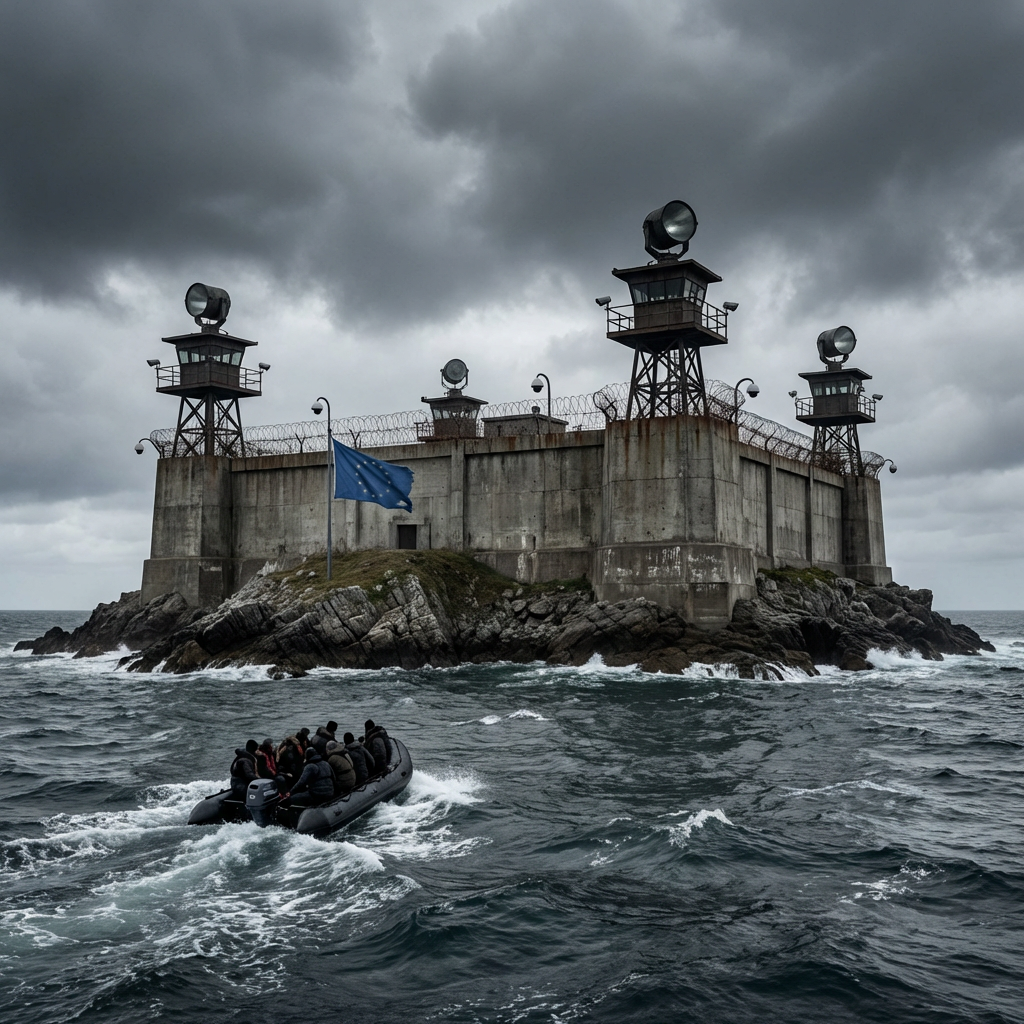
The European Parliament, in a vote that reverberated through the halls of Brussels on March 26, 2026, approved a contentious legal framework authorizing the establishment of offshore migrant detention centres, fundamentally altering the bloc’s migration architecture and igniting a fierce debate over sovereignty, security, and the soul of European solidarity.
Background
The decision culminates years of escalating political pressure following the 2015 migration crisis, which saw over a million asylum-seekers arrive in Europe. Previous ad-hoc measures, like the 2016 EU-Turkey deal, proved fragile and temporary. This new framework represents a deliberate, systemic shift towards externalizing border control, moving processing and detention beyond the EU’s physical frontiers.
The policy draws direct inspiration from models like Australia’s offshore processing regime, which has been operational since 2012. It aims to deter irregular crossings by ensuring that those intercepted at sea are not brought to EU soil for asylum claims, but rather to third-country facilities for assessment.
Political Fault Lines and the Parliamentary Vote
The vote passed with a majority of 397 to 215, reflecting a stark political divide. Centre-right and right-wing parties largely championed the measure as essential for regaining control over the EU’s external borders and undermining smuggling networks.
Opposition came from the left, Greens, and some liberal MEPs, who decried the plan as a betrayal of international law and European values. Member states remain split; governments in Italy and Greece, often on the frontline of arrivals, have been vocal proponents, while Germany and France have expressed cautious, conditional support, emphasizing the need for humane conditions.
Comparisons with national approaches are inevitable. Hungary’s hardline, fence-building strategy contrasts with Spain’s more integration-focused model. This EU-wide framework attempts to harmonize these divergent philosophies into a single, albeit controversial, policy.
Economic Costs and Geopolitical Bargaining
The financial implications are substantial. Initial estimates from the European Commission suggest start-up costs exceeding €3 billion, with annual operational expenses to be shared among member states based on GDP. This funding will compete directly with budgets for domestic social services, infrastructure, and the green transition.
Geopolitically, the EU is now engaged in delicate negotiations with potential host countries in North Africa and the Western Balkans. Nations like Tunisia and Morocco are seen as likely partners, but their cooperation will come at a high price—likely in the form of increased development aid, trade concessions, and visa facilitation for their own citizens.
This externalization creates new dependencies. The EU’s leverage on human rights and democratic standards in partner countries may be compromised by the imperative to secure deals for detention centres, as noted in recent analysis by the European Council on Foreign Relations.
Humanitarian and Legal Quagmires
Human rights organizations have issued stark warnings. The UNHCR has reiterated that offshore processing often leads to indefinite detention, mental health crises, and inadequate access to fair asylum procedures. Historical data from Australia’s system shows prolonged detention times and high rates of self-harm among detainees.
Legal challenges are imminent. NGOs like Amnesty International and the European Council on Refugees and Exiles (ECRE) are preparing cases to bring before the European Court of Justice. They argue the framework violates the EU’s Charter of Fundamental Rights, particularly the principles of non-refoulement and the right to asylum.
The comparison with the Australian model is instructive but fraught. While proponents cite a decrease in sea arrivals, critics point to the immense human and moral cost, questioning whether such a trade-off is acceptable for a union founded on human dignity.
What Analysts Are Saying
Analysts at the Bruegel economic think tank argue that the policy could have unintended economic consequences. “The significant fiscal outlay for offshore infrastructure may strain public finances without a guaranteed reduction in long-term migration pressures, potentially diverting funds from more effective integration programs that boost host economies,” a recent briefing stated.
Geopolitical analysts offer a contrasting view. “From a realist perspective, this is the EU finally acting as a strategic power,” says a senior fellow at the International Institute for Strategic Studies. “It addresses a core vulnerability—the inability to control external borders—which has fueled populism and threatened the Schengen area. The humanitarian concerns are valid, but without order, there can be no sustainable compassion.”
Meanwhile, voices from the Migration Policy Institute stress the operational risks. “Outsourcing detention does not outsource responsibility. The EU will remain legally and morally accountable for what happens in these centres, yet its ability to monitor conditions on the ground will be severely limited,” their report concludes.
The Real-World Impact
Here is what this means if you work for a living. The billions allocated to building and maintaining offshore centres are taxpayer funds. This could mean less money available for your local hospital, school, or public transport system, or pressure to increase taxes elsewhere.
For communities in coastal regions like the Greek islands or Italian Lampedusa, the policy may reduce the immediate pressure of disembarkations and temporary camps. However, it does not address the root causes of migration, meaning flows may simply shift to new, more dangerous routes, increasing the risk of tragedies at sea.
The move signals a broader shift in how the EU prioritizes security over certain civil liberties. The surveillance and intelligence-sharing required to intercept boats and manage remote detention could expand state monitoring capabilities, with potential implications for personal privacy and data rights for everyone.
Access to fair asylum procedures is a core tenet of international law. If offshore centres lack robust legal oversight, the chance of wrongful deportations increases. This erodes the legal protections that, in theory, exist to protect anyone from arbitrary state power.
Political Accountability
Elected officials have voted for this framework. The European Commission will now negotiate implementation agreements with third countries. National governments must decide whether to opt-in and contribute funding. To date, the debate has been dominated by security and deterrence rhetoric, with less public discussion on the long-term fiscal trade-offs or diplomatic concessions required.
The Standard They Should Be Held To
Economic growth must be supported by efficient, competitive markets, but not by creating a shadow system of detention that consumes public resources without clear, accountable returns. Innovation in border technology should be encouraged, but not at the expense of transparent, cost-effective governance.
Social investment is a baseline obligation. Every euro spent on externalizing borders is a euro not spent on integrating newcomers who could fill labour shortages, or on strengthening public services for all citizens. Governments must demonstrate how this policy enhances, rather than detracts from, universal healthcare, education, and housing.
Civil liberties are non-negotiable. Any policy that risks creating legal black holes, where due process and human dignity are suspended, must be rigorously challenged. The standard is clear: security must be achieved within the bounds of the rule of law and fundamental rights, not by circumventing them.
The Uncharted Waters Ahead
The immediate next step is the selection of host countries, with negotiations expected to begin in Q2 2026. Legal challenges will be filed in the European Court of Justice by autumn, seeking injunctions on implementation. All eyes will be on the first operational centre, likely to be established under a pilot program by late 2027.
Key signals to watch include the stance of the European Court of Human Rights in Strasbourg, which operates separately from the EU’s own court. Monitor the public reaction in potential host nations—popular opposition there could derail agreements. Finally, track migration flow data from Frontex: a significant drop in crossings would be hailed as a success by proponents, while a steady or redirected flow would underscore the policy’s limitations.
The continent has chosen a path of externalization, but the journey will test whether Europe can harden its borders without hardening its heart.
