






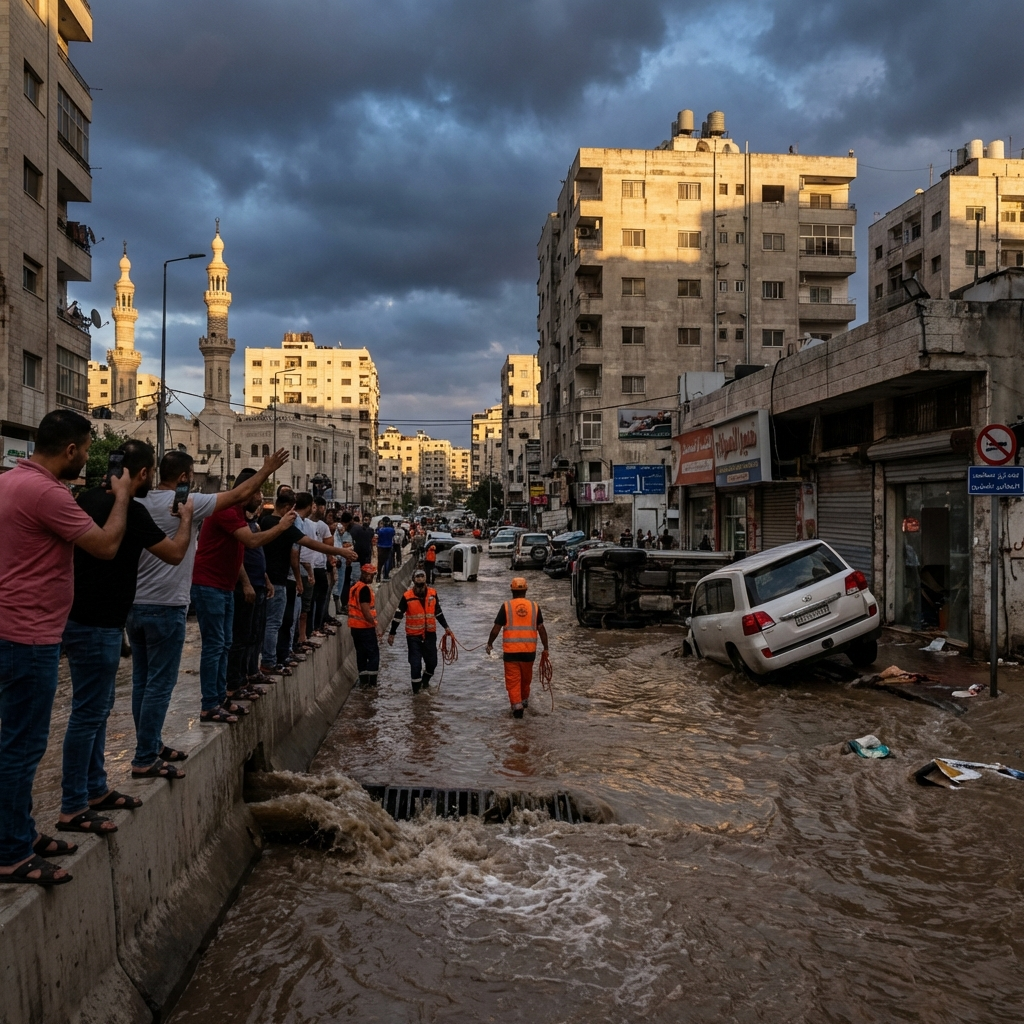
Devastating storms have torn across the Middle East and North Africa in recent months, sweeping vehicles through flooded streets, collapsing homes, and killing dozens of people from the Gulf states to the Levant and North Africa. A dramatic video circulating from late March 2026 captured torrential waters ripping cars and SUVs through narrow residential streets — a visceral reminder that the region’s climate crisis has arrived with terrifying force. The disasters, which have intensified across a six-month window from October 2025 through March 2026, have exposed crumbling infrastructure, overwhelmed emergency services, and forced governments to confront a reality they have long downplayed: the Arabian Peninsula and the broader MENA region are now ground zero for a new era of extreme precipitation events.
Background
The Middle East and North Africa has historically been defined by aridity. Annual rainfall across much of the Arabian Peninsula hovers below 100 millimeters — among the lowest on Earth. Yet over the past decade, the region has experienced a dramatic uptick in extreme rainfall events, flash flooding, and cyclonic activity that defies long-held climatic assumptions.
In April 2024, the United Arab Emirates recorded its heaviest rainfall in 75 years, with more than 250 millimeters falling in under 24 hours in parts of Dubai and Sharjah — roughly two years’ worth of rain in a single day. The event paralyzed the city-state’s world-class infrastructure, flooded the international airport, and caused billions of dollars in damage. Oman suffered even worse: at least 20 people died in flash floods that swept through mountain villages and coastal towns.
Those events were not anomalies. They were harbingers. In September 2023, Storm Daniel — a Mediterranean hurricane — struck eastern Libya with catastrophic force, bursting two aging dams above the city of Derna and killing more than 4,000 people, with thousands more still unaccounted for. The disaster laid bare the lethal intersection of climate volatility, political dysfunction, and infrastructure neglect.
According to the Intergovernmental Panel on Climate Change (IPCC).The MENA region is experiencing a perfect storm of converging forces. Greenhouse gas emissions have driven regional temperatures to rise at roughly twice the global average, and because warmer air holds approximately seven percent more moisture per degree Celsius of warming, storms that do form release dramatically larger volumes of rain in compressed timeframes. Adjacent sea basins — the Arabian Sea, Red Sea, and eastern Mediterranean — have warmed considerably, injecting additional latent heat and moisture into developing weather systems, at times spawning Mediterranean hurricanes, or “medicanes,” capable of catastrophic landfall. Shifts in large-scale atmospheric circulation are channeling atmospheric rivers — dense, elongated plumes of water vapor — deep into ordinarily arid landscapes, overwhelming terrain and drainage systems utterly unprepared for such volumes. Compounding these physical dynamics, rapid urbanization has blanketed deserts and flood-prone wadis with impermeable concrete and asphalt, eliminating natural absorption and turning entire city surfaces into runoff accelerators.
The Six-Month Surge: October 2025 to March 2026
The period from late 2025 into early 2026 has been particularly brutal. In October 2025, heavy flooding struck parts of southern Iraq and Kuwait, submerging roads and displacing thousands of families. Iraq’s drainage infrastructure — much of it dating to the Saddam Hussein era and never adequately upgraded — proved wholly inadequate for the volume of water that descended.
In November 2025, Saudi Arabia’s western province experienced severe flash flooding along the Hejaz mountain range. The city of Jeddah, which has suffered repeated catastrophic floods since 2009 and 2011, saw renewed inundation despite billions of riyals invested in flood mitigation infrastructure. Residents reported water levels reaching the second floors of buildings in low-lying neighborhoods.
December brought a series of powerful storm systems to the eastern Mediterranean. Lebanon, already reeling from economic collapse and political paralysis, saw severe flooding in the Bekaa Valley and along the northern coast. Syria’s Idlib province — home to millions of internally displaced people living in makeshift camps — suffered devastating flood damage to tent settlements, destroying what little shelter families had.
By January and February 2026, the storm track shifted southward. Oman and Yemen bore the brunt of tropical moisture surges from the Arabian Sea. In Yemen, floods compounded an already dire humanitarian crisis, destroying agricultural land in the Tihama coastal plain and contaminating water supplies in Houthi-controlled areas where healthcare infrastructure has been systematically bombed.
The late March 2026 storms — the ones captured in the widely circulated video — struck with particular ferocity across Jordan, Palestine, and parts of Israel and the occupied West Bank. Vehicles were swept away in Amman’s steep wadi channels. Palestinian communities in the Jordan Valley, already under severe water stress due to Israeli control of aquifer access, saw homes and farmland inundated.
What Analysts Are Saying
Climate scientists and regional policy experts have converged on a grim consensus: these events are not aberrations but the new baseline. “What we are witnessing in the MENA region is a fundamental shift in precipitation patterns,” said Dr. Elfatih Eltahir, a climate scientist at MIT who has published extensively on Middle Eastern climate projections. “The warming of the Arabian Sea is creating conditions for more frequent and more intense tropical cyclone impacts on the Arabian Peninsula — something that was virtually unheard of a generation ago.”
Analysts at the World Bank’s MENA division have warned that the economic costs of climate inaction will be staggering. A 2024 World Bank report estimated that climate-related damages in the region could reduce GDP by up to 14 percent by 2050 under high-emissions scenarios. “These countries have built their economies around hydrocarbons and their cities around air conditioning,” said Dr. Hafez Ghanem, a former World Bank vice president for the MENA region. “Neither of those strategies prepares you for six inches of rain in three hours.”
Not all analysts agree on the immediacy of the threat. Some Gulf-based urban planners argue that the region’s infrastructure investment — particularly in Saudi Arabia’s NEOM project and the UAE’s post-2024 drainage upgrades — demonstrates adaptive capacity. “The Gulf states have the financial resources to engineer solutions,” said Dr. Khalid Alkhudair, a Riyadh-based infrastructure consultant. “The real danger is in countries like Iraq, Yemen, and Libya, where governance failures compound climate vulnerability.”
The Real-World Impact
Here is what this means if you live and work in the Middle East and North Africa.
Cost of living: Flood damage to agricultural land in Iraq, Yemen, and Egypt has driven food prices higher at a time when regional food inflation was already running above 8 percent annually, according to the UN Food and Agriculture Organization. In Jordan, where the government subsidizes bread and basic staples, the fiscal burden of flood recovery is squeezing budgets that were already strained by debt exceeding 110 percent of GDP.
Housing and shelter: Across the region, an estimated 300,000 people have been displaced or had their homes damaged by flooding in the past six months alone. In Syria and Yemen, the destruction of informal settlements and refugee camps has left vulnerable populations without shelter during winter months. In Gulf states, homeowners face rising insurance premiums — some reporting increases of 25 to 40 percent — as insurers reassess flood risk in areas previously considered arid.
Transportation: Repeated flooding of roads, tunnels, and airport facilities has disrupted commerce and daily life. Dubai International Airport, the world’s busiest for international traffic, suffered operational disruptions during the March 2026 storms. In Amman, commuters faced days of road closures as the city’s steep terrain channeled floodwaters through major arteries.
Public services: Hospitals in flood-affected areas of Iraq and Yemen have been overwhelmed, not only by direct injuries but by waterborne disease outbreaks. Cholera cases in Yemen spiked by an estimated 30 percent in the first quarter of 2026 compared to the previous year, according to WHO data. Schools in affected areas have lost weeks of instruction time.
Employment: The destruction of farmland, small businesses, and commercial districts has eliminated livelihoods for tens of thousands. In Libya, where the post-Derna recovery remains incomplete, reconstruction employment has not offset the loss of productive economic activity. Young workers across the region face a labor market already defined by 25-plus percent youth unemployment, now compounded by climate-driven economic disruption.
Political Accountability
Government responses have varied dramatically across the region, largely tracking with national wealth and institutional capacity. The UAE and Saudi Arabia have accelerated infrastructure spending — the UAE allocated an additional AED 8 billion for drainage and flood management following the April 2024 disaster. Saudi Arabia’s Vision 2030 program includes climate resilience components within its giga-project pipeline.
Iraq’s response has been sluggish. Despite repeated parliamentary pledges after each successive flood season, Baghdad has failed to complete a national drainage master plan. Corruption within the Ministry of Water Resources has been documented by multiple Iraqi civil society organizations, with funds earmarked for flood infrastructure allegedly diverted to patronage networks.
Jordan has sought international assistance, securing a $200 million World Bank loan for climate adaptation in late 2025. But implementation has been slow, and critics argue the funds are insufficient for a country facing simultaneous water scarcity and flood risk — a paradox that defines the new climate reality.
Libya remains the most tragic case. The Derna catastrophe exposed a governance vacuum in which rival eastern and western authorities could not coordinate even basic disaster preparedness. Eighteen months later, reconstruction in Derna remains incomplete, and no unified national flood management strategy exists.
The Standard They Should Be Held To
Governments exist to protect their people. That means investing in resilient infrastructure that can withstand foreseeable climate extremes — not as charity, but as the most basic obligation of the social contract. Economic growth and climate adaptation are not competing priorities; they are inseparable. A government that builds gleaming towers while neglecting storm drains has failed a fundamental test.
Social investment — in healthcare systems that can respond to climate-driven disease outbreaks, in education systems that can adapt to disrupted school years, in housing standards that account for flood risk — is not optional. It is the baseline expectation citizens should hold for any elected or appointed authority.
And when governments suppress reporting on disaster casualties, restrict journalists’ access to flood zones, or use emergency powers to curtail civil liberties under the guise of disaster response, they cross a line that no amount of infrastructure spending can justify. The right to information, the right to organize, and the right to hold power accountable do not evaporate when the waters rise.
The Storm Track Ahead: What to Watch in 2026 and Beyond
The Arabian Sea cyclone season, which typically runs from May to November, will be a critical test. Sea surface temperatures in the basin remain elevated, and forecasters at the India Meteorological Department have warned of above-average cyclone activity through 2026. Oman and Yemen remain the most vulnerable coastal targets.
The COP31 climate summit, scheduled for late 2026, will place renewed pressure on Gulf petrostates to reconcile their hydrocarbon revenues with their climate adaptation obligations. Saudi Arabia and the UAE have positioned themselves as climate leaders through renewable energy investment, but their continued status as major oil exporters creates an inherent tension that flooding disasters make viscerally tangible.
Watch three specific indicators: first, whether Iraq completes its long-promised national drainage infrastructure plan before the next flood season. Second, whether international climate finance commitments to the MENA region — currently falling short by an estimated $40 billion annually — are meaningfully increased. Third, whether Gulf states share their flood management technology and expertise with less wealthy neighbors, or retreat behind national borders as the waters rise.
The Middle East was built on the assumption that water was scarce. The new reality is that water will arrive — violently, unpredictably, and with increasing frequency — and the question is no longer whether the region can afford to adapt, but whether it can afford not to.
