



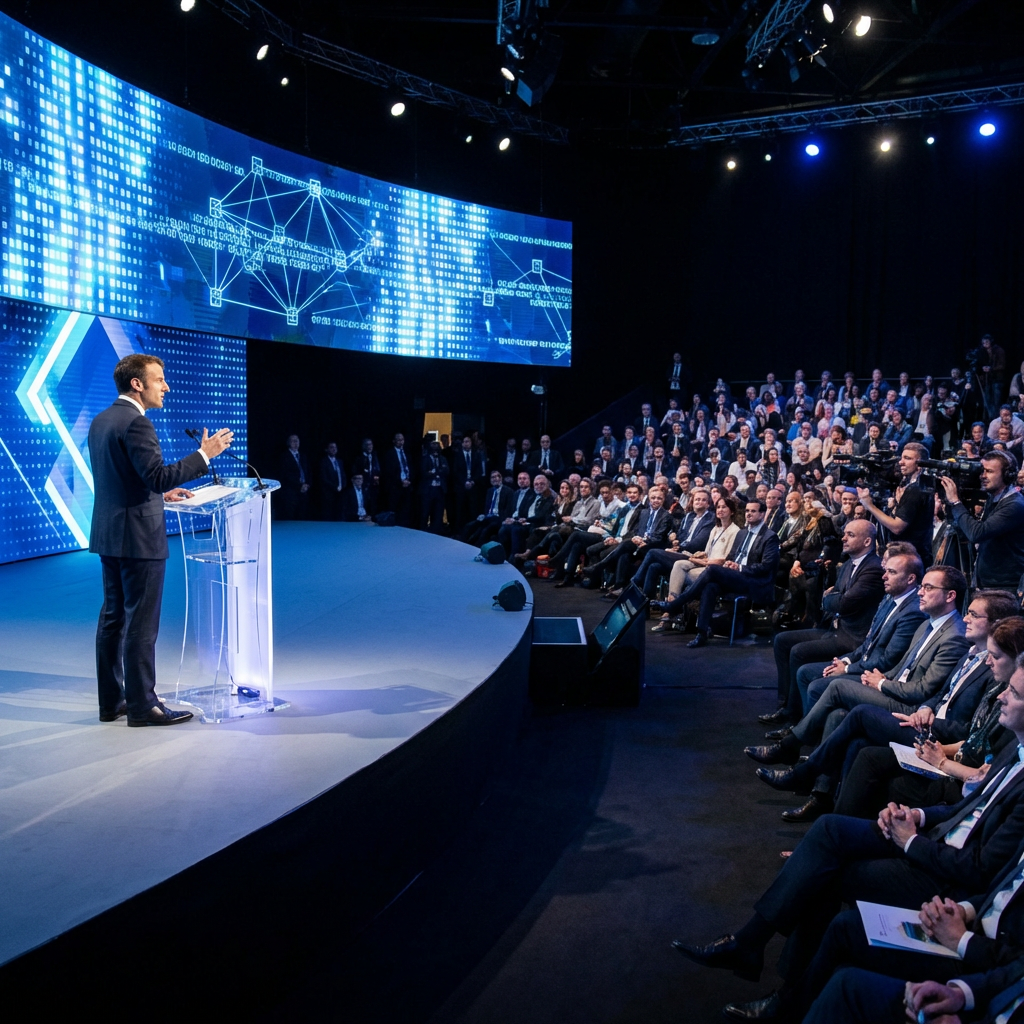
The convergence of sovereign statecraft and decentralized protocol governance has entered a new, tangible phase. French President Emmanuel Macron’s decision to deliver a special address at Paris Blockchain Week is not merely a symbolic gesture; it is a definitive on-chain event for the institutional layer, a catalyst with implications that will ripple through regulatory frameworks, capital allocation, and the very narrative of crypto’s integration into the global financial stack. As Bitcoin’s NVT ratio suggests a network increasingly valued for its settlement utility over pure speculation, Macron’s move validates the decade-long thesis that digital assets are becoming a critical geopolitical and economic pillar.
The Strategic Context: MiCA, Euro-Denominated Liquidity, and the Quest for Sovereignty
To understand the magnitude of Macron’s address, one must ground it in the EU’s existing regulatory framework: the Markets in Crypto-Assets (MiCA) regulation. MiCA is the world’s most comprehensive attempt to create a unified licensing regime for crypto-asset service providers (CASPs). Macron’s appearance is the ultimate political endorsement of this framework, transforming it from a bureaucratic document into a competitive national strategy. The subtext is clear: Europe is open for business and intends to be the premier jurisdiction for compliant, institutional-grade digital asset innovation.
This move is a direct challenge to the regulatory ambiguity emanating from Washington and a counter to the rapid, state-driven adoption seen in places like the UAE and Singapore. From a liquidity perspective, it’s an aggressive play to attract and anchor Euro-denominated liquidity in DeFi and centralized venues. We should monitor on-chain EUR stablecoin supply (like EURS and EURT) and EUR trading pair volumes on major DEXs and CEXs for early signs of a structural shift. A sustained increase in EUR TVL on protocols like Aave or Curve would be a leading indicator of success.
Core Analysis: The Institutional On-Ramp and Protocol-Level Implications
From Political Speech to Protocol Adoption: The Transmission Mechanism
The address acts as a de-risking event for traditional finance (TradFi) boards and investment committees. When a G7 leader provides political cover, the compliance and legal hurdles within large institutions lower significantly. This doesn’t just benefit Bitcoin and Ethereum ETFs; it creates a fertile environment for more complex institutional engagement. We can expect accelerated development in:
- Tokenized Real-World Assets (RWAs): French and European banks will be emboldened to fast-track tokenization of bonds, funds, and private equity on public or permissioned chains, likely leveraging Ethereum L2s or enterprise-focused chains for settlement.
- Institutional DeFi: Protocols offering under-collateralized lending via verifiable credentials (like those exploring soulbound tokens) or compliant derivatives will see increased pilot programs with European financial giants.
- Custody and Staking: The “Macron Signal” will drive a new wave of RFP processes for qualified custodians and institutional staking solutions, benefiting infrastructure providers like Fireblocks, Copper, and Figment.
Comparative Jurisdictional Analysis: Europe vs. The Rest
Unlike the US’s enforcement-first approach or the UAE’s free-zone model, the EU under Macron’s explicit backing is pursuing a regulated integration model. This is a nuanced but critical difference. It offers predictability, which is the single most valuable commodity for institutional capital. The risk is over-regulation that stifles permissionless innovation—a tension that will play out in real-time as MiCA’s technical standards are finalized. The key metric to watch will be the migration of developer talent and venture capital within the EU. Will Paris dethrone Berlin or Lisbon as a crypto hub? On-chain developer activity and grant funding flows from entities like the European Investment Bank will be telling.
Practical Applications: Positioning for the “Macron Effect”
For traders and allocators, this event creates several asymmetric opportunities. The immediate play is a volatility bet around the event date, but the deeper alpha lies in identifying the ecosystem beneficiaries. Focus on:
- EU-Centric Infrastructure Tokens: Projects building core infrastructure within the MiCA framework, particularly those focused on identity, compliance, and institutional DeFi gateways, may see a re-rating.
- Euro Liquidity Pools: Providing liquidity to key EUR-stablecoin pairs on decentralized exchanges could capture increased fee generation from anticipated volume spikes.
- The “Regulatory Moat” Thesis: Protocols and companies that proactively secure MiCA licenses will possess a formidable competitive advantage. Due diligence on corporate structures and licensing pipelines becomes paramount.
The primary risk is a “buy the rumor, sell the news” event, but the structural tailwinds are likely to persist for quarters, if not years. Advanced risk management should include hedging long-term spot positions with short-dated puts around the event and monitoring cross-chain bridge flows from non-EU jurisdictions into EU-based protocols for signs of capital flight to safety.
Future Implications: The Sovereign-Protocol Nexus
Macron’s speech is a harbinger of the next narrative cycle: the integration of nation-states into the blockchain stack. This goes beyond CBDCs. We are moving toward a world where sovereign wealth funds may hold ETH as a strategic asset, where national treasuries issue tokenized bonds on public ledgers, and where protocol governance votes could be influenced by geopolitical interests. The convergence with AI is also inevitable; Europe’s stringent AI Act will interact with MiCA, creating a unique crucible for the development of autonomous agents that manage on-chain assets.
Furthermore, this sets a precedent. Other G7 and G20 leaders will now face domestic pressure to articulate their own blockchain strategies. The global regulatory conversation shifts from “if” and “how to ban” to “how to compete.” This elevates the importance of cross-chain interoperability protocols and privacy-preserving technologies that can navigate a fragmented but increasingly active global regulatory landscape.
The Sovereign Flywheel: Can State Backing Accelerate Decentralization?
The ultimate irony and opportunity of this moment is that state endorsement may be the catalyst needed to achieve true, global-scale decentralization. By providing regulatory clarity and attracting massive institutional liquidity, nations like France could inadvertently fund and fortify the very protocols designed to operate beyond their control. The capital and talent influx will accelerate technical development in scalability, security, and user experience at a pace the purely organic ecosystem could not match.
The contrarian insight is this: The greatest beneficiary of Macron’s address may not be the French banking system or compliant Euro-stablecoins, but the base-layer public goods of Ethereum, Bitcoin, and their most decentralized L2s. Institutional capital, once on-ramped through regulated gates, will inevitably seek the highest-yielding, most composable, and credibly neutral venues—which are, by design, the permissionless protocols. The state-sponsored on-ramp could lead to a state-agnostic destination.
The question for every serious participant now is not whether to engage with this trend, but how. Will you build the compliant bridges, or will you fortify the permissionless foundations they lead to? The architecture of the next financial system is being drafted in real-time, and for the first time, a major head of state is holding the pen.
