





Crypto Community Sentiment: January 2026 01 05 Pulse Check – Four Tribes, One Market.
How AAVE, BTC, ETH, and SOL communities are feeling right now. Across these four tokens, the communities feel like different tribes stuck in the same storm. None of them are in full “moon mission” mode, but very few are truly giving up either. Instead, each group mixes hope, fatigue, and a specific set of worries.
Crypto Fear & Greed Index
Real-time community sentiment across AAVE, Bitcoin, Ethereum & Solana
📊 Updated January 5, 2026 | Based on Reddit, Twitter/X, Discord, and TradingView community discussions
⚠️ Key Market Insight: Social Sentiment Divergence
Fear metrics dominate (26-28 on the index), yet social media shows rare optimism with +20% positive mentions since Jan 1.
This split reflects institutional caution versus retail hope about regulation, ETFs, and recovery potential.
Overall Crypto Market
0
100
27
Fear
0
20
40
60
80
100
Mood: Cautious and tired. Post-holiday selloff has created fear-based consolidation. Most traders are watching $88–$92K BTC range waiting for a decisive break.
Social Sentiment (Reddit/Twitter)
0
100
46
Neutral to Greed
0
20
40
60
80
100
Mood: Surprisingly optimistic. Keywords like “rally,” “opportunity,” and “bull cycle” up 40%. Community feels like capitulation bottom has passed. Retail is quietly hopeful.
Index Components (Updated January 5, 2026)
Volatility (BTC/ETH)
40%
Market Momentum / Volume
29%
Market Dominance (BTC %)
46%
Social Media Sentiment
61%
Google Trends (Crypto Search)
44%
On-Chain Metrics (Active Addresses)
31%
Bitcoin (BTC)
29
Fear – Cautious Hope
Consolidating around $86–$93K. Community mood: tired but unflinching. Talk of $91K as resistance. Long-term stackers dominate, day traders quiet. Biggest fear: macro headwinds.
Ethereum (ETH)
44
Neutral to Greed
Staking queue growing stronger, quiet momentum. Community focused on tech, not price. ETH/BTC ratio discussion positive. Least emotional of the bunch – builders vs. traders.
Solana (SOL)
53
Greed – Bullish
Highest social enthusiasm. Community is loud, optimistic, believes in “maturity narrative.” Die-hard believers shrug off past reliability concerns. Loudest bulls in the market.
AAVE
20
Extreme Fear – Governance Chaos
Lowest sentiment score. Governance vote aftermath still raw. Community feels betrayed by “decentralization theater.” Technical bullish signals exist, but trust is fractured. Most divided group.
Understanding the Index Zones
0–20: Extreme Fear (Panic)
21–39: Fear (Caution)
40–59: Neutral (Waiting)
60–79: Greed (Risk-on)
80–100: Extreme Greed (Euphoria)
Bitcoin (BTC) – “Stoic, Tired, Still Convicted”
Long‑term believers stay calm while retail feels worn out
Bitcoin discussions lean surprisingly calm and almost stoic, with an undercurrent of fatigue. On Reddit, many posters talk about “a new chapter” and encourage others to stay grounded, keep learning, and just keep stacking sats instead of obsessing over every tick. The tone is often: “If you’re here and still buying, you’re lucky,” mixed with jokes about praying BTC stays above key round numbers.
At the same time, there is clear emotional exhaustion. Some traders say it “feels like 2026 will be more of the same,” and describe Bitcoin as a “mockery of an asset when it never goes up,” even as they still call it a “battered quality asset” worth accumulating. This captures the split: long‑term conviction is intact, but the day‑to‑day mood swings between hopeful and jaded.
Common topics include macro pressure, tax‑loss harvesting, and whether Bitcoin is now mostly an institutional game with retail on the sidelines. Many comments frame dips as routine and almost boring, reinforcing the usual “zoom out, think in years” narrative. Sentiment tools and market chatter suggest things have shifted from extreme fear toward a more cautiously hopeful zone, but not full euphoria.
Frequent phrases and ideas are “stack sats,” “just keep accumulating,” “Bitcoin will thrive long term,” “dead for retail,” and “rough year but no alternative.” Overall, the BTC community feels like an old army: tired of the battles, still convinced they win the war.tacking sats,” “casino alts,” “stay humble.”
Ethereum (ETH) – “Quietly Optimistic Builders”
Focused on staking, upgrades, and slow, durable progress
Ethereum discussions right now feel cautiously upbeat, with more attention on fundamentals than vibes. In multiple community threads, people talk about scalability, user experience, and how Ethereum is strengthening its base layer to work well at real‑world scale. The emphasis is less “number go up,” more “can this actually run the world’s finance and apps without breaking.”
Staking is a big emotional anchor. Users are noticeably relieved that the long exit queue has almost cleared and that the entry queue has grown again, with expectations of staked ETH hitting new highs. For many, that signals strong long‑term belief and reinforces the idea that Ethereum is still the main settlement layer for DeFi and serious projects. People speculate about whether ETH finally pushes to new price milestones, but the tone is hopeful rather than manic.
Common topics include: the rollup roadmap, L2 adoption, ETH versus BTC positioning, and how to structure portfolios for the coming year. There is also the usual light teasing of alternatives like Solana, with some Ethereum fans saying they do not want a future where SOL runs anything “meaningful,” hinting at deeper ideological differences about decentralization and design choices.
Frequently used ideas and phrases: “staking all‑time highs,” “scalability, UX, speed,” “Ethereum as base layer,” “ETH/BTC ratio,” and “DeFi still lives here.” The overall mood feels like quiet confidence: not euphoric, but comfortable with a long grind higher as the tech matures.
Solana (SOL) – “High Conviction, High Anxiety”
Fans are loud and bullish, critics still question reliability
Solana conversations are emotionally louder and more polarized than most. On one side, you have die‑hard believers who proudly say they “invested all their savings into Solana” and keep averaging in even after buying high, trusting the ecosystem to keep growing. On the other, there are skeptics who still drag up past outages and say they do not want a future where Solana controls anything important.
Among supporters, the mood is excited and ambitious. Recent threads highlight 2025 as a year of “technical maturity,” with talk of institutional‑grade infrastructure, better staking flows, and growing adoption. People are already debating the next big narrative after memecoins, treating Solana as the place where fast, consumer‑facing crypto experiments really happen. There is also a strong “just wait” energy, with users joking about past missed buys at low prices and arguing they’re happy to keep stacking here.
At the same time, there is noticeable anxiety and self‑awareness. Some posts acknowledge that sentiment around SOL can be quite bearish in broader crypto, even while models and more “pro” analysis are positive, creating a gap between crowd emotion and data. Others poke fun at doom posts declaring “Solana is dead” while pointing to active ecosystems, phones, and new token launches as proof of life.
Key talking points: reliability versus speed, whether past outages are forgiven, how far SOL can run versus ETH, and how sustainable the “high‑performance chain” story really is. Common phrases and memes revolve around “technical maturity,” “adoption curve,” “cheap SOL,” “is SOL dead,” and “high‑performance chain for real use.
AAVE – “Bullish Tech, Bearish Vibes”.
Community torn between excitement for the protocol and anger at governance drama
The AAVE crowd right now feels tense, frustrated, but still grudgingly respectful of the underlying protocol. A big chunk of recent discussion is dominated by the governance fight over who really controls the brand, the DAO, and the protocol’s future. Long‑time users talk about “decentralization theater” and say the recent vote and founder behavior exposed how much power still sits with insiders, not the community.
Emotionally, the mood is defensive and skeptical rather than euphoric. People are not saying “AAVE is dead,” but many are clearly disillusioned with how “decentralized” DeFi really is when one controversial vote can trigger this much drama. There is a sense of betrayal from some who thought AAVE was the mature blue‑chip DeFi play, only to watch it become a case study in governance capture and back‑room influence.
At the same time, others argue the fallout is a necessary reality check and could lead to better structures, like an independent Aave foundation and clearer rules around power and voting. These users are cautiously optimistic that if the community pushes through the current mess, AAVE can come out stronger, with more transparent value capture for token holders.
Common talking points include: founder token buys and whether they signal conviction or desperation, how much value actually flows to AAVE holders, and whether institutions can trust a protocol with this much governance noise. Frequently repeated phrases and themes are “governance crisis,” “hostile takeover,” “DAO vs founders,” “is this really decentralized,” and “AAVE vote could reshape DeFi.” Overall, the community feels battle‑worn, more angry than hyped, but still deeply engaged.
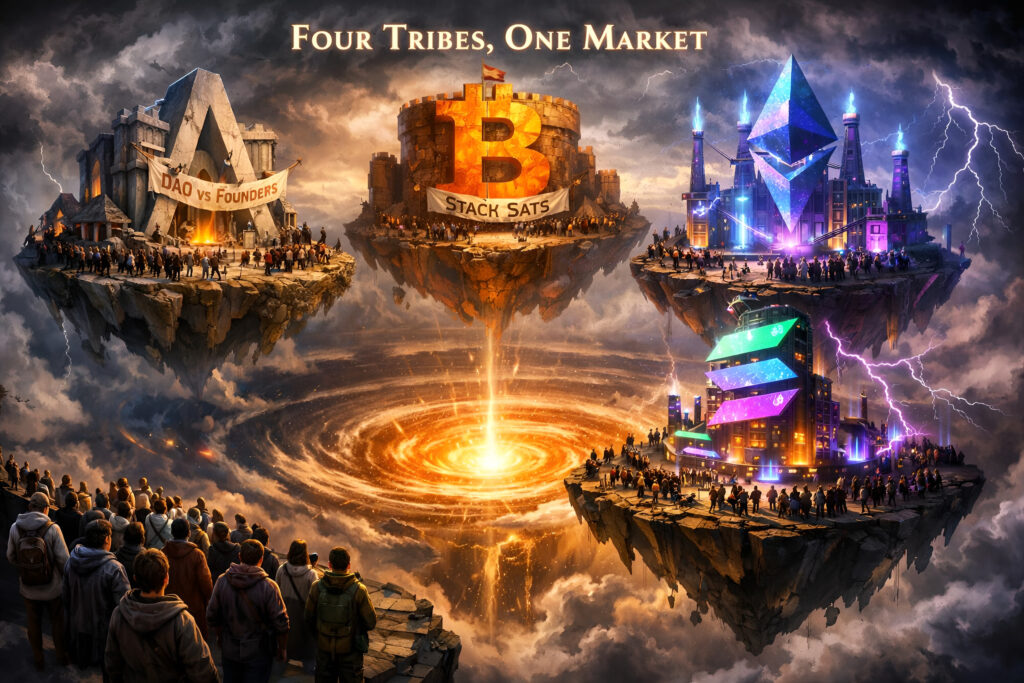
The Broader Picture: – Four Tribes, One Cycle – How BTC, ETH, SOL, and AAVE communities feel right now.
The most excited right now are clearly the Solana die‑hards. Their tone is loud, emotional, and risk‑on: people talk about going all‑in, treating recent years as “technical maturity” and expecting bigger narratives ahead. They acknowledge the FUD but double down on conviction and adoption stories. Ethereum’s crowd is also optimistic, but in a calmer, more technical way: their excitement is about staking growth, scaling, and Ethereum’s role as infrastructure rather than a single big bet.
The most worried or divided group is AAVE’s community. The token is at the center of a messy governance fight, and people are openly questioning how decentralized DeFi really is when founders and big delegates can steer outcomes. Some still believe the protocol can come out stronger with better structures, but the current mood feels bruised and distrustful. Bitcoin sits in a different kind of split: it is not a governance drama, but a psychological one between tired traders and unshakable long‑term holders. There is less “panic,” more “I’m exhausted but still here.”
A few shared themes cut across all four:
- People are more focused on survival and structure than quick flips. For BTC and ETH, that shows up as long‑term accumulation and staking; for AAVE, as arguing over governance; for SOL, as talking about reliability and real‑world use.
- There is a recurring sense of fatigue. Many users sound tired of constant drama, volatility, and cycles of over‑hype followed by disappointment, even when they still believe in their chosen asset.
- Yet conviction has not vanished. Each community has its core mantra: “stack sats” for Bitcoin, “Ethereum as base layer” for ETH, “governance must evolve” for AAVE, and “high‑performance chain with growing adoption” for Solana.
In plain terms: Solana fans are the loudest bulls, Ethereum folks are the patient builders, Bitcoiners are the stoic veterans, and AAVE holders are the disgruntled shareholders trying to fix the company from the inside.
