




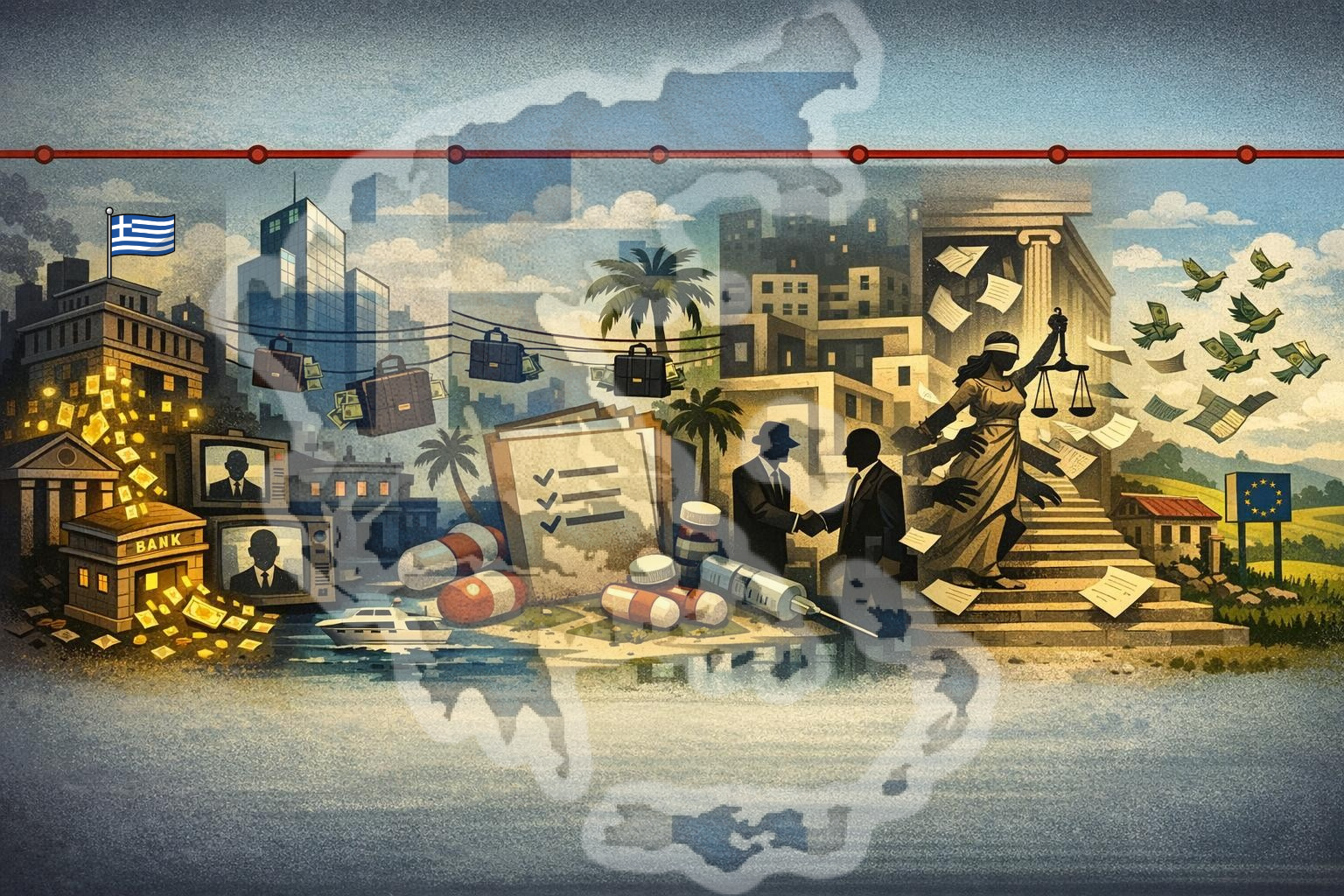

Greece does not suffer from “isolated scandals.” It lives inside a permanent system where corruption, party power and state structures are tightly welded together. This page follows that system across four decades, using six emblematic cases as milestones: the Koskotas scandal of the 1980s, the Siemens network of bribes, the Lagarde list of protected tax evasion, the Novartis pharmaceutical affair, the OPEKEPE fraud in agricultural subsidies, and finally the deeper structural problems of governance that allow all of them to exist.
Each scandal will be presented with three simple questions: How did the scheme work? Who really paid the price? What changed afterwards – if anything? Behind the different names and sectors, the same patterns appear again and again: parties treating the state as private property, a public administration built on clientelism, weak and politicized justice, and media that too often protect the powerful instead of the public.
The goal of this project is not just to document past scandals, but to show why corruption in Greece is likely to continue and why the country’s political and economic elite has remained largely immune. Corruption here is not a “disease” attacking a healthy body; it is part of the operating system of governance. Unless those underlying rules change, the timeline you are about to explore is not a museum of the past, but a preview of the future
Greek Corruption Scandals. Case Selection:
- Koskotas scandal (1988–1989) – Bank of Crete political–financial scandal that peaked in 1988–1989.
- Tsochatzopoulos arms‑procurement scandal (submarines, TOR‑M1) – Defense contracts signed around 1997–2001; the corruption case was highlighted and investigated from 2006 onward, with prosecution in 2011.
- Siemens scandal in Greece – Bribery related to telecommunications and other contracts mainly during 1990–2004, with formal investigations starting in 2006.
- Lagarde List – List of Greek depositors sent to Greece in 2010, but politically and judicially exploited from 2012 when it became public.
- Novartis scandal in Greece – Investigation into illicit practices in drug pricing and promotion, starting from whistleblower allegations in 2016; case files were sent to Parliament in 2018.
- OPEKEPE scandal (EU agricultural subsidies) – Irregular subsidies and fictitious entitlements exposed by audits from about 2020, with major revelations and EU scrutiny in 2024–2025.
- Tempi railway tragedy and corruption scandal (2023–2026) – Greece’s deadliest rail crash on 28 February 2023 (57 dead) after decade‑long failure to install safety systems, with at least €18.3 million in misappropriated EU and state rail funds and prosecutions hampered by ministerial immunity
Note: This compilation is not comprehensive. Numerous other major and significant corruption cases exist within Greek institutional history. The scandals presented here reflect the author’s selection criteria prioritizing documented cases with substantial public impact and institutional consequences. Other notable cases warrant separate detailed analysis.
Uncover the details of Greek corruption through these in-depth articles, each focusing on a distinct scandal.
-

From Democracy to Kleptocracy: The Koskotas Template.
Read more: From Democracy to Kleptocracy: The Koskotas Template.In the late 1980s, against a backdrop of roiling political turbulence, a financial scandal of staggering proportions erupted from the heart of Athens. Presided over by the Panhellenic Socialist Movement (PASOK) and its charismatic leader, Andreas Papandreou, this was an era where populist ambition often blurred the lines between state…
-

Siemens Bribed Greek Officials for €35-40 Million to Win Telecom Contracts.
Read more: Siemens Bribed Greek Officials for €35-40 Million to Win Telecom Contracts.Siemens Bribed Greek Officials for €35-40 Million to Win Telecom Contracts Content is coming soon
-

Greek Ex‑Defense Minister Jailed in Submarine and TOR‑M1 Bribery Scandal
Read more: Greek Ex‑Defense Minister Jailed in Submarine and TOR‑M1 Bribery ScandalGreek Ex‑Defense Minister Jailed in Submarine and TOR‑M1 Bribery Scandal Content is coming soon
-

Greece’s Lagarde List: Elite Tax Evasion and Failed Accountability During the Debt Crisis.
Read more: Greece’s Lagarde List: Elite Tax Evasion and Failed Accountability During the Debt Crisis.Greece’s Lagarde List: Elite Tax Evasion and Failed Accountability During the Debt Crisis. Content is coming soon
-

Novartis Greece Pharmaceutical Bribery Scandal: A €3 Billion Healthcare Corruption.
Read more: Novartis Greece Pharmaceutical Bribery Scandal: A €3 Billion Healthcare Corruption.Novartis Greece Pharmaceutical Bribery Scandal: A €3 Billion Healthcare Corruption. Content is coming soon
-

OPEKEPE Scandal: Systemic EU Farm Subsidy Fraud Inflicts Nearly €3 Billion in Damage on Greek Public Finances.
Read more: OPEKEPE Scandal: Systemic EU Farm Subsidy Fraud Inflicts Nearly €3 Billion in Damage on Greek Public Finances.OPEKEPE Scandal: Systemic EU Farm Subsidy Fraud Inflicts Nearly €3 Billion in Damage on Greek Public Finances. Content is coming soon
-

Greece’s Tempi Rail Disaster: 57 Dead, €18.3 Million Stolen, Zero Ministers Prosecuted.
Read more: Greece’s Tempi Rail Disaster: 57 Dead, €18.3 Million Stolen, Zero Ministers Prosecuted.Greece’s Tempi Rail Disaster: 57 Dead, €18.3 Million Stolen, Zero Ministers Prosecuted. Content is coming soon
Disclaimer: This platform provides educational content on matters of public interest, including corruption, institutional failures, and historical events. All information is compiled from publicly available sources, official documents, news reports, and court filings. The author is not a professional investigator or legal authority; this constitutes historical study, not investigative journalism or legal analysis.
No accusations are made against individuals beyond what is documented in official proceedings or court records. All persons retain presumptions of innocence regarding pending charges until final judicial determination. This content does not substitute for professional legal counsel, official investigations, or accredited news reporting. Information reflects the publication date and may not include subsequent developments or appeals.
Readers should consult official sources and authoritative outlets for comprehensive understanding. The author disclaims responsibility for misuse or reliance beyond educational purposes. All citations direct readers to primary sources for independent verification.