




Daily Intelligence Briefing — July 04, 2026 D34
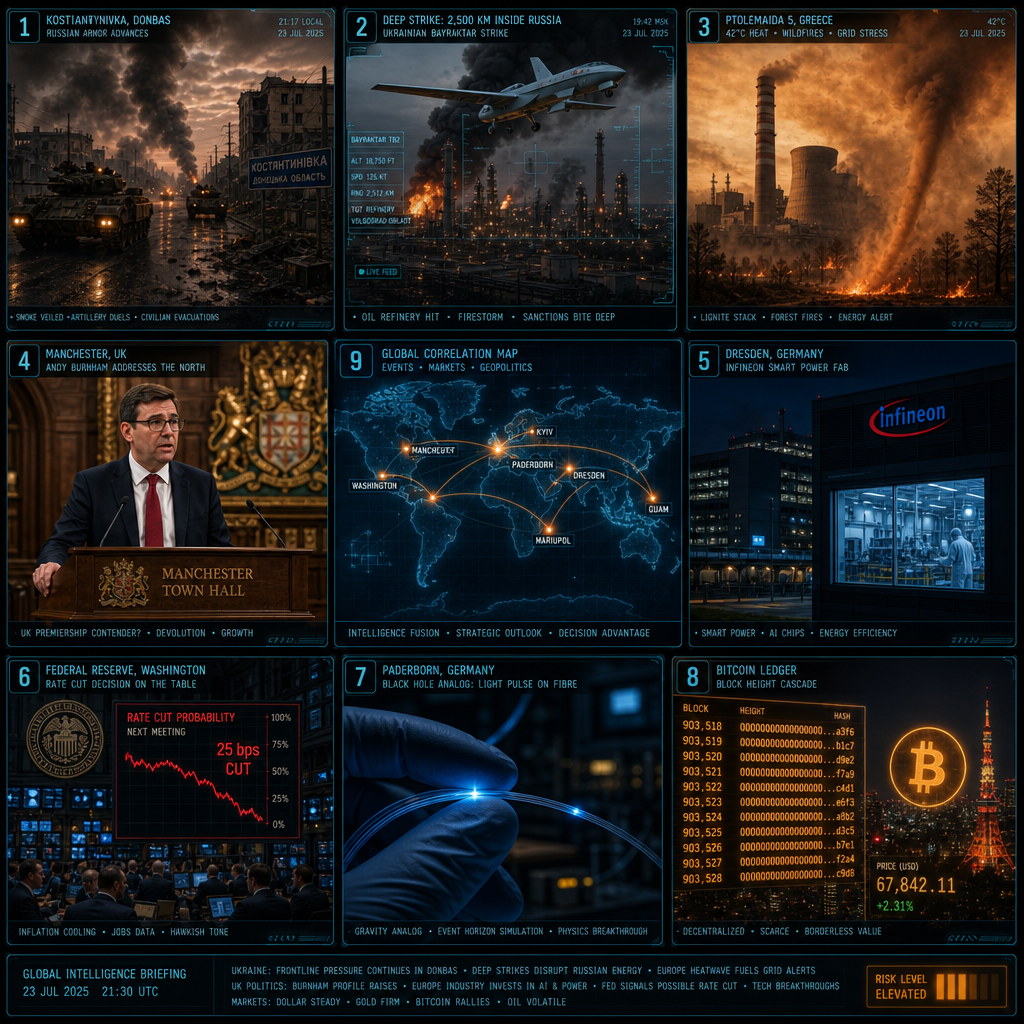
On the eve of the Ankara NATO summit, Russia claims the capture of Kostiantynivka while a Gallup poll finds 66% of Ukrainians now favour immediate ceasefire negotiations. Ukraine strikes 2,500 km into Russian oil-refining territory in the Donbas region, and Washington watches as Andy Burnham prepares to enter No 10 Downing Street this month. Super Typhoon Bavi threatens Guam and the Northern Marianas, El Niño escalates across the Pacific basin, and Fed Governor Warsh vows to 'disappoint' inflation tolerators. Will the Western coalition commit to a longer war at Ankara — or pivot toward ceasefire diplomacy before the Kostiantynivka collapse becomes strategically irreversible? #NATO #RussiaUkraine #Ukraine #Geopolitics #BreakingNews #WorldNews

Contents
- Geopolitics & Defence
- Russia Claims Kostiantynivka: The Donbas Geometry Shifts
- Ukraine’s Long-Range Strike Architecture Deepens
- Taiwan’s Largest-Ever Civil-Military Drill Tests the Worst-Case Cascade
- Pratt & Whitney F119 Crosses One Million Flight Hours as the Engine Becomes the Story
- Iran’s Post-Khamenei Power Vacuum and the Hormuz Question
- Nord Stream Indictment, Ukraine War Fatigue, and Taiwan Airspace
- Environment & Climate
- Society & Civil Issues
- AI & Technology
- Infineon Opens Europe’s Largest Power-Semiconductor Fab as the Energy-AI Convergence Crystallises
- Austrian Supercomputer, Chinese Storage, and the New Compute Geography
- Lead-Cooled Nuclear, Lithium-Sulfur Batteries, and the Industrial Pivot
- AI Sovereignty, Antibiotic Discovery, and the Indigenous-Knowledge Question
- Economy & Business
- Science & Space
- Crypto, Digital Assets & Blockchain
- Correlations & Analysis
- References
Click any heading to jump to that section. Click the section heading to return to this menu.
Daily Intelligence Briefing — 2026-07-04 (D34)
Geopolitics & Defence↑ Contents
Russia Claims Kostiantynivka: The Donbas Geometry Shifts
Russia announced overnight that it has fully captured Kostiantynivka, the last major Ukrainian stronghold on the southern approach to Kramatorsk and Sloviansk and the linchpin of the Ukrainian defensive line in the western Donbas[1][2]. The fall of the city, if confirmed by independent geolocation, would represent the most consequential Russian territorial gain of the past several months and would leave the road network north toward the two remaining Ukrainian regional capitals significantly more exposed. The loss transforms the front-line geometry of the entire theatre from stalemate into a phase of accelerating Russian momentum.
The news arrives at the precise moment when a Gallup poll published today found that 66% of Ukrainians believe their country should pursue a negotiated end to the war as soon as possible[13]. The combination of a major Russian advance and a domestic political mood trending toward negotiations is a strategically awkward development for Kyiv’s Western backers, who are simultaneously finalising a US$1 billion procurement of Patriot PAC-2 missiles to strengthen Ukraine’s anti-aircraft shield[4]. The two signals point in opposite directions, and how the Western coalition reconciles them will determine whether the coming weeks bring another escalation or a quiet pivot toward ceasefire diplomacy.
Ukraine’s Long-Range Strike Architecture Deepens
Beyond the Donbas, Ukraine’s strike campaign is reaching further into Russian territory than at any point in the war. A Ukrainian drone was intercepted more than 2,500 km inside Russia heading toward a petroleum refinery, demonstrating the maturation of a long-range architecture that has systematically degraded Russian fuel production since 2024[3]. In occupied Crimea, the SBU’s drone strikes on the Saki Air Base have damaged at least six of seven hardened aircraft shelters, with Vantor satellite imagery confirming structural damage to the facility that houses Su-30SM Flankers of the Russian Navy’s 43rd Independent Naval Attack Aviation Regiment[5]. The combination is producing compound attrition the Russian reserve fleet cannot replace.
On the more experimental front, Ukraine has begun fielding humanoid combat robots. American startup Foundation Robotics has sent two Phantom MK1 platforms to the frontline, while Ukraine’s Brave1 tech hub has announced a major state grant programme dedicated to humanoid combat robotics, a transition that D31’s coverage of the Saab Gripen contract framed as the next phase of the alliance’s industrial deepening[6]. The programme is 100% defence-oriented, with the goal of “robotising” the contact line. Whether the platforms can survive the electromagnetic environment of a peer war is an open question.
Taiwan’s Largest-Ever Civil-Military Drill Tests the Worst-Case Cascade
Taiwan conducted its most ambitious Han Kuang-series civil-military exercise to date on Friday, simulating an integrated crisis in which a Chinese blockade, a magnitude 6.8 earthquake, mass bank withdrawals, broadcast hacking, infrastructure sabotage, social unrest and ultimately a full Chinese military invasion all hit simultaneously[7]. The drill, presented to 370-plus government and military officials, included live cyberattacks by professional hackers on government networks, drills for transporting hospital operations into underground parking structures, and food-distribution simulations. China’s response was immediate: Beijing dispatched another “joint combat-readiness patrol” around the island, with Taipei reporting at least 22 military aircraft including H-6 bombers with nuclear weapons capability[14].
The exercise operationalises the strategic shift D33’s Modi-Takaichi coverage identified. Taiwan is hedging by building an autonomous total-defence architecture as the US security guarantee becomes more conditional. The drill is also a signal to Beijing that the cost of any invasion would be higher than assumed.
Pratt & Whitney F119 Crosses One Million Flight Hours as the Engine Becomes the Story
Pratt & Whitney announced that its F119 engine, which powers the F-22 Raptor, has passed one million flight hours, doubling the 500,000 hours logged in 2017[8]. The milestone matters less as a celebration of the airframe than as a quiet measure of the manufacturing and sustainment base that US competitors have spent two decades trying to replicate. The F119’s thrust vectoring nozzle, supercruise capability and low radar cross-section have made the F-22 the only US fighter capable of supersonic flight without afterburners, an underappreciated but critical operational advantage.
The UK’s parallel submarine industrial story continues to unfold. Rolls-Royce has broken ground on a more than 100,000 m² expansion of its Raynesway facility, which will more than double its submarine reactor manufacturing capacity, create 1,170 skilled jobs, and support both the Dreadnought deterrent programme and the Australian SSN-AUKUS attack submarine programme under AUKUS[9]. Together, the two milestones illustrate the central paradox of the post-Trump NATO landscape.
Iran’s Post-Khamenei Power Vacuum and the Hormuz Question
Iran has begun a multi-day funeral procession for Ayatollah Ali Khamenei, who was killed by an airstrike at the start of the war, with the casket to visit five cities across Iran and Iraq[17][18]. The ritual doubles as Shia-influence projection but masks an internal power struggle visible in Tehran’s behaviour. Iran was absent from this week’s Doha talks, a no-show that has become a concrete signal the post-succession government cannot commit to the implementation phase D30 identified as the framework’s load-bearing step[16].
Into that vacuum, the UK, France and Oman have jointly committed to ensuring Omani territorial waters remain safe for navigation[10], positioning London and Paris as security guarantors of the Strait’s southern flank. Combined with today’s report that a senior NATO commander has confirmed European allies are replacing most US force cuts, the picture emerging is one in which the transatlantic alliance is recalibrating in real time [11]. The Ankara summit on 7-8 July, which D15’s Greek-language coverage of NATO’s Eastern Mediterranean positioning is preparing for[15], will be the formal ratification moment of that recalibration.
Nord Stream Indictment, Ukraine War Fatigue, and Taiwan Airspace
German federal prosecutors have charged a former Ukrainian military officer as a co-conspirator in war crimes related to the 2022 Nord Stream pipeline explosions, accusing him of acting on behalf of Ukrainian state services[12]. The case is politically explosive: it makes a German court the venue that will adjudicate Ukrainian state responsibility for the most consequential attack on German critical infrastructure in decades, while Germany continues to be Ukraine’s second-largest military supplier. Combined with the 66% Gallup finding, the indictment signals the war’s political-legal complexity is rising even as its military tempo accelerates.
On a constructive front, the Spanish Army has begun deploying drones for wildfire surveillance in Tenerife under the Canarian Sentinel 2026 operation[19], demonstrating the dual-use civil-military integration.
Environment & Climate↑ Contents
Super Typhoon Bavi and the Pacific’s New Climate Geometry
Super Typhoon Bavi, with sustained winds of 259 km/h and gusts reaching 314 km/h, is bearing down on Guam and the Northern Mariana Islands, threatening to become the second super typhoon to strike the Marianas in two months[20]. The WMO confirmed yesterday that El Niño has now established itself in the tropical Pacific as a “high-intensity phenomenon,” a phase change that raises the probability of further intense tropical cyclone activity across the Western Pacific through the autumn. Two super typhoons in two months in the same island chain is, as one resident put it, “historic.”
The El Niño phase change connects the Pacific typhoon story to the broader climate picture. D31’s record June ocean temperatures, D33’s 2,025 French excess deaths, and today’s announcement together form a single global climate system approaching the thresholds D28 first identified. The same phase change will influence monsoons, wildfires and storm tracks through 2027.
Europe’s New Heat Baseline and the Grid That Buckles Beneath It
The UK Met Office has forecast that temperatures will exceed 30°C as another heatwave begins, set to last significantly longer than the June event that D33 reported produced the 2,025 French excess deaths[21]. The BBC’s seven-chart analysis of Europe’s new climate reality underlines that the temperature records tumbling across the continent in 2026 are no longer aberrations but signs of a new normal[22]. In France, supermarkets have begun installing cool-down stations as a commercial adaptation to recurring heat, a small consumer-facing signal of the structural changes now embedded in everyday retail[26].
The grid is the constraint that increasingly binds the entire European energy transition. PJM Interconnection, the largest US grid operator serving 65 million customers across 13 states, likely hit an all-time record electricity demand on July 2 as a heat dome settled over the eastern United States[24]. In New York, Con Edison temporarily cut power to 9,800 customers in southwest Queens after equipment failures triggered by the extreme heat and high demand[23]. Greece’s grid is similarly strained, with demand forecast to surge from 6,500 MW to 9,000 MW, forcing the Ptolemaida 5 lignite unit to operate at maximum capacity to compensate for low renewable output during peak demand[31].
Climate Adaptation Reaches From Bridges to Bogs to Soils
New research on America’s aging bridge infrastructure, where 220,295 of 624,167 spans need repair and 45% have exceeded their 50-year design life, suggests that quantum magnetometers could detect corrosion, stress and scour damage before it becomes visible from the road[25]. The technology exemplifies dual-use climate infrastructure that benefits from defence-industrial R&D spillovers. The total repair bill is approximately $467 billion, and quantum sensing may compress the diagnostic timeline enough to make targeted repairs economically rational.
The University of East Anglia produced three results that together reframe the climate-adaptation toolkit: salt-tolerant microbes that could help crops survive salinisation[29], Antarctic sea-ice compounds with a previously unappreciated cooling role[28], and NHS data showing even modest weather changes measurably affect psychiatric service demand[27]. Welsh peatland restoration continues to provide the largest cost-effective carbon store available to policymakers[71].
Mountain Wildlife, Soil Microbes, and a Russian Tractor That Injects Its Own Exhaust
A study of 395 mountain-dwelling species projects that under a high-emissions scenario, wildlife will lose 16% more range by 2050 compared to a low-emissions scenario, with the “escalator to extinction” pattern accelerating as species run out of safe mountain habitat[30]. The 16% range-loss differential is large enough to register in cost-benefit analysis yet small enough to be plausibly reducible by current-generation policy. In the Amazon, insect-borne diseases are forming distinct regional patterns linked to land use and rural economies as the forest frontier recedes[72].
Researchers at Novgorod State University have developed a tractor attachment that injects cooled exhaust gases into the soil as a “gas therapy” intended to stimulate soil microorganisms[32]. The technology risks overheating the soil if misconfigured, but its emergence is a reminder that the agritech agenda is now globally focused on closing the carbon cycle at the field level rather than only at the industrial stack.
Society & Civil Issues↑ Contents
Trump at Mount Rushmore: The 250th Anniversary as Political Theatre
President Trump delivered his America’s 250th anniversary address at Mount Rushmore on Friday evening, focusing on the country’s history, calls for unity, and a sharp framing of communism as “the enemy”[33]. The speech was a deliberate deployment of the rhetorical architecture that D33’s report on the Trump “ridiculous” NATO comment and the D31 analysis of the conditional-alliance doctrine first identified as the emerging Trump-era foreign-policy framework. The Mount Rushmore venue itself, with its four carved presidents, provided the symbolic architecture for a worldview in which the American founding is treated as a permanent political settlement, communism as the perennial external enemy, and disunity as the principal internal threat. The fireworks over the monument, televised to the largest 4th of July audience in years, were a deliberate display of national unity that doubled as a campaign statement ahead of the autumn midterms.
Burnham Takes the UK Prime Ministership and the Centre-Left Realigns
Andy Burnham is set to become UK Prime Minister following Keir Starmer’s exit, with the Manchester mayor having confirmed his frontrunner status in the Labour leadership race that D33’s coverage first identified as opening[34]. The transition, expected to be finalised in the coming weeks, marks a generational shift in UK centre-left politics: from a London-based technocratic lawyer to a Greater Manchester mayor with a track record of devolution and regional rebalancing. The economic adviser’s pension-tax-relief redirection proposal that D31 reported is expected to feature prominently in the Burnham government’s first months, alongside a likely recalibration of the UK’s defence investment posture that D30 and D31 had already documented. The Scottish National Party, the Liberal Democrats and the Conservatives will each face strategic decisions in response, but the most consequential near-term effect is on the UK’s contribution to the Ankara NATO summit, which D15 flagged as a stress test for the alliance.
Religious Schism, Self-Immolation, and the Soft Power of Faith
The Lefebvrist Society of St Pius X has rejected the Holy See’s excommunication following the consecration of bishops without Pope Leo XIV’s approval, while the Transalpine Redemptorists have announced another episcopal consecration in Scotland, signalling a deepening Catholic schism that has institutional as well as theological dimensions[36]. In New York, a Tibet-born activist died after self-immolating outside UN headquarters, an act of protest that carries diplomatic implications for US-China relations at a moment when Beijing is escalating its grey-zone pressure on Taiwan[35]. The two events, separated by an ocean and by religious tradition, together illustrate how the soft-power architecture of faith and the hard-power architecture of geopolitics are now entangled in ways that 2026’s diplomatic practitioners cannot afford to ignore.
Civil-Society Strain from the Heat, the Flood, and the Polls
In France, former Prime Minister Édouard Philippe will hold a presidential campaign launch meeting at the Adidas Arena in Paris on Sunday, attempting to shake off his image as an austere figure as he presents his platform ahead of the 2027 election[37]. The Philippe campaign signals that the French centre is recalibrating in response to both the RN threat and the post-Philippe Macron legacy. In Australia, NSW Premier Chris Minns admitted that Labor must “climb Everest” to stay in power amid rising One Nation threat, with protesters interrupting the state conference over the Gaza conflict[39]. The Australian centre-left faces centrifugal pressure similar to that reshaping European centre-left parties since 2024.
On the disaster-response front, Canada’s Minister of Emergency Management has approved a federal military assistance request for the flood-ravaged Parkland region in western Manitoba, deploying troops to support the disaster response as the country faces accelerating climate-driven extreme weather events[38]. And in Wisconsin, three people died and seven were rescued after a boat capsized on Lake Geneva during a strong storm, the latest in a series of severe-weather incidents affecting the US Midwest[40]. The human cost of intensifying summer weather is now so regular that the news cycle is in danger of normalising it, which is itself a warning sign.
AI & Technology↑ Contents
Infineon Opens Europe’s Largest Power-Semiconductor Fab as the Energy-AI Convergence Crystallises
Infineon has opened its Smart Power Fab in Dresden, the world’s largest facility for intelligent power semiconductors and analog/mixed-signal technologies, with a €5 billion (US$5.7 billion) investment that doubles the company’s Dresden capacity and creates 1,000 direct jobs[41]. The chips produced in the fab will manage and control electrical power more efficiently inside AI data centres, wind turbines, solar installations, industrial equipment, and software-defined vehicles. Chancellor Friedrich Merz, who attended the opening, called the project “a strong signal for Europe’s semiconductor sector” and emphasised that “competitive chip manufacturing remains possible in Germany.” The fab’s digital twin, AI-assisted process qualification, and integration with Infineon’s Villach, Austria site through a “One Virtual Fab” network reflect a manufacturing philosophy in which the AI revolution is as much about how chips are made as about what they enable.
The Dresden fab is the clearest single signal yet that the European industrial policy that D24 and D27 had been tracking is now producing operational results rather than only policy papers. The convergence of AI compute demand, electric-vehicle power electronics, and renewable-energy grid integration is creating a structural pull-through for power semiconductors that no previous generation of policy had anticipated. Whether the European fab base can scale to meet this demand without Chinese upstream dependencies remains an open question, but Dresden is now a meaningful part of the answer.
Austrian Supercomputer, Chinese Storage, and the New Compute Geography
Austria has launched MUSICA, a supercomputer delivering 45.11 petaflops of performance through 1,088 Nvidia H100 GPUs, ranking among the world’s 100 fastest systems and more than eight times the computing power of its VSC predecessors[43]. The system, distributed across three Austrian university sites and managed centrally, is integrated with the country’s first production-ready OTTER trapped-ion quantum computer, bringing AI, quantum, and high-performance computing under a single infrastructure. MUSICA exemplifies the kind of middle-power compute strategy that several European and Asian states are now adopting: not competing with the hyperscalers, but building research-grade capability that anchors national research communities and provides alternatives to US-dominant infrastructure.
At the storage layer, China’s Longsys has reached stable monthly production of one million micro SSDs based on a System-in-Package design that integrates the controller, NAND flash and power management into a single package, with Lenovo and ASUS already qualifying the modules[44]. The mSSD design is a useful counter-trend to the recentralisation of AI compute in hyperscale data centres, enabling edge AI devices to carry meaningful local storage without the cost or thermal profile of a conventional SSD. The PCI Express Gen6 compatibility of the platform positions it for the next generation of edge AI hardware, which is the area where the China-US compute competition is most likely to fragment.
Lead-Cooled Nuclear, Lithium-Sulfur Batteries, and the Industrial Pivot
Blykalla has partnered with Hitachi Energy to develop standardised electrical systems for its lead-cooled advanced modular reactors, with initial efforts targeting data centres and energy-intensive industrial users in Europe and the United States[42]. The collaboration reflects a broader recognition that even the most successful advanced reactor design can be delayed by site-specific electrical engineering, and that standardisation is the missing link between reactor design and commercial deployment. GE Vernova has separately completed a $7.2 million upgrade of its high-voltage research laboratory in northern Italy, expanding its ability to test transformers and disconnectors used in electricity transmission as the country prepares for rising power demand and renewable energy integration[48].
In batteries, researchers at Tohoku University and collaborating institutions have developed a covalent organic framework-graphene interface that prevents the polysulfide shuttle effect in lithium-sulfur batteries, allowing the cells to retain capacity over 1,000 charge-discharge cycles while delivering 1,455.7 mAh/g[46]. Lithium-sulfur has long been the most promising post-lithium-ion chemistry but has been held back by the rapid capacity fade that the Tohoku work directly addresses. The D30 report on sodium-ion matching Tesla performance and the D31 report on CATL’s field-validated sodium-ion grid battery together framed the battery diversification story; the Tohoku result is the lithium-sulfur equivalent of those milestones. Separately, China’s Zoomlion has unveiled five new-energy heavy-machinery achievements including what it claims is the world’s largest 300-ton electric-drive hybrid mining truck, reflecting the breadth of the Chinese industrial pivot to electric and hybrid drivetrains in non-road mobile machinery[47].
AI Sovereignty, Antibiotic Discovery, and the Indigenous-Knowledge Question
Le Monde’s analysis of Europe’s AI strategy argues that the continent must develop a “catch-up strategy” and pursue technology transfers to maintain technological sovereignty between the US and Chinese giants[49]. The argument is now conventional wisdom in European policy circles, but the operational mechanisms for closing the investment gap remain underdeveloped. In a related development, researchers are using generative AI and physics-based simulation to design new antibiotics, a critical tool against the projected 8 million annual deaths from antibiotic-resistant infections by 2050[51]. The D31 report on machine-learning-guided discovery of new superconductors and the D30 report on the NIST-style AI jobs debate have both flagged AI’s expanding role in the basic research enterprise, and the antibiotic work is a particularly high-stakes example.
As Australia marks 50 years of NAIDOC Week, researchers argue that AI development must incorporate Indigenous Knowledges to avoid becoming another extractive force that takes without consent, credit, or return[45]. The argument is part of a broader conversation about data governance and benefit-sharing that has been gaining traction in conservation genomics and biodiversity research. The Washington DC metro area is also installing its first en-route overhead pantograph electric bus chargers, an infrastructure upgrade that addresses range anxiety in transit fleets and is expected to accelerate the conversion of US bus networks to zero-emission vehicles[50].
Economy & Business↑ Contents
Fed Hawkishness Meets a Weakening Labour Market
Federal Reserve Governor Kevin Warsh vowed to “disappoint” anyone who thinks he will tolerate inflation above 2%, the strongest signal yet that the FOMC is preparing to maintain a hawkish stance even as the labour market shows signs of softening[52]. The combination of a hawkish Fed and a softening labour market is the most uncomfortable configuration for US monetary policy: the central bank cannot easily cut rates to support employment without rekindling the inflation that the D32 report on the BoE holding rates and the D30 report on the ECB internal debate had identified as the principal risk. The June jobs data crystallised the tension: the US economy added only 57,000 positions, well below the downwardly revised 129,000 in May and forecasts of 110,000, the weakest gain in four months[53]. The unemployment rate dipped to 4.2% from 4.3%, but the composition showed leisure and hospitality shedding 61,000 jobs, the sector that benefited most from seasonal noise and the World Cup effect.
The US bank deposit data provides a useful counterweight. Deposits rose to $19.374 trillion from $19.304 trillion the prior week, suggesting that the household balance sheet remains structurally robust even as the labour market softens. The combination of a strong household balance sheet, a weakening labour market, and a hawkish Fed is the configuration that D24’s report on the BoJ’s June summary and D30’s report on the Asian dollar dominance had flagged as the macro setup heading into H2 2026.
European Inflation, Asian Energy Lessons, and the German Industrial Dilemma
Swiss consumer prices rose 0.5% year-on-year in June, down from 0.7% in May, with core inflation steady at 0.3%, reflecting the country’s deeply embedded low-inflation expectations and limited fossil-fuel dependence[54]. The Swiss numbers are the clearest counterpoint in Europe to the French and British inflation pressures that D32 reported, and they are a reminder that the Eurozone inflation story is now a multi-track rather than single-track narrative. Hong Kong retail sales rose 4.8% year-on-year in May, down from 6.6% in April, marking the eleventh consecutive month of growth but losing momentum as fuel, supermarket and food sales all deteriorated[55].
Bloomberg reports that although no lasting peace deal exists in the Persian Gulf, energy-hungry Asia is already drawing structural lessons from four months of war: bigger strategic reserves, greater diversity of fossil-fuel suppliers, and a more balanced power generation mix to reduce exposure to Persian Gulf disruption[57]. The structural adjustment is the most consequential medium-term effect of the Iran crisis, and it will reshape Asian energy trade flows for the rest of the decade. Meanwhile, the AfD meets in Erfurt for its federal congress amid record polling, with Björn Höcke demonstrating his power even as the party remains divided on key questions of strategy[61]. The German centre’s response is crystallising around Saxony Minister-President Michael Kretschmer’s call for a “Pact for Germany” that would prioritise lower energy prices, faster approval procedures, and structural reform[62]. The federal budget is set to raise rail infrastructure subsidies to approximately €2.2 billion in 2027, a small but symbolic step toward addressing the chronic underinvestment that has been a major factor in the country’s economic stagnation[60].
China’s E-Commerce Law, Saudi Coalition, and the New Trade Geometry
China has proposed a broader e-commerce law that will cover platforms and digital businesses, extending the regulatory perimeter beyond traditional e-commerce transactions and signalling a tightening grip on the country’s $1.5 trillion digital economy[56]. The move is consistent with the broader pattern D26 and D29 had identified of Beijing using regulatory architecture as an instrument of state power, and it will affect how foreign platforms operate in the Chinese market. In the Middle East, the Saudi-led coalition in Yemen has issued a statement vowing to respond firmly with “unprecedented force” to any attempts targeting the kingdom, accusing the Houthis of seeking to divert attention from violations against Yemeni people[58]. The statement is the latest in a sequence of escalatory rhetoric that D31 and D32 had tracked.
In the critical-minerals space, NIOB Seigneurie’s first assays from drill hole SGN-2026-007 returned modest grades of 76.7 ppm dysprosium oxide over 10 metres and 528 ppm heavy rare earth oxide over 32.20 metres, providing a Canadian foothold in the strategic heavy rare earths market that has been dominated by China[59]. The grades are modest but the strategic significance is large, given the D24 and D30 reports on the US scramble for tungsten and the broader Western critical-minerals policy push. Finally, the US Commerce Department has blocked Polestar from selling its cars in the US market, citing China-linked vehicle technology and escalating the connected-vehicle rules that D26 reported as already beginning to reshape the global automotive industry[63].
Science & Space↑ Contents
Hawking Radiation, Working Memory, and the Foundations of Mind and Cosmos
Physicists at Paderborn University have observed the backreaction of Hawking radiation in a black hole analog made of light, identifying a direct process for energy transfer that could shed light on the information paradox Hawking himself struggled with until his final 2018 paper[65]. The result, published in Nature, simplifies the theoretical understanding of black hole evaporation by showing that the radiation emerges through a single direct process rather than a complex cascade. The work is a small but meaningful step toward resolving the deepest problem in theoretical black hole physics, and it illustrates the kind of analog-experiment methodology that is increasingly bridging the gap between cosmological theory and laboratory-verifiable physics.
On the cognitive side, Scientific American reports on new research suggesting that working memory, the cognitive system that holds information needed for current tasks, may be closely entwined with the neural basis of consciousness itself[64]. The hypothesis, if confirmed, would reframe both the philosophical question of what consciousness is and the engineering question of how to build machine systems that approach it. And in fundamental cosmology, a University of Bonn study has presented new data that calls the existence of dark matter into question, a fundamental pillar of the current cosmological model[66]. The Bullet Cluster has historically been the strongest empirical case for dark matter, and the Bonn analysis will need to be replicated and stress-tested before it can be said to have shifted the consensus, but the fact that one of physics’ most foundational assumptions is now subject to serious re-examination is itself a marker of where the field is moving.
Treatment-Resistant Depression, Microplastics, and the Clinical Frontier
The RECOVER trial, the largest study of vagus nerve stimulation for treatment-resistant depression, has found that 69% of patients showed meaningful improvement at 12 months, with 92% of the strongest responders maintaining benefit at 24 months[67]. On average, the patients in the trial had lived with depression for 29 years and three-quarters were unable to work, making the 12-month and 24-month sustainability data particularly striking. The data are intended to inform a US Medicare and Medicaid coverage decision, and the broader implication is that a non-pharmacological, device-based treatment for the most severe depression cases is moving from experimental to standard-of-care candidate.
Researchers have developed an imaging technique that reveals microplastics moving through the body, providing the first real-time visualisation of how the ubiquitous pollutant travels through living tissue[68]. The D24 report on the Louisiana sickle cell cure, the D30 report on the UK antibiotic-resistant superbug, and now the microplastics imaging work together frame the broader story of how medical imaging is moving from anatomical visualisation to functional and molecular visualisation. The ability to see microplastics in living tissue is the prerequisite for understanding the health implications that the D28 report on the IMSI policy debate had flagged as a critical research gap.
Quantum Light, Electronic Noses, and the Engineering Frontier
South Korea’s KRISS has developed a room-temperature single-photon source built into a 19-inch rack-mounted device that operates without cryogenic cooling, moving quantum light source technology beyond the laboratory and closer to practical on-site use[69]. The development is part of the broader pattern of quantum technologies maturing from laboratory experiments to deployable systems, a theme the D31 report on the Swift rescue, the D30 report on SETI protocol revision, and the D32 report on SpudCell all touched. UC Berkeley engineers have separately developed an “electric nose” using 16 carbon nanotube-based sensors and machine learning that detects gases from spoiled food and common allergens, achieving 93% prediction accuracy[70]. The technology could be incorporated into smart fridges and portable allergen-detection devices, with potential applications in biometrics and medical diagnostics that extend well beyond food safety.
And in nutrition science, Adelaide University research has shown that intermittent fasting may help people who repeatedly lose and regain weight, with the psychological effects of intermittent fasting comparing favourably to traditional calorie counting for weight management[73]. The D27 report on the DFG political screening stalling NIH grants, the D29 report on the safer opioid path and limb-regrowth pathway, and now the intermittent fasting work together illustrate how the basic research enterprise continues to produce clinically actionable findings despite the political pressure on funding agencies.
Crypto, Digital Assets & Blockchain↑ Contents
CLARITY Act Gains First Law-Enforcement Endorsement as Senate Vote Approaches
The Major County Sheriffs of America (MCSA) has shifted its position on the Digital Asset Market CLARITY Act (H.R. 3633) from opposition to neutrality, in a July 3 letter to Senate Banking Committee leadership, removing a significant political obstacle to the bill’s July floor vote[74]. The MCSA had been one of the most vocal law-enforcement groups opposing the bill’s Section 604, the Blockchain Regulatory Certainty Act provision that digital-asset advocates see as the central reform. The shift to neutrality, which follows weeks of behind-the-scenes negotiation, signals that the legislation has crossed the law-enforcement threshold that D33’s report on the first law-enforcement endorsement had identified as the next critical gate.
The CLARITY Act is now positioned for a July Senate vote that would represent the most consequential US digital-asset legislation since the spot Bitcoin and Ether ETF approvals. The bill’s passage would resolve the long-standing jurisdictional dispute between the SEC and CFTC over digital-asset regulation, and would provide a clear regulatory framework for the institutional tokenisation projects that D30 and D31 had tracked. The principal remaining risk is procedural: a single senator can place a hold on the bill, and several Democratic senators remain uncommitted. The D30 report on the CBDC ban riding the housing bill into the 10-day deadline suggests that the legislative calendar is becoming more, not less, crowded.
Bitcoin Reclaims $61,000 on ETF Inflows as the Capitulation Trade Reverses
Bitcoin and Ether bounced off multi-year lows as dip buyers stepped in, with spot BTC ETFs recording a $221 million inflow on July 2, the first meaningful signal that institutional demand is returning after the protracted selloff that took BTC to $60,000[75]. The D25 report on the $397 million liquidation cascade, the D30 report on the Altcoin market cap roundtripping 900 days, and the D32 report on the Saylor-Garlinghouse public clash together documented the depth of the institutional capitulation that has now, tentatively, begun to reverse. The structural question is whether the ETF inflows are the start of a sustained recovery or a single-day bear-market rally, and the answer will depend on whether the macro setup that D30 had identified (Fed hawkishness meeting labour-market softening) is sufficient to drive a renewed risk-on rotation.
JPMorgan has separately forecast that gold could reach $4,500 per ounce by late 2026, driven by central bank buying and institutional demand, even as short-term weakness from higher real interest rates keeps the metal flat[76]. The forecast is significant for the Bitcoin-gold correlation that has dominated 2026 flows: if the central-bank demand for gold continues to climb while Bitcoin remains below $65,000, the institutional capital that has been treating the two assets as substitutes will face a reallocation question. The D31 report on the Caplight Series A co-led by BlackRock and UBS suggests that the institutional infrastructure for such a reallocation is already in place.
Open USD Consortium Reveals Coordination Challenges in Stablecoin Diplomacy
The Open USD consortium has named Samsung, Visa and other global giants as participants, but some Korean companies have said their names were used without consent, a governance dispute that reveals the early-stage coordination problems in the new stablecoin alliance that sets itself apart from USDT and USDC[77]. The controversy is the first concrete test of the consortium’s governance model, and the resolution will set a precedent for how the alliance handles member consent and brand usage. The shared revenue model that the consortium has proposed is structurally different from the issuer-level economics of USDT and USDC, and the governance dispute is essentially about whether the alliance can credibly maintain a different economic structure without the brand-association risks that Tether and Circle have each faced in their own ways.
For the broader digital-asset regulatory environment, the Open USD controversy highlights the maturity gap between the technical and institutional infrastructure being built for stablecoins and the governance standards that institutional participants expect. The D33 report on the Bitcoin-Ether-Solana short-squeeze rally, the D30 report on the SEC NanoBit default judgment, and the D31 report on the Europol $47 million seizure together frame a regulatory environment that is becoming more, not less, attentive to the compliance architecture of stablecoin issuers. The Open USD consortium will need to resolve the Samsung-Visa consent question quickly if it is to maintain credibility with both the regulators and the institutional participants whose buy-in is the whole point of the shared-revenue model.
Correlations & Analysis↑ Contents
The single most consequential development of the past 24 hours is the convergence of three story arcs that were already being tracked in D31, D32 and D33 but that have now produced simultaneous operational events: Russia’s claim of capturing Kostiantynivka, Ukraine’s interception of a drone 2,500 km inside Russia, and the Gallup finding that 66% of Ukrainians now favour early negotiations. The three signals point in different directions, and the strategic question is whether the Western coalition can sustain military support at the moment the Ukrainian domestic mood is turning toward ceasefire. D32’s correlations identified the Russia-Ukraine dual-track as the dominant story, and today’s developments are the predictable next stage of that arc: kinetic escalation by Russia, deepening Ukrainian strike capability, and a domestic political mood that is no longer automatically committed to maximalist war aims. The Ankara NATO summit on 7-8 July, which D15 flagged as a stress test for the alliance, will now be the venue where the Western coalition either commits to a longer war or begins to manage a transition toward ceasefire diplomacy.
The climate story of the past 24 hours is the convergence of three previously separate signals into a single global picture: Super Typhoon Bavi’s threat to the Marianas, the UK’s second heatwave of the summer, and the WMO’s confirmation that El Niño has established itself in the tropical Pacific. The D31 report on Copernicus’s record June ocean temperatures and the D33 report on the 2,025 French excess deaths had established the baseline, and today’s three signals together show that the climate baseline is being crossed simultaneously in the Pacific, Europe and the North Atlantic. The structural implication, which D30 and D28 first identified, is that the climate-adaptation agenda is no longer separable from the energy-policy, food-security, and migration agendas. The fact that the Greek grid is running Ptolemaida 5 lignite at maximum capacity during peak demand, that PJM likely hit an all-time record demand on July 2, and that Con Edison cut power to 9,800 Queens customers on the same day is a single signal that the transition is now constrained by grid reliability rather than by ambition.
The AI and technology story of the past 24 hours is the operational delivery of the European industrial-policy agenda that D24, D26 and D27 had been tracking. The Infineon Dresden fab, the MUSICA supercomputer, the Blykalla-Hitachi lead-cooled reactor partnership, and the GE Vernova Italian lab upgrade together represent a level of operational industrial commitment that no previous generation of European policy had produced. The D33 report on the Anthropic Fable 5 and Mythos models, the D31 report on the Vinton Cerf retirement and edge AI on the front, and the D32 report on the SpudCell synthetic cell together framed the AI-and-energy convergence, and today’s results show that the European side of that convergence is now being built out at industrial scale. The Le Monde analysis of European AI sovereignty is the explicit policy articulation of the same trend, and the open question is whether the US capital and the Chinese scale advantages can be neutralised by the European standardisation and integration advantages.
The economic story of the past 24 hours is the tension between a hawkish Fed and a weakening labour market, a configuration that D30 and D32 had flagged as the macro setup heading into H2 2026. The Warsh “disappoint” comment and the 57,000 June jobs print together put the Fed in the most uncomfortable position of the cycle: it cannot easily cut to support employment without rekindling the inflation that D32 had identified as the principal risk, and it cannot easily maintain hawkishness without risking the labour-market deterioration that the leisure and hospitality sector is already showing. The Bloomberg report on Asian energy lessons and the German Kretschmer “Pact for Germany” appeal are the international manifestations of the same stress. Burnham’s transition to the UK premiership, which D33 first identified as opening, will add a centre-left politician to the macroeconomic-policy conversation whose own adviser’s pension-tax-relief proposal is a structural intervention that the D31 report had framed as a potential template for similar moves in other countries.
The crypto story of the past 24 hours is the convergence of regulatory progress and market recovery. The MCSA shift to neutrality on the CLARITY Act, the $221 million spot BTC ETF inflow, and the JPMorgan gold $4,500 forecast together suggest that the institutional infrastructure for the next phase of digital-asset adoption is being built out even as the macro setup remains uncertain. The D33 report on the CLARITY Act first law-enforcement endorsement, the D30 report on the Securitize NYSE debut, and the D31 report on the Caplight Series A together framed the institutionalisation arc, and today’s three signals are the predictable next steps. The Open USD consortium governance controversy is the reminder that institutional infrastructure requires institutional governance, and the resolution of the Samsung-Visa consent question will be a useful early signal of whether the new stablecoin alliance can credibly differentiate itself from the existing USDT and USDC models.
What to watch in the next reporting period: The Ankara NATO summit on 7-8 July will be the venue where the Western coalition either commits to a longer war or begins to manage a transition toward ceasefire diplomacy, with the Kostiantynivka capture and the Gallup Ukraine poll as the immediate context. The CLARITY Act Senate vote, now expected in July, will be the first concrete test of the post-MCSA legislative window. The July non-farm payrolls revision, the next Powell speech, and the Warsh follow-up will determine whether the Fed can sustain the hawkish “disappoint” posture against a weakening labour market. And the Super Typhoon Bavi landfall on Monday will provide the first Pacific read on the El Niño phase change, with implications for the rest of the tropical cyclone season across the Western Pacific and beyond.
References
1. “Russian forces claim capture of Kostiantynivka in eastern Ukraine” — Investing.com, 2026-07-03. link
2. “Russia-Donbas: Kostiantynivka has fallen… towards Kramatorsk and Sloviansk” — Defence Point, 2026-07-04 (originally in Greek). link
3. “Guerre en Ukraine: un drone ukrainien repéré côté russe à plus de 2 500 km de la frontière en direction d’une raffinerie de pétrole” — Le Parisien, 2026-07-04 (originally in French). link
4. “Ucrania fortalece su escudo antiaéreo con una nueva compra de misiles Patriot PAC-2 por US$ 1.000 millones” — Zona Militar, 2026-07-03 (originally in Spanish). link
5. “Hardened Aircraft Shelters at Russian Air Base in Crimea Damaged from Ukrainian Drone Strikes” — TWZ, 2026-07-03. link
6. “Η εποχή του Terminator: Η Ουκρανία μετατρέπεται σε παγκόσμιο εργαστήριο δοκιμήσεως ανθρωποειδών ρομπότ μάχης” — DefenceNet, 2026-07-03 (originally in Greek). link
7. “Ταϊβάν: Προχωρά σε ασκήσεις μεγάλης κλίμακας εν μέσω έντασης με την Κίνα” — DefenceNet, 2026-07-03 (originally in Greek). link
8. “Pratt & Whitney’s F119 Engine Just Passed One Million Flight Hours — a Milestone China and Russia Spent Decades Trying to Match” — 19FortyFive, 2026-07-04. link
9. “Rolls-Royce starts Raynesway site expansion to double submarine reactor manufacturing capacity for UK and Australian programmes” — Defence Industry EU, 2026-07-03. link
10. “UK Downing Street: The Sultanate of Oman agreed to work with the UK and France to ensure its sovereign territorial waters are safe for navigation” — FinancialJuice, 2026-07-03. link
11. “European NATO allies replace most U.S. force cuts, commander says” — Investing.com, 2026-07-04. link
12. “Γερμανία, σαμποτάζ Nord Stream: Κατηγορητήριο κατά Ουκρανού” — Defence Point, 2026-07-03 (originally in Greek). link
13. “Οι Ουκρανοί επιθυμούν τερματισμό του πολέμου – GALLUP” — Defence Point, 2026-07-03 (originally in Greek). link
14. “China launches coast guard patrol east of Taiwan amid regional tensions” — Crypto Briefing, 2026-07-04. link
15. “Σύνοδος ΝATO – Άγκυρα: Τι αλλάζει και ποιος ο ρόλος της Ελλάδας” — Defence Point, 2026-07-03 (originally in Greek). link
16. “Iran absence at Doha talks casts doubt on US-Iran negotiations” — Crypto Briefing, 2026-07-04. link
17. “Khamenei funeral procession to visit 5 cities in Iran and Iraq amid tensions” — Crypto Briefing, 2026-07-04. link
18. “Iran begins dayslong funeral for the late Supreme Leader Ayatollah Ali Khamenei, killed in war” — The Independent, 2026-07-04. link
19. “Centinela Canario: el Ejército desplegará drones para reforzar la vigilancia y prevención de incendios forestales en Tenerife” — Zona Militar, 2026-07-04 (originally in Spanish). link
20. “Το Ελ Νίνιο είναι εδώ: Ο «υπερτυφώνας» Μπάνι απειλεί νησιά των ΗΠA στον Ειρηνικό” — iefimerida, 2026-07-04 (originally in Greek). link
21. “UK temperatures forecast to exceed 30C as another heatwave imminent” — BBC Weather, 2026-07-04. link
22. “‘Hotter and hotter and hotter’ – Europe’s new climate in seven charts” — BBC News, 2026-07-04. link
23. “Con Edison: power outage in southwest Queens caused by equipment issues from extreme heat and high demand” — FinancialJuice, 2026-07-03. link
24. “The largest US grid PJM likely hit record demand on July 2nd” — FinancialJuice, 2026-07-03. link
25. “The United States has 624,167 bridges, of which more than 220,000 are in need of repair, but a new generation of quantum sensors could detect hidden damage before it becomes visible from the road” — Ecoticias, 2026-07-04. link
26. “Canicule : et maintenant, des « escales fraîcheur » dans les supermarchés !” — Le Parisien, 2026-07-04 (originally in French). link
27. “Everyday Weather Can Increase Demand for Mental Health Support, Study Finds” — EN, 2026-07-03. link
28. “Antarctic Sea Ice Packed With Climate Cooling Compounds” — EN, 2026-07-03. link
29. “The Miracle Microbes That Could Save Crops From Impact of Rising Sea Levels” — EN, 2026-07-03. link
30. “Tropical mountain wildlife are at high risk from climate change impacts, study finds” — Mongabay, 2026-07-03. link
31. “Η ζέστη θα δοκιμάσει το ηλεκτρικό δίκτυο” — Kathimerini, 2026-07-04 (originally in Greek). link
32. “A Russian university has just unveiled a tractor attachment that injects cooled exhaust gases directly into the soil” — Ecoticias, 2026-07-03. link
33. “Trump focuses America’s 250th anniversary speech on Communism and unity” — NBC News, 2026-07-04. link
34. “Andy Burnham set to become UK prime minister after Starmer exit” — Investing.com, 2026-07-04. link
35. “Tibet-born activist dies after self-immolation outside UN headquarters” — Investing.com, 2026-07-04. link
36. “Lefebvrists answer Pope after excommunication as Redemptorist schism looms” — Euronews, 2026-07-04. link
37. “Edouard Philippe : un meeting pour briser la glace dimanche à Paris ?” — Libération, 2026-07-04 (originally in French). link
38. “Military support coming to flood-ravaged Parkland region after federal approval” — Global News, 2026-07-04. link
39. “Chris Minns admits NSW Labor needs to ‘climb Everest’ to stay in power as protesters interrupt state conference” — The Guardian, 2026-07-04. link
40. “Three dead after boat capsizes on Wisconsin lake during severe storm” — The Independent, 2026-07-04. link
41. “Germany opens world’s largest power semiconductor fab with massive $5.7B investment” — Interesting Engineering, 2026-07-04. link
42. “Lead-cooled nuclear reactors move closer to deployment with standardized grid design” — Interesting Engineering, 2026-07-03. link
43. “MUSICA supercomputer performs 45,110 trillion calculations/sec with 1,088 Nvidia chips” — Interesting Engineering, 2026-07-03. link
44. “Chinese firm hits one million monthly micro SSD production milestone for edge computing” — Interesting Engineering, 2026-07-04. link
45. “AI must be built with Indigenous Knowledges, not against them” — Phys.org, 2026-07-04. link
46. “New graphene interface keeps lithium-sulfur batteries running for 1,000 cycles” — Interesting Engineering, 2026-07-04. link
47. “Chinese firm unveils hybrid, electric technologies for next-generation heavy machinery” — Interesting Engineering, 2026-07-04. link
48. “Italy strengthens power grids with $7.2 million high-voltage testing lab expansion” — Interesting Engineering, 2026-07-03. link
49. “IA : entre les géants américains et chinois, l’Europe tente d’exister” — Le Monde, 2026-07-04 (originally in French). link
50. “DC metro area is getting its first en-route electric bus chargers” — Electrek, 2026-07-03. link
51. “How generative AI and physics can help design new antibiotics” — Phys.org, 2026-07-03. link
52. “Fed’s Warsh vows to ‘disappoint’ anyone who thinks he will tolerate inflation above 2%” — Reuters via Investing.com, 2026-07-04. link
53. “United States: Employment rises less than expected in June” — FocusEconomics, 2026-07-03. link
54. “Switzerland: Inflation slows in June from the prior month” — FocusEconomics, 2026-07-03. link
55. “Hong Kong: Retail sales lose momentum in May” — FocusEconomics, 2026-07-03. link
56. “China proposes broader e-commerce law covering platforms and digital businesses” — Investing.com, 2026-07-04. link
57. “Energy-Hungry Asia Is Already Drawing Lessons From Iran Crisis” — Bloomberg via Financial Post, 2026-07-04. link
58. “Saudi-led coalition in Yemen: will respond firmly with ‘unprecedented force’ to any attempts targeting kingdom” — FinancialJuice, 2026-07-03. link
59. “NIOB Seigneurie Assays Confirm Heavy Rare Earth Mineralization” — GlobeNewswire via Financial Post, 2026-07-04. link
60. “Haushalt: Bund plant mehr Geld für Neu- und Ausbau der Schiene ein” — Handelsblatt, 2026-07-04 (originally in German). link
61. “AfD-Parteitag: Streit trotz Umfragehoch” — Die Zeit, 2026-07-04 (originally in German). link
62. “Reformen: Kretschmer: „Wir brauchen einen Pakt für Deutschland“” — Stern, 2026-07-04 (originally in German). link
63. “US blocks Polestar’s future sales over China-linked car tech” — New Atlas, 2026-07-04. link
64. “How working memory could give rise to consciousness” — Scientific American, 2026-07-04. link
65. “Physicists Simulated a Black Hole in a Lab. Then It Started to ‘Evaporate'” — Science Alert, 2026-07-04. link
66. “A New Study into Dark Matter in the Bullet Cluster Could Disprove its Existence” — Universe Today, 2026-07-03. link
67. “Vagus Nerve Stimulation Improves Severe Depression by 70%, Major US Trial Finds” — Science Alert, 2026-07-03. link
68. “Imaging technique reveals microplastics moving through the body” — Refractor, 2026-07-04. link
69. “Plug-and-play single-photon source can work at room temperature” — Phys.org, 2026-07-03. link
70. “Tiny Device Developed in Berkeley Could Help Save Millions From Food Poisoning” — Science Alert, 2026-07-04. link
71. “Scientist dubbed ‘The Bogfather’ is restoring peatland to fight climate change” — BBC News, 2026-07-03. link
72. “Insect-borne diseases in the Amazon linked to land use and rural economies” — Phys.org, 2026-07-04. link
73. “Scientists Say Intermittent Fasting Could Make Weight Loss Easier” — Adelaide University via SciTech Daily, 2026-07-04. link
74. “CLARITY Act Update Today: Crypto Bill Gains Momentum After MCSA Policy Shift” — Coinpedia, 2026-07-04. link
75. “Bitcoin, Ether extend relief rallies as extreme fear meets renewed ETF buying” — Cointelegraph, 2026-07-04. link
76. “JPMorgan forecasts gold may reach $4,500 per ounce by late 2026 despite short term stagnation” — Cointurk, 2026-07-04. link
77. “Global giants like Samsung and Visa named in Open USD launch! What’s behind the controversy?” — Cointurk, 2026-07-04. link
AI Disclosure: This post was created with the assistance of artificial intelligence. The ideas, analysis, and opinions expressed are my own — AI was used to help compose, structure, and refine my personal notes and thoughts into the final written content. Images, videos and music featured in this post were also generated using AI tools, based on my own creative prompts and direction.
