






In a stunning rebuke of the political status quo in President Donald Trump’s literal backyard, Democrat Emily Gregory has won a special election for Florida’s House District 87, flipping a seat Republicans held by a commanding 19-point margin just two years ago. The March 24, 2026, victory in Palm Beach County—home to Trump’s Mar-a-Lago resort—saw Gregory defeat Trump-endorsed Republican Jon Maples by a razor-thin 2.4 points, a margin of 797 votes. This result marks a seismic shift in a deep-red district and represents the 29th legislative seat Democrats have flipped since Trump took office, while Republicans have failed to flip a single Democratic seat in the same period.

The Upset
The outcome in District 87 is more than a local surprise; it is a data point of national significance. The district, which voted for Trump by wide margins, was considered a safe Republican stronghold. Gregory’s win there dismantles the narrative of unshakeable GOP loyalty in Trump-aligned areas. Adding a layer of irony, President Trump himself cast a ballot in the race via mail-in voting—a method he has repeatedly and publicly attacked as prone to fraud, according to statements from his office and campaign rallies.
This victory is not an isolated event but the latest in a sustained pattern. With 29 seats flipped across state legislatures and the U.S. House since the start of the current administration, Democrats are demonstrating a potent ability to compete in traditionally conservative territory. The Republican counter-record of zero flipped Democratic seats in the same timeframe points to a significant defensive posture and an inability to expand their electoral map.
Why the Republican Base Is Shrinking
The Gregory victory occurs against a backdrop of measurable erosion in the Republican Party’s foundational support. According to Gallup’s fourth-quarter 2025 survey, party identification among Americans has dropped for the GOP, falling from 46% to 40%. This decline is particularly acute among key demographics that form the future of the electorate.
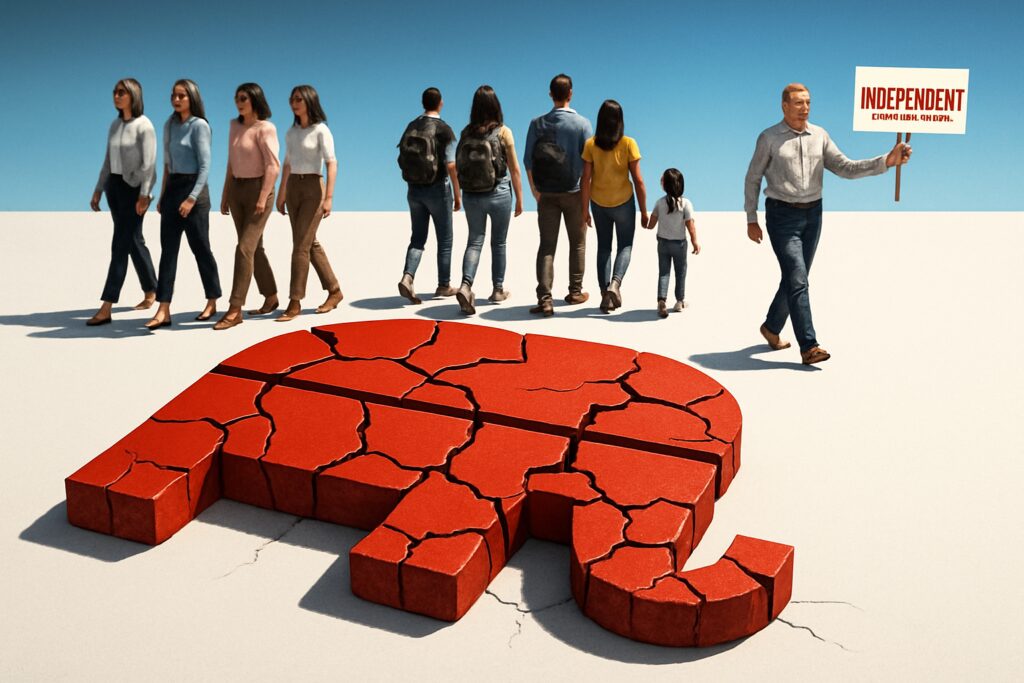
Independent voters, a crucial bloc for any majority coalition, are breaking away. Current data indicates that only 15% of independents plan to vote for Republican candidates in the 2026 midterm elections. The trend is even more pronounced among younger adults, with a mere 19% of adults under 35 stating they will support the GOP, according to recent polling from the Pew Research Center.
Shifts within specific demographic groups further illustrate the contraction. Hispanic voter support for the president has seen a notable decline, dropping from 49% to 38% in the last year, as tracked by the National Association of Latino Elected and Appointed Officials (NALEO) Educational Fund. Meanwhile, a persistent gender gap continues to define American politics, with women favoring Democratic candidates for the U.S. House by a margin of 10 to 15 points in generic ballot polls.
Underpinning these political shifts is a pervasive economic anxiety. Voter surveys consistently rank inflation and the high cost of living as the top concerns, issues that are currently driving sentiment away from the party in power. This economic discontent is acting as a powerful accelerant for the demographic and political trends already in motion.

What This Means for Congress and the Senate
The implications of this political environment for the 2026 midterms are profound and immediate. In the U.S. House of Representatives, the Republican majority is hanging by a thread, holding a bare-minimum 218–213 seat advantage. This slim margin means Democrats need a net gain of only five seats to flip control of the chamber.
The electoral map is already reflecting this vulnerability. The non-partisan Cook Political Report currently lists 18 House races as toss-ups, the vast majority of which are Republican-held seats. National sentiment aligns with this localized data; Democrats lead the generic congressional ballot by an average of 5.3 points, a significant advantage at this stage in the cycle. Furthermore, they hold a 12-point lead in voter enthusiasm, a critical indicator of turnout likelihood.
The repeated special election victories have rendered the “fluke election” explanation politically exhausted. With 29 seats flipped across diverse geographies—from suburban swing districts to now Trump’s own Palm Beach—the results constitute a clear and sustained electoral trend. Each victory builds a narrative of momentum and organizational strength that is difficult for the opposing party to counter.
Closing Insight
The Mar-a-Lago upset is not an anomaly but a symptom of converging structural forces: demographic erosion of the traditional Republican coalition, widespread economic anxiety that disadvantages the incumbent party, and a growing Trump-era fatigue that is alienating independents and younger voters. These factors are creating a political headwind of gale force ahead of November 2026.
With their base contracting and independents fleeing, the Republican Party’s congressional control now rests on a foundation of sand.
