





Explore the corruption in Greece.
Expand your knowledge on Greece’s transparency and accountability issues. Learn how oversight bodies, legal reforms, and
civil society efforts address corruption and strengthen public trust in institutions. Just click on the button below.
From Democracy to Kleptocracy: The Koskotas Template.
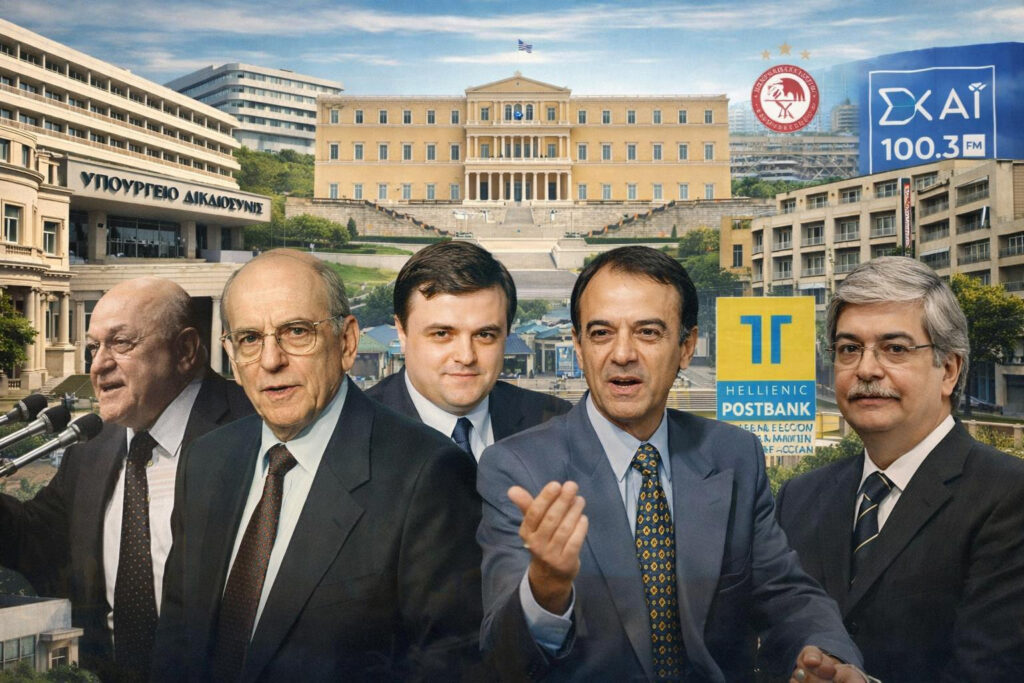
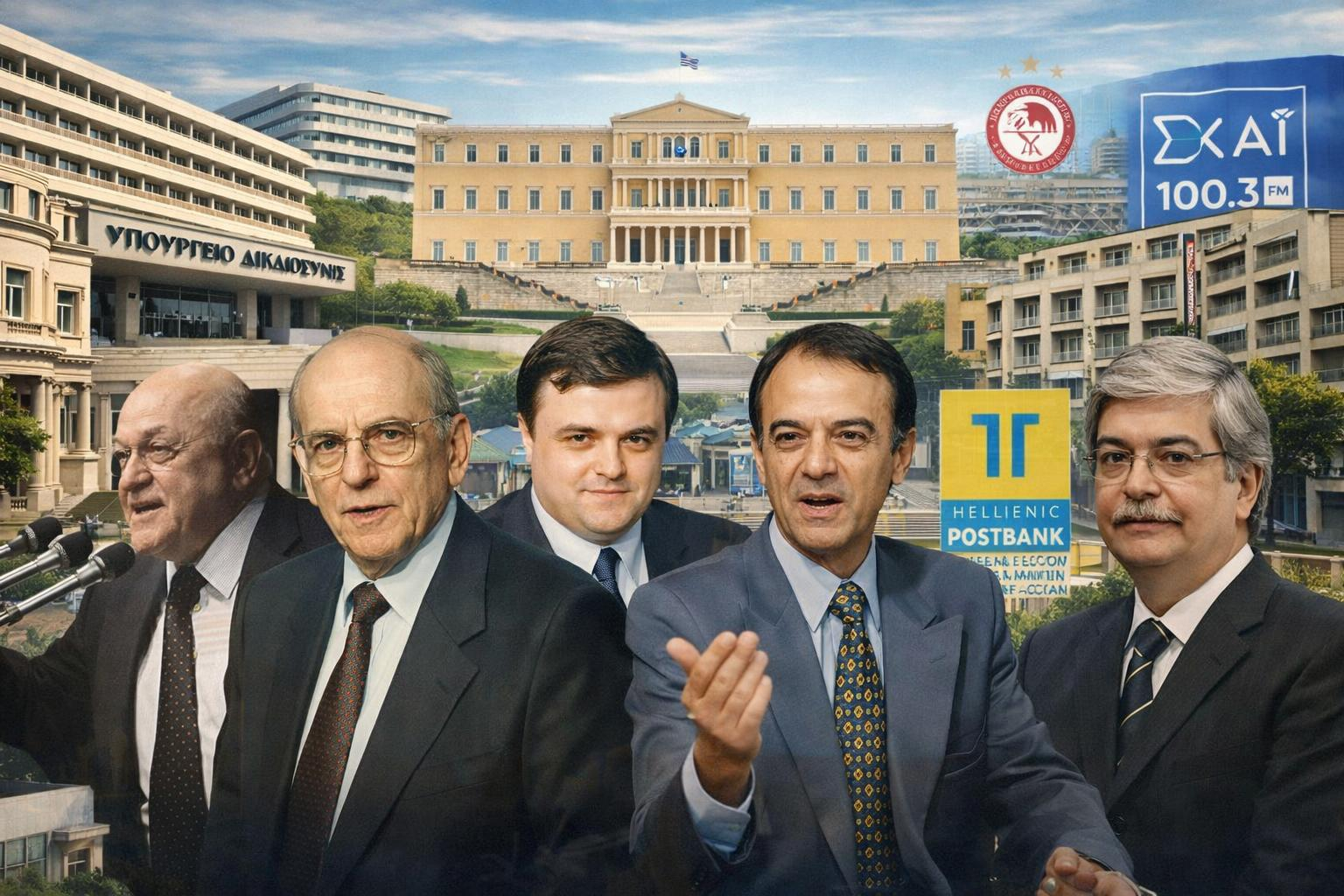
The Koskotas Affair: Anatomy of a Scandal that Defined an Era of Greek Corruption.
In the late 1980s, against a backdrop of roiling political turbulence, a financial scandal of staggering proportions erupted from the heart of Athens. Presided over by the Panhellenic Socialist Movement (PASOK) and its charismatic leader, Andreas Papandreou, this was an era where populist ambition often blurred the lines between state governance and party patronage. The Koskotas affair was not an anomaly; it was the system’s logical endpoint. To understand this scandal is not merely to revisit a historical event, but to perform an autopsy on a foundational case study in the architecture of systemic corruption that would plague Greece for decades.
This report dissects the Koskotas/Bank of Crete scandal, tracing its chronology and themes from the mechanics of the crime to its devastating political, economic, and social fallout. The analysis moves beyond the headlines to reveal how the affair established a template for political impunity, becoming a benchmark against which subsequent crises—from the Siemens bribery cases to the OPEKEPE subsidy frauds—would inevitably be measured [20].
The Man at the Center: The Rise of George Koskotas
The improbable ascent of George Koskotas is more than a story of personal ambition; it is a case study in how institutional rot creates openings for calculated predation. His rapid rise from a mid-level bank employee to a media and finance magnate starkly illustrates the systemic vulnerabilities he so masterfully exploited.
Koskotas began his career at the Bank of Crete in 1979 as a modest administrative officer, later serving as an accountant [4, 20]. From this perch, he allegedly began embezzling the bank’s own funds, funneling them into his personal accounts to methodically acquire a controlling stake in the institution itself [4, 20]. By the mid-1980s, Koskotas was the bank’s chairman and majority shareholder. Under his leadership, the small financial institution was transformed into the second-largest bank in Greece, a meteoric expansion fueled entirely by plundered capital [4].
Using these illicit funds, Koskotas constructed a formidable business empire. Through his holding company, Grammi Inc., he acquired two daily newspapers, five magazines, and a radio station, giving him immense influence over public opinion [4, 20]. His reach extended into the cultural sphere with the purchase of the popular Olympiacos F.C. football club, cementing his status as a public figure [4, 20]. This empire, however, was built on a foundation of massive fraud, the mechanics of which would soon unravel the Greek state.
2. The Mechanics of a Multimillion-Dollar Embezzlement
The methods employed in the Koskotas embezzlement were audacious in their simplicity, revealing a profound and systemic failure of both internal banking controls and state regulatory oversight. The scheme was not a sophisticated financial maneuver but a brazen siphoning of capital, allegedly enabled by the highest levels of government.
At its core, the operation hinged on the vast sums of money deposited into the Bank of Crete by state-owned companies. Koskotas would later claim this was no coincidence, but the result of a direct order from Prime Minister Andreas Papandreou to channel public funds into his bank [4]. Once deposited, the capital was looted. The total amount embezzled is estimated to be between $210 million and $235 million—an astronomical sum for the Greek economy of the 1980s [4, 20].
The financial scale of the crime, as detailed in subsequent investigations, was breathtaking [20]:
- Estimated Total Embezzled: $210 million to $235 million
- Missing US Bank Deposits: $30 million (from accounts at Irving Trust & Merrill Lynch)
- Alleged Kickbacks to PASOK: Over $30 million
- Political Payoffs: $20 million (allegedly delivered in briefcases)
This colossal theft went undetected for years, not because it was cleverly hidden, but because the very institutions meant to prevent such fraud were allegedly complicit. The sheer scale of the embezzlement underscores the complete collapse of oversight that allowed the scandal to flourish.
3. The Collapse of Oversight: How Political Protection Enabled the Scandal
The Koskotas affair was not a story of passive regulatory failure; it was one of active and deliberate political interference. This dynamic demonstrates a textbook example of “competitive particularism,” a governance model where state institutions are co-opted to serve party networks and distribute public resources as patronage [12, 20]. The old Greek adage, “the fish rots from the head,” has rarely been more apt [21].
Despite mounting alarms in the press about Koskotas’s inexplicable accumulation of wealth, the Bank of Greece—the nation’s central regulator—failed to conduct a meaningful investigation [20]. This inaction was, according to Koskotas, by design. He alleged that approximately 50 national audits of the Bank of Crete were “squelched” over the years by PASOK officials. On at least two occasions, he claimed, the interventions came directly from Prime Minister Papandreou himself [20]. This pattern of neutralizing regulatory bodies from within would become a hallmark of subsequent scandals, most recently seen in the systemic failures at the OPEKEPE agricultural fund [20].
This political protection was allegedly part of a quid pro quo. In exchange for shielding the Bank of Crete from scrutiny, millions of dollars were funneled back to the PASOK government as payoffs. Koskotas provided a vivid account of this arrangement, describing weekly deliveries of cash stuffed into “blue briefcases” to the Prime Minister’s residence, transported by his confidant, Georgios Louvaris. These deliveries, he claimed, amounted to more than 3 billion drachmas—equivalent to $20 million—in a single year [20]. This network of alleged protection and bribery implicated some of the most powerful figures in the Greek government.
4. The Web of Complicity: Politicians and Officials Implicated
The scandal reached the highest echelons of the Greek state, demonstrating how deeply corruption had permeated the apparatus of power. The list of those accused reads like a directory of an administration that had transformed public office into a tool for personal and political enrichment.
- Andreas Papandreou: The Prime Minister was at the center of Koskotas’s most explosive allegations. He was accused of ordering state companies to deposit their funds in the Bank of Crete, personally accepting bribes from the stolen money, and intervening directly to halt audits of the bank’s finances [4, 20].
- Dimitris Tsovolas: As Minister of Finance, Tsovolas became a symbol of the government’s reckless patronage. His public command at a rally to “give it all [to them]” (Τσοβόλα δώσ’τα όλα) was seen as epitomizing an era of blatant political handouts financed by a fragile economy [15].
- Two Former Cabinet Ministers: In 1989, a special court convicted two former cabinet ministers for their involvement, marking one of the few instances of legal accountability for high-ranking officials in the immediate aftermath [4].
- George Petsos and Nikos Akritides: The Minister of Public Order and Minister of Commerce, respectively, were removed from their positions following allegations of improper contacts with Koskotas, signaling the scandal’s widening political fallout [21].
As the web of accusations expanded, the pressure on Koskotas intensified, culminating in a dramatic and ill-fated attempt to evade justice.
5. The Fugitive’s Fall: Flight, Arrest, and Extradition
By the autumn of 1988, the walls were closing in on George Koskotas. His escape from Greece and subsequent arrest in the United States transformed a domestic scandal into an international affair, riveting public attention and further embarrassing the Papandreou government.
The timeline of his flight and capture unfolded with cinematic speed [4]:
- October 20, 1988: Koskotas was indicted on five counts of forgery and embezzlement and was formally suspended from his position as chairman of the Bank of Crete.
- November 7, 1988: Evading a 24-hour guard posted at his house, Koskotas fled the country. He picked up his wife and five children in Switzerland before continuing to Rio de Janeiro.
- November 24, 1988: After arriving by private jet at Hanscom Field in Bedford, Massachusetts, Koskotas and his family were apprehended by the Federal Bureau of Investigation.
Following his arrest, Koskotas was incarcerated in the United States, first at the Essex County Correctional Institution in Salem, Massachusetts, and later at the Federal Correctional Institution in Danbury, Connecticut [4]. From his jail cell, he began making the sensational allegations against Papandreou that would rock Greek politics. After a lengthy legal process, he was extradited back to Greece to face trial for the crimes that had brought a government to its knees [4].
6. Judgment and Acquittal: The Scandal’s Legal Aftermath
The trials that followed the Koskotas affair were as politically charged and consequential as the scandal itself. The verdicts delivered by the Greek courts would profoundly shape public perception of political impunity for years to come, revealing a justice system capable of holding some accountable while exonerating the most powerful.
George Koskotas, the architect of the scheme, was ultimately convicted and sentenced to 25 years in prison. He was released on March 16, 2001, having served approximately 12 years since his initial arrest in the United States [4]. Other officials were also held to account. Two former cabinet ministers were convicted for their roles in 1989 [4]. Former Finance Minister Dimitris Tsovolas was also convicted and sentenced to two and a half years in prison [15].
The case against Andreas Papandreou, however, ended very differently. In 1992, he was cleared of all charges by a special session of the Supreme Court in a narrow 7-to-6 vote [4, 15]. The acquittal of the prime minister, juxtaposed with the convictions of his subordinates, sent a powerful message to the Greek public: accountability was selective, and the highest levels of power remained beyond the law’s reach.
7. The Political Earthquake of 1989 and the “Katharsis”
The Koskotas scandal culminated in the general elections of June 1989, which became a national referendum on the corruption that had defined the final years of PASOK’s rule. The vote triggered an unprecedented political realignment and ushered in a period of national reckoning known as “katharsis.”
Sensing a devastating loss, Prime Minister Papandreou changed the electoral law shortly before the election. The move was a calculated attempt to implement a system of proportional representation that would prevent the main opposition party, the conservative New Democracy, from securing an absolute majority [15]. The gambit worked, but only partially. The election resulted in PASOK’s loss of power, but New Democracy fell short of the seats needed to govern alone. This deadlock led to the formation of an extraordinary and short-lived coalition government between the conservatives and the communists, two ideological arch-rivals united by a single objective [15].
This new government’s primary mandate was to pursue “katharsis,” a Greek term meaning catharsis or cleansing [15]. Its goal was to launch a full-scale investigation into the scandals of the Papandreou administration, holding those responsible to account and purging the political system of corruption.
8. A Nation in Uproar: Public Opinion and Media Reaction
The Koskotas affair was more than a political crisis; it was a cultural phenomenon that crystallized years of frustration with a political class perceived as arrogant and corrupt. The scandal galvanized a nation that felt it had been betrayed.
The mood of the Greek public was one of outrage. Street posters appeared declaring that the people had “had enough,” capturing a sentiment of widespread disgust [21]. One Athens-based diplomat noted at the time that the affair “captured the public imagination like nothing in recent Greek memory” [22]. The media, which Koskotas himself had sought to control, “had a field day” with the story’s lurid details: a “fat banker, mink-coated women, death threats, corrupt politicians, [and] suitcases of cash” [22]. The story went international, with Koskotas’s explosive interview from his U.S. jail cell appearing in Time magazine under the headline “The Looting of Greece” [4, 21]. For Andreas Papandreou, the affair was a political catastrophe, shattering his image and directly contributing to his government’s collapse [15, 22].
9. Assessing the Economic Damage
While the political and social shockwaves were profound, the tangible financial cost to the Greek state was equally severe. Quantifying this damage provides a concrete measure of the price of systemic corruption, borne not by the perpetrators but by the nation and its citizens.
The direct financial loss from the embezzlement is estimated at $210 million to $235 million [4, 20]. For the Greek economy of the late 1980s, this was a crippling blow. As one Athens-based diplomat observed, this was a massive sum “in a country whose legal economy is only about $42 billion” [22]. The theft drained public resources that were desperately needed for development and social services, diverting them instead into private pockets and political slush funds. This loss was not just a matter of stolen money; it was a critical blow to the country’s financial stability and a severe stain on its credibility on the international stage.
10. The Enduring Legacy: A Touchstone for Future Corruption
The ultimate significance of the Koskotas scandal lies not in its immediate impact but in its long and dark legacy. It created the framework for understanding and contextualizing the decades of corruption that followed, establishing an “architecture of impunity” that proved remarkably resilient.
Internationally, the affair cemented a damaging narrative of Greece as a “chronic patient” of European governance, a state defined by endemic clientelism and a fundamental lack of strategic planning [20]. This perception would haunt the country for years, particularly during the sovereign debt crisis two decades later. More importantly, the Koskotas scandal became the primary reference point for subsequent major corruption cases. The patterns of political protection and institutional failure it exposed were echoed time and again in the Siemens bribery case, the Lagarde list tax evasion scandal, the Novartis pharmaceutical scandal, and the OPEKEPE EU subsidy fraud [20]. The “architecture of impunity” established in the 1980s had set a precedent of unaccountability that continues to challenge Greek governance to this day.
Conclusion
The Koskotas scandal was far more than a simple case of bank embezzlement. It was a systemic breakdown rooted in a model of “competitive particularism,” where state institutions are co-opted for political patronage and public resources are treated as spoils to be distributed to loyal networks [20]. From the brazen theft of hundreds of millions of dollars to the alleged complicity of a sitting prime minister, the affair exposed a political culture where the rule of law was subordinate to the preservation of power.
The events of the late 1980s wrote the first chapter in modern Greece’s long struggle with accountability and transparency. The patterns of behavior established during the Koskotas affair became deeply embedded in the country’s governance, creating a blueprint for future scandals. Ultimately, the specter of George Koskotas and his “blue briefcases” continues to inform the Greek public’s deep-seated distrust in its political institutions. It remains a crucial and cautionary lesson on the corrosive effects of unchecked political power and the enduring challenge of building a state where no one is above the law.
References
1. Analysis: EU subsidy scandal leaves Greece with no place to hide – TRT World
2. DO REFORMS INFLUENCE CORRUPTION PERSEPTIONS? How NPM-type reforms affect the corruption perceptions in Greece1 – LSE
3. Drugs scandal roils Greek politics – POLITICO
4. George Koskotas – Wikipedia
5. EU prosecutors allege Greek ministers were complicit in major farm subsidy fraud
6. Forgiving Siemens: Unraveling a Tangled Tale of German Corruption in Greece | corpwatch
7. Former Protected Witnesses Found Guilty in Greece’s Novartis Scandal – Greek Reporter
8. Greece – June 2025 | The Global State of Democracy
9. Greece asks IMF chief for more information on death threat claims – The Guardian
10. Greece rocked by claims drug giant bribed former leaders – The Guardian
11. Greece’s Broken Democracy Is a Warning for Europe – Jacobin
12. Greece’s Enduring Struggle with Corruption: Why Systemic Change …
13. Greece: EPPO arrests 37 members of organised criminal group involved in large-scale agricultural funding fraud and money laundering | European Public Prosecutor’s Office
14. Greek MPs approve prosecution of ex-minister | News | Al Jazeera
15. Koskotas scandal – Wikipedia
16. Greek Parliament investigates former finance minister over ‘tax list’ – Marketplace
17. Greek Police Arrest Dozens for Farm Subsidy Fraud – GreekReporter.com
18. Greek police arrest dozens in raids over EU farm subsidies scandal | Classic Rock 103.5 WIMZ | Knoxville, TN
19. Lagarde list – Wikipedia
20. The Architecture of Impunity: A Systematic Analysis of Institutional Corruption and Governance Failure in Greece from Koskotas to OPEKEPE (1989–2025)
21. The Chaos Continues – The Athenian
22. international – Awash in Scandal, Greece … – stephen brookes
23. New EU Rule of Law Report Greece 2025: Flawed and selective
24. Novartis Hellas S.A.C.I. and Alcon Pte Ltd Agree to Pay over $233 Million Combined to Resolve Criminal FCPA Cases
25. Siemens AG and Three Subsidiaries Plead Guilty to Foreign Corrupt Practices Act Violations and Agree to Pay $450 Million in Combined Criminal Fines – Department of Justice
26. Siemens settles decade-long Greek bribery case – The Global Legal Post
27. The SIEMENS scandal may finally reach court after 17 years of investigation
28. Yugoslav corn scandal – Wikipedia
How Political Protection Enabled the Scandal
Disclaimer: This platform provides educational content on matters of public interest, including corruption, institutional failures, and historical events. All information is compiled from publicly available sources, official documents, news reports, and court filings. The author is not a professional investigator or legal authority; this constitutes historical study, not investigative journalism or legal analysis.
No accusations are made against individuals beyond what is documented in official proceedings or court records. All persons retain presumptions of innocence regarding pending charges until final judicial determination. This content does not substitute for professional legal counsel, official investigations, or accredited news reporting. Information reflects the publication date and may not include subsequent developments or appeals.
Readers should consult official sources and authoritative outlets for comprehensive understanding. The author disclaims responsibility for misuse or reliance beyond educational purposes. All citations direct readers to primary sources for independent verification.
Explore the corruption in Greece.
Expand your knowledge on Greece’s transparency and accountability issues. Learn how oversight bodies, legal reforms, and
civil society efforts address corruption and strengthen public trust in institutions. Just click on the button below.

[…] From Democracy to Kleptocracy: The Koskotas Template. […]
[…] From Democracy to Kleptocracy: The Koskotas Template. […]