




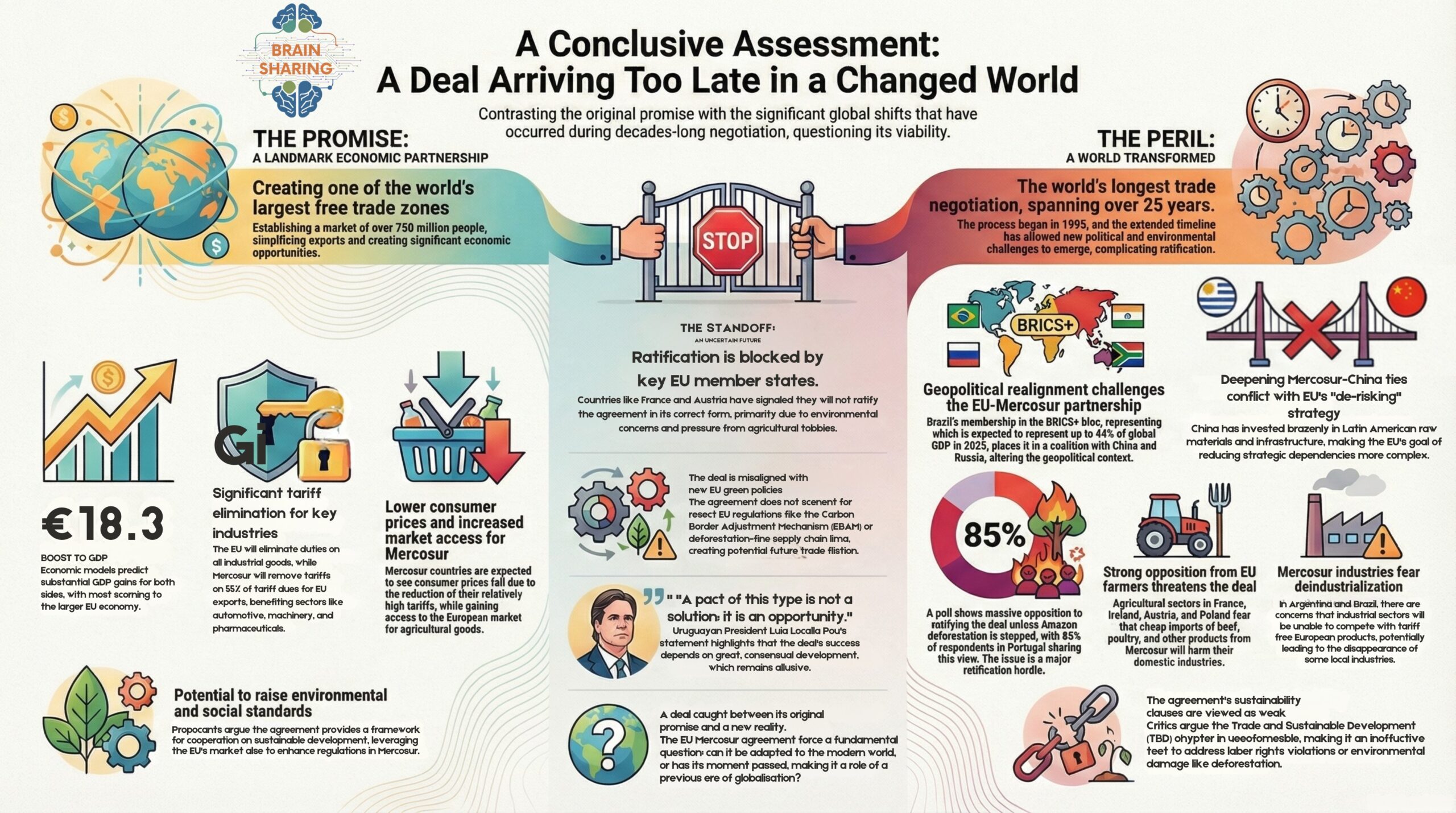

A Postponed Deal Arriving Too Late: The EU‑Mercosur Agreement in a Changed World.
The infographic presents a critical assessment of the long‑negotiated EU‑Mercosur trade agreement, arguing that a once visionary project may now be overtaken by a radically changed world. At its core, the deal promised to create one of the world’s largest free‑trade zones, opening a market of more than 750 million people, boosting GDP, and delivering tariff elimination for key industrial sectors such as automotive, machinery, and pharmaceuticals. Lower consumer prices and improved access for Mercosur’s agricultural exports were promoted as central economic gains, alongside the possibility of using the deal as leverage to raise environmental and social standards in Mercosur countries.
Yet the center of the image focuses on a “stand‑off.” Ratification is blocked by key EU member states, notably due to concerns over deforestation, climate commitments, and the agreement’s failure to align with new EU green policies or mechanisms like carbon border measures. The graphic highlights criticism that the text does not properly account for supply‑chain due diligence or enforceable sustainable development provisions. Political quotes emphasize that, while some leaders frame the pact as an opportunity, others question whether it can still serve as a credible instrument of fair and balanced globalization.
On the right side, the infographic underlines how geopolitical realignment has transformed the context. Brazil’s role in an expanded BRICS+ bloc and deepening Mercosur‑China ties clash with the EU’s “de‑risking” and strategic autonomy agenda, complicating cooperation. Strong opposition from EU farmers, particularly in France, Ireland, Austria, and Poland, reflects fears of unfair competition and environmental dumping, with polls indicating widespread public hostility unless Amazon deforestation is meaningfully addressed. Meanwhile, Mercosur industries worry about deindustrialization if European imports undercut local manufacturing.
The overall message is clear: after more than 25 years of negotiation, the EU‑Mercosur agreement risks arriving too late, trapped between its original promise and a new geopolitical, economic, and environmental reality. Already is postponed.
